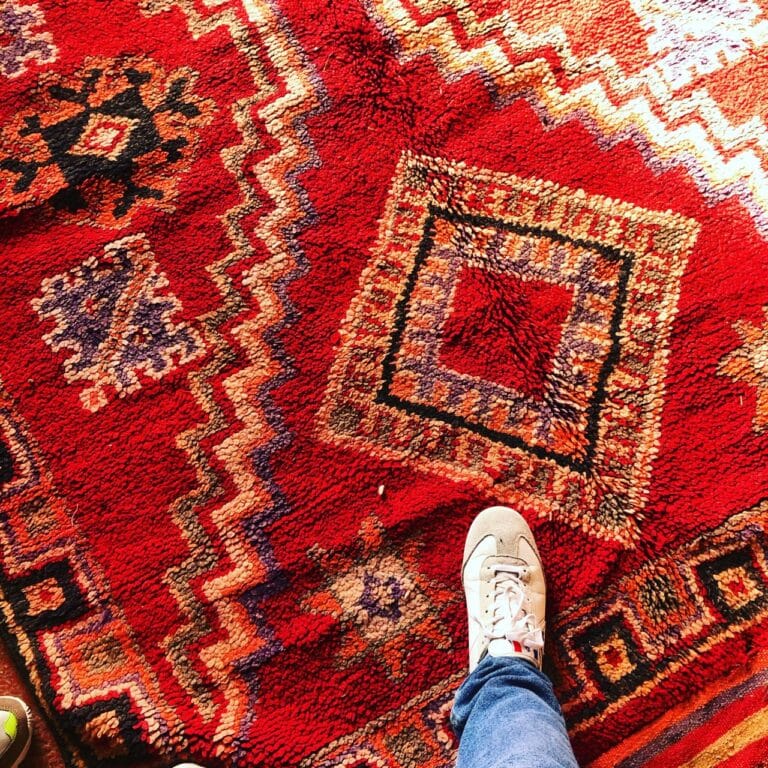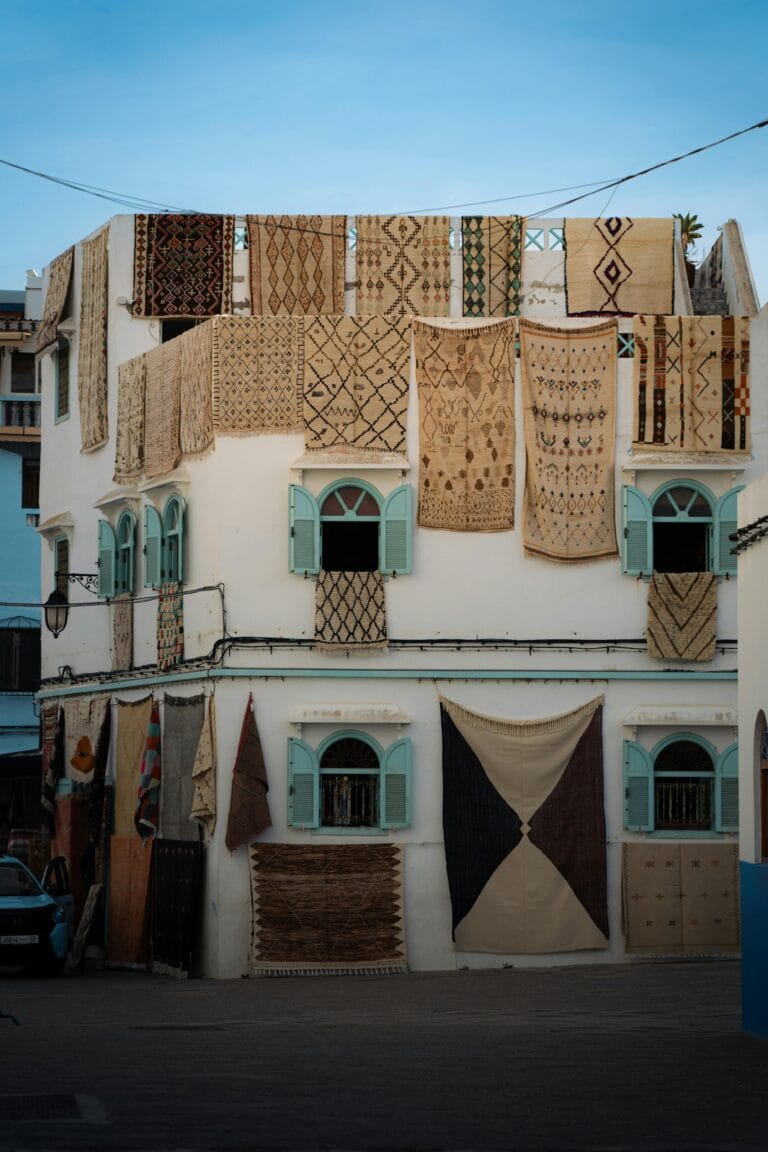
Moroccan rugs Explained: Types, Sizes, Weaving Techniques and How to Choose the Right Rug
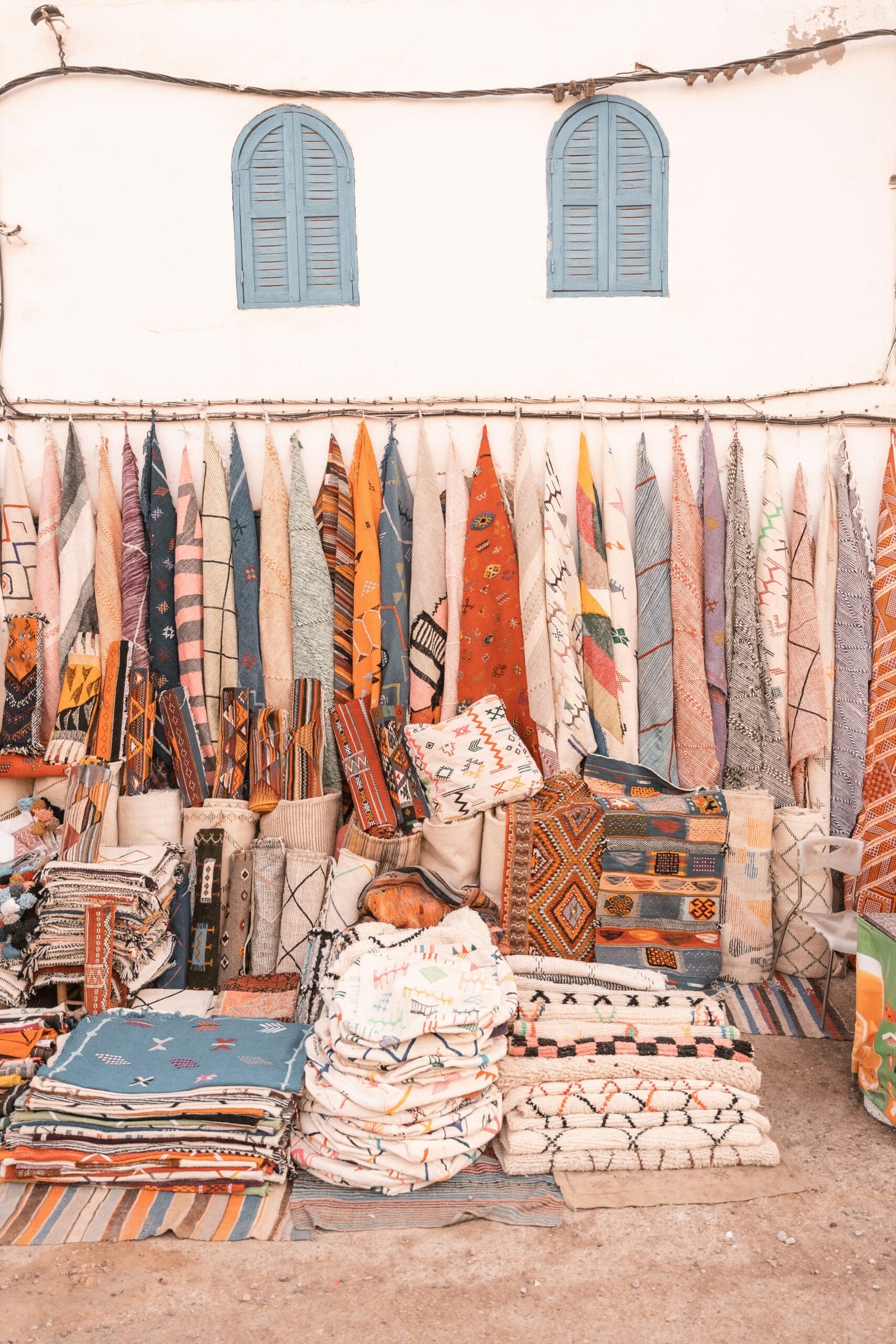
before stepping into a moroccan rug shop
Save yourself time, money, and pressure by reading this guide before you walk into a carpet shop. Don’t let a seller rush you into buying something simply because it looks beautiful at first glance or because you are told it is “special” or “rare.” Understand how Moroccan rugs are made, learn the differences between their styles, materials, textures, and weaving techniques, and know what to look for before you start shopping. The more you understand, the easier it becomes to choose a carpet you truly like—and pay a fair price for it.
Moroccan carpets are not one style. They are a whole world of weaving traditions shaped by mountains, climate, communities, materials, history and the hands of individual weavers.
A thick ivory Beni Ourain from the Middle Atlas can look completely different from a colourful Azilal from the High Atlas. A refined Rabat carpet belongs to a very different urban tradition, while a flatwoven Zanafi or Moroccan kilim has an entirely different construction. Some carpets are soft and deep, some are thin and reversible, some combine pile with flatweaving, and others look almost like abstract paintings.
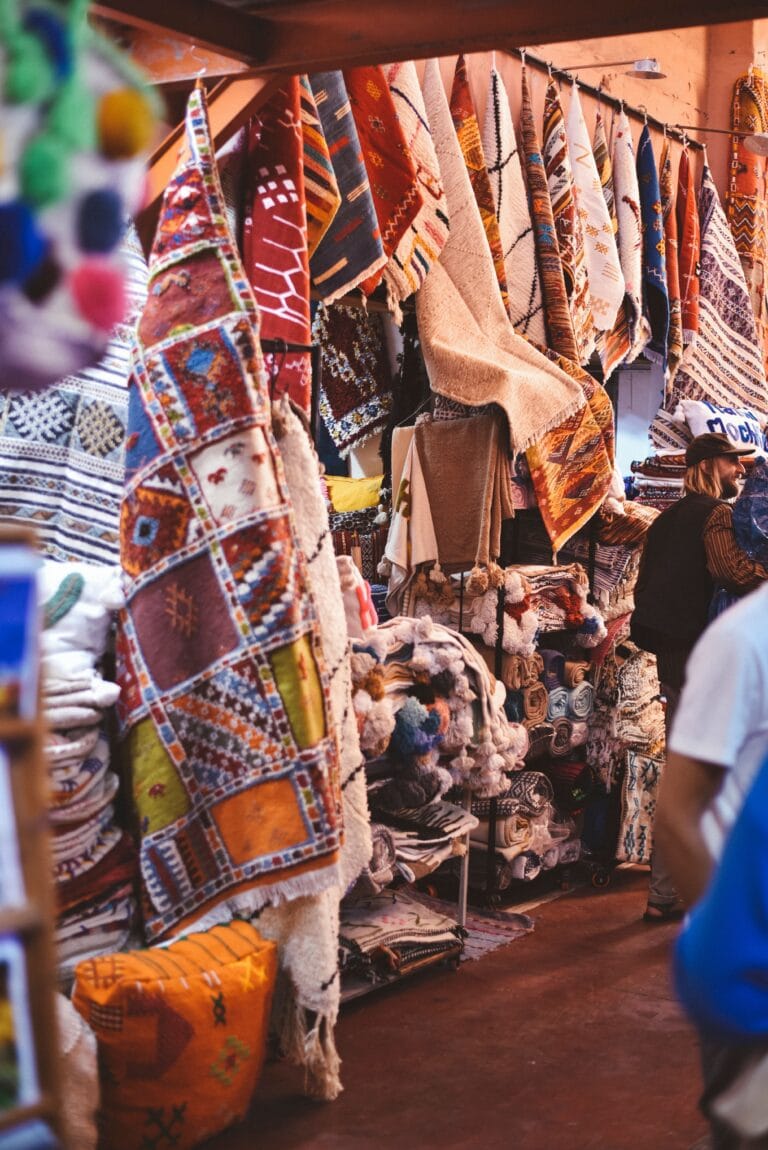
For a first-time visitor to Morocco, this diversity can be confusing. In a Marrakech souk, for example, several carpets may simply be presented as “Berber rugs” or “Moroccan rugs,” even though their origins, techniques and characteristics may be very different.
This guide is designed to make those differences easier to understand.
Whether you are travelling to Morocco, decorating your home, looking for an authentic handmade rug, or simply interested in Moroccan culture, this guide will take you from the basic structure of a carpet to its regional identity, from pile height to weaving techniques, and finally to choosing the right size for your home.
Important: Moroccan carpet names are not always used consistently in the international market. A regional or tribal name can sometimes become a commercial “style” label. The best way to understand a carpet is to consider several things together: where it comes from, how it was woven, what material was used, its pile height and density, its colours, and its design language.
Table of Contents
What Is a Moroccan rug?
A Moroccan rug is a handmade textile traditionally produced in Morocco using weaving, knotting, embroidery, or combinations of these techniques.
But the expression “Moroccan carpet” does not describe one single type of rug.
Morocco contains several major geographical and cultural zones, including the Middle Atlas, High Atlas, Anti-Atlas, Sirwa, Atlantic plains and historic imperial cities. Each area developed its own approaches to weaving, colour, wool preparation and decoration.
This is why a Moroccan carpet can be thick and shaggy, dense and relatively short-piled, completely flat, or made using several techniques on the same piece.
Many rural Moroccan carpets were traditionally made by Amazigh women for practical household purposes: warmth, bedding, floor covering, seating, tent use and other domestic needs. Over time, some of these textiles became important objects of artistic and commercial value.
Today, Moroccan carpets occupy two worlds simultaneously. They remain part of living craft traditions while also being collected, exported and used extensively in contemporary interior design.
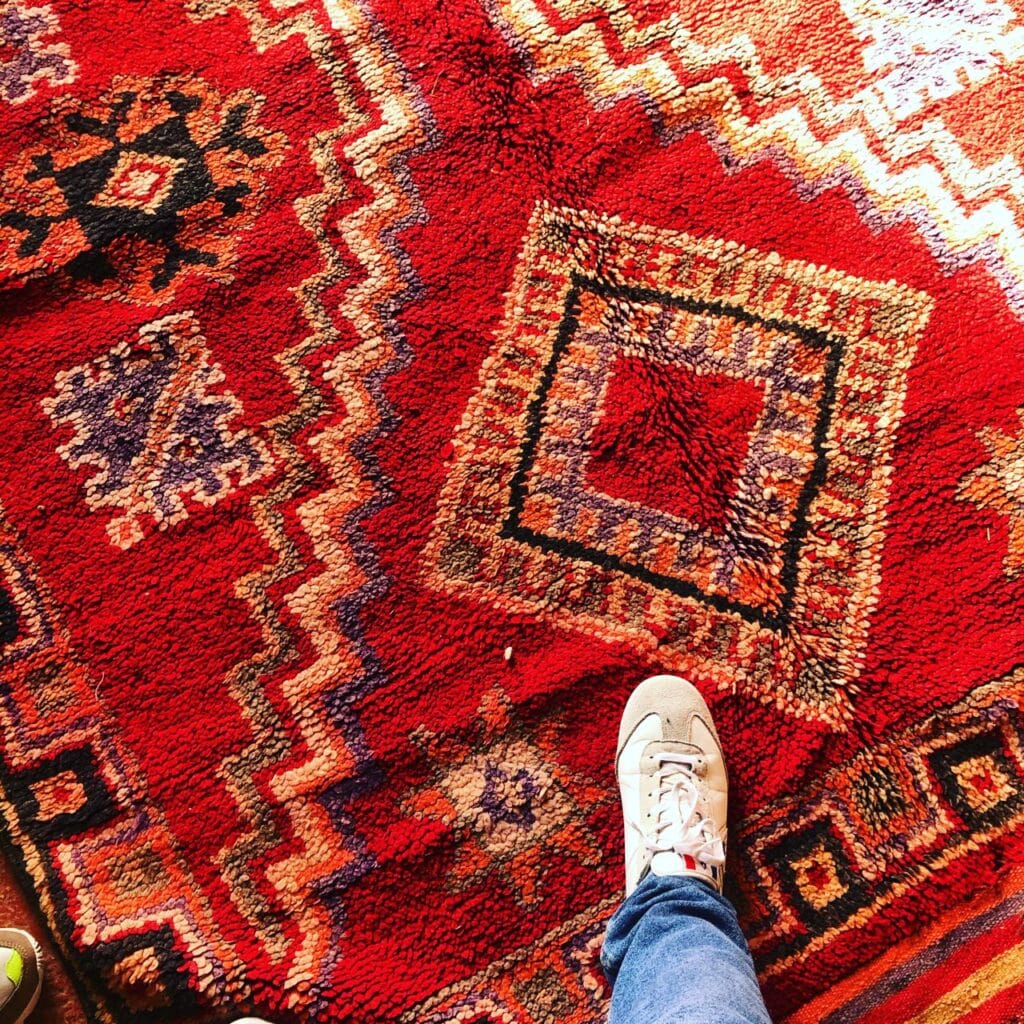
The international popularity of Moroccan rugs has particularly increased their visibility in modernist and contemporary interiors. Their strong geometry, natural wool, irregular handmade character and often open compositions work surprisingly well alongside minimalist furniture and architecture.
A Short History of Moroccan Carpet Weaving
The history of Moroccan weaving is much older than the modern international carpet market.
For generations, weaving was connected to everyday life in rural and mountain communities. Wool was not simply an artistic material. It was a resource that could become clothing, blankets, bedding, floor coverings and other household textiles.
The mountains played an important role in this development.
In cold regions of the Atlas Mountains, thick woollen textiles provided insulation against winter temperatures. In warmer and drier regions, lighter flatwoven textiles could be more practical.
The result was not a single Moroccan carpet tradition but a collection of regional traditions.
Urban carpet production developed along a somewhat different path. Rabat, for example, became associated with a refined urban carpet tradition. The Metropolitan Museum of Art notes that Rabat carpets developed in an urban context and that their designs were influenced by Ottoman carpets while being adapted to Moroccan tastes and local architectural spaces.
The Rabat tradition is particularly interesting because it demonstrates that Moroccan carpet history cannot be reduced to rural Amazigh weaving alone. Morocco has both urban workshop traditions and rural/tribal weaving traditions, and they have influenced one another over time.
Morocco’s cultural institutions continue to treat craftsmanship and traditional knowledge as important parts of intangible cultural heritage. UNESCO’s documentation on Morocco notes the role of national cultural institutions, IRCAM, archives, universities and apprenticeship programmes in documenting and transmitting traditional knowledge.
Why Moroccan rugs Matter
A carpet can obviously make a room warmer and more comfortable, but a handmade Moroccan carpet can represent much more than decoration.
It may contain the labour of an individual weaver, knowledge inherited within a family, regional visual traditions, locally available wool, historical techniques and memories of a particular community.
For many Moroccan households, weaving was also connected to economic life. A carpet could be made for the home, but it could also become a source of income.
This is particularly important when discussing carpets made by women.
The weaver is not simply producing a decorative object. She is applying knowledge acquired through observation, repetition and practice. In many rural contexts, weaving knowledge has historically been transmitted between generations.
That is one reason handmade carpets contain small irregularities.
A perfectly repeated geometric pattern produced by a machine is not the same thing as a geometric composition produced by a person working by hand. A slight change in line, knot or colour may reveal the movement of the weaver rather than a manufacturing defect.
The individuality of handmade Moroccan carpets is one of their greatest attractions.
How Moroccan Carpets Are Made
Although techniques vary considerably, the basic process can begin with the sheep and end with the finished carpet.
The wool may be:
Sheared → washed → cleaned → carded → spun → dyed → prepared → woven or knotted → finished → washed
The exact process differs according to region, workshop, material and carpet type.
Traditional Moroccan weaving commonly uses wool, although other fibres can also appear. Some textiles incorporate cotton, while certain decorative traditions use plant fibres such as cactus silk.
Natural dyes have also played an important role in Moroccan textile traditions, although modern production does not always use exclusively natural dyes.
Once the yarn is prepared, the weaver begins working on the loom.
Unlike factory production, the finished carpet develops gradually under the hands of the weaver.
Understanding Pile, Density and Flatweave
Before learning the names of Moroccan carpet styles, it helps to understand three basic words:
Pile
The pile is the raised surface of a carpet.
In a hand-knotted carpet, wool is tied around the warp threads. The ends are then cut, creating the soft surface that you feel when you touch the carpet.
Pile can be:
- low
- medium
- high
- very high or shaggy
A high-pile carpet is softer and warmer but can be heavier and more difficult to clean.
A low-pile carpet is generally easier to maintain and can work better beneath furniture or in high-traffic areas.
Density
Density refers broadly to how closely the knots or woven structures are packed.
A highly dense carpet can have a more compact surface and finer visual detail.
However, density should not automatically be treated as a simple measure of quality. A carpet designed as a loose, expressive tribal rug is not necessarily inferior to a finely knotted urban carpet. The correct question is whether the construction is appropriate to its tradition and intended use.
Flatweave
A flatweave has no raised pile.
Instead of creating a surface of cut wool knots, the weft is woven through the warp to create a flat textile.
Moroccan kilims and related flatwoven textiles are generally lighter than thick-pile rugs and can be particularly useful in warmer climates, hallways, dining areas and other places where a low-profile surface is practical.
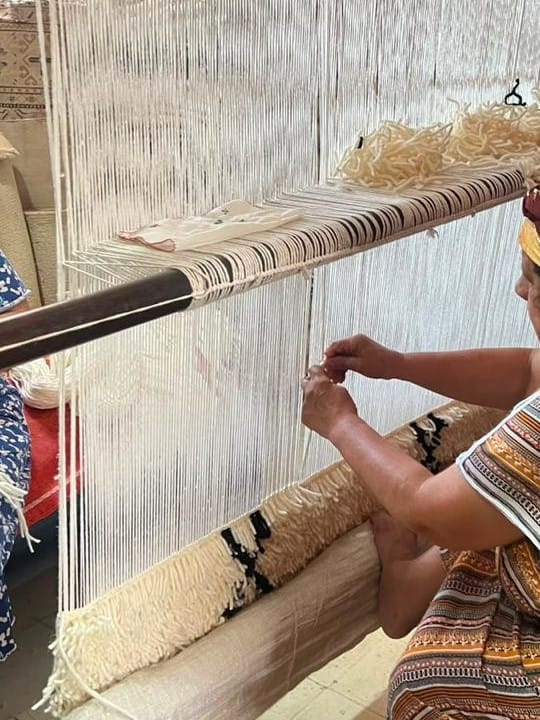
The Moroccan Vertical Loom
One of the most important tools in Moroccan weaving is the vertical loom, traditionally known in Amazigh contexts by terms such as astta.
The basic structure holds the warp threads vertically while the weaver works across the width.
Research on carpet design in the Sirwa region specifically documents the use of vertical two-beam looms with a single heddle.
The loom may look simple, but the skill required to use it is not.
The weaver must maintain tension, control the yarn, create the desired structure, manage the width, develop patterns and gradually keep the whole piece coherent.
For a visitor who has only seen a finished carpet in a shop, seeing a woman working at a traditional loom can completely change the way the object is understood.
The carpet is no longer simply a product.
You can see how it is constructed row by row.
Moroccan Carpet Sizes: Choosing the Right Rug for Your Home
Buying the correct size is just as important as choosing the correct Moroccan style.
A beautiful carpet can look wrong if it is too small for the room.
There is no single “Moroccan” standard size. Handmade rugs often have irregular dimensions because they are woven individually, so you should always measure your room and furniture before buying.
Bedroom Rug Sizes
King Bed
For a king-size bed, a large rug such as:
9 × 12 ft (274 × 366 cm)
is an excellent starting point for a spacious bedroom.
It allows the rug to extend beyond the sides and foot of the bed.
For a smaller room, a 8 × 10 ft (244 × 305 cm) rug can also work.
Queen Bed
For a queen-size bed, consider:
8 × 10 ft (244 × 305 cm)
or
9 × 12 ft (274 × 366 cm)
depending on the room.
If you want only a smaller area of softness beside the bed, runners or smaller rugs can be used instead.
Twin or Single Bed
A 5 × 8 ft (152 × 244 cm) rug can work well beneath or around a single bed, while runners can be positioned beside it.
Living Room Rug Sizes
The most important rule is to think about the relationship between the carpet and the furniture.
A common mistake is buying a rug that is too small and placing it like a small island underneath the coffee table.
For a large living room, a 9 × 12 ft or larger carpet can allow the front legs of the sofa and chairs to sit comfortably on the rug.
For a medium living room:
8 × 10 ft
is often a versatile choice.
For a smaller seating area:
5 × 8 ft
may work well.
The exact choice depends on the dimensions and arrangement of your furniture.
Dining Room Rug Sizes
A dining-room rug should normally extend beyond the dining table enough that chairs remain on the rug when pulled away from the table.
For a 6-person rectangular table, an 8 × 10 ft rug is often a good starting point.
For a larger table, consider:
9 × 12 ft
or larger.
For a round dining table, a round rug can create a more harmonious composition, provided it is large enough to accommodate the chairs.
Flatwoven Moroccan kilims can be particularly practical in dining rooms because their low profile makes chairs easier to move.
Hallways and Entryways
Long Moroccan runners are ideal for:
- hallways
- entrances
- beside beds
- narrow corridors
- kitchens
A runner might measure approximately:
2–3 ft wide × 6–14 ft long
depending on the space.
The key is not to choose the size because it is a “standard Moroccan size.” Measure the actual corridor first.
Formal and Royal Moroccan Carpets
Among Morocco’s most distinctive urban carpet traditions is the Rabat or R’Bati carpet.
These carpets represent a very different aesthetic from the rustic high-pile rugs commonly associated with the modern international image of Moroccan carpets.
Rabat carpets are generally more formal, refined and densely decorated.
The Metropolitan Museum describes the Rabat carpet as an urban Moroccan tradition associated with the city of Rabat and notes its use of Ottoman-inspired designs adapted to Moroccan tastes.
A specialised Rabat carpet source also documents the Aouqda R’batya, a symmetrical knot associated with Rabat’s carpet-making tradition.
The Rabat or R’Bati Carpet
The traditional R’Bati carpet can feature:
- a relatively low or medium pile
- tightly organised knotting
- elaborate floral decoration
- central medallion or field compositions
- detailed borders
- rich colours
- formal symmetry
Traditional examples can include red, blue, saffron, green and other saturated colours.
The overall impression is elegant and urban rather than rustic.
This is why a Rabat carpet can sit comfortably in a formal salon, traditional Moroccan interior or sophisticated contemporary room.
Rabat Carpets and Amazigh Carpets: Two Different Visual Worlds
It is useful to make a distinction here without creating a false division.
Moroccan carpets come from many communities and traditions.
The Rabat carpet represents an important urban tradition, while many of the internationally recognised mountain carpets come from Amazigh communities.
The differences are often visible in:
Rabat / urban traditions
- formal composition
- floral decoration
- symmetrical organisation
- elaborate borders
- urban workshop tradition
- Ottoman and eastern design influences
Many Amazigh regional traditions
- geometric forms
- open compositions
- asymmetry
- symbolic motifs
- strong regional identities
- more direct expression of the individual weaver
However, it is important not to say that every Amazigh carpet has symbolic meanings that can be translated into one fixed dictionary.
A diamond does not automatically mean exactly the same thing in every Moroccan community.
Meanings can vary according to region, community, context and individual interpretation.
Beni Ourain Carpets
If there is one Moroccan rug that became internationally famous in contemporary interior design, it is the Beni Ourain.
Beni Ourain rugs are associated with Amazigh communities of the Middle Atlas.
Their best-known appearance is:
natural ivory or cream wool + dark geometric lines + deep pile
The designs commonly include diamonds, crossing lines, lozenges and other geometric forms.
The thick wool makes them particularly attractive for:
- bedrooms
- living rooms
- reading spaces
- minimalist interiors
- Scandinavian-inspired interiors
- contemporary homes
The combination of natural wool and restrained colour explains much of their international popularity.
However, one of the biggest mistakes in today’s market is treating every cream Moroccan rug with black diamonds as automatically being a genuine Beni Ourain.
The name refers to a regional and cultural tradition, not simply a colour combination.
This distinction matters when you are buying an authentic rug.
Beni M’rirt and Mrirt Carpets
The Middle Atlas also produced another important family of carpets associated with Beni M’rirt/Mrirt.
These carpets are often appreciated for their dense wool, softness and luxurious pile.
Compared with the stereotypical minimalist Beni Ourain, Mrirt carpets can be:
- denser
- more compact
- more finely worked
- richer in colour
- more contemporary in their designs
Modern Mrirt-style carpets are particularly popular with interior designers because their deep wool surface creates warmth and texture without necessarily requiring the strong geometric contrast of a classic Beni Ourain.
The Middle Atlas climate is important here. Mountain environments influenced the development of warm wool textiles.
Modern commercial production, however, should not be confused automatically with an untouched historical tribal tradition.
Azilal Carpets
From the High Atlas comes one of the most expressive Moroccan carpet traditions: Azilal.
Azilal carpets are famous for their colourful, spontaneous appearance.
Instead of the restrained ivory-and-black palette associated with Beni Ourain, Azilal carpets often introduce:
- red
- orange
- yellow
- pink
- blue
- green
- black
- natural cream
The designs can look almost like drawings or abstract paintings.
Lines may appear irregular. Shapes may change scale. Motifs may not repeat perfectly.
That individuality is part of the appeal.
Azilal carpets are especially attractive to people who want their carpet to become a major artistic element in the room rather than simply a neutral background.
They are associated with the High Atlas and are commonly described as more expressive and colourful than Beni Ourain traditions.
Boujad Carpets
Boujad carpets are another highly recognisable Moroccan style.
They are associated with the Boujad area of central Morocco and are particularly known for warm and expressive colours.
Common tones include:
- pink
- red
- terracotta
- orange
- purple
- burgundy
- faded rose
Vintage Boujad pieces can be especially attractive because age and use may soften their colours into beautiful dusty tones.
Their compositions can be traditional and geometric, but many older examples have a remarkably free and artistic appearance.
This makes Boujad carpets particularly interesting for interiors where you want colour without using a perfectly symmetrical formal rug.
Taznakht Carpets
Taznakht is one of the important carpet-producing regions of southern Morocco.
Located in the wider High Atlas/Sirwa cultural landscape, Taznakht is associated with the weaving traditions of communities including the Aït Ouaouzguite.
Taznakht carpets can vary considerably.
You may encounter:
- dense pile carpets
- geometric carpets
- colourful wool carpets
- flatwoven pieces
- mixed-technique textiles
- contemporary interpretations
Traditional colour palettes may include saffron, yellow, red, orange, black, brown and natural wool shades.
Taznakht is particularly important because the region demonstrates why it is dangerous to reduce Moroccan carpets to only a handful of famous names.
There is a whole family of weaving techniques and visual traditions associated with the region.
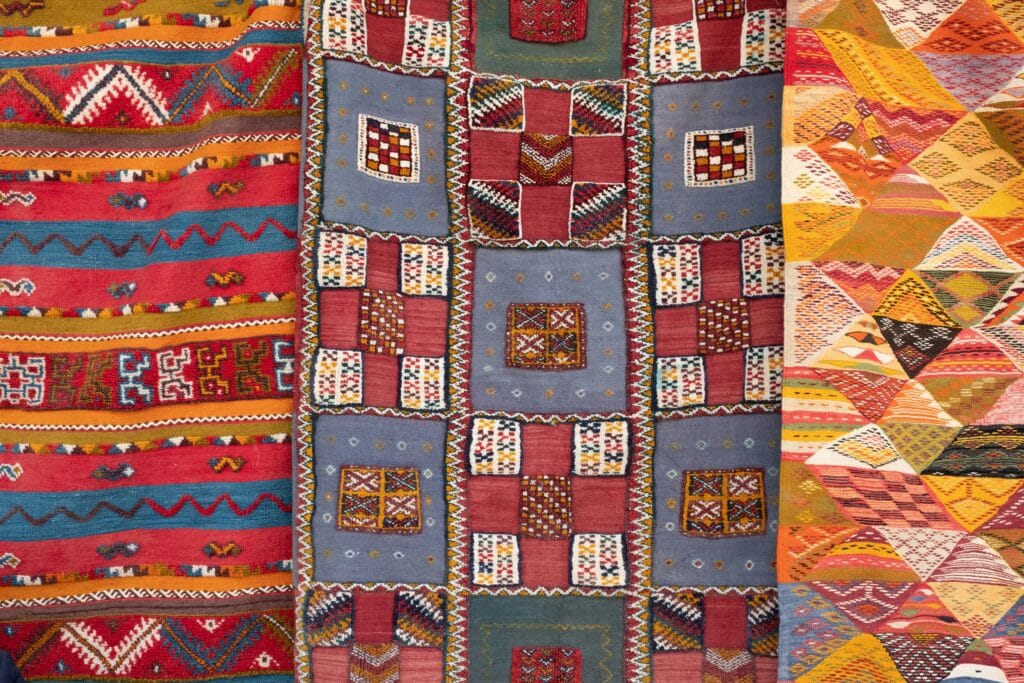
Sirwa and Akhnif-Inspired Carpets
The Jbel Sirwa/Sirwa region is one of the most fascinating areas for anyone interested in Moroccan weaving.
The region has a strong textile tradition connected to the Aït Ouaouzguit communities.
One particularly important textile is the akhnif, traditionally a woollen hooded cloak.
Research on Sirwa weaving documents how the motifs and techniques associated with the akhnif later became important sources for carpet production. An academic study notes that Sirwa weavers developed carpets inspired by the brocaded patterns of the akhnif cloak, and that the resulting “akhnif carpet” became commercially successful.
This is an excellent example of how Moroccan textile traditions evolve.
A motif does not necessarily begin as a carpet motif.
It may begin on clothing and later move into another textile form.
This is why understanding Moroccan carpets requires looking beyond the carpet itself.
Modern High-Pile Moroccan Carpets
The modern Moroccan rug market has also developed new interpretations of older mountain weaving traditions.
These contemporary carpets are often designed specifically for today’s interiors.
The emphasis may be on:
- softness
- natural wool
- neutral colours
- minimal patterns
- abstract compositions
- large dimensions
- luxurious texture
Two styles particularly associated with the contemporary market are Mrirt-style high-pile carpets and modern Taznakht/Sirwa interpretations.
Modern Mrirt
Modern Mrirt carpets are often made with very soft, long wool and can have a deep pile.
They work particularly well in:
- bedrooms
- lounge areas
- minimalist interiors
- luxury interiors
- spaces where texture is more important than strong colour
The neutral versions, especially ivory, cream, beige, grey and black, are easy to combine with contemporary furniture.
But Mrirt carpets can also be highly artistic.
Contemporary weavers create colourful abstract compositions that can resemble paintings.
Modern Taznakht Carpets
Modern Taznakht carpets occupy an interesting position between tradition and contemporary design.
Some have a relatively long pile, but many are more compact and practical than very deep Mrirt pieces.
Contemporary versions may use:
- abstract shapes
- traditional Amazigh geometric motifs
- natural colours
- strong contemporary colour combinations
- minimalist compositions
This flexibility is one reason southern Moroccan weaving traditions have become popular among designers.
Moroccan Flatweave Kilims and Hanbels
Now we move from pile carpets to flatwoven textiles.
A Moroccan kilim has no raised pile.
Instead, the yarns are woven together to produce a flat surface.
This makes kilims:
- lighter
- easier to fold
- easier to transport
- lower profile
- suitable for layering
- practical in many high-traffic spaces
They can also be used beyond the floor.
A beautiful Moroccan kilim can become:
- a wall hanging
- a bed covering
- a decorative textile
- a sofa throw
- a room divider
The term Hanbel is also used in Morocco for flatwoven textiles, although terminology varies according to region and commercial context.
Zanafi Carpets
The Zanafi tradition is associated with the Taznakht area and the Zanafi/Aït Ouaouzguite weaving world.
Zanafi pieces are especially interesting because they demonstrate the sophisticated relationship between flatweaving, geometric design and texture.
Traditional and contemporary examples can be relatively flat, lightweight and strongly geometric.
Earthy and natural colours are common, although contemporary designers increasingly experiment with different palettes.
Zanafi carpets are often appreciated because they bring together:
traditional Moroccan weaving + modern graphic design
This makes them particularly effective in contemporary interiors.
Some modern descriptions also use the term Zanafi for pieces incorporating different structural effects or raised elements, so buyers should examine the actual construction rather than relying on the name alone.
Tiffelt and Embroidered Flatweave Traditions
Some Moroccan flatwoven textiles go beyond simple horizontal weaving.
They can combine weaving with decorative techniques that resemble embroidery.
The result can be a textile where the background is relatively flat while the motifs appear raised or visually embroidered.
This is especially interesting in pieces associated with southern Moroccan weaving traditions.
The designs can include:
- diamonds
- zigzags
- triangles
- crosses
- stepped forms
- Amazigh geometric motifs
The important point for buyers is that not every Moroccan flatweave is made using exactly the same technique.
Two rugs may both be called “kilim” but have very different structures.
Vintage Moroccan Carpets
A vintage Moroccan carpet is not simply a new carpet with an old-looking design.
A genuinely old carpet has lived through time.
Its wool may have softened.
Its colours may have changed.
Its pile may have become lower through use.
Its edges may show repairs.
These characteristics can be part of its beauty.
Vintage Moroccan carpets are particularly interesting because many of them preserve weaving traditions that may have changed significantly in contemporary production.
Common vintage styles include:
- Beni Ourain
- Azilal
- Boujad
- Beni M’Guild
- Kilim
- regional High Atlas carpets
- Sirwa/Southern Moroccan carpets
A vintage Beni Ourain, for example, may have the familiar ivory-and-dark geometric language but a softer, more aged appearance.
A vintage Boujad can develop faded pink, red and purple tones.
A vintage Azilal may have colours that have softened naturally over decades.
Collectors often value these changes because they cannot be perfectly reproduced by a newly manufactured rug.
Boucherouite Carpets
Boucherouite carpets are among the most visually unconventional Moroccan textiles.
Unlike traditional wool carpets, they are often made from recycled textiles and fabric scraps.
Old clothing, synthetic fabrics, cotton and other available materials can be transformed into colourful woven compositions.
The result can be:
- extremely colourful
- irregular
- playful
- abstract
- highly textured
Boucherouite is therefore particularly interesting from a sustainability and material-culture perspective.
It demonstrates that Moroccan weaving has never been only about using expensive materials.
The weaver could transform what was available into something useful and beautiful.
This also makes every Boucherouite highly individual.
How to Understand Moroccan Carpet Symbols
One of the most fascinating subjects surrounding Amazigh carpets is symbolism.
You may see:
- diamonds
- triangles
- zigzags
- crosses
- human-like forms
- animals
- plants
- stars
- eyes
- stepped mountains
It is tempting to search for a single dictionary saying:
“This symbol means fertility.”
“This symbol means protection.”
“This symbol means freedom.”
But reality is more complicated.
Moroccan Amazigh weaving traditions are diverse, and the meaning of a motif can depend on the region, community, context and individual weaver.
Therefore, a responsible description should say that certain motifs can be associated with ideas such as protection, fertility, nature, identity or social life, rather than claiming that every diamond has one universal meaning.
The carpet is not a universal written language.
It is a visual tradition.
Natural Wool, Dyes and Materials
Wool is central to Moroccan carpet production.
Its qualities make it particularly suitable for carpets:
- warmth
- resilience
- softness
- insulation
- ability to absorb dye
- natural texture
The character of the wool can vary considerably.
Mountain sheep living in colder environments may provide different wool characteristics from sheep raised in other regions.
Colours may be natural or dyed.
Traditional dye materials can include plants, roots, leaves, bark and other natural sources, although modern carpets may also use commercial dyes.
When buying a carpet, do not assume that a bright colour automatically means synthetic dye or that every natural-looking colour is necessarily natural dye.
If natural dye is important to you, ask the seller specifically about the dyeing process.
How to Tell Major Moroccan rug Types Apart
Here is a practical starting point:
| Type | Main Region | Surface | Typical Visual Character |
|---|---|---|---|
| Rabat / R’Bati | Rabat | Low/medium pile | Formal, floral, medallions, refined |
| Beni Ourain | Middle Atlas | High pile | Ivory, black/brown geometric |
| Mrirt / Beni M’rirt | Middle Atlas | Medium/high pile | Dense, soft, luxurious |
| Azilal | High Atlas | Medium pile | Colourful, expressive, abstract |
| Boujad | Central Morocco | Medium/loose pile | Pink, red, purple, expressive |
| Taznakht | High Atlas/Sirwa | Various | Geometric, colourful, dense |
| Sirwa/Akhnif-inspired | Sirwa | Various | Strong geometric/brocaded motifs |
| Zanafi | Taznakht | Flatweave / mixed constructions | Graphic, geometric |
| Kilim/Hanbel | Several regions | Flatweave | Thin, reversible, geometric |
| Boucherouite | Various | Variable | Recycled textiles, colourful |
| Vintage Moroccan | Various | Variable | Age, patina, softened colours |
The table should be understood as a guide rather than a strict scientific classification. Moroccan weaving traditions overlap, evolve and vary between communities.
How to Buy a Moroccan Carpet in Morocco
If you are visiting Morocco and want to buy a carpet, do not begin by asking:
“How much is this?”
Begin by asking:
“What is it?”
Then ask:
“Where was it made?”
Then:
“How was it made?”
Then:
“What is it made from?”
And finally:
“How old is it?”
These questions tell you much more than the seller’s first price.
A good seller should be able to explain the carpet’s material, construction, approximate origin and condition.
If a seller tells you that every symbol has a precise ancient meaning, every carpet is “100% antique,” or every rug is from a famous tribe without being able to explain its construction or provenance, take the story cautiously.
The carpet should be judged by the object itself.
Questions to Ask Before Buying
Before buying a Moroccan carpet, ask:
1. Where was it made?
Try to get a region rather than simply “Morocco.”
2. Is it hand-knotted or flatwoven?
This immediately tells you something about its construction.
3. What is the pile height?
This matters for comfort and maintenance.
4. What is the material?
Ask whether it is:
- wool
- cotton
- cactus silk
- recycled textile
- mixed fibre
5. Are the colours natural dyes?
If this matters to you, ask specifically.
6. Is it vintage or new?
Do not confuse “vintage style” with an actual vintage carpet.
7. Has it been repaired?
For an older rug, repairs are not necessarily bad, but you should know about them.
8. Has the carpet been chemically washed or treated?
This can affect the feel and colour.
9. What are the exact measurements?
Always measure the carpet yourself or request precise measurements.
How to Choose the Right Moroccan Carpet for Your Interior
The best Moroccan carpet is not necessarily the most expensive one.
It is the one that works with your room, lifestyle and taste.
For a minimalist home
Consider:
Beni Ourain or neutral Mrirt
Their natural ivory and cream tones can add warmth without overwhelming the room.
For a colourful interior
Consider:
Azilal or Boujad
Their strong colours can become the visual centre of the room.
For a traditional Moroccan interior
Consider:
Rabat/R’Bati, Taznakht or regional traditional carpets
These can work especially well with wood, carved plaster, zellige, brass and traditional furniture.
For a contemporary home
Consider:
Zanafi, modern Taznakht, modern Mrirt or an abstract Azilal
Their geometry and texture can bridge traditional craftsmanship and modern architecture.
For a dining room
Consider:
flatwoven kilim or Zanafi
Their lower profile makes them practical around dining chairs.
For a bedroom
Consider:
high-pile Beni Ourain or Mrirt
The softness works beautifully around the bed.
Frequently Asked Questions
What is the most famous Moroccan carpet?
Beni Ourain is probably the most internationally recognisable Moroccan rug style today, especially in contemporary interior design.
What is the difference between Beni Ourain and Azilal?
Beni Ourain carpets are generally associated with the Middle Atlas and are famous for their natural ivory wool and restrained dark geometric designs. Azilal carpets come from the High Atlas and are generally more colourful, expressive and improvisational.
What is a Moroccan kilim?
A Moroccan kilim is a flatwoven textile without a raised pile. It is generally lighter and thinner than a pile carpet.
Are Moroccan carpets always made from wool?
No. Wool is extremely important, but Moroccan textile traditions also use other materials, including cotton and recycled textiles. Boucherouite carpets, for example, are particularly associated with recycled fabric materials.
What is the difference between a kilim and a pile carpet?
A pile carpet has raised fibres created through knotting or other pile-forming techniques. A kilim is woven flat without a raised pile.
Which Moroccan carpet is best for a bedroom?
High-pile rugs such as Beni Ourain or Mrirt can be excellent choices because they provide warmth and softness.
Which Moroccan carpet is best for a dining room?
A flatwoven kilim or low-profile rug is often more practical because dining chairs can move more easily across it.
Are Moroccan carpets handmade?
Traditional Moroccan carpets are handmade, but the international market also contains machine-made carpets inspired by Moroccan designs. Always ask about the actual construction.
Are Moroccan carpet symbols universal?
No. Symbolic meanings can vary by region, community and context. It is better to understand Moroccan carpet symbolism as a diverse visual tradition rather than a universal dictionary.
What makes a Moroccan carpet valuable?
Value can depend on many factors, including:
age
provenance
rarity
regional tradition
wool quality
weaving quality
knot density
condition
colour
design
artistic quality
historical significance
A high knot count alone does not determine whether a Moroccan carpet is valuable.
Final Thoughts: A Moroccan rug Is More Than a Floor Covering
The easiest way to understand Moroccan carpets is to stop thinking of them as a single category.
There is no single “Moroccan rug.”
There is a Rabat carpet from an urban tradition. There are Middle Atlas carpets with deep woollen piles. There are colourful High Atlas weavings. There are expressive Boujad pieces. There are southern carpets connected to the Sirwa and Taznakht traditions. There are flatwoven kilims and Hanbels. There are Zanafi textiles. There are recycled Boucherouite rugs. And there are countless individual pieces that do not fit neatly into one modern commercial label.
Each one reflects a different combination of place, material, technique, climate, history and human creativity.
That is what makes Moroccan carpets so interesting.
When you buy one, you are not simply choosing a colour for your living room.
You are choosing a piece of Moroccan material culture.
And the more you understand the carpet before buying it, the more meaningful that choice becomes.