
Iwziwn (often miswritten as “Ouzioua”) stands as one of the oldest Amazigh villages belonging to the Aït Wawzguit tribal confederation of the High Atlas–Sous region. Historically, the village played a major role in reinforcing unity among neighboring tribes, acting as a strategic threshold between the fertile Sous plain and the mountainous High Atlas. This article synthesizes anthropological, geographic, and linguistic scholarship to offer an academically structured narrative about Iwziwn’s historical significance, identity, and socio-cultural continuity.
HISTORICAL SIGNIFICANCE WITHIN AÏT WAWZGUIT
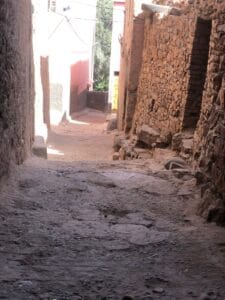 Iwziwn’s importance emerges from its geographic and political position. The Sous valley has long been a contested space due to its natural wealth and agricultural productivity. Iwziwn (Ouzioua) functioned as a protective entry point and strategic settlement for the Aït Wawzguit. Anthropological research (Hart, 1999; Boum, 2013) reveals that such intermediary zones were essential in shaping tribal defensive strategies, local alliances, and communal decision-making.
GEOGRAPHICAL CONTEXT
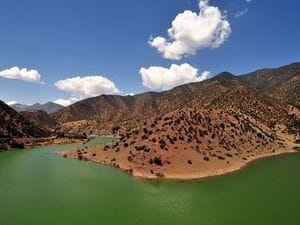
Situated between the High Atlas (Adrar n’Dern) and the Anti-Atlas foothills, Iwziwn is surrounded by:
• Aït Ounain tribe (north-east)
• Tafnout/Toubkal region (east)
• Talouine and the Anti-Atlas (south)
• Awlouz (west)
The valley of Oued Sous, which nurtures the village, is recognized as one of Morocco’s most productive agricultural zones. Its geography explains patterns of settlement, irrigation traditions, and the socio-economic life of the inhabitants.
THE TOPONYMY OF IWZIWN: MEANING AND CULTURAL DEPTH
The name “Iwziwn” originates from the Amazigh concept of *Tiwizi*—mutual aid and collective work. Linguists (Chaker, 1995) confirm that Amazigh place names frequently embody values and collective memory. This linguistic heritage reveals much about the founding structure of the village: solidarity, collaboration, and reciprocity remain at the core of social relations.
The alternative form “Ouzioua,” popularized through administrative Arabization and French colonial transcription, deviates from the original phonology. Restoring “Iwziwn” honors historical authenticity and cultural identity.
AGRICULTURE AS THE FOUNDATION OF IWZIWN LIFE
For centuries, agriculture was the backbone of Iwziwn’s survival and economy. The fertile soils of the Sous valley, regenerated by seasonal floods, supported:
• Wheat and barley
• Olives and almonds
• Pomegranates, figs, and local fruits
Agriculture shaped:
• Social hierarchies
• Community solidarity
• Irrigation councils (*l’jmaa n lma*)
• Seasonal celebrations tied to planting and harvest
CRAFTS AND DAILY LIFE
Traditional life in Iwziwn integrated multiple crafts, each essential for community sustainability:
• **Amzil (Blacksmiths)** — producers of tools, weapons, and agricultural instruments
• **Potters** — creators of household items and storage containers
• **Builders/Architects** — using earthen materials adapted to local climate
These crafts reflect Amazigh adaptation to environment and communal economy.
CULTURAL IDENTITY, MEMORY, AND NAMING STRUGGLES
 The distortion of Amazigh place names occurred through:
• Arabization in governance
• Colonial administrative transliteration
• Linguistic shifts over generations
Academic literature (Ennaji, 2005) stresses that preserving original toponyms is part of cultural resistance and recognition of indigenous memory. “Iwziwn” is not simply a name—it encodes identity, spirituality, and communal values.
IWZIWN AS A SYMBOL OF AMAZIGH CONTINUITY
Iwziwn is a microcosm of Amazigh civilization:
1. Deep relationship with land and agriculture
2. Shared social structures rooted in *tiwizi*
3. Rich oral traditions
4. Distinct architecture, crafts, and rural economy
5. Survival of Tamazight language
6. Seasonal festivals and collective rituals
These components position the village as a living example of cultural resilience.
CONCLUSION
Iwziwn’s past and present reflect a timeless Amazigh worldview rooted in cooperation, identity, and harmony with nature. Its mountains, rivers, crafts, and traditions preserve an ancient cultural heritage that continues to thrive. Understanding Iwziwn academically and historically ensures that its legacy remains visible and appreciated.
REFERENCES (MLA Style)
• Boum, Aomar. *Memories of Absence: How Muslims Remember Jews in Morocco.* Stanford University Press, 2013.
• Chaker, Salem. *Berbères Aujourd’hui.* L’Harmattan, 1995.
• Ennaji, Moha. *Multilingualism, Cultural Identity, and Education in Morocco.* Springer, 2005.
• Hart, David M. *The Aith Waryaghar of the Moroccan Rif.* University of Arizona Press, 1999.
• Mahdi, Mohamed. “Agrarian Structures in the High Atlas.” *Revue Marocaine d’Ethnologie*, 2014.