Amazigh Blacksmithing Art: Fire, Tradition, and Cultural Heritage
Introduction: When Fire Becomes Memory
Long before modern workshops and industrial production transformed the way objects were made, Amazigh artisans worked with one of the most demanding materials known to humanity: metal. Through heat, force, patience, and extraordinary skill, the blacksmith transformed raw material into tools, weapons, jewelry, and objects that became part of everyday life and cultural expression.
Amazigh blacksmithing art is therefore more than a traditional craft. It represents a relationship between people, material, fire, and community. In the hands of the amzil, the traditional blacksmith, metal could become something useful, protective, decorative, or deeply symbolic.
Across different Amazigh regions of Morocco and North Africa, Amazigh metalworking traditions developed according to local needs, resources, social structures, and artistic languages. Although techniques and objects varied from one community to another, the forge remained a place where practical knowledge and cultural memory could be transmitted from one generation to the next.
Today, this heritage faces important challenges. Mass-produced goods, changing lifestyles, declining numbers of traditional workshops, and the loss of specialized knowledge have placed some forms of traditional metalworking under pressure. Yet Amazigh artisans and contemporary makers continue to reinterpret traditional techniques and motifs, demonstrating that heritage does not necessarily have to remain frozen in the past.
This article explores the origins, techniques, symbolism, social significance, challenges, and contemporary revival of Amazigh blacksmithing art, while considering why this remarkable tradition still matters in Morocco and beyond.
Table of Contents
Opening: When Flame Becomes Memory
Imagine yourself stepping into a dim workshop at dusk. The scent of coal and hot iron stirs something in your soul. You feel the heat on your face, and in that moment, you understand: this is more than a trade — it’s a covenant with the ancestors.
Perhaps you have held a knife, a blade, a pendant, and not realized how many lifetimes of lineage lie within its metal. For the Amazigh people, blacksmithing isn’t just creating tools or weapons — it is weaving story, weaving identity, forging power. The spark from the forge is not merely heat. It is a spark of memory, of resistance, of reconnection.
As you journey with me through Amazigh blacksmithing art, you’ll discover how fire becomes language, how metal shapes identity, and how this tradition continues its flicker in today’s changing world.
What Is Amazigh Blacksmithing Art? The Cultural Furnace
What Is Amazigh Blacksmithing Art?
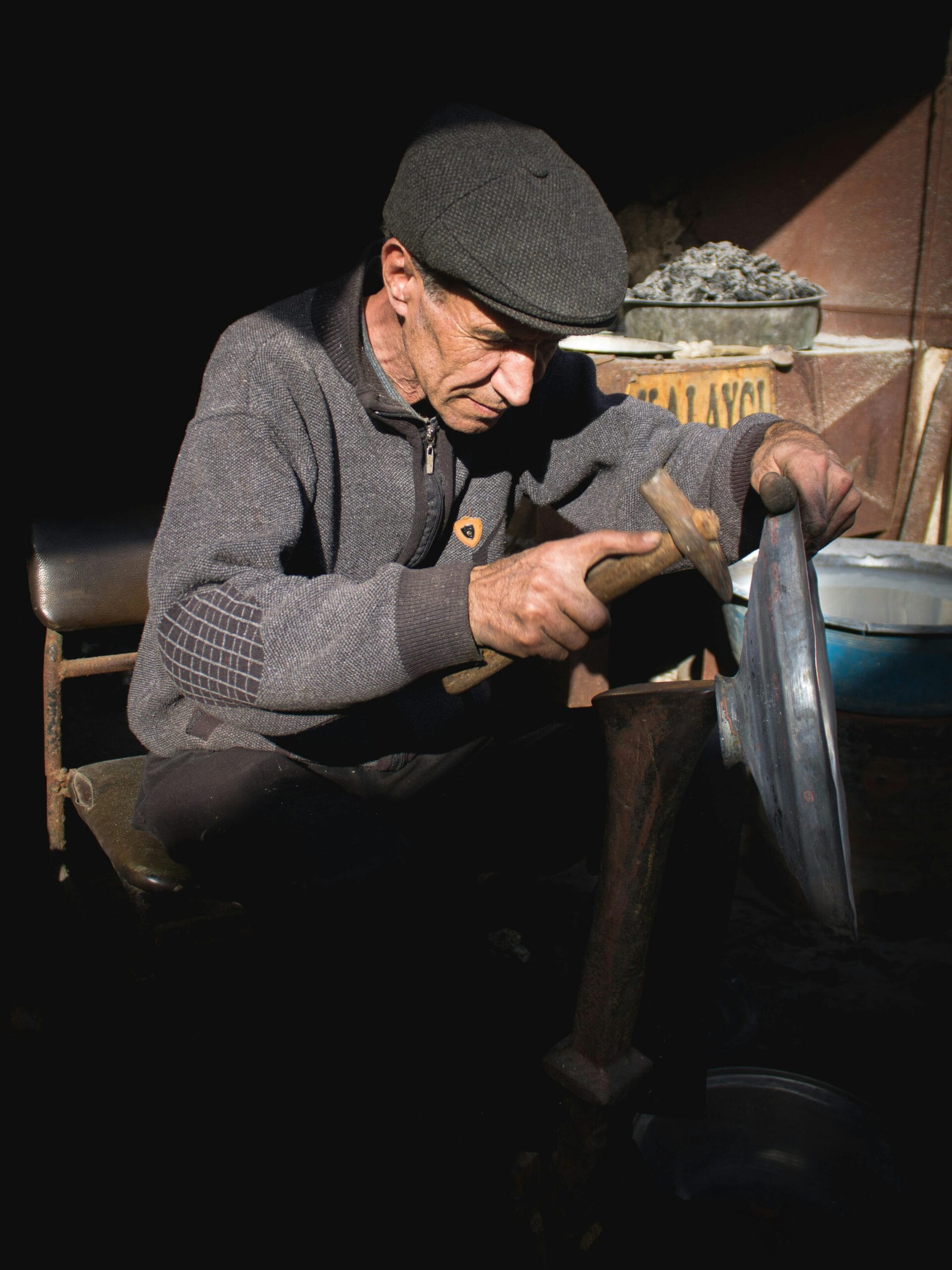
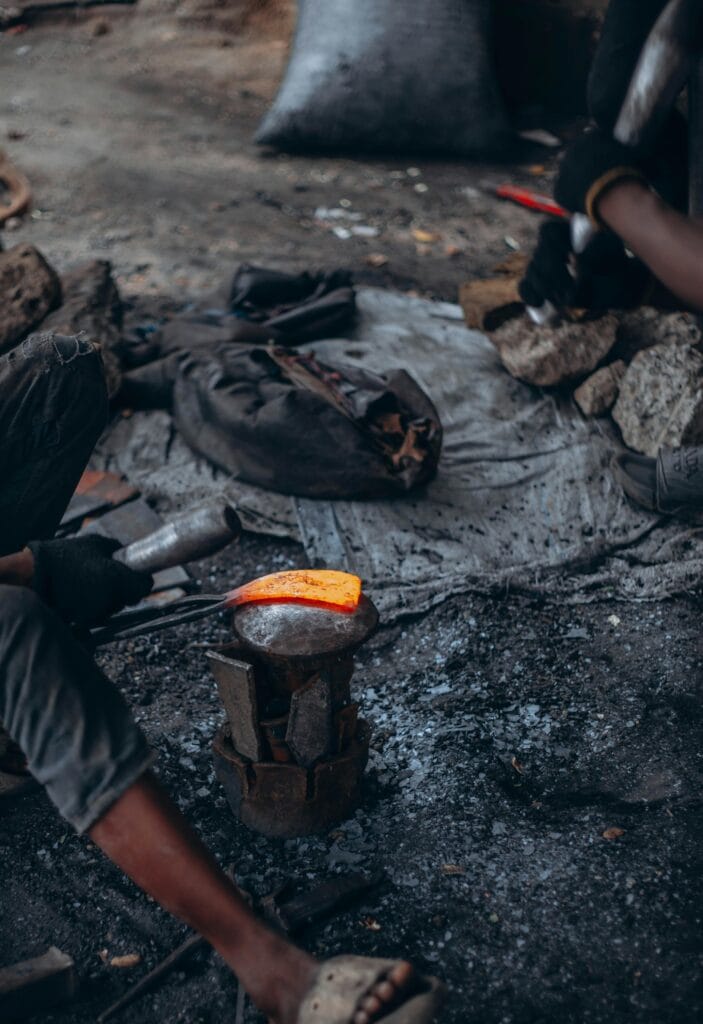
Amazigh blacksmithing art refers to traditional metalworking practices developed and maintained within Amazigh communities of North Africa. At its practical level, the craft involves heating, shaping, hammering, cutting, joining, and finishing metal to produce objects required by households, farmers, travelers, craftsmen, and communities.
But describing it only as a technical occupation would overlook its cultural importance. The traditional forge could also function as a place where specialized knowledge was concentrated and transmitted. The blacksmith possessed knowledge of materials, fire, tools, proportions, and techniques that could take many years to master.
The craft also intersected with other areas of Amazigh material culture. Metal objects could complement clothing, jewelry, agricultural equipment, architectural elements, or ceremonial objects. Their forms and decorations could communicate ideas about identity, status, protection, beauty, and belonging.
For this reason, Amazigh blacksmithing should be understood both as craftsmanship and cultural knowledge. Its significance lies not simply in the finished object but also in the process, skills, social relationships, and memories surrounding its production.
Roots and Origins: The Amzil Among the Imazighen
The traditional Amazigh blacksmith, commonly associated with the term amzil in several Amazigh linguistic contexts, occupied a distinctive position within many communities. Blacksmithing required specialized knowledge that was not easily acquired through occasional practice. It depended on familiarity with fire, metal, tools, temperature, timing, and physical technique.
The history of metalworking in North Africa is much older than any single modern ethnic or cultural label. Archaeological evidence demonstrates long histories of metallurgy across the region, while later Amazigh communities incorporated metalworking into their own economic and social environments. It is therefore important not to claim that every contemporary Amazigh blacksmithing practice has an uninterrupted line directly from prehistoric metallurgy. Instead, the tradition should be understood as the result of long-term technological development, cultural adaptation, and local transmission.
In rural communities, the blacksmith’s work could be closely connected to agriculture and everyday survival. Repairing tools, producing agricultural implements, making horseshoes, creating household objects, or producing decorative pieces meant that the forge could serve practical needs as well as artistic ones.
- The Amazigh peoples (also called Imazighen, “free people”) have roamed North Africa—Berber-speaking populations across Morocco, Algeria, Tunisia, Libya, the Sahara, and beyond.
- In many communities, the blacksmith — the Amzil (or similar local term) — held a unique role as artisan, mediator, and keeper of arcane knowledge. iwziwn.com
- In villages, farmers, herders, and households turned to the blacksmith for tools (plowshares, axes), repair, blades, and ritual implements. The blacksmith’s workshop often functioned as a social hub. iwziwn.com
- Over centuries, these smithing traditions merged local metallurgy, tribal symbols, spiritual associations, and functional needs.
Defining the Craft: Materials, Tools, Technique
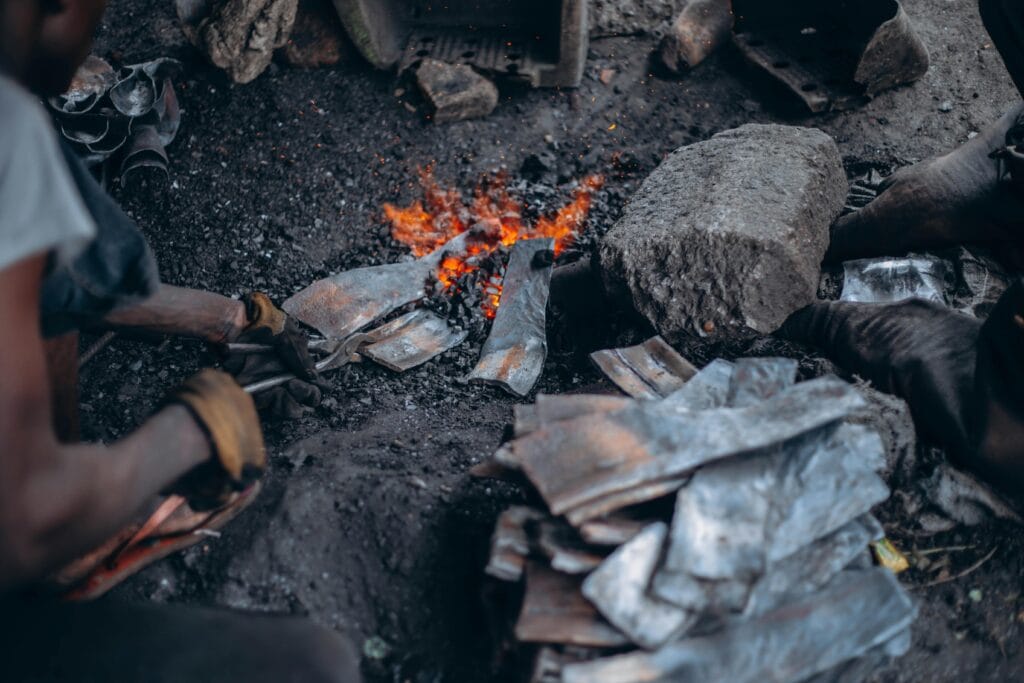
Traditional blacksmithing begins with a simple transformation: solid metal is heated until it becomes workable, then shaped through controlled force. The process requires precision rather than brute strength alone. A skilled artisan must know when metal has reached a workable temperature, how much force it can withstand, and when it must return to the fire.
The basic equipment of a traditional forge could include a hearth or furnace, fuel, bellows or another method of producing airflow, anvils, hammers, tongs, chisels, punches, and files. The precise tools varied according to the workshop and the objects being produced.
Iron and other metals could be shaped into agricultural implements, household tools, weapons, jewelry components, architectural fittings, and decorative objects. Finishing techniques might include filing, polishing, engraving, punching, twisting, or adding geometric details.
What makes the craft remarkable is the combination of technical knowledge and visual judgment. The artisan must create an object that is structurally functional while also achieving an appropriate form and finish.
You deserve to see how the art is practiced:
- Materials: Local iron or steel, occasionally bronze or copper; scrap metal sometimes recycled; silver and other precious metals reserved for jewelry or ceremonial objects.
- Tools: Hammer, anvil, tongs, chisels, punches, grinding stones, bellows or manual air supply, forge or hearth.
- Technique:
- Heating metal until red-hot in the forge.
- Hammering it to shape.
- Annealing, quenching, tempering for strength.
- Engraving, inlaying, embossing, filigree work, decorative motifs.
- Polishing, patination.
- Hand‑forged vs mechanized: The authentic Amazigh blacksmithing art remains primarily manual, preserving irregularities, marks, and soul in each piece.
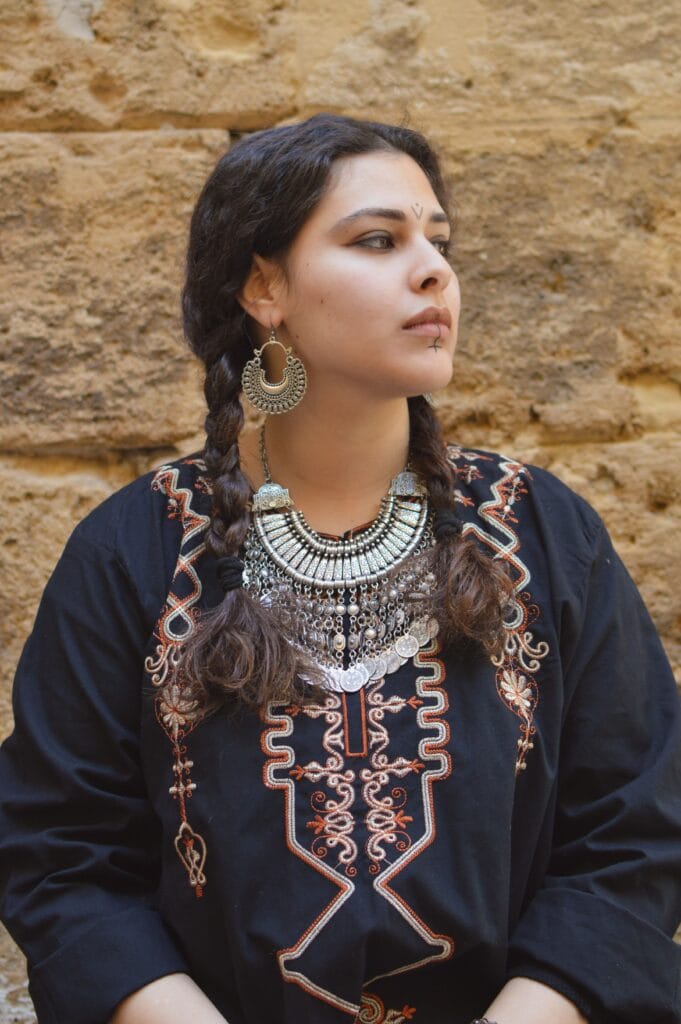
- Motifs & Symbols: Traditional Amazigh symbols (triangles, zigzags, dots, Tifinagh letters, stylized animals) are often engraved or embossed on blades, jewelry, metal plates.
Include examples (images or references) of traditional sword hilts, daggers, fibulae with engraved symbols, etc. (e.g. Amazigh fibula as cultural jewelry) Wikipédia+1
Amazigh Blacksmithing art and Everyday Life
The importance of Amazigh blacksmithing becomes clearer when we look beyond spectacular objects and consider ordinary life. A farming community depends on tools, households require functional metal objects, and travelers need equipment capable of surviving demanding environments. The forge therefore participated directly in the material economy of the community.
Blacksmithing also connected different forms of craftsmanship. Metal could be used alongside leather, wood, textiles, stone, and other materials. A single object might therefore reflect the cooperation of several specialized skills. In this sense, traditional craftsmanship was not a collection of isolated professions but an interconnected system of knowledge.
This practical dimension is essential for understanding Amazigh material culture. Heritage is not preserved only in ceremonial objects displayed in museums. It can also survive in the tools, utensils, agricultural implements, jewelry, and architectural details that once formed part of everyday life.
From Useful Object to Cultural Symbol
An important feature of traditional metalwork is the transition between function and symbolism. An object may begin as something designed to perform a practical task, yet its shape, decoration, ownership, or context can give it additional cultural meaning.
This is particularly visible in jewelry and ceremonial objects. Geometric forms, repeated patterns, inscriptions, and carefully finished surfaces can transform metal from a simple material into a carrier of identity and memory.
However, symbolism should always be interpreted carefully. Not every geometric motif has one universal meaning across all Amazigh communities. Meanings can vary according to region, language, historical period, object type, and individual or community interpretation. Avoiding simplistic “one symbol equals one meaning” explanations makes the study of Amazigh metalwork more historically responsible.
The Symbolism of Power in Amazigh Metalwork
Fire as Spiritual Force and Social Authority
You may already sense: fire is no mere tool in Amazigh culture — it is a symbol:
- Purifier: The forge’s flame is seen as cleansing, transmuting base metal to higher purpose.
- Mediator: The blacksmith is a conduit between earth (ore), fire (transformation), and the community.
- Protector: Weapons and amulets crafted by the blacksmith guard families and tribes.
- Ritual role: In ceremonies (birth, marriage, death, warfare), metal objects made in certain ways carry blessing or power.
Decoding Traditional Symbols
Provide a table or list of common motifs and their meanings:
| Symbol | Meaning | Common Use |
|---|---|---|
| △ Triangle | Fertility, femininity | Jewelry, fibulae |
| ≡ Zigzag | Water, life, continuity | Blade etchings |
| ⊕ Cross/X | Four elements/directions | Amulets, pendants |
| • Dots | Stars, spiritual energy | Ornamentation |
Tifinagh Script in Metalwork
- Tifinagh letters (Amazigh alphabet) increasingly used in modern jewelry
- Used for initials, names, tribal slogans, cultural expressions
- Blends ancient writing with contemporary design
Weapons, Tools, and Jewelry as Symbols of Authority
- The koummya (curved dagger) or straight swords often coded as status symbols — to bear one implied prestige.
- Jewelry and fibulae (e.g. Amazigh brooch) carried meaning: tribe, fertility, protection, lineage. Wikipédia+1
- The ornamented fibula is a striking example. Its triangular/semicircle-shape, pin mechanism, and engraved motifs show the blend of function and symbolism. Wikipédia
- In many communities, possession or gifting of a metal object implied political or familial alliances.
You could include a small table summarizing symbol ↔ meaning (triangle = protection, zigzag = water/flow, cross or X = four directions, etc.).
Craftsmanship Passed Through Generations: The Line of Fire
Apprentice, Master, Family Lineage
- The forging methods were seldom written—they passed from generation to generation orally, by demonstration.
- A boy (or, increasingly, a girl) would serve as apprentice, observing in silence, learning by doing.
- Secrets of tempering, alloys, inlay, pattern making often remained within the family or close kin.
- Rituals or taboos might surround certain steps (e.g. specific days, naming taboos, spiritual protections) — these deepen the mystique of power.
Gender, Change, and Modern Resurgence
- Traditionally, blacksmithing was male-dominated, given its physical demands and cultural roles.
- However, in modern times, women are reclaiming and participating, especially in decorative metalwork, jewelry, and forging smaller pieces.
- This shift broadens the craft, opens new interpretations, and challenges tradition while honoring it.
You might include a mini‑case: a female Amazigh blacksmith or craftswoman forging jewelry, if you find a real-life example.
Threats to Amazigh Blacksmithing artToday
You, the reader, may wonder: in a globalized, industrial world, can this fire survive?
Industrialization and Mass Production
- Mechanized factories produce cheaper blades, tools, jewelry — reducing demand for handmade craft.
- Younger generations often migrate to cities, abandoning rural trades.
- Traditional blacksmithing produces small quantities with long hours; in competition with mass goods, it becomes economically difficult.
Cultural Marginalization and Language Loss
- Beyond materials, the decline of Amazigh language, suppression of cultural symbols, and social neglect contribute to erosion of craft knowledge.
- Crafts anchored in identity lose meaning if the community no longer remembers the stories.
- UNESCO’s recent recognition of metal engraving traditions across North Africa may help (e.g. UNESCO listing for metal engraving skills) newagebd.net
Include statistics or reports (where available) on number of traditional artisans declining in regions (e.g. Morocco, Algeria). Interview quotes (if accessible) from artisans lamenting generational gaps would be potent.
Amazigh Blacksmithing Art in the Modern World: Revival & Reinvention
Contemporary Artisans, Cooperatives, and Revival Movements
You’ll be heartened: the flame is not extinguished.
- Across Morocco, Algeria, and the Maghreb, artisans, cooperatives, NGOs, and cultural activists are re-establishing blacksmithing programs.
- Some artisans train youth, host workshops, sell globally.
- In Tunisia, metal engraving was inscribed on UNESCO’s intangible heritage list, giving renewed recognition to artisans. newagebd.net
- In Morocco, cultural stores (e.g. “Afus Art” in Tinghir) promote Amazigh craftsmanship in modern marketplaces. Morocco World News
- Some modern artists fuse Tifinagh, Amazigh symbols, and contemporary design (e.g. Ben Azri blending Berber graphic forms) Wikipédia
From Village Forge to Global Galleries
- Works now appear in museums, galleries, design fairs in Rabat, Casablanca, Paris, London.
- Interest in “ethical handmade,” Indigenous crafts, and cultural heritage fuels demand.
- Designers collaborate with blacksmiths to produce jewelry, installations, decorative works that adapt tradition to modern aesthetics.
Include one or two notable examples (names, works, exhibitions) if available, and images.
Why Amazigh Blacksmithing Art Still Matters to You (and the World)
- Cultural resistance: In asserting Amazigh identity, this craft proclaims permanence against erasure.
- Connection to ancestry: You hold a piece carrying centuries of memory.
- Artistic value: Hand-forged works carry imperfections, uniqueness, soul.
- Educational bridge: Teaching this craft fosters pride, identity, and intergenerational dialogue.
- Economic potential: Artisan tourism, global markets, cooperatives can revitalize rural economies.
Frequently Asked Questions About Amazigh Blacksmithing Art
What is Amazigh blacksmithing art?
Amazigh blacksmithing art is the traditional practice of shaping metal within Amazigh communities to create practical, decorative, agricultural, architectural, and sometimes ceremonial objects. It combines technical craftsmanship with local cultural knowledge.
What materials are used in Amazigh blacksmithing art?
Primarily iron or steel, sometimes copper, bronze, or silver for decorative pieces. Some metal may be recycled or imported depending on region.
How does Amazigh blacksmithing art differ from other smithing traditions?
It incorporates symbolic motifs, oral transmission, ritual significance, and lineage-based secrets—not merely form and function but identity-laden works.
Is Amazigh blacksmithing still practiced today?
Yes, though at risk. Revival initiatives, artisan cooperatives, museums, and cultural programs are helping sustain and renew the craft.
What is an amzil?
Amzil is a term associated with the traditional blacksmith in several Amazigh contexts. The artisan’s role could extend beyond making new objects to repairing tools and producing items needed for everyday community life.
Where can I see Amazigh blacksmithing art?
Local souks, craft fairs in Morocco and Algeria, ethnographic museums (e.g. Abderrahman Slaoui Museum in Casablanca) Wikipédia, specialized boutique galleries, and online artisan platforms.
How can I support its preservation?
Purchase directly from authentic artisans
Promote awareness and cultural appreciation
Support NGOs or craft cooperatives
Encourage educational programs in Amazigh communities
Document and share stories, imagery, and meaning
What objects were made by Amazigh blacksmiths art?
Traditional metalworkers could produce or repair agricultural tools, household implements, weapons, horseshoes, architectural fittings, jewelry components, and other functional or decorative objects.
What makes Amazigh metalwork culturally important?
Its importance comes from the combination of technical knowledge, practical function, artistic expression, and cultural transmission. Objects can provide insight into the history and material culture of the communities that produced and used them.
Are Amazigh metalwork symbols universal?
No. Symbolic interpretations can differ between regions, communities, historical periods, and object types. It is better to examine each motif within its specific cultural and historical context.
Is Tifinagh used in Amazigh metalwork?
Tifinagh can appear in contemporary Amazigh artistic and cultural production, including metalwork. However, not every traditional geometric motif should automatically be interpreted as Tifinagh.
What threatens traditional Amazigh blacksmithing art?
Industrial mass production, changing consumer preferences, declining demand for handmade objects, economic pressures, and difficulties in transmitting specialized skills can all affect traditional crafts.
Conclusion: Keeping the Fire Alive
Amazigh blacksmithing art is more than the transformation of metal through fire. It is a record of practical knowledge, craftsmanship, creativity, social relationships, and cultural memory.
From the traditional amzil and the village forge to contemporary artisans and cultural initiatives, this heritage continues to demonstrate the remarkable ability of Amazigh communities to turn everyday materials into objects of function and meaning.
Preserving this tradition does not mean keeping it frozen in the past. It means documenting techniques, supporting artisans, respecting regional differences, encouraging younger generations to learn traditional skills, and recognizing craftsmanship as an important part of Morocco’s living cultural heritage.
The forge may have changed, and the market may have changed, but the knowledge carried through generations can continue to burn brightly—as long as there are people willing to learn, practice, and pass it on.
Call to Action:
If this resonated with you, here’s how you can help stoke the flame:
- Visit African or Amazigh artisan markets and purchase directly from blacksmiths.
- Share what you learn: post images, stories, or lessons about Amazigh blacksmithing on social media (credit the communities).
- Connect with cultural NGOs or cooperatives working to preserve Amazigh arts and ask how you can support.
- Learn: enroll in workshops, if offered locally or online, or commission a custom piece including your own symbols.
- Advocate: urge cultural ministries, museums, and local governments to support these artisans.
The flame is your invitation. Let it burn wider.