Ahwach Dance: History and Tradition in the Souss Valley
Introduction
In the villages and communities of Morocco’s Souss Valley, music can become much more than entertainment. It can bring people together, preserve poetry, celebrate important occasions, and express a shared sense of belonging. Ahwach dance is one of the most powerful examples of this living cultural tradition.
Ahwach is a collective performance that brings together dance, chanting, poetry, rhythm, and coordinated movement. It is particularly associated with southern Morocco and is deeply connected with Amazigh cultural life in the Souss and surrounding mountain regions. Rather than being simply a choreographed dance performed for an audience, Ahwach traditionally creates a social space in which participants and spectators can share a communal experience.
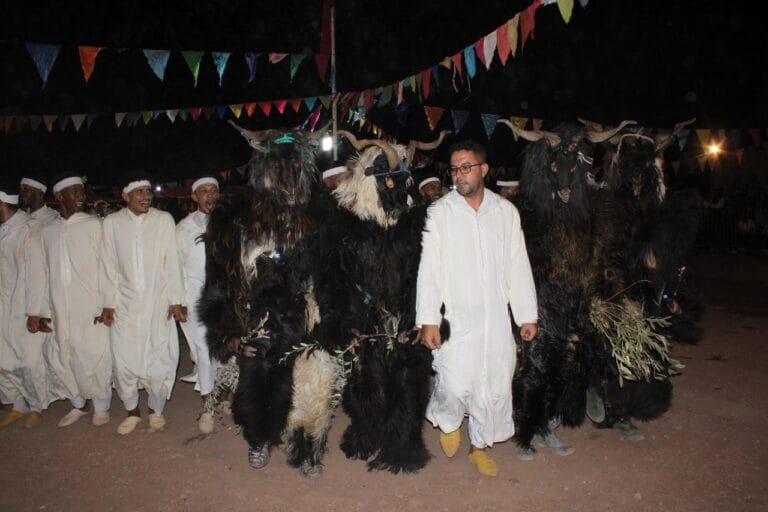
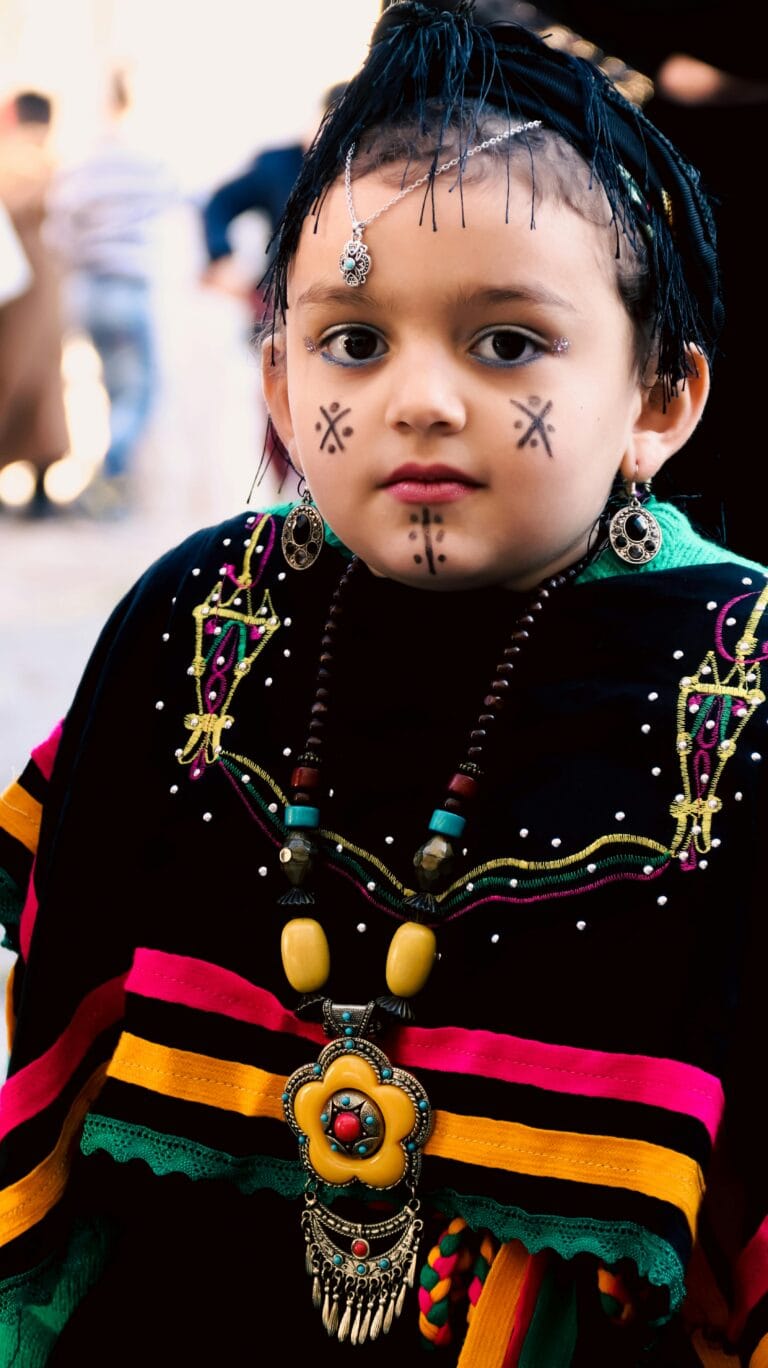
The sound of drums, the synchronized movements of performers, the exchange of poetic lines, and the visual presence of traditional clothing can transform a village gathering into a powerful expression of collective identity. Depending on the local tradition, Ahwach may be performed during weddings, festivals, communal celebrations, and other important occasions.
In the rugged valleys of the High Atlas and Anti-Atlas mountains, one tradition has survived for centuries as both an art form and a way of life: Ahwach dance (أحواش). More than just music or dance, Ahwach represents collective memory, spiritual symbolism, and social unity among Amazigh communities.
Performed during weddings, agricultural celebrations, and moussems (seasonal festivals), Ahwach reflects the balance between heritage and resilience. To understand Ahwach is to enter the world of Amazigh philosophy, where art is not individualistic but communal, sacred, and deeply symbolic.
This guide explores the history, structure, symbolism, music, poetry, social meaning, and contemporary transformation of Ahwach dance, with particular attention to its place in the cultural landscape of the Souss Valley.
Table of Contents
The Origins of Ahwach Dance
The exact historical origin of Ahwach is difficult to establish. There is no single documented event that can be identified as the moment when the tradition began. Like many forms of oral and community-based heritage, Ahwach developed through practice and transmission rather than through written documentation.
What can be established more confidently is its long-standing association with Amazigh communities of southern Morocco. The term Ahwach (ⴰⵃⵡⴰⵛ) refers to a performance tradition combining collective movement, singing or chanting, poetry, and percussion. Local forms can differ considerably, and related traditions may use different names depending on the region and community.
For this reason, it is more accurate to speak about historical continuity and cultural transmission than to assign Ahwach a precise prehistoric date. Its history has been carried largely through performers, families, communities, oral poetry, and repeated participation.
Pre-Islamic Roots
It is tempting to describe Ahwach as a direct survival of a pre-Islamic ritual. However, there is insufficient evidence to make such a simple claim.
Some elements of collective performance—rhythm, communal dancing, seasonal celebration, and poetic expression—may resemble practices found in many ancient societies, but resemblance alone does not prove direct historical continuity.
A more careful interpretation is that Ahwach developed within a changing North African cultural landscape and absorbed influences from different historical periods. Some aspects may preserve older communal patterns, while others reflect later social and religious contexts.
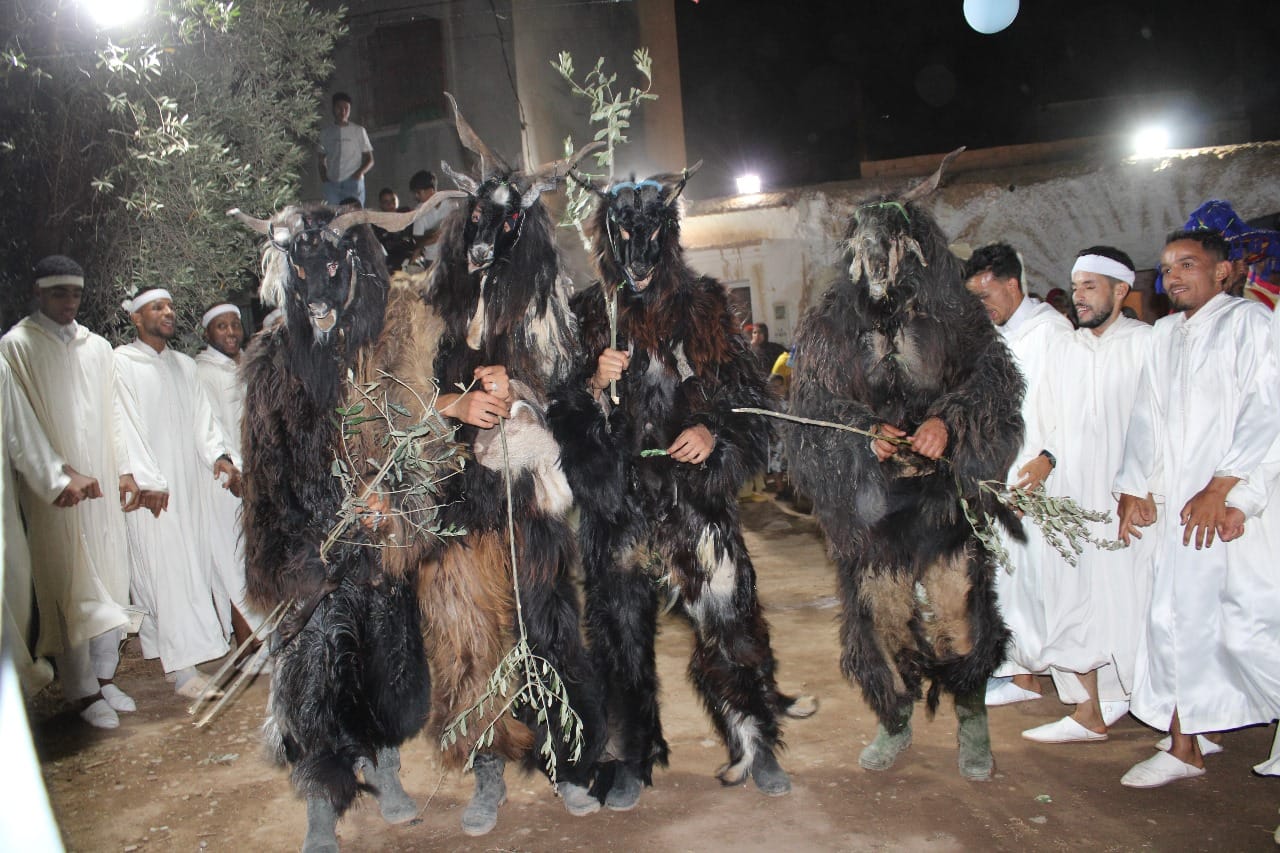
Historians trace the Ahwach dance back to ancient Amazigh rituals connected with fertility, harvest, and protection. The circle formation resembles cosmological symbolism, echoing the cycles of life and the unity of the tribe. The origins of Ahwach dance reach back to pre-Islamic Amazigh society, where music, dance, and oral poetry were central to community life and spirituality. Long before Islam spread across North Africa, Amazigh tribes used rhythmic movements, collective chants, and drum beats as a way to honor nature, celebrate harvests, and strengthen tribal unity. The dance was often tied to seasonal rituals, fertility rites, and even ceremonies of protection, where the circle formation symbolized harmony with the universe and the community’s bond with their land. The use of poetry in Ahwach also reflects the Amazigh oral tradition, serving not only as entertainment but as a means of preserving collective memory, history, and wisdom. This deep-rooted connection to pre-Islamic rituals makes Ahwach more than just a performance—it is a cultural echo of ancient Amazigh spirituality, still visible today in the way the dance blends rhythm, poetry, and symbolism into a communal experience.
This distinction is important because Amazigh cultural history should be studied through evidence rather than romanticized claims about an unchanged tradition surviving for thousands of years.
Integration with Islam
With the arrival of Islam, Ahwach dance absorbed religious poetry and praises for saints (awliya), blending pre-Islamic heritage with spiritual devotion. Thus, Ahwach became a living archive of Amazigh resilience through time.
The spread of Islam across Morocco did not simply eliminate local forms of cultural expression. Instead, communities adapted many aspects of social and artistic life to new religious and cultural circumstances.
Ahwach developed within predominantly Muslim Amazigh communities, and its performance became associated primarily with social occasions rather than being understood simply as a surviving pre-Islamic religious ceremony.
Poetry could address love, community, morality, social relationships, nature, daily life, and other subjects. The tradition therefore demonstrates how cultural practices can evolve while remaining meaningful within changing religious and social environments.
The Symbolism of Ahwach dance
The meaning of Ahwach cannot be reduced to the physical movements of the dancers. Its deeper significance comes from the relationship between people, rhythm, language, space, and collective participation.
The performance creates a temporary social environment in which individuals become part of a larger group. The synchronized movement of performers can visually express unity, while the rhythm establishes a common pulse that connects musicians, singers, dancers, and spectators.
Ahwach can therefore be understood as a form of embodied cultural memory. Knowledge is not only spoken or written; it is learned through participation, listening, movement, repetition, and observation.
The Circle Formation
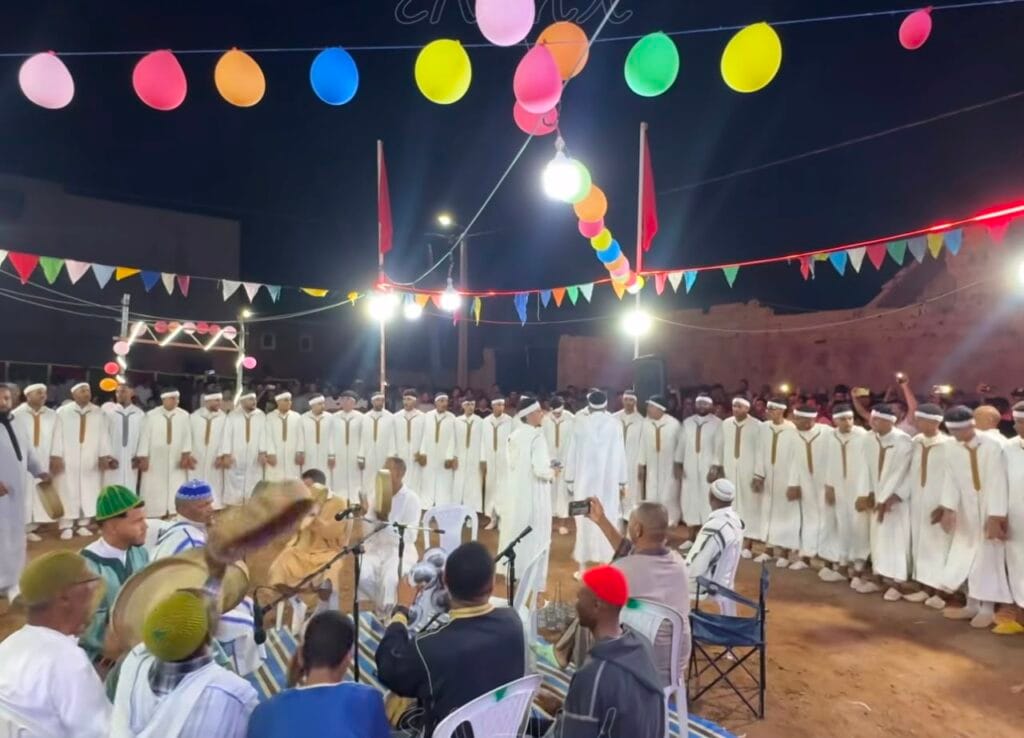
One of the most recognizable features of the Ahwach dance is the formation of performers into lines, semicircles, or circular arrangements. The precise formation varies according to the local style and performance context.
The arrangement is significant because it emphasizes collective participation rather than placing a single performer at the center of attention. Participants move and respond to one another while maintaining a shared rhythm.
The performance space itself can become important. Traditional Ahwach may take place in communal village spaces, where the distinction between performer and audience can be less rigid than in a modern theater.
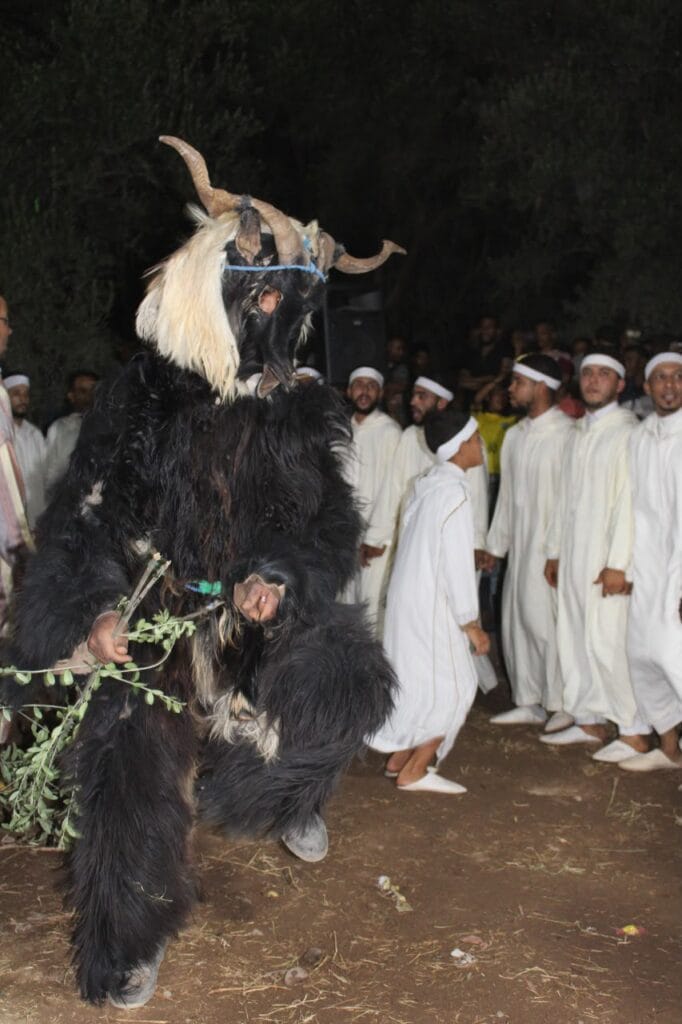
Ahwach dance performers — often 20 to 200 people — stand in semicircles or full circles, symbolizing unity, protection, and equality. In Amazigh cosmology, the circle is sacred, representing the sun, continuity, and tribal solidarity.
The Instruments: Bendir and N’qous
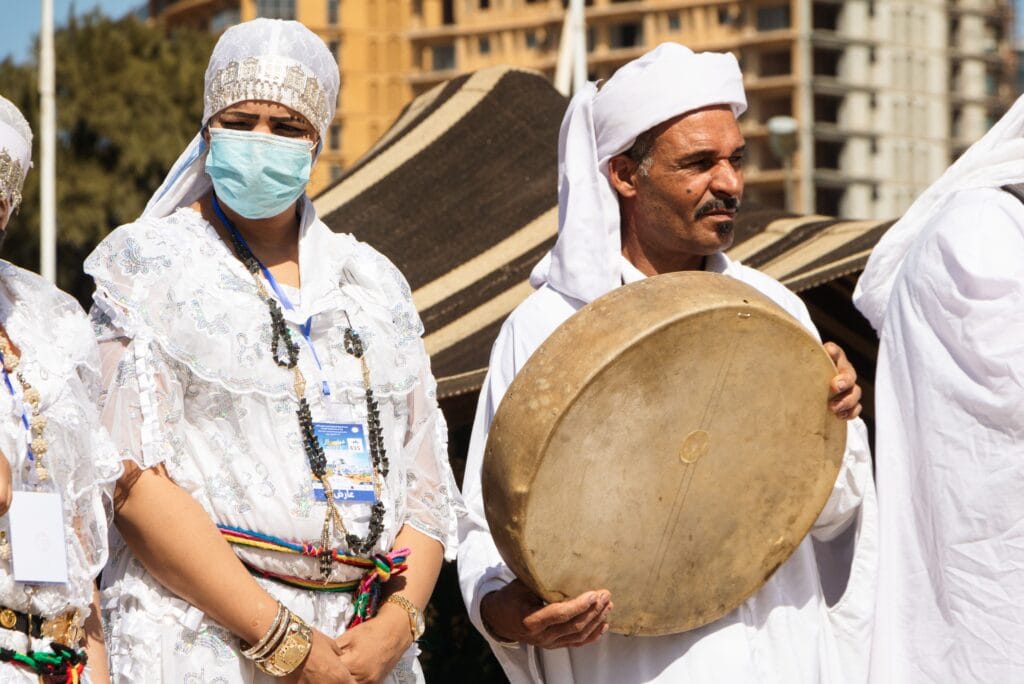
Rhythm is the foundation of Ahwach dance. Traditional performances rely heavily on percussion, particularly frame drums and other locally used rhythmic instruments. The bendir is one of the instruments commonly associated with Moroccan Amazigh musical traditions, while smaller percussion instruments can reinforce the rhythm.
The instruments do more than accompany the dancers. Their rhythm establishes the structure of the performance and helps coordinate collective movement.
In a traditional setting, the sound of percussion can carry across a village or open gathering space, announcing that a communal celebration has begun.
- Bendir (بندير): A large frame drum that provides the heartbeat of the performance.
- N’qous: A metallic percussion instrument adding sharp rhythm.
Together, they represent earth and fire — grounding the dancers in both material and spiritual worlds.
Call-and-Response Poetry (Amarg)
One of the most intellectually rich dimensions of the Ahwach dance is its relationship with Amazigh oral poetry.
Poetic expression can involve exchanges between performers, responses, improvisation, and carefully constructed verses. The precise structure varies between local traditions, but the broader principle is that poetry becomes part of a collective performance rather than remaining an isolated literary form.
The concept of amarg is particularly important in Amazigh cultural studies because poetry and music have historically provided ways to preserve memory, express emotions, comment on social relationships, and communicate ideas.
This oral dimension makes Ahwach more than dance. It is simultaneously a musical, poetic, and social practice.
Poets improvise verses that the chorus repeats. Themes include:
- Love and longing
- Nature and mountains
- Heroism and resistance
- Spiritual devotion
This oral tradition preserves Amazigh history and worldview.
Ahwach dance and the Life of the Souss Village
Historically, Ahwach was closely connected to community life. A performance could bring together people who normally occupied different roles within the village and create an occasion for social interaction.
Celebrations such as weddings and local festivities could provide important opportunities for Ahwach. The performance could accompany moments of joy, strengthen social relationships, and create a shared public experience.
This community dimension helps explain why Ahwach cannot be fully understood by watching a short performance online. The meaning of the tradition also lies in who participates, why they gather, where the performance takes place, and what relationships are created through it.
Anthropology of Ahwach
From an anthropological perspective, Ahwach offers an important window into Amazigh social life. It demonstrates how performance can function simultaneously as entertainment, communication, education, memory, and identity.
Rather than separating music from society, an anthropological approach asks what the performance does for the community. Who participates? Who creates the poetry? How are performers organized? What occasions call for Ahwach? How have these practices changed over time?
Recent scholarship particularly emphasizes that Ahwach is not a frozen tradition. Researchers have documented its transformation through migration, urbanization, associations, festivals, media, and staged performances.
Gender and Participation
Women and men can both have important roles in Ahwach, although participation and performance arrangements vary according to the local tradition.
Research on Ahwach Ntfrkhin, for example, highlights the importance of women’s poetic and performative expression within a Souss context. One study argues that this form can provide women with a space for expression and social participation.
It is therefore better to avoid describing Ahwach as exclusively male or exclusively female. Its gender dynamics are diverse and should be understood within their particular regional and social contexts.
Contrary to stereotypes, women often lead chants, while men provide rhythm and movement. This shows Amazigh society’s complementary gender roles rooted in cooperation, not separation.
Collective Identity
Perhaps the most important social dimension of Ahwach is its ability to create a sense of collective identity.
Participants must listen to one another, maintain rhythm, coordinate movement, and respond to poetic or musical cues. The performance therefore requires cooperation.
In this sense, Ahwach does not merely represent community—it actively produces a temporary experience of community.
Oral Heritage
Amazigh oral traditions have historically played an important role in preserving knowledge and cultural memory. Poetry, songs, stories, and performance allow ideas to travel from one generation to another without depending entirely on written archives.
Ahwach contributes to this process by combining words with rhythm and movement. A poem heard during a performance can be remembered not only through its language but also through the melody, rhythm, gestures, and social context in which it was performed.
Each Ahwach chant is an unwritten history book. Through metaphors and allegories, it transmits ancestral wisdom, tribal history, and moral lessons across generations.
Ahwach Dance Across the Souss and Southern Morocco
Although this article focuses on the Souss Valley, Ahwach should not be treated as a single standardized performance found everywhere in exactly the same form.
Researchers have identified local names and forms associated with Ahwach, while studies also document traditions extending through parts of the High Atlas, Anti-Atlas, and southern Moroccan regions. A recent study, for example, describes Ahwach as a generic designation covering several local forms and names.
This regional diversity is one of the tradition’s greatest strengths. Each community can preserve its own rhythms, poetic conventions, costumes, instruments, movements, and performance structures.
For visitors, this means that experiencing Ahwach in one village does not necessarily represent the entire tradition.
Ahwach in Contemporary Morocco
Ahwach has not disappeared with modernization. Instead, it has entered new spaces.
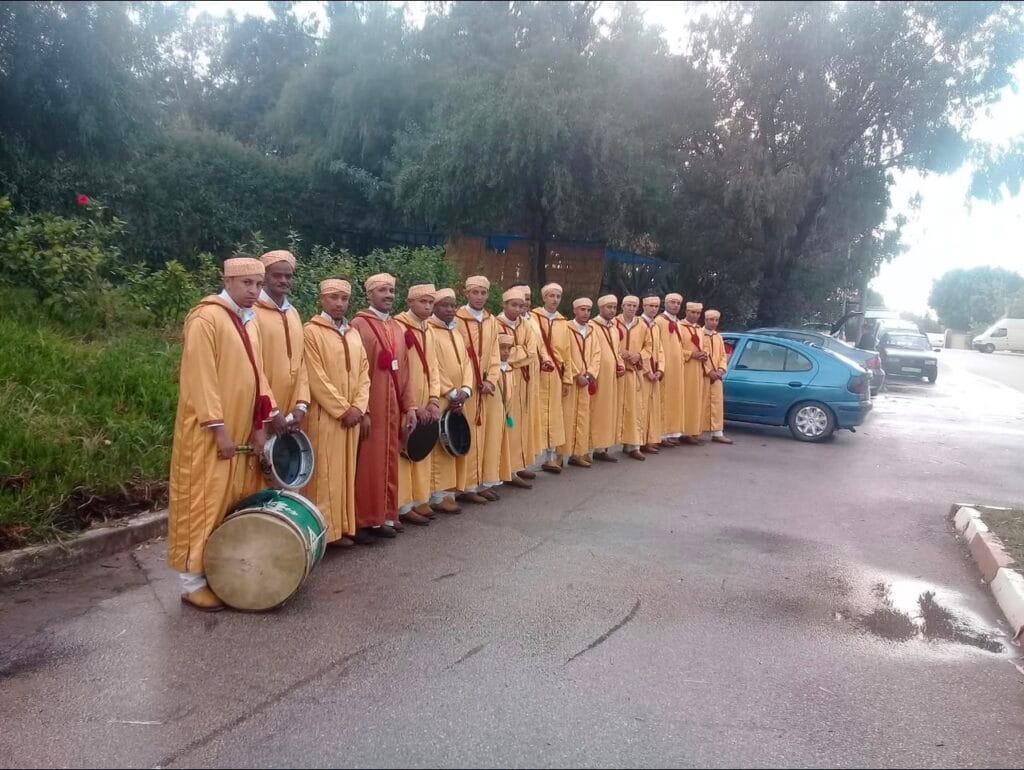
Traditional village performances now exist alongside cultural festivals, associations, recordings, social media, tourism events, and performances on formal stages. This transition has created new opportunities for visibility while also raising questions about authenticity, commercialization, and cultural ownership.
Research on Ahwach in Casablanca shows how migration and urbanization can transform a village-based practice while allowing performers to maintain and renegotiate Amazigh identity in a new environment.
The result is not simply a choice between “traditional” and “modern.” Ahwach is continually being adapted by the people who practice it.
- Cultural festivals: From Toubkal villages to large cities, Ahwach is performed as a symbol of Amazigh pride.
- Tourism and heritage: Ahwach groups are invited to represent Morocco’s intangible heritage in festivals worldwide.
- Resistance and identity: For Amazigh activists, Ahwach is not just folklore — it is a symbol of cultural survival in the face of arabisation and globalization.
Experiencing Ahwach dance as a Visitor
Ahwach matters because it demonstrates that cultural heritage is not simply something preserved in old buildings or historical documents. It can live through voices, rhythms, movements, poetry, and collective participation.
Its continued practice also provides an important connection between generations. Younger performers can learn from older musicians and poets while adapting the tradition to contemporary realities.
For travelers interested in Moroccan culture, Ahwach can offer an opportunity to encounter Amazigh heritage through living performance rather than through museum displays alone.
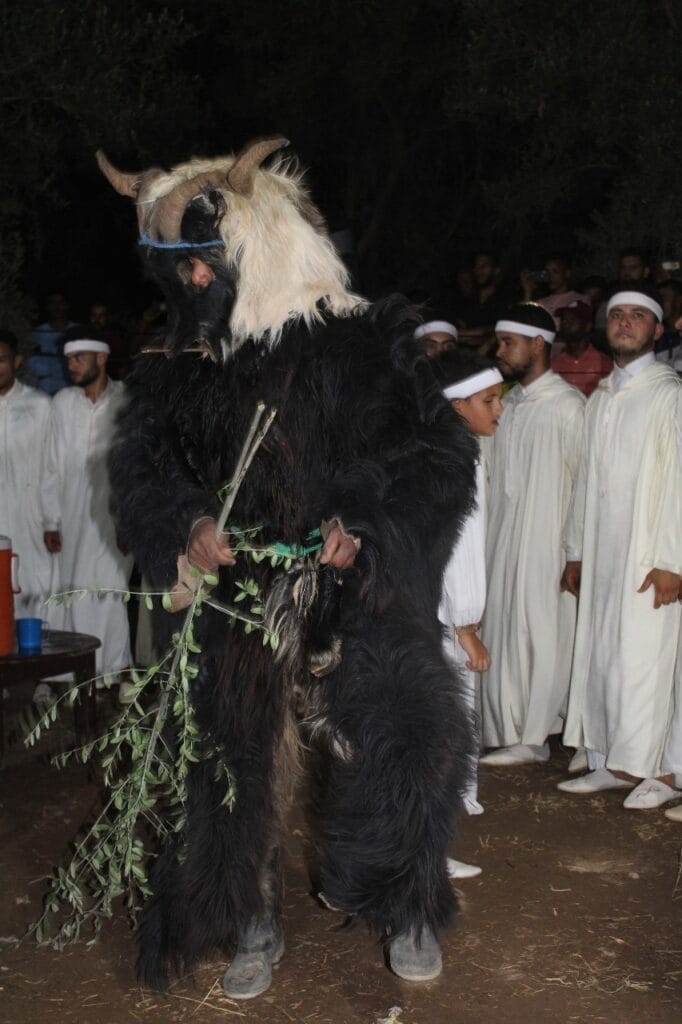
However, visitors should remember that Ahwach is first and foremost a community tradition. A performance created specifically for tourists is not necessarily identical to one taking place within a village celebration.
Morocco’s broader intangible-heritage framework increasingly recognizes the importance of safeguarding living cultural practices. UNESCO currently lists several Moroccan traditions, including Gnawa, Tbourida, argan-related knowledge, and Taskiwin, while Ahwach itself should not be described as a UNESCO-inscribed element.
The most respectful approach is to observe local customs, ask permission before photographing people, avoid interrupting performers, and recognize that clothing, poetry, music, and performance spaces may have meanings that are not immediately obvious to an outside observer.
Why Ahwach Matters Today
Ahwach dance matters today because it continues to serve as a living bridge between Amazigh communities and their ancestral heritage, while also adapting to the rhythms of modern life. In a world that often pushes people toward individualism, Ahwach reminds you of the strength of unity, where voices, drums, and steps merge into one shared heartbeat. It is not just a performance for tourists or festivals—it is a form of cultural resistance that preserves Tamazight identity, oral poetry, and collective memory in the face of globalization. At the same time, Ahwach has gained new meaning as a symbol of Moroccan diversity and pride, inspiring younger generations to reconnect with their roots while sharing this heritage with the world. Its survival and revival show that traditions can remain relevant, offering both joy and belonging to those who witness or participate in it.
- Cultural continuity: A practice that links modern Amazighs with their ancestors.
- Social glue: Strengthening unity during weddings, moussems, and community events.
- Artistic heritage: Recognized by anthropologists as one of North Africa’s richest collective arts.
FAQs About Ahwach Dance
1. What is Ahwach dance?
Ahwach dance is a traditional Amazigh collective performance from southern Morocco, particularly associated with the Souss, High Atlas, and Anti-Atlas regions. It combines synchronized movement, percussion, singing, and poetry. More than a dance, Ahwach functions as a form of communal artistic expression and oral heritage.
2. Where does Ahwach dance come from?
The Ahwach dance is strongly associated with Amazigh communities in southern Morocco, especially inTachelhit-speaking areas of the Souss and Atlas regions. Its exact historical origin cannot be established with certainty because much of its transmission has been oral rather than documented in written sources. Different villages consequently developed their own local forms and performance styles.
3. What does Ahwach mean in Amazigh culture?
Ahwach represents collective identity, social cohesion, artistic expression, and the transmission of oral knowledge. Through poetry, rhythm, and coordinated movement, communities express ideas about love, everyday life, social relationships, spirituality, and important communal events. Its meaning therefore extends far beyond entertainment.
4. Is Ahwach a dance or a musical performance?
Ahwach is best understood as a collective performance tradition rather than simply a dance. It brings together dance, singing, poetry, percussion, and choreographed group movement. The balance between these elements varies considerably from one region or village to another.
5. In which regions of Morocco is Ahwach performed?
Ahwach is particularly associated with the Souss, High Atlas, and Anti-Atlas regions of southern Morocco. Local forms can also be found farther toward southeastern and Saharan areas. Because Ahwach developed within individual communities, its rhythms, choreography, poetry, and organization can differ from one locality to another.
6. What instruments are used in Ahwach dance?
Percussion is central to Ahwach, with frame drums such as the bendir playing an important rhythmic role. Some regional forms also use instruments such as the naqus and other traditional drums or percussion instruments. The exact combination depends on the local tradition and type of Ahwach being performed.
7. Why do Ahwach dancers form a circle or line?
The collective formation emphasizes unity and coordination rather than individual performance. Participants move and respond to the rhythm as a group, creating a strong visual representation of communal solidarity. However, formations are not identical everywhere, and some local traditions use lines, semicircles, or different arrangements.
8. Is Ahwach performed by men and women?
Yes. Many forms of Ahwach involve both men and women, although some performances are traditionally organized exclusively for women or exclusively for men. The precise arrangement depends on the community, occasion, and regional tradition.
9. What occasions are associated with Ahwach?
Ahwach is traditionally performed during important community celebrations, including weddings, harvest celebrations, circumcisions, festivals, and occasions welcoming guests. It can also provide a space for collective social interaction and artistic expression. In this sense, the performance is closely connected to the rhythm of community life.
10. What role does poetry play in Ahwach?
Poetry is one of the defining elements of Ahwach. Performers may use poetic dialogue and call-and-response structures to express emotions, social observations, memories, ideas, and reflections on community life. This oral poetry also contributes to the transmission of cultural knowledge between generations.
11. Is Ahwach an ancient Amazigh dance?
Ahwach has deep roots in the oral traditions of Amazigh communities, but it is difficult to assign it a precise ancient date. Claims that it is directly unchanged from a specific pre-Islamic ritual should therefore be treated cautiously because the historical evidence is limited. What can be established more confidently is its long-standing place within the cultural life of southern Moroccan communities.
12. What is the difference between Ahwach and Ahidous?
Ahwach and Ahidous are both Amazigh collective performance traditions, but they belong primarily to different regional cultural contexts and have distinct musical and choreographic structures. Ahwach is especially associated with southern Morocco, the Souss, High Atlas, and Anti-Atlas, while Ahidous is strongly associated with the Middle Atlas. Their formations, rhythms, poetry, and performance practices should not be treated as identical.
13. Is Ahwach still practiced in Morocco today?
Yes. Ahwach remains a living tradition, particularly in rural communities of southern Morocco, while also appearing at cultural festivals and heritage events. Contemporary performances provide opportunities for younger generations to learn and continue the tradition, although changes in rural life and the loss of experienced practitioners create challenges for transmission.
14. Is Ahwach recognized by UNESCO?
Ahwach is an important element of Morocco’s intangible cultural heritage, but Ahwach itself is not currently inscribed on UNESCO’s Representative List of the Intangible Cultural Heritage of Humanity. This should not be confused with Taskiwin, another Amazigh performance tradition from Morocco that UNESCO inscribed in 2017.
15. Why is Ahwach important to Amazigh heritage?
Ahwach preserves much more than music and dance: it carries poetry, collective memory, social values, local identity, and knowledge transmitted through performance. Because much of this heritage has historically been passed from one generation to another orally and through practice, Ahwach provides an important window into the cultural history of southern Moroccan Amazigh communities.
Conclusion
Ahwach (أحواش) is not only a dance — it is a philosophy of life, blending rhythm, poetry, and unity. It reflects the heart of Amazigh identity: rooted in community, nature, and resilience.
Ahwach dance is one of the most expressive forms of Amazigh cultural heritage in the Souss Valley. Through rhythm, poetry, movement, and collective participation, it connects community life with cultural memory.
Its history cannot be reduced to a single origin story, nor can every local performance be treated as identical. Ahwach is a diverse and evolving tradition whose meaning continues to change as communities adapt it to contemporary Morocco.
For the Souss Valley, however, its central message remains powerful: heritage lives when people continue to perform, remember, and transmit it.
For those who witness it, Ahwach is more than performance; it is a journey into the living memory of Morocco’s indigenous people.
Sources and Further Reading
This article draws on academic research, institutional documentation, and cultural heritage resources to examine Ahwach dance as a living Amazigh tradition of southern Morocco. Because Ahwach varies between communities, regions, and performance groups, no single description can represent every local form. Readers interested in deeper research should therefore consult both scholarly studies and community-based documentation, particularly research concerning the Souss, High Atlas, and Anti-Atlas regions.
References
Academic and Institutional References
Bara, A. (2025). رقصة أحواش إسمݣان في المشهد الثقافي المغربي [Ahwach Ismkan dance in the Moroccan cultural landscape]. Revue de LaRSLAME: Société, Langage, Art, Médias et Éducation. https://doi.org/10.34874/IMIST.PRSM/larslam-i12.59318
Chadli, M. (2023, April 27). The Ahwach dance in Aoulouz, Taroudant. High Atlas Foundation.
UNESCO. (n.d.). Morocco: Intangible Cultural Heritage. UNESCO Intangible Cultural Heritage.
UNESCO. (2017). Taskiwin, martial dance of the western High Atlas. UNESCO Intangible Cultural Heritage.
UNESCO. (n.d.). Morocco: Elements on the Lists of Intangible Cultural Heritage. UNESCO.
High Atlas Foundation. (2023). The Ahwach dance in Aoulouz, Taroudant. High Atlas Foundation, Dakira Cultural Program.
Suggested scholarly background
Brett, M., & Fentress, E. (1996). The Berbers. Blackwell.
Chaker, S. (1992). Imazighen ass-a: Berbères dans le monde contemporain. Éditions Bouchène.
Hart, D. M. (1984). The Aith Waryaghar of the Moroccan Rif: An Ethnography and History. University of Arizona Press.
Hoffman, K. E. (2008). We Share Walls: Language, Land, and Gender in Berber Morocco. Wiley-Blackwell.
Rachik, H. (1992). Sacred Pastures: The Political and Religious Organization of an Amazigh Community. University of Wisconsin.