Crochet in Moroccan and Amazigh Culture: Women, Craft, and Identity
Introduction: When a Single Hook Becomes a Language of the Hands
A ball of yarn and a small hook may appear simple. Yet in the hands of an experienced maker, they can become much more than materials and tools. A loop becomes another loop; one stitch becomes a row; a row becomes a surface; and that surface gradually becomes something useful, beautiful, intimate, and sometimes economically valuable.
This is one of the quiet powers of crochet.
Unlike monumental architecture, silver jewelry, or large woven carpets, crochet often begins with almost nothing that appears extraordinary: thread, yarn, a hook, patience, and practiced fingers. Its finished objects can be small enough to fit in a hand, yet the knowledge required to produce them can represent years of observation, repetition, correction, and informal teaching.
In Morocco, crochet exists within a much larger world of women’s textile and handicraft production. It can be found alongside sewing, embroidery, knitting, lace-like techniques, and traditional weaving. In some communities, women have used crochet for household decoration, clothing, accessories, caps, bags, decorative borders, and other objects. Contemporary Moroccan artisans and designers have also transformed crochet into commercially successful products, demonstrating that a domestic technique can move from the household into workshops, cooperatives, markets, tourism, and international design.
At the same time, an important distinction must be made.
Crochet and weaving are not the same craft.
Morocco possesses a particularly deep history of weaving, especially among Amazigh communities. Anthropological research has documented women’s production of carpets, blankets, clothing, and other textiles and has shown how woven objects can carry social, aesthetic, economic, and identity-related meanings. Cynthia Becker’s research among the Ait Khabbash, for example, demonstrates the importance of women’s textile production in the construction and expression of Amazigh identity.
Crochet belongs to a different technical genealogy. Modern crochet as a clearly identifiable textile technique becomes especially visible in European sources during the nineteenth century, although earlier looped techniques and hooked forms complicate any simple story of a single “invention.” Textile historian Cary Karp has shown that earlier printed sources did not always distinguish between what we now classify as knitting and crochet, making the history of the technique more complicated than the familiar claim that crochet simply appeared at one precise moment.
This matters when discussing Morocco.
Rather than inventing an ancient “Berber origin” for crochet, a historically responsible approach is to examine how Moroccan women incorporated a relatively modern textile technique into older systems of domestic knowledge, aesthetic judgment, women’s sociability, clothing, household production, and craft entrepreneurship.
That story is fascinating precisely because it is not a story of cultural isolation.
It is a story of adaptation.
Moroccan culture has never been a static museum object. It has continuously absorbed, transformed, reinterpreted, and localized materials, techniques, languages, designs, and technologies. Crochet provides a small but revealing example of this larger process.
For Amazigh communities, this question becomes particularly interesting because women have historically been central producers of material culture. Anthropological scholarship has demonstrated how textiles and other forms of women’s artistic production can participate in the construction of identity, social relationships, memory, gender roles, and economic life.
The hook, therefore, deserves attention not because every crochet stitch is necessarily an ancient symbol, but because the act of making can become part of a living cultural environment.
This article explores that environment in depth: the history of crochet, its technical logic, its presence in Morocco, its relationship with Amazigh women’s craft traditions, the question of symbolism, the role of women, contemporary Moroccan crochet, patterns and aesthetics, economic opportunities, and—most importantly—the fundamental difference between crochet and weaving.
Table of Contents
What Exactly Is Crochet?
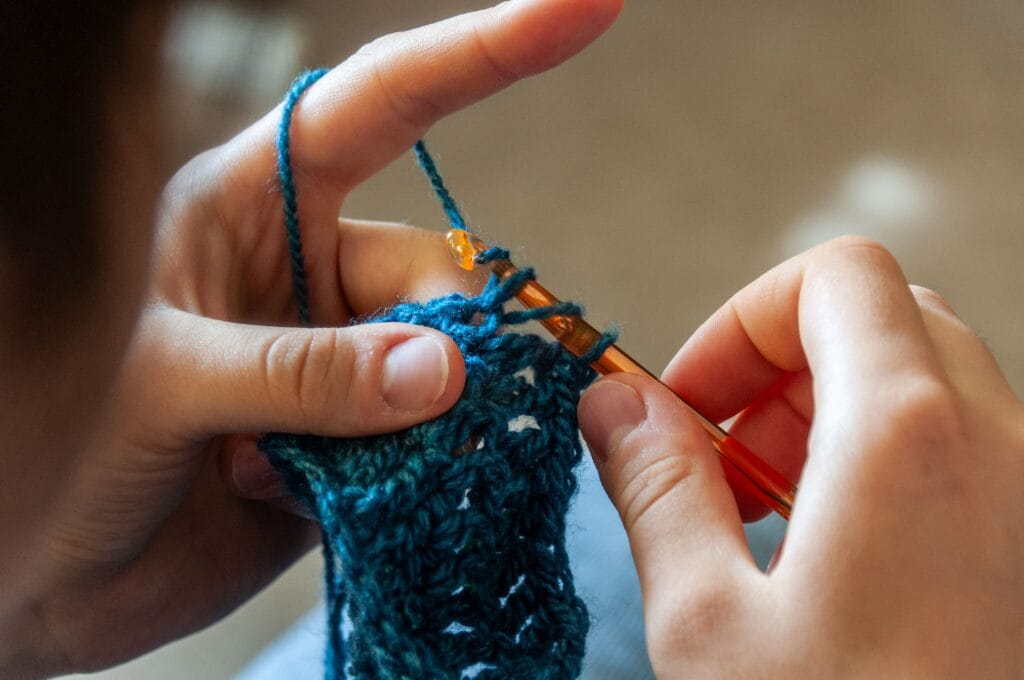
Crochet is a textile-making technique in which yarn, thread, or another flexible material is manipulated with a single hooked tool to create interconnected loops.
The essential principle is surprisingly simple.
A loop is placed on the hook. Yarn is drawn through that loop or through another group of loops. The maker repeats the movement, building a chain, row, motif, or three-dimensional structure.
From these basic actions, an enormous variety of structures can emerge.
Crochet can produce:
- chains;
- dense fabrics;
- open mesh;
- lace-like surfaces;
- circular motifs;
- geometric forms;
- flowers;
- borders;
- bags;
- clothing;
- household decorations;
- accessories;
- sculptural objects;
- and three-dimensional forms.
Its flexibility is one reason the technique has travelled so successfully between cultures.
A person does not need a large loom, a permanent workshop, or an elaborate mechanical apparatus to crochet. A hook can be carried in a pocket, yarn can be stored in a small basket, and work can be stopped and resumed almost anywhere.
That portability is socially important.
Traditional textile production often depends on a particular spatial arrangement. A loom occupies space. Preparing warp threads requires organization. Large carpets may take considerable time and physical effort.
Crochet can be considerably more mobile.
A woman can work while sitting with relatives, travelling, waiting, talking, or carrying out other domestic activities. The technique can therefore fit into forms of everyday life in which time is divided among numerous responsibilities.
This does not mean crochet is inherently “women’s work” everywhere. Nor should all Moroccan women be treated as belonging to a single craft tradition.
Rather, gendered craft practices must be studied locally.
Anthropological research on Amazigh Morocco repeatedly demonstrates the importance of examining what women actually do in particular communities rather than assuming that every Amazigh group shares identical customs. Katherine E. Hoffman’s ethnographic work, for example, shows how women’s everyday labor, language, social relationships, and changing economic circumstances interact in rural Moroccan communities.
Crochet can be understood through the same principle.
The question is not simply:
“Is crochet an Amazigh craft?”
A more useful academic question is:
“How has crochet been incorporated into particular Moroccan and Amazigh women’s craft environments, and what meanings and uses have developed around it?”
That question allows the evidence to speak rather than forcing modern crochet into an inaccurately ancient narrative.
The History of Crochet: An Old-Looking Craft With a Complicated Past
Why the History Is Difficult to Date
One of the most persistent problems in popular craft writing is the assumption that every traditional-looking technique must have existed unchanged for thousands of years.
Crochet demonstrates why that assumption is dangerous.
A loop made with a hooked tool is an extremely simple technological idea. Similar looping structures can be produced using different tools and methods. Consequently, identifying the precise “first crochet” is much more difficult than identifying the appearance of a named modern craft tradition.
Textile historian Cary Karp argues that historical classification itself creates part of the problem. Before the nineteenth century, written textile sources did not consistently distinguish between structures that modern researchers would classify as knitting and crochet. Instructions involving a single hook can therefore provide clues to earlier crochet-like practices, even when historical authors used different terminology.
This is a valuable methodological lesson.
The absence of the word “crochet” does not automatically prove that no related technique existed.
But the presence of a looped textile also does not automatically prove that it was crochet.
Researchers must examine:
- the tool;
- the structure;
- the production method;
- the date;
- the geographical context;
- the terminology;
- and the documentary evidence.
That is particularly important when connecting European textile history with North African craft traditions.
Crochet Becomes Clearly Visible in the Nineteenth Century
The history of modern crochet becomes much easier to trace during the nineteenth century.
Printed instructions, pattern books, textile publications, and commercial production helped standardize the technique and spread it among different social groups.
Irish crochet became particularly significant during the nineteenth century. It developed partly through the adaptation of lace aesthetics into a more accessible production method. Irish crochet could imitate expensive lace while requiring comparatively inexpensive materials and a relatively portable technique.
This history is important because it demonstrates that crochet has always been more than a purely technical practice.
It has been connected with:
- class;
- fashion;
- household production;
- women’s labor;
- commercial markets;
- imitation;
- adaptation;
- and economic survival.
Those themes later become relevant when considering Moroccan crochet.
How Crochet Entered Moroccan Textile Life
The history of crochet in Morocco should not be reduced to a single date or a single person who supposedly “introduced” it.
Morocco has long been connected to multiple commercial, cultural, educational, and colonial networks linking North Africa with Europe, the Mediterranean, the Middle East, and sub-Saharan Africa.
Textile techniques could travel through:
- trade;
- schools;
- domestic instruction;
- magazines;
- imported clothing;
- missionaries and charitable institutions;
- urban workshops;
- family networks;
- migration;
- tourism;
- and later television and the internet.
Once a technique becomes locally useful, its origin may become less important than the way communities transform it.
This is a recurring pattern in material culture.
A technique may arrive from elsewhere but become culturally Moroccan through its use, materials, vocabulary, forms, colors, and social context.
This distinction is essential.
Calling crochet a “foreign technique” does not mean Moroccan crochet lacks cultural authenticity.
Cultures continually localize technologies.
The same principle can be seen with:
- photography;
- printing;
- sewing machines;
- modern architecture;
- industrial dyes;
- smartphones;
- and digital design.
The fact that a technology has an external historical origin does not prevent local communities from making it their own.
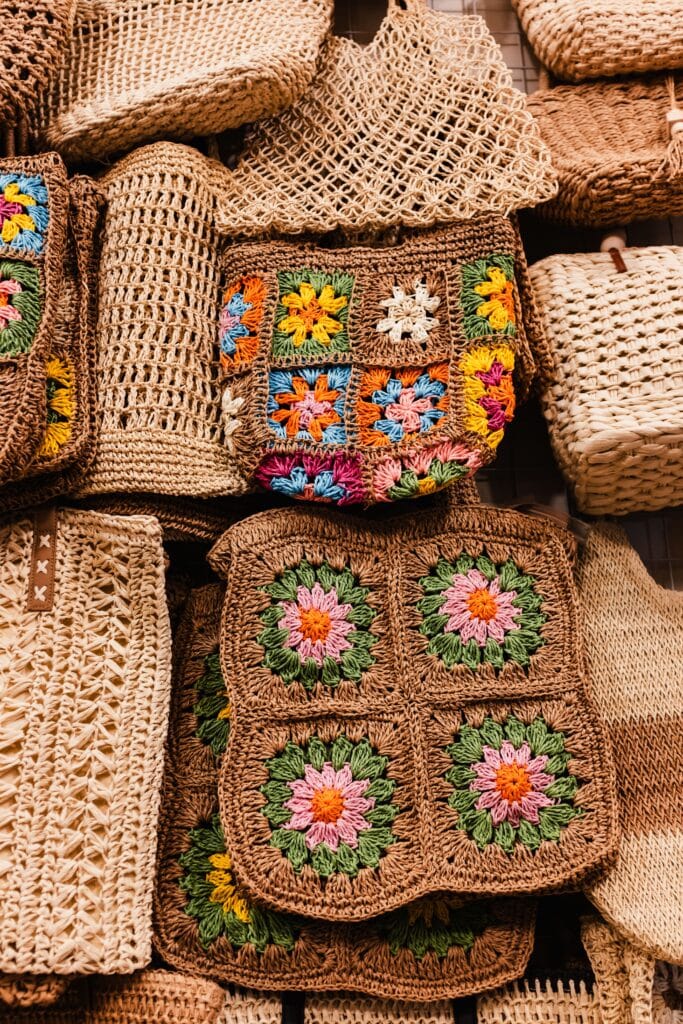
the Amazigh World: What Can We Actually Say?
Avoiding the Myth of an Ancient “Berber Crochet”
The phrase “Berber crochet” is attractive for SEO, but it can become misleading if used without qualification.
There is extensive academic evidence for Amazigh women’s textile production, especially weaving, embroidery, dress, jewelry, and other forms of material culture.
There is much less evidence establishing crochet as an ancient, pan-Amazigh textile tradition.
Therefore, this article uses “Amazigh crocheting” in a more precise sense: crochet practiced by women and artisans within Moroccan communities that may identify as Amazigh or operate in regions with strong Amazigh cultural traditions.
That distinction protects the historical integrity of the subject.
Cynthia Becker’s study of Amazigh arts in southeastern Morocco is particularly useful here. Her research emphasizes that women’s artistic production—including textiles, jewelry, body decoration, and verbal art—played an important role in expressing and negotiating Amazigh identity.
But the fact that weaving is deeply embedded in Amazigh artistic traditions does not mean every textile technique found among Amazigh women is equally ancient.
This is precisely where careful cultural scholarship differs from romanticized heritage writing.
Amazigh Women and the Broader Tradition of Making
To understand Moroccan crochet, it is useful to step back from the hook itself.
The larger story concerns women’s knowledge of materials.
Across many Moroccan communities, women have historically participated in activities involving:
- wool;
- spinning;
- weaving;
- sewing;
- embroidery;
- dyeing;
- clothing construction;
- basketry;
- decorative arts;
- food processing;
- and other forms of domestic production.
The boundaries between “economic activity” and “household work” have often been fluid.
A woman producing a textile for her family might simultaneously be producing something with exchange value.
A garment could be:
- worn;
- gifted;
- sold;
- inherited;
- altered;
- repaired;
- or transformed into another object.
This flexibility is particularly important when analyzing handmade crafts.
A craft should not be evaluated only by its commercial price.
Its value can also be:
- practical;
- emotional;
- social;
- symbolic;
- educational;
- aesthetic;
- familial;
- and historical.
Moroccan anthropological research has repeatedly shown the importance of women’s craft production to identity and social life. Naima Chikhaoui’s work, for example, examines weaving from an anthropology-of-gender perspective and treats textiles as material and immaterial records through which women’s social worlds can be studied.
Crochet belongs to this broader analytical environment even when its technical history differs from that of traditional weaving.
Crochet as Everyday Knowledge
Learning Without a Classroom
One of the most fascinating aspects of handmade crochet is that it can be learned without formal education.
A beginner may learn by:
- watching another woman;
- copying a finished object;
- repeating a stitch;
- counting loops;
- correcting mistakes;
- memorizing sequences;
- or gradually developing visual intuition.
This kind of learning is often described as embodied knowledge.
The knowledge does not exist only in written instructions.
It exists in the hands.
An experienced crocheter may look at a pattern and immediately recognize:
- where the increase belongs;
- how many stitches are needed;
- when the tension is wrong;
- how the yarn will behave;
- and how a finished shape should develop.
That knowledge is difficult to communicate entirely through words.
The Importance of Repetition
Repetition is central to crochet.
The same movement may be performed hundreds or thousands of times.
Yet repetition does not necessarily mean mechanical monotony.
An experienced maker constantly makes small decisions.
She decides:
- how tightly to hold the yarn;
- how strongly to pull the loop;
- whether the fabric is becoming too dense;
- whether the shape is expanding correctly;
- whether a color combination works;
- whether the material needs changing;
- and whether the design should be modified.
The result is a form of practical intelligence.
This is one reason handmade crochet should not be understood simply as “following a pattern.”
The pattern provides a framework.
The artisan provides judgment.
Moroccan Domestic Life
Crochet has been used in Morocco for both functional and decorative purposes.
Examples include:
- household covers;
- tablecloths;
- decorative borders;
- clothing;
- shawls;
- caps;
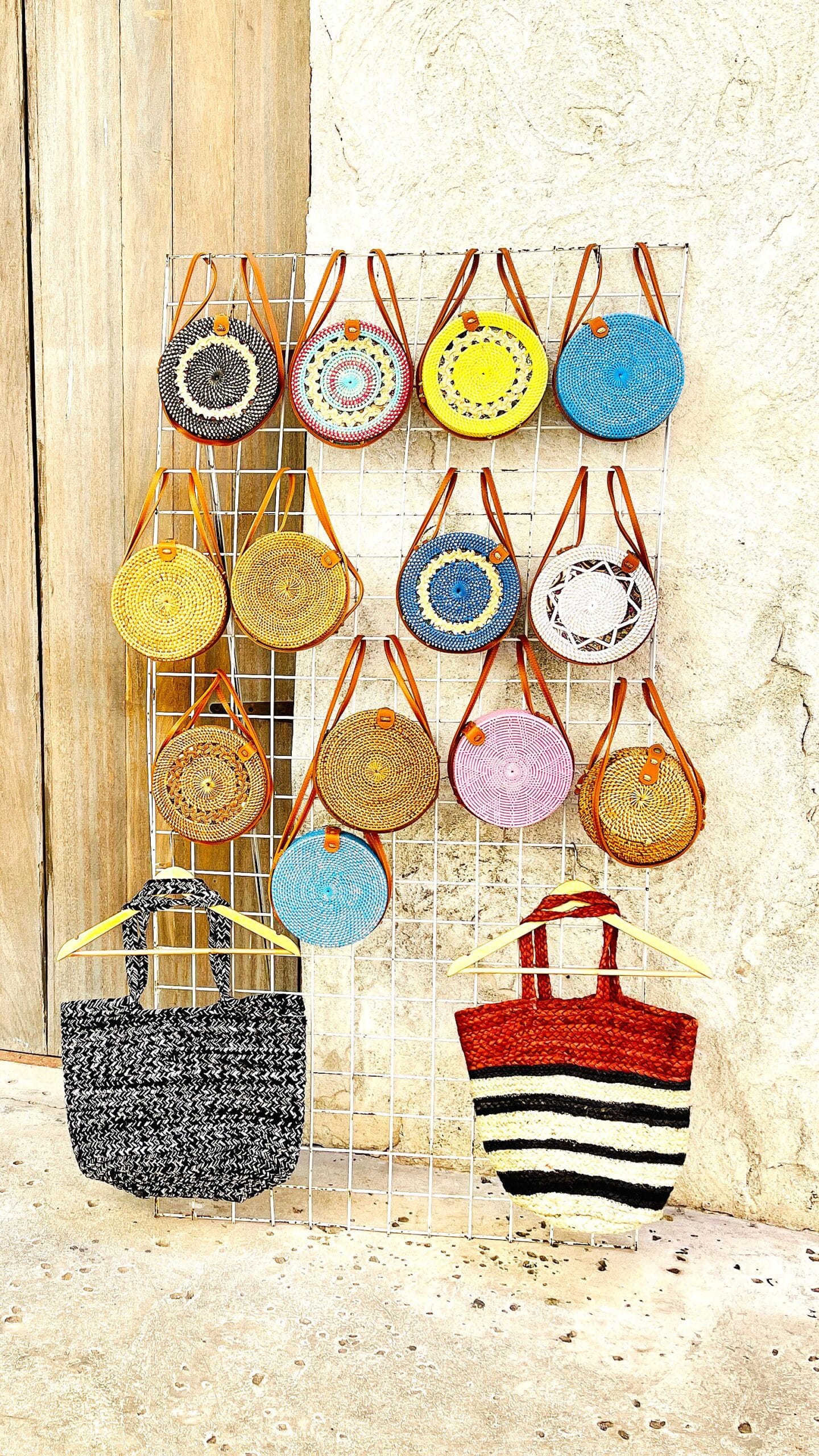
- bags;
- slippers;
- blankets;
- baskets;
- accessories;
- children’s garments;
- and decorative objects.
Contemporary Moroccan crochet also appears in design products that reinterpret the technique for modern interiors and fashion.
Some Moroccan artisans working near Marrakech, for example, produce crochet lighting and contemporary decorative objects, demonstrating how a domestic craft can be transformed into an international design language.
This transformation is culturally significant.
The craft does not disappear when its object changes.
Instead, its function changes.
A technique once used primarily for household purposes can become:
household craft → gift → market product → design object → international commodity
Each stage creates new meanings.
Moroccan and the Rural–Urban Connection
Crochet should not be placed exclusively in rural Morocco.
Its contemporary life crosses the rural–urban divide.
Urban Moroccan craft markets and workshops provide new spaces for handmade crochet, while rural women may continue to produce objects within household or cooperative settings.
The Moroccan Ministry responsible for handicrafts recognizes the broad importance of women’s artisanal production across the country and has established programs such as Dar Sanâa, which provide women artisans with spaces for production, training, exhibition, and commercialization.
This institutional framework matters because it demonstrates a broader transformation in the meaning of women’s handicrafts.
Handmade production is increasingly understood not only as cultural heritage but also as:
- entrepreneurship;
- income generation;
- professional skill;
- rural development;
- tourism;
- and women’s economic participation.
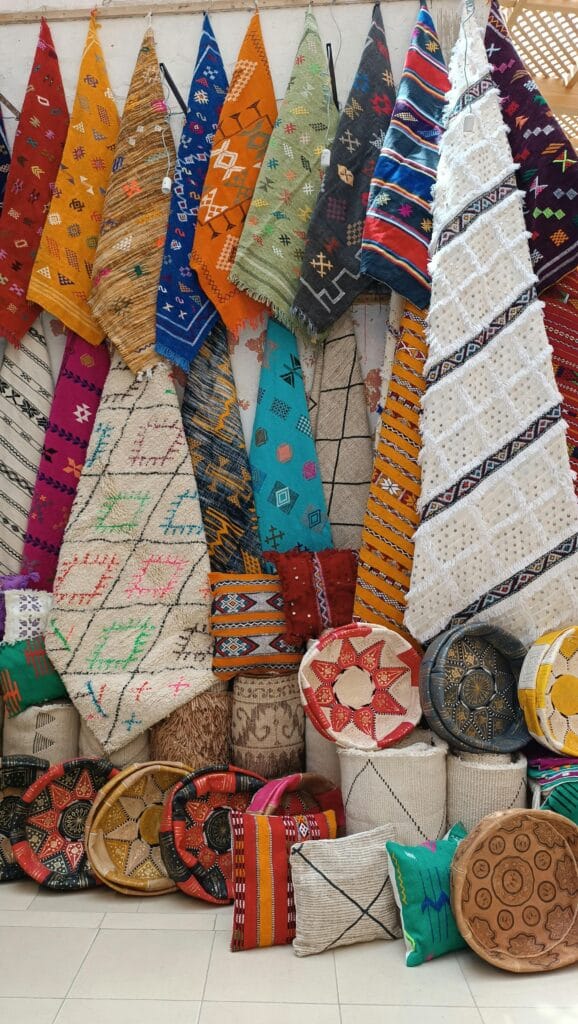
The Difference Between Crochet and Weaving
This is one of the most important sections of the article because crochet is frequently confused with weaving.
They are fundamentally different techniques.
Crochet Uses a Hook
Crochet normally uses a single hook.
The maker builds fabric by pulling yarn through loops.
The fabric grows directly from the active loop being manipulated.
There is no requirement for a loom.
Weaving Uses Intersecting Sets of Threads
Weaving operates according to a different principle.
A woven textile is produced through the interaction of at least two systems of threads:
- the warp, running longitudinally;
- and the weft, passing across it.
These threads intersect according to a particular structure.
Traditional Moroccan and Amazigh weaving therefore involves a technological system fundamentally different from crochet.
Crochet Is Loop Construction
It can be thought of as loop construction.
The hook pulls yarn through existing loops.
This makes crochet particularly adaptable to:
- curved forms;
- three-dimensional objects;
- irregular shapes;
- motifs;
- flowers;
- circles;
- decorative borders;
- and sculptural structures.
Weaving Is Plane Construction
Weaving is especially suited to creating broad textile surfaces.
A loom establishes a field through which threads can be interlaced.
This is why weaving has historically been so important for:
- carpets;
- blankets;
- large textiles;
- tent materials;
- clothing fabrics;
- and household coverings.
Moroccan official craft documentation continues to distinguish weaving as a major artisanal sector with specialized techniques and regional traditions.
Crochet vs. Weaving: A Detailed Comparison
| Feature | Crochet | Traditional Weaving |
|---|---|---|
| Main tool | Hook | Loom |
| Basic action | Pulling loops through loops | Interlacing warp and weft |
| Number of active loops | Usually one active loop | Multiple warp threads and weft |
| Equipment | Small and portable | Usually larger and more spatially demanding |
| Fabric structure | Loop-based | Interlaced |
| Typical flexibility | Highly flexible for shaping | Excellent for planar textiles |
| Curved forms | Relatively easy | More technically complex |
| Large carpets | Possible only through specialized methods, but not traditional crochet’s main domain | Historically central |
| Learning | Often highly portable and informal | Often requires knowledge of loom setup |
| Moroccan/Amazigh documentation | Modern and localized evidence | Extensive historical and ethnographic documentation |
| Cultural symbolism | Depends heavily on object and context | Strongly documented in many Amazigh textile traditions |
| Economic role | Increasingly linked to contemporary handmade markets | Long-established household and commercial role |
| Equipment cost | Generally low | Can require loom and associated equipment |
The difference is not simply a matter of vocabulary.
It is a difference in technology, spatial organization, bodily movement, and textile structure.
Why Crochet Can Complement Rather Than Replace Weaving
It should not be presented as a competitor to Moroccan weaving.
The two techniques can coexist.
A handmade textile may combine:
- woven fabric;
- crochet borders;
- embroidery;
- tassels;
- stitching;
- appliqué;
- and other decorative elements.
Contemporary Moroccan products sometimes deliberately combine techniques to create new aesthetic effects.
This is particularly important for heritage preservation.
Cultural continuity does not necessarily mean reproducing an old object exactly.
Sometimes continuity occurs through combination.
A younger maker may know fewer traditional weaving techniques than her grandmother but may combine crochet, sewing, embroidery, digital design, and social-media marketing to create something that belongs to her own generation.
That is not necessarily cultural disappearance.
It may be cultural transformation.
Moroccan Crochet Patterns: From Simple Loops to Visual Design
Crochet patterns are not merely decorative instructions.
They are systems.
A pattern can determine:
- stitch type;
- repetition;
- direction;
- density;
- shape;
- color sequence;
- and final dimensions.
Common crochet structures include:
- chain stitch;
- single crochet;
- double crochet;
- slip stitch;
- half-double crochet;
- shells;
- clusters;
- mesh;
- circular motifs;
- floral forms;
- geometric repetitions.
The terminology varies according to language and instructional tradition.
Moroccan crocheters may learn through French, Arabic, English, Amazigh, visual demonstrations, or informal vocabulary.
This linguistic diversity is important.
The language used to describe a craft does not necessarily determine the cultural identity of the craft.
A Moroccan woman may learn a crochet technique from a French-language magazine, modify it according to Moroccan aesthetic preferences, and teach it orally to another woman.
The resulting object can become locally meaningful despite the external origin of some terminology.
Why Moroccan Crochet Often Relies on Visual Memory
One fascinating aspect of informal craft learning is the importance of visual memory.
A maker may not know the formal name of a stitch.
She may simply know:
“Do it like this.”
That sentence can contain considerable technical knowledge.
She may recognize a pattern through:
- shape;
- symmetry;
- repetition;
- number of loops;
- texture;
- and color.
This form of knowledge challenges the assumption that written literacy is the only form of expertise.
A woman who cannot read a printed crochet pattern may nevertheless produce a highly complex object by observing and remembering a sample.
This is particularly relevant to anthropological studies of women’s work.
Knowledge is not always stored in books.
Sometimes it is stored in:
hands, eyes, memory, rhythm, and repetition.
The Symbolism of Crochet: What Can We Responsibly Claim?
The phrase “symbolism of crochet” can easily lead to exaggerated claims.
There is no universal symbolic meaning for a crochet stitch.
A flower-shaped crochet motif does not automatically mean fertility.
A triangle does not automatically mean protection.
A particular color does not automatically possess the same meaning in every Moroccan or Amazigh community.
Symbolic interpretation requires context.
Researchers such as Becker have demonstrated that Amazigh women’s artistic motifs can have culturally significant associations, but those meanings must be situated within particular communities and artistic systems rather than converted into a universal dictionary of “Berber symbols.”
This principle should guide the study of crochet.
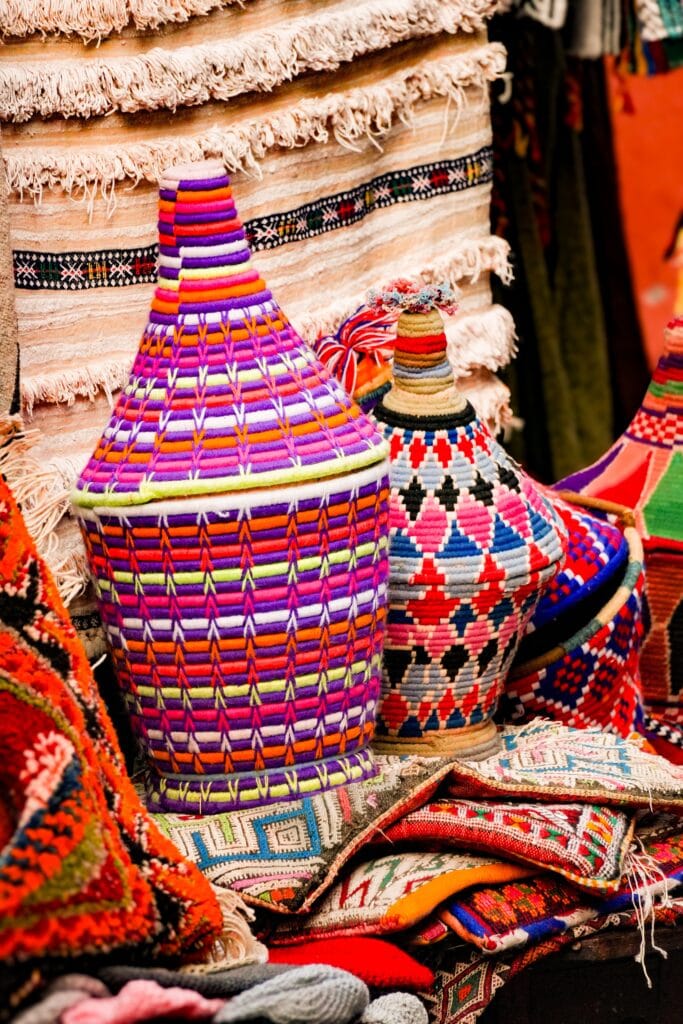
When Crochet Becomes Symbolic
It can acquire symbolic meaning through the object, situation, maker, recipient, and community.
A handmade crochet garment may symbolize:
- affection;
- patience;
- domestic competence;
- care;
- femininity;
- family continuity;
- creativity;
- generosity;
- or economic independence.
But these meanings arise from social context.
The crochet hook itself does not contain a universal symbolic message.
The meaning emerges through use.
This distinction is academically important.
Crochet and Women’s Identity
Women’s textile production has long been an important subject in Amazigh anthropology.
Cynthia Becker’s research among Ait Khabbash communities demonstrates how women’s art can become a visible expression of identity, while other scholarship emphasizes the relationship between women’s everyday work, social networks, language, and community life.
Crochet can participate in similar processes, especially when women create objects for:
- themselves;
- daughters;
- mothers;
- relatives;
- weddings;
- household decoration;
- gifts;
- or commercial sale.
The craft can therefore connect private identity with public identity.
A woman may crochet something inside her home, yet that object may eventually appear:
- at a wedding;
- in a photograph;
- in a market;
- on social media;
- in a tourist shop;
- or in an international design collection.
The boundaries between private and public craft are increasingly porous.
a Social Activity of moroccan handicraft
Handmade crafts can create social spaces.
Women may gather while working.
They can:
- talk;
- exchange advice;
- discuss family events;
- teach younger relatives;
- compare patterns;
- share yarn;
- correct mistakes;
- and evaluate finished objects.
The object being produced becomes secondary to the social environment surrounding production.
This is one reason it is dangerous to analyze handmade crafts only as commodities.
A crocheted object may be worth a modest amount of money while the social relationships created during its production are far more significant.
Anthropology therefore asks not only:
“What is the object?”
but also:
“Who made it, with whom, where, when, and under what social conditions?”
the Transmission of Women’s Knowledge
Traditional knowledge survives through transmission.
But transmission does not always mean perfect repetition.
A grandmother might teach her daughter one technique.
The daughter may teach her daughter another.
The granddaughter may learn from:
- YouTube;
- Instagram;
- TikTok;
- Pinterest;
- online courses;
- WhatsApp groups;
- or international pattern websites.
The learning environment has changed dramatically.
Yet the fundamental structure remains surprisingly familiar:
observe → imitate → practice → modify → teach
Digital media have not necessarily destroyed craft transmission.
In some cases, they have expanded it.
From the Living Room to YouTube
The internet has transformed crochet.
A Moroccan beginner no longer depends entirely on a relative living nearby.
She can watch a video made in:
- Morocco;
- France;
- the United States;
- Turkey;
- Japan;
- Algeria;
- Tunisia;
- or elsewhere.
This creates a new global crochet vocabulary.
The result is an interesting cultural hybrid.
A Moroccan maker might combine:
- a global crochet stitch;
- Moroccan colors;
- Amazigh-inspired geometric aesthetics;
- locally available yarn;
- traditional garment forms;
- and contemporary fashion.
The resulting object cannot be neatly categorized as either “traditional” or “modern.”
It belongs to both worlds.
Amazigh-Inspired Crochet and the Question of Cultural Appropriation
The growing popularity of Amazigh aesthetics raises another important question.
What happens when designers use Amazigh-inspired patterns in crochet products?
There is a difference between:
inspiration, adaptation, documentation, and appropriation.
A designer who studies a motif, acknowledges its regional context, works with artisans, and compensates them fairly is operating differently from a company that copies a community’s visual language, removes its cultural context, and sells the design as an anonymous exotic aesthetic.
This issue is especially important because Amazigh visual culture has often been simplified in global fashion.
A responsible approach should therefore ask:
- Which community does the motif come from?
- Is the attribution accurate?
- Is the motif being reproduced faithfully or merely stereotyped?
- Are artisans involved?
- Are they compensated?
- Is the historical context explained?
- Is the object being marketed as “ancient” without evidence?
These questions should accompany any discussion of “Berber crochet patterns.”
the Idea of Authenticity
Authenticity is one of the most complicated concepts in heritage studies.
A product does not become authentic simply because it looks old.
Nor does a modern object become inauthentic because it uses a technique introduced relatively recently.
Consider a Moroccan woman who creates a contemporary crochet bag using colors inspired by the landscape around her village.
The technique may have a complex international history.
But her creative decision is local.
Her labor is real.
Her aesthetic choices are real.
Her relationship with the object is real.
Authenticity therefore needs to be understood as a relationship between:
people + practice + place + memory + meaning.
It should not be reduced to an imaginary date of origin.
the Context of Moroccan Women’s Economic Life
Handmade crochet can have economic value even when production begins as domestic activity.
A woman may start crocheting for:
- family use;
- pleasure;
- decoration;
- or gifting.
Later she may discover that others are willing to pay for her work.
This can lead to:
- small-scale sales;
- cooperative production;
- craft fairs;
- tourism markets;
- online shops;
- social-media businesses;
- workshops;
- and export opportunities.
Morocco’s handicraft institutions increasingly recognize women’s artisanal production as an important area of economic development. The government describes women’s handicraft activity as widespread across Moroccan regions and supports structures designed to provide production, exhibition, training, and marketing opportunities.
Cooperatives and Collective Entrepreneurship
The cooperative model is especially important in rural Morocco.
A cooperative can help artisans overcome individual limitations involving:
- access to markets;
- equipment;
- training;
- branding;
- packaging;
- transportation;
- digital marketing;
- and customer relationships.
This does not mean cooperatives automatically solve every problem.
They can also face:
- weak market access;
- limited digital skills;
- inconsistent demand;
- unequal management;
- insufficient financing;
- and competition from industrial products.
Nevertheless, collective organization can turn individual domestic skills into a more visible economic activity.
Research on Amazigh women’s agency in Morocco has documented how women involved in craft cooperatives can use traditional skills as resources for economic participation, community development, and cultural recognition.
Rural Development of this art
The relationship between crochet and rural development should not be exaggerated.
Crochet alone cannot transform a rural economy.
But small crafts can contribute to diversified household income.
The value may be especially important when production:
- requires little space;
- uses relatively inexpensive tools;
- can be performed at home;
- allows flexible working hours;
- and can be sold through multiple channels.
These characteristics make crochet potentially suitable for micro-enterprise.
The challenge is ensuring that the maker receives a fair share of the final value.
If an artisan produces a handmade object for a very low price and an intermediary sells it internationally at several times the original price, the existence of an export market does not necessarily mean the artisan has been economically empowered.
Fair compensation matters as much as market access.
Moroccan artisan in Contemporary Design
The contemporary design world has increasingly rediscovered handmade techniques.
Crochet has several qualities that designers find attractive:
- texture;
- flexibility;
- irregularity;
- handmade variation;
- three-dimensionality;
- softness;
- and visible labor.
Moroccan designers can therefore reinterpret crochet without treating it as a museum artifact.
Contemporary Moroccan studios have already demonstrated how crochet can be transformed into lighting, accessories, clothing, and interior objects. Some businesses explicitly work with women artisans near Marrakech to create contemporary crochet products for international markets.
This development illustrates an important principle:
heritage survives when people can still use it.
Sustainable Craft traditions
Crochet is sometimes described as inherently sustainable.
That claim needs qualification.
Handmade production can have environmental advantages, particularly when it:
- uses durable materials;
- avoids mass industrial production;
- repairs existing objects;
- uses recycled yarn;
- produces items on demand;
- and extends product life.
But crochet is not automatically sustainable.
Synthetic fibers such as acrylic and polyester originate largely from fossil-fuel-based systems and can contribute to microfiber pollution.
Therefore, the sustainability of crochet depends on:
- fiber;
- dye;
- production;
- transportation;
- durability;
- repairability;
- and end-of-life disposal.
A responsible Moroccan crochet economy should therefore consider both cultural and environmental sustainability.
Natural Fibers and Moroccan Craft Traditions
Moroccan textile traditions include extensive knowledge of natural fibers.
Amazigh weaving has historically made substantial use of:
- sheep wool;
- goat hair;
- camel hair;
- plant fibers;
- and other locally available materials.
Cynthia Becker’s research among Ait Khabbash communities emphasizes the central place of wool and textile production within women’s artistic practice.
Crochet can connect with this material heritage when contemporary makers choose locally appropriate natural fibers.
But again, we should not automatically call every crochet object made from wool an ancient Amazigh tradition.
The material may have a long local history while the technique may be more recent.
That distinction is crucial.
Why the Distinction Between Technique and Material Matters
Imagine a woman using Moroccan wool to crochet a bag.
The wool may come from an animal raised within a region with centuries of pastoral traditions.
The color may be inspired by the surrounding landscape.
The maker may be Amazigh.
The object may be sold in an Amazigh cultural center.
Yet the crochet technique itself may have entered the local craft environment relatively recently.
The object is therefore a meeting point of different histories.
This is not a weakness.
It is precisely what makes material culture fascinating.
A single object can contain:
ancient materials + modern technique + local identity + global market
That is cultural history in miniature.
Regional Dimensions of Moroccan art
It would be misleading to claim that Moroccan crochet looks identical everywhere.
Morocco contains substantial regional differences in:
- climate;
- materials;
- dress;
- language;
- aesthetic preferences;
- market connections;
- and craft traditions.
Crochet in an urban environment may be influenced by fashion and global design.
Crochet in a rural community may be connected more strongly to household production.
A crochet product sold in Marrakech’s tourist economy may have different commercial expectations from one produced in a village in the Atlas.
Similarly, an Amazigh woman in the High Atlas does not necessarily share the same craft vocabulary as an Amazigh woman in the Anti-Atlas, Rif, Middle Atlas, or southeastern Morocco.
This regional diversity should be preserved rather than flattened into a single concept called “Berber craft.”
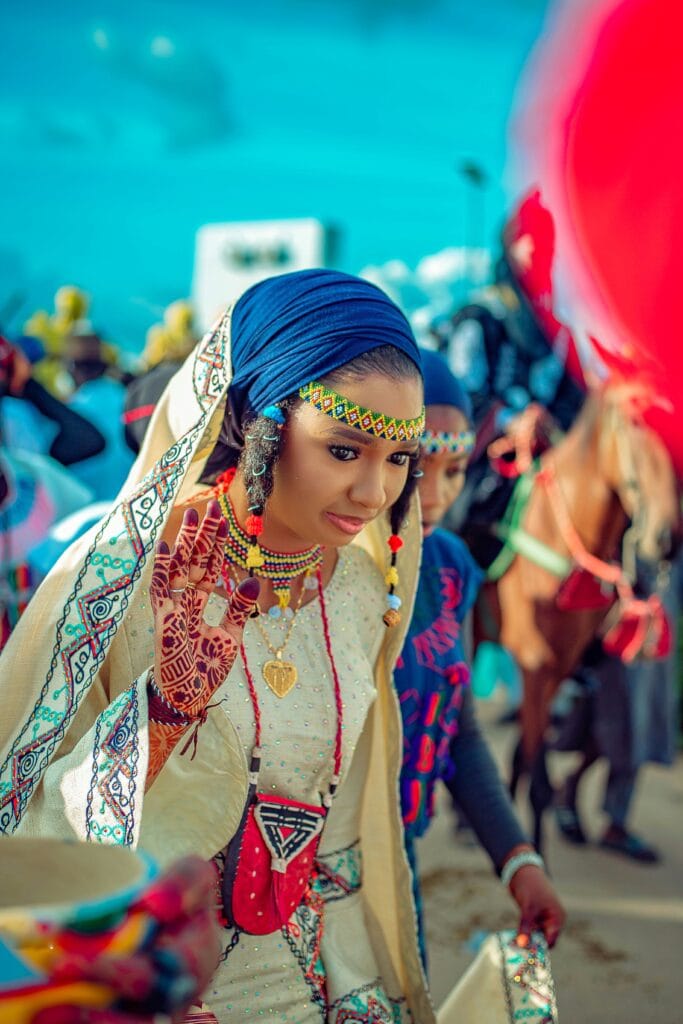
art and the Amazigh Regions of Morocco
High Atlas
The High Atlas contains numerous Amazigh communities with rich traditions of weaving, dress, agriculture, pastoralism, and household production.
The established scholarly evidence is particularly strong for weaving and women’s textile arts.
Crochet should therefore be understood as one possible later addition to a much older textile environment rather than as the foundation of High Atlas textile culture.
Middle Atlas
The Middle Atlas is particularly well known for Amazigh carpet traditions and women’s textile production.
Official Moroccan craft documentation highlights the region’s textile heritage, while Smithsonian documentation has also presented Middle Atlas women producing and preparing wool for weaving.
Crochet can exist within this broader textile environment, but it should not be confused with the region’s historically documented carpet traditions.
Anti-Atlas and Souss
The Anti-Atlas and Souss are home to diverse Amazigh-speaking communities with extensive traditions of clothing, jewelry, weaving, agriculture, and domestic craft.
The Royal Institute of Amazigh Culture has documented scholarly attention to women’s creativity in areas including Anti-Atlas women’s dress, Amazigh weaving, symbolism, and women’s artisanal creativity.
Crochet in these environments should be studied as part of changing women’s material practices rather than automatically described as an ancient regional tradition.
Southeastern Morocco
The southeastern regions provide especially rich evidence for women’s artistic production.
Becker’s work among the Ait Khabbash in the Tafilalet area demonstrates the importance of textiles and other women’s artistic practices in expressing identity and social relationships.
This provides an important comparative framework for understanding how newer techniques such as crochet might become incorporated into existing artistic environments.
Crochet, Clothing, and Moroccan Dress
Crochet can intersect with Moroccan dress in several ways.
It can function as:
- an accessory;
- a decorative border;
- a cap;
- a shawl;
- a garment;
- or an independent fashion object.
In contemporary design, crochet can also be combined with:
- traditional Moroccan textiles;
- leather;
- embroidery;
- beads;
- metal;
- and woven materials.
The result is a layered aesthetic.
Traditional clothing does not have to remain frozen in one historical form.
Moroccan dress has always evolved.
UNESCO’s recent inscription of Moroccan caftan craftsmanship on the Representative List of the Intangible Cultural Heritage of Humanity in 2025 provides another contemporary example of how Moroccan clothing traditions combine historical knowledge with continuing practice.
Crochet can participate in this wider culture of adaptation without becoming the historical origin of Moroccan textile art.
Moroccan Hospitality
Handmade objects can also participate in hospitality.
A household may decorate:
- tables;
- cushions;
- serving areas;
- bedrooms;
- guest rooms;
- or ceremonial spaces.
The object communicates effort.
When something has been made by hand, the maker’s time becomes part of the gift.
This is particularly important in cultures where hospitality is expressed through material preparation.
The value of handmade crochet therefore may lie not only in the object but in the message:
“I made this for you.”
That message can be more important than its market price.
Memory of this art
A handmade object can outlive its maker.
A daughter may keep:
- her mother’s tablecloth;
- her grandmother’s shawl;
- an old cap;
- a decorative piece;
- or a crocheted garment.
Over time, the object becomes a memory device.
Its physical condition may change.
The yarn may fade.
Edges may wear.
But its emotional significance may increase.
This is one reason handmade textiles are valuable anthropological evidence.
They can preserve stories that formal historical records never documented.
The Hidden Archive of Women’s Craft
Historical archives often privilege:
- rulers;
- wars;
- treaties;
- cities;
- architecture;
- religious institutions;
- and male political actors.
Women’s domestic production can remain under-recorded.
Textiles provide another archive.
A textile can reveal:
- available materials;
- technological knowledge;
- color preferences;
- economic relationships;
- gender roles;
- social status;
- regional identity;
- and changing aesthetics.
Naima Chikhaoui’s research specifically emphasizes textiles as material and immaterial records capable of opening a path into women’s social worlds and gender relations.
Crochet can eventually become part of this archive.
Oral History
If researchers want to understand Moroccan crochet historically, written documents alone are insufficient.
They should also record oral histories.
Questions might include:
- Who taught you?
- At what age did you begin?
- What was your first object?
- What yarn did you use?
- Where did the patterns come from?
- Did your mother crochet?
- Did your grandmother?
- Did you sell your work?
- When did crochet become fashionable locally?
- Which objects were made for household use?
- Which were made for sale?
- Did migration change your practice?
- Did social media change your designs?
These questions can transform a seemingly ordinary hobby into a rich ethnographic subject.
Why Older Women Are Important Knowledge Holders
In many craft traditions, older women possess knowledge that younger generations may not fully recognize as valuable.
They may remember:
- discontinued stitches;
- forgotten objects;
- old color combinations;
- local terminology;
- material substitutions;
- and social uses.
This knowledge can disappear quickly.
Morocco’s handicraft authorities themselves recognize the danger of losing craft knowledge through insufficient transmission between generations and have created programs intended to preserve endangered artisanal knowledge.
The preservation of craft therefore requires more than photographing finished objects.
It requires documenting how they are made.
From Pattern to Personal Style
Experienced crocheters often move beyond copying.
They develop a recognizable style.
Two women may use exactly the same stitch but produce completely different objects because they differ in:
- tension;
- color;
- proportion;
- finishing;
- materials;
- and design choices.
This is where craft becomes authorship.
The artisan stops being simply a reproducer of patterns.
She becomes a designer.
That transition is especially important for contemporary Moroccan women entering commercial craft markets.
Berber Patterns: Why the Label Needs Care
The expression “Berber crochet patterns” can be useful as a search term, but it should be treated cautiously.
A pattern may be:
- genuinely derived from a particular Amazigh textile tradition;
- inspired by Amazigh geometry;
- adapted from a Moroccan carpet;
- created by a contemporary Moroccan designer;
- or simply marketed using the word “Berber” because it appeals to consumers.
These are not the same thing.
An academically responsible article should identify the source of a pattern whenever possible.
For example:
“This contemporary crochet design is inspired by geometric forms associated with Moroccan Amazigh textiles.”
is more responsible than:
“This ancient Berber crochet symbol means protection.”
The first statement identifies inspiration.
The second makes a historical claim requiring evidence.
Geometric Inspiration From Amazigh Textiles
Amazigh textiles contain extensive geometric vocabularies.
Research on Amazigh art has examined:
- diamonds;
- triangles;
- zigzags;
- crosses;
- chevrons;
- stepped forms;
- and other geometric arrangements.
But motifs should not be interpreted through a universal symbolic dictionary.
Their meaning can change by:
- community;
- object;
- location;
- historical period;
- maker;
- and context.
This is one of the most important lessons from anthropological research on Amazigh women’s art.
The pattern is not the whole story.
The maker matters.
The Danger of Inventing Symbolism
Online craft articles frequently make unsupported claims such as:
- “the diamond always represents femininity”;
- “the triangle always represents the mountains”;
- “the zigzag always represents water”;
- “red always represents fertility.”
Some of these interpretations may have parallels in particular ethnographic contexts.
But turning them into universal rules is methodologically weak.
A better approach is to say:
“In some Moroccan and Amazigh artistic contexts, geometric forms have been interpreted in relation to fertility, protection, landscape, identity, or other cultural concepts; meanings vary according to community and context.”
That wording is less sensational.
It is also more credible.
Crochet as a Contemporary Amazigh Expression
Modern Amazigh identity is not restricted to objects inherited from grandparents.
Amazigh identity is also expressed through:
- contemporary music;
- literature;
- film;
- fashion;
- architecture;
- social media;
- education;
- activism;
- and new artistic forms.
Crochet can become part of this contemporary expression when makers consciously incorporate:
- Amazigh color palettes;
- regional textile references;
- Tifinagh-inspired lettering;
- locally meaningful forms;
- or regional clothing aesthetics.
But the contemporary nature of the work should be acknowledged.
A modern crochet object inspired by Amazigh culture is still Amazigh-inspired contemporary art.
It does not need to pretend to be an artifact from antiquity.
Tifinagh and Crochet
Tifinagh offers an especially interesting possibility for contemporary crochet.
Letters can be translated into:
- geometric motifs;
- decorative panels;
- bags;
- wall hangings;
- garments;
- and accessories.
However, designers should distinguish between:
Tifinagh as a writing system
and
decorative geometric patterns that merely resemble Tifinagh.
Not every diamond or line is a Tifinagh character.
When actual Tifinagh letters are used, spelling should be verified carefully.
This is particularly important because decorative misuse can unintentionally distort Amazigh linguistic identity.
Crochet as a Language of Adaptation
One of the deepest lessons of crochet in Morocco is not historical antiquity.
It is adaptability.
A technique can enter a new cultural environment and be transformed by:
- local materials;
- local aesthetics;
- local labor;
- local economic conditions;
- and local social relationships.
That is precisely how living cultures work.
Amazigh culture should not be represented as a frozen collection of ancient objects.
It is a living cultural field.
Crochet and Globalization
Globalization has two contradictory effects.
It can weaken local craft traditions by introducing:
- cheap industrial goods;
- mass-produced decorations;
- imported clothing;
- and standardized designs.
But globalization can also create new markets.
A Moroccan crocheter can now potentially sell to:
- Casablanca;
- Marrakech;
- Paris;
- London;
- New York;
- Dubai;
- or Tokyo.
The internet makes geographical distance less restrictive.
The challenge is to ensure that globalization increases the value received by artisans rather than simply increasing the profits of intermediaries.
Social Media and the New Moroccan Crocheter
Instagram, TikTok, Pinterest, and other platforms have transformed craft visibility.
A crocheter can photograph:
- the yarn;
- the first stitches;
- the developing pattern;
- the finished object;
- the packaging;
- and the customer receiving it.
This creates a new form of craft storytelling.
The artisan is no longer only a maker.
She can become:
- photographer;
- marketer;
- designer;
- teacher;
- entrepreneur;
- and cultural storyteller.
That transformation creates opportunities but also new demands.
Crochet Tutorials as Digital Oral Tradition
There is an interesting parallel between traditional teaching and digital tutorials.
A grandmother might sit beside a girl and say:
“Watch my hands.”
A YouTube creator effectively says the same thing through video.
The medium changes.
The pedagogical principle remains.
This suggests that digital craft education should not automatically be viewed as the opposite of traditional transmission.
It can be understood as a new form of transmission.
Tourism, and the Moroccan Handmade Economy
Tourism creates demand for portable handmade objects.
Travelers generally cannot carry a large loom or a massive carpet easily.
Small crochet products can be more accessible.
They can function as:
- souvenirs;
- gifts;
- fashion accessories;
- home decorations;
- or design objects.
This makes crochet potentially compatible with tourist economies.
However, tourism can also encourage simplification.
A complex cultural tradition may be reduced to a decorative “Moroccan look.”
For cultural preservation, the challenge is to create products that remain commercially attractive without stripping away context.
The Difference Between Heritage and Heritage Branding
Heritage branding uses cultural identity as a market value.
This is not necessarily negative.
Craft communities need markets.
But heritage branding becomes problematic when:
- history is invented;
- cultural origins are exaggerated;
- community ownership is ignored;
- or artisans receive little benefit.
For a Moroccan craft brand, transparency is therefore valuable.
Instead of claiming:
“5,000-year-old Amazigh crochet,”
a responsible brand might say:
“Hand-crocheted in Morocco by women artisans, inspired by Moroccan and Amazigh textile aesthetics.”
The second statement is less sensational.
It is also far more defensible.
the Future of Moroccan Craft
The future of Moroccan crochet will probably not be a simple return to the past.
It will involve experimentation.
Future makers may combine:
- crochet;
- recycled materials;
- natural fibers;
- digital patterns;
- 3D design;
- traditional colors;
- Amazigh-inspired geometry;
- contemporary fashion;
- and international markets.
The challenge will be maintaining human authorship in an increasingly automated world.
Machine-made products can reproduce visual patterns.
They cannot reproduce the complete social history of the person who made a handmade object.
That history remains part of the object’s value.
Can Crochet Be Considered a Form of Cultural Heritage?
Yes—but the answer requires precision.
Crochet as a globally recognized technique has a complex and relatively recent history.
A particular Moroccan crochet practice can nonetheless become local cultural heritage if a community adopts it, transmits it, gives it meaning, and incorporates it into its social life.
Heritage is not only about ancient origins.
It is also about:
- transmission;
- community recognition;
- practice;
- memory;
- and continuity.
The Moroccan government increasingly recognizes the importance of protecting craft knowledge and preventing the disappearance of traditional skills.
The preservation question is therefore not:
“Is crochet ancient enough?”
It is:
“Has this particular crochet practice become meaningful enough to a community that its knowledge and transmission deserve documentation and protection?”
That is a much more useful heritage question.
the Future of Amazigh Women’s Creativity
The future of Amazigh women’s artistic production should not be limited to preserving old objects.
Preservation must also allow creativity.
A young Amazigh woman should be able to:
- weave;
- crochet;
- embroider;
- design digitally;
- create contemporary fashion;
- use Tifinagh;
- sell online;
- collaborate internationally;
- and still participate in Amazigh cultural life.
Her identity does not become less authentic because she uses a smartphone.
Nor does a modern crochet hook erase older textile traditions.
The important question is whether knowledge remains connected to people, place, memory, and cultural meaning.
Crochet and Weaving Should Be Studied Together—and Separately
Crochet and weaving deserve comparison because both belong to textile culture.
But they must also be studied separately.
Weaving has a deep and well-documented place in Moroccan and Amazigh material culture.
Crochet has a different technical and historical trajectory.
Studying them together reveals:
- how women use textile knowledge;
- how techniques move between cultures;
- how household labor becomes economic activity;
- how aesthetic ideas travel;
- and how traditions adapt.
Studying them separately prevents historical confusion.
That balance is essential.
A New Way to Think About Moroccan Crochet
Perhaps the most interesting way to understand Moroccan crochet is not as an isolated “traditional craft.”
Instead, think of it as a meeting point.
At that point meet:
- global textile history;
- Moroccan domestic culture;
- women’s knowledge;
- Amazigh artistic environments;
- contemporary fashion;
- entrepreneurship;
- tourism;
- digital media;
- and cultural identity.
Crochet therefore provides a small window into a much larger question:
How do cultures change without losing themselves?
The answer is rarely simple.
They change by selecting, adapting, remembering, forgetting, borrowing, reinventing, and teaching.
Crochet illustrates this process beautifully.
Comparison: Crochet, Weaving, Embroidery, and Knitting
| Craft | Main Tool | Basic Technique | Typical Moroccan Context | Relationship to Amazigh Heritage |
|---|---|---|---|---|
| Crochet | Hook | Looping yarn through loops | Household crafts, accessories, contemporary design | Often contemporary/localized rather than demonstrably ancient |
| Weaving | Loom | Interlacing warp and weft | Carpets, blankets, textiles | Very strongly documented in Amazigh women’s material culture |
| Embroidery | Needle | Decorative stitches on existing fabric | Clothing and household textiles | Strong regional traditions |
| Knitting | Two needles | Interlocking loops | Clothing and household production | Varies by community and period |
| Sewing | Needle/machine | Joining fabric pieces | Clothing and domestic production | Widespread across Morocco |
| Basketry | Various tools/materials | Plaiting or coiling | Household and agricultural objects | Strong regional traditions |
The comparison demonstrates why the word “textile” should not be treated as synonymous with “weaving.”
What Crochet Teaches Us About Amazigh Culture
The study of crochet ultimately teaches us something broader about Amazigh culture.
Amazigh identity cannot be reduced to:
- ancient symbols;
- carpets;
- jewelry;
- tattoos;
- mountains;
- or archaeological remains.
It also exists in contemporary daily life.
It exists in:
- language;
- family;
- food;
- clothing;
- music;
- architecture;
- entrepreneurship;
- artistic experimentation;
- and new forms of making.
A culture survives not because nothing changes.
It survives because people continue to give meaning to change.
Why Women Must Remain at the Center of the Story
Any serious discussion of Moroccan textile culture must take women’s labor seriously.
Women are not simply anonymous “craft producers.”
They are:
- designers;
- teachers;
- entrepreneurs;
- cultural transmitters;
- innovators;
- economic actors;
- and interpreters of aesthetic traditions.
Cynthia Becker’s work is particularly valuable because it places Amazigh women at the center of the analysis rather than treating their artistic production as decorative background.
More recent research on Amazigh women’s agency similarly emphasizes that women use craft knowledge and cooperative activity as forms of economic and social empowerment.
This perspective should guide future research on crochet.
The Craft Is Small; the Cultural Question Is Large
A crochet hook is small.
A stitch is tiny.
A finished object may fit inside a handbag.
Yet the questions surrounding it are enormous.
Who teaches?
Who remembers?
Who earns?
Who owns the design?
Who decides what is traditional?
Who decides what is modern?
Who benefits from cultural branding?
Who gets to tell the story?
These are not merely craft questions.
They are questions of:
- gender;
- economics;
- identity;
- heritage;
- globalization;
- and cultural power.
That is why crochet deserves serious study.
FAQ: Morocco and Amazigh Culture
Is crochet an ancient Amazigh craft?
There is not sufficient evidence to describe modern crochet as an ancient, pan-Amazigh craft. Amazigh textile traditions, particularly weaving, are much more extensively documented historically and anthropologically. Crochet has a more recent and complex history and should be discussed as a technique adopted and adapted in particular Moroccan contexts.
What is the history of it?
The history of modern crochet is complicated. Clear documentary evidence becomes especially visible during the nineteenth century, while earlier hooked and looped textile techniques make it difficult to identify one precise point of invention. Textile historian Cary Karp has shown that older sources did not always distinguish crochet from other looped textile techniques.
Is Moroccan crochet different from European crochet?
The basic technical principles may be similar, but Moroccan makers can adapt crochet through their choice of yarn, colors, objects, finishing methods, cultural references, and commercial uses. Cultural adaptation does not require a completely different stitch system.
What is the difference between crochet and weaving?
Crochet normally uses one hook to build fabric from interconnected loops. Weaving uses a loom to interlace warp and weft threads. Moroccan Amazigh weaving has a much deeper documented history than modern crochet.
What are common Moroccan crochet products?
Moroccan crochet can be used for garments, caps, bags, decorative pieces, household textiles, accessories, lighting, and contemporary design objects. Modern Moroccan artisans and studios have developed crochet products for both domestic and international markets.
Do Amazigh patterns have specific meanings?
Not necessarily. Crochet motifs should not automatically be assigned universal Amazigh meanings. Some designs may be inspired by Amazigh textile aesthetics, but interpretation depends on regional, historical, and social context.
Can crochet be considered Moroccan cultural heritage?
A particular crochet practice can become part of local cultural heritage when a community adopts, transmits, practices, and values it. However, this does not mean that crochet itself originated in Morocco or among Amazigh communities.
Do Moroccan women still crochet today?
Yes. Crochet remains present in contemporary Moroccan craft life, including domestic production, workshops, cooperatives, commercial craft businesses, and contemporary design. Moroccan institutions also support women’s handicraft production through training, production, exhibition, and commercialization programs.
Can crochet support women’s economic empowerment?
Yes, when artisans have access to fair markets, training, cooperative organization, financing, and direct customers. Research on Amazigh women’s economic agency shows that handicraft cooperatives can contribute to income generation and community development.
Is crochet more sustainable than industrial textile production?
It can be, especially when products are durable, repairable, locally produced, and made from responsible materials. But handmade production is not automatically sustainable; the environmental impact depends on fibers, dyes, transportation, durability, and disposal.
Can Amazigh motifs be used in crochet?
They can be used as inspiration, but designers should identify the regional and cultural source of motifs accurately and avoid presenting contemporary adaptations as ancient designs without evidence.
Conclusion: A Hook, a Thread, and a Living Culture
Crochet may begin with a single loop, but its cultural story is much larger.
In Morocco, it exists within a world of women’s making that includes weaving, embroidery, sewing, dressmaking, spinning, and other forms of material knowledge. In communities with strong Amazigh traditions, it can intersect with an already rich environment of women’s artistic production.
But historical accuracy matters.
Crochet should not be artificially transformed into an ancient Amazigh invention simply because contemporary Moroccan women practice it or because some modern designs draw inspiration from Amazigh aesthetics.
The stronger story is more interesting.
It is the story of adaptation.
A technique with a complicated international history can become meaningful in Morocco because women take it into their homes, learn it from others, modify it, teach it, sell it, wear it, decorate with it, and connect it with their own aesthetic worlds.
That is how living culture works.
The history of Amazigh textile art teaches us that women have never been merely passive consumers of culture. They have been among its most important makers. Through textiles, women have transmitted knowledge, expressed identity, supported households, created beauty, and participated in changing economic systems. Anthropological research in Morocco has made this role increasingly visible.
Crochet adds another chapter to that story.
Its hook is smaller than a loom.
Its objects may be lighter than carpets.
Its history may be more recent.
But its significance can still be profound.
The most valuable lesson is therefore not that every crochet stitch carries an ancient secret.
It is that people give meaning to techniques through the way they live with them.
A woman sitting with a crochet hook is not necessarily reproducing an ancient tradition. She may be doing something equally important: creating a new layer of cultural memory.
And perhaps that is the real beauty of crochet.
It shows us that heritage does not always survive by remaining unchanged.
Sometimes heritage survives because someone’s hands are willing to make something new.
References — APA Style
- Becker, C. J. (2006). Amazigh arts in Morocco: Women shaping Berber identity. University of Texas Press.
- Chikhaoui, N. (2020). Tisser… du textile au discours : paroles féminines d’un patrimoine immatériel. Bulletin d’Archéologie Marocaine, 25. Institut National des Sciences de l’Archéologie et du Patrimoine.
- Hoffman, K. E. (2007). We share walls: Language, land, and gender in Berber Morocco. Blackwell Publishing.
- Karp, C. (2018). Defining crochet. Textile History, 49(2), 208–223. https://doi.org/10.1080/00404969.2018.1491689
- Goodman, J. E. (2009). Review of Amazigh Arts in Morocco: Women Shaping Berber Identity. Museum Anthropology.
- Ministère du Tourisme, de l’Artisanat et de l’Économie Sociale et Solidaire. (2026). Appui à la production: Programme Dar Sanâa.
- Ministère du Tourisme, de l’Artisanat et de l’Économie Sociale et Solidaire. (2026). Découvrir l’artisanat marocain.
- Ministère du Tourisme, de l’Artisanat et de l’Économie Sociale et Solidaire. (2026). Préservation des métiers de l’artisanat marocain menacés de disparition.
- Royal Institute of Amazigh Culture. (2018). La créativité féminine dans tous ses éclats.
- Smithsonian Center for Folklife and Cultural Heritage. (2011). Moroccan weaving. Smithsonian Folklife Festival.
- UNESCO. (2025). Moroccan caftan: Art, traditions and skills. Intangible Cultural Heritage.
Suggested External Academic and Institutional Sources
- Cary Karp — “Defining Crochet,” Textile History
- Cynthia Becker — Amazigh Arts in Morocco
- Katherine E. Hoffman — We Share Walls
- Bulletin d’Archéologie Marocaine — Naima Chikhaoui
- Royal Institute of Amazigh Culture (IRCAM)
- Moroccan Ministry of Tourism, Handicrafts and Social and Solidarity Economy
- UNESCO Intangible Cultural Heritage — Moroccan Caftan