Threads of Heritage: The Art of Amazigh Weaving – Carpets That Tell Stories
Introduction – Where Wool Becomes Word, and Carpets Speak of the Earth
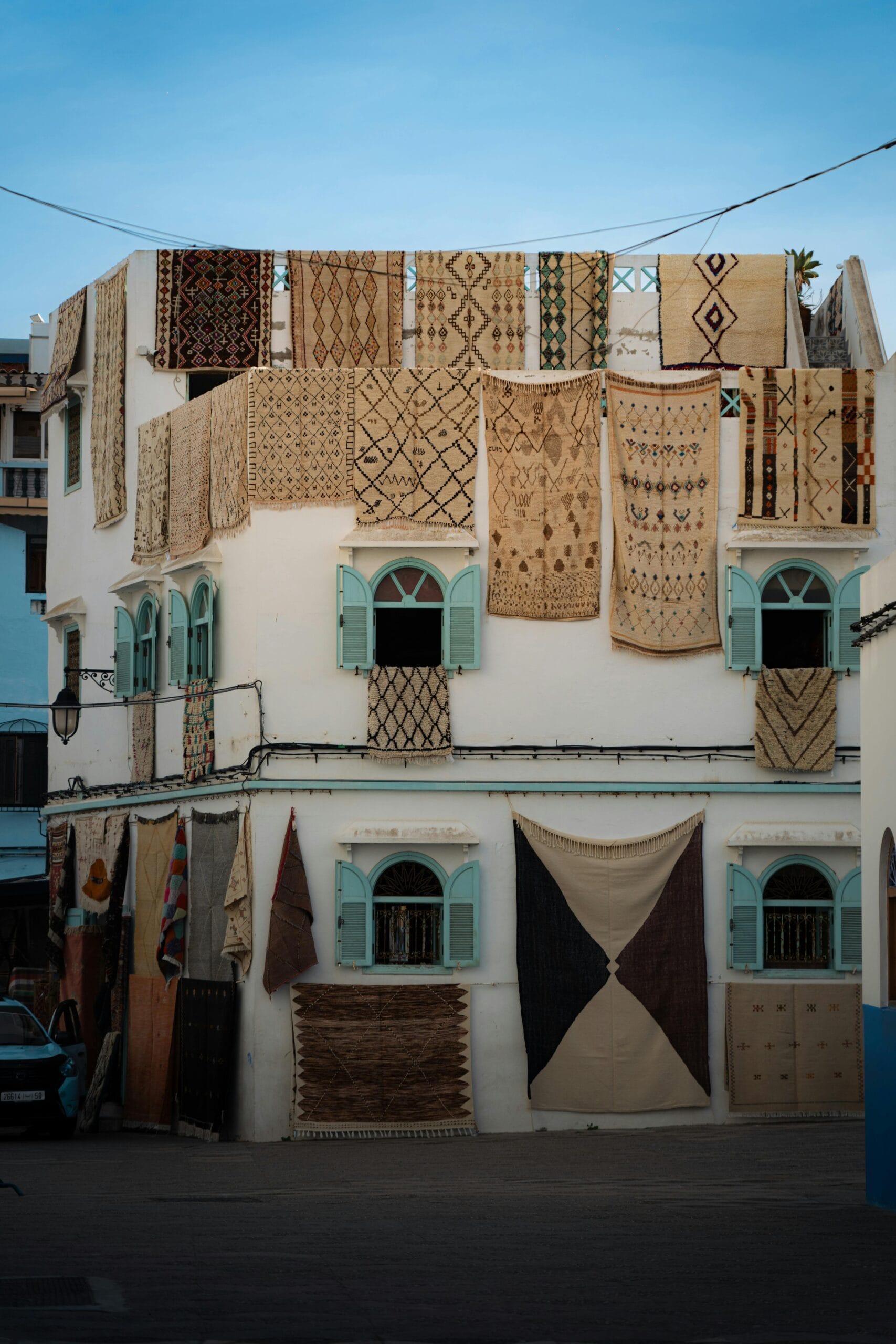
Across the vast landscapes of Morocco — from the windswept High Atlas to the rolling Anti-Atlas and the red plains of the Souss — there exists an ancient art that speaks in color and pattern rather than ink and paper. Amazigh weaving, the creation of Morocco’s distinctive carpets, is not simply the making of a textile but the recording of a story — a visual language of memory, geography, and soul.
Each carpet woven by the Amazigh women is a map of emotions and identity, where every knot, line, and motif is born of centuries of tradition. When you unroll a Moroccan carpet, you are unfolding a landscape of meaning — where tribe, region, and spirit intertwine in wool and color.
This article explores the types of Moroccan carpets, their regional diversity, symbolic depth, natural pigments, and weaving techniques — revealing how these textiles form a living library of Morocco’s artistic and cultural heritage.
Table of Contents
The Essence of Amazigh Weaving – Weaving as Cultural Language
The Amazigh (Berber) people of Morocco are not a monolithic culture but a mosaic of tribes, each with distinct traditions, dialects, and aesthetics. Amazigh Weaving, long before writing, was a means of communicating identity and experience. Through carpets, Amazigh women encoded their worldview — telling stories of fertility, spirituality, protection, and the passage of time.
Weaving is deeply gendered and spiritual. The loom, called azta, is seen as a sacred boundary between the material and spiritual worlds, while the act of weaving connects the weaver to her ancestors and the land. Each region’s carpets — whether from the Atlas Mountains or the Sahara fringes — bear the fingerprint of its environment: the color of the soil, the wool of local sheep, and the symbols of tribal memory.
The Geography of Wool – Carpet Regions and Their Cultural Identity
Moroccan carpets are classified not by material or pattern alone, but by region and tribe. Each tribe has evolved its own color palette, motif vocabulary, and weaving method — creating a rich spectrum of styles that together define the art of Amazigh weaving.
Below is an academic overview of Morocco’s major carpet types and the regions that birthed them.
1. Beni Ouarain Carpets – The Minimalist Masterpieces of the Middle Atlas
Location:
Originating from the Beni Ouarain tribes in the Middle Atlas Mountains (near Azrou and Khenifra), this region is characterized by cold winters and abundant sheep pastures, producing some of Morocco’s finest wool.
Characteristics:
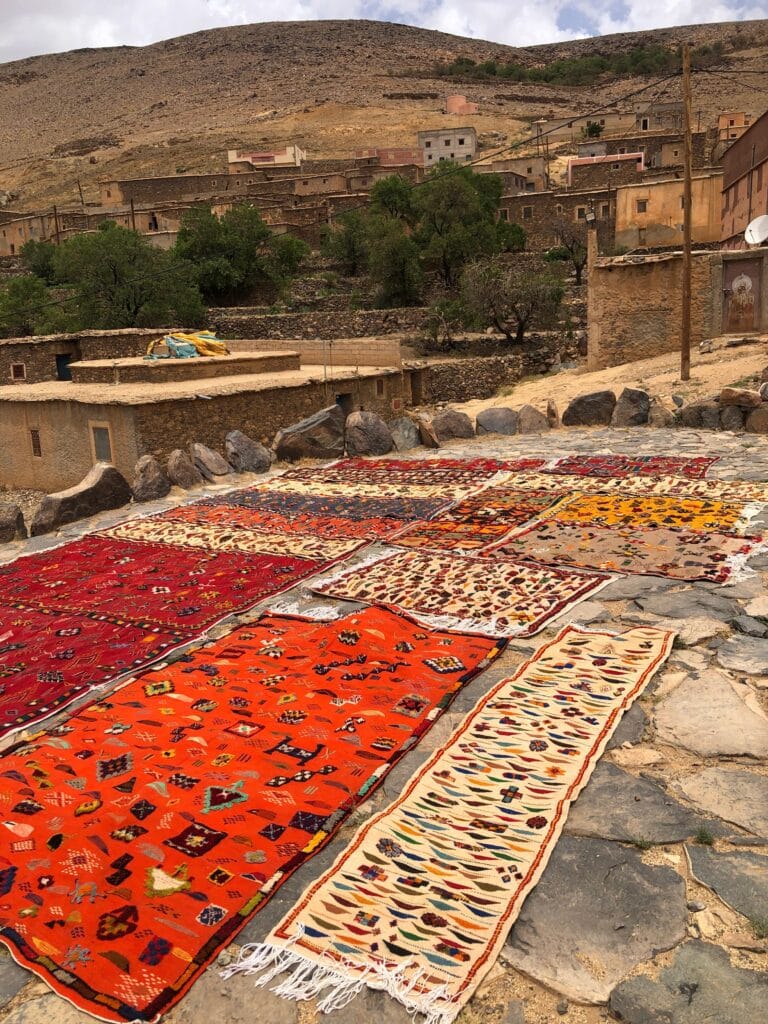
- Colors: Natural ivory or cream backgrounds with geometric black or brown designs.
- Material: 100% undyed sheep’s wool.
- Technique: Thick pile weaving with high knot density for insulation.
Symbolism and Meaning:
Beni Ouarain carpets are minimalist in color but rich in symbolism. The crisscrossed lines and diamond shapes represent life paths, fertility, and protection. Each rug serves as a personal diary, expressing the weaver’s emotions and experiences.
Cultural Significance:
Traditionally, these carpets served as bedding, cloaks, and floor coverings in mountain homes. Today, they have become international symbols of elegance and simplicity — blending modern minimalism with ancestral authenticity.
2. Azilal Carpets – The Abstract Art of the High Atlas
Location:
Produced in the Azilal province of the High Atlas, southeast of Marrakech.
Characteristics:
- Colors: Vibrant multicolored motifs on a light or cream base.
- Technique: A hybrid of pile and flat weaving, often using single-weft knots.
- Design: Spontaneous, abstract, and emotionally expressive.
Symbolism and Meaning:
Azilal carpets are known as the visual poetry of the Atlas women. Their patterns do not follow rigid symmetry — instead, they are intuitive compositions symbolizing love, fertility, motherhood, and protection.
Natural Pigments:
Women use henna, pomegranate rind, indigo, saffron, and madder root to achieve rich reds, blues, and oranges — all derived from plants native to the High Atlas region.
Cultural Role:
These carpets are not made for commercial sale but as personal or family heirlooms, expressing inner life rather than external order.
3. Taznakht Carpets – The Royal Tradition of the Anti-Atlas
Location:
The Taznakht region lies in the southern Anti-Atlas Mountains near Ouarzazate.
Characteristics:
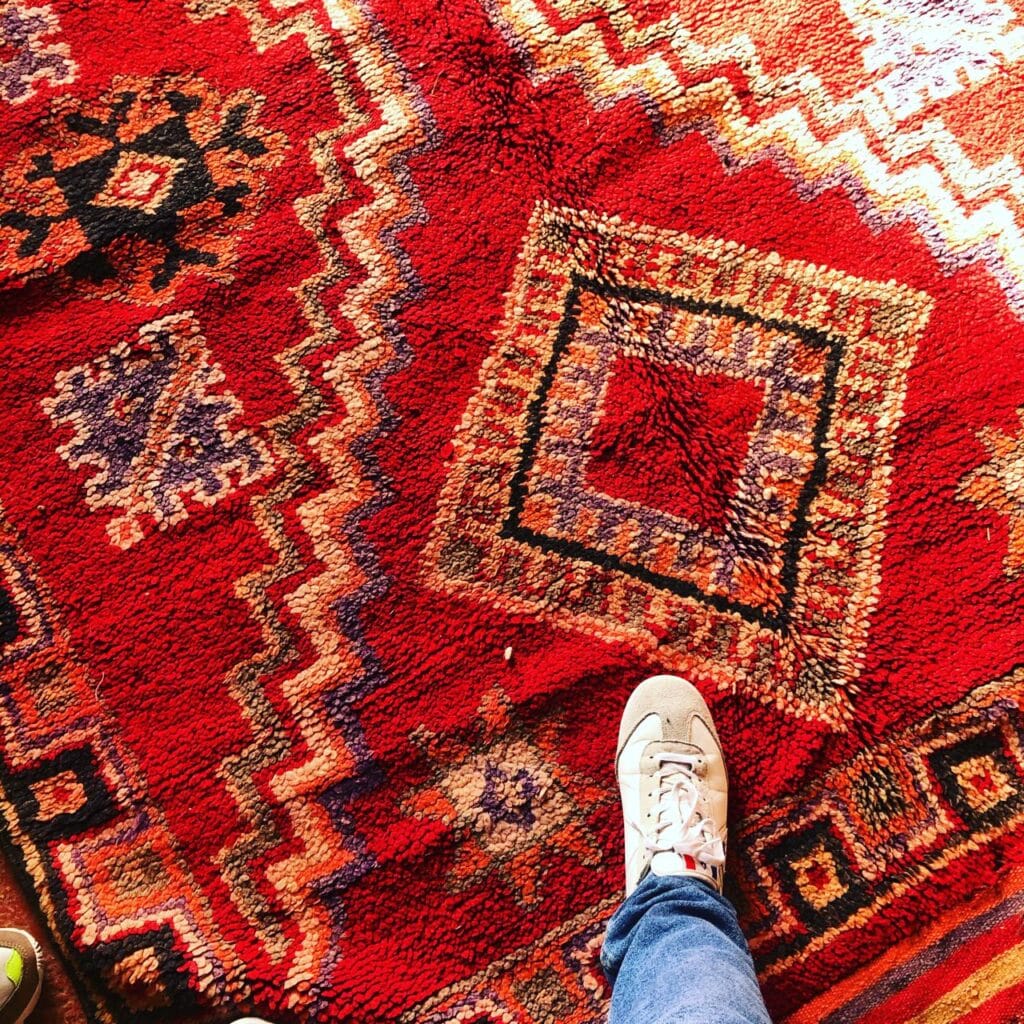
- Colors: Deep reds, saffrons, ochres, and blacks.
- Technique: Often a flat weave (kilim) or a pile and embroidery hybrid.
- Motifs: Geometric lozenges, stylized flowers, and zigzag lines.
Pigments:
- Henna and madder: red, orange
- Walnut husks: brown
- Saffron: gold, yellow
- Indigo: blue
Symbolism and Meaning:
Taznakht carpets often serve as tribal signatures. The diamond shape (lozenge) represents the female principle and fertility, while the zigzag denotes water and protection.
Cultural Importance:
These carpets were once part of dowries and ceremonial exchanges. Today, Taznakht remains one of the most respected weaving centers in Morocco, supported by women’s cooperatives that preserve traditional natural dyeing and techniques.
4. Aït Ouaouzguite Carpets – The Harmony of Geometry and Spirit
Location:
This weaving tradition comes from the Aït Ouaouzguite confederation near Ouarzazate and Tazenakht, bridging High Atlas and Anti-Atlas aesthetics.
Characteristics:
- Colors: Deep terracottas, dark blues, saffron yellows.
- Technique: Pile weave with symmetrical knots.
- Design: Balanced geometry — repeating diamonds, triangles, and stepped motifs.
Symbolism:
These patterns are cosmological — representing the balance between heaven and earth, life and death, woman and man.
Pigments and Process:
Aït Ouaouzguite dyers are renowned for their mastery of madder root reds and indigo blues, using slow, time-honored fermentation methods.
Cultural Role:
These carpets were historically used in sacred and social ceremonies, emphasizing protection and harmony within the household.
5. Boujad Carpets – Expression of Feminine Energy
Location:
Originating from Boujaad, also spelled Boujaad[a] is a town in central Morocco, located in Khouribga Province within the Béni Mellal-Khénifra region.
Characteristics:
- Colors: Warm pinks, oranges, and magentas.
- Technique: Medium pile weave with soft wool and asymmetric composition.
- Design: Organic, free-form motifs and shifting patterns.
Symbolism and Spirit:
Boujaad carpets reflect personal emotion and transformation — less geometric, more expressive. The irregularity of the design represents the unpredictability of life and female creativity.
Pigments:
Derived from cochineal, pomegranate, and natural safflower.
Cultural Value:
Historically woven for dowries or personal expression, Boujaad carpets are now prized for their artistic spontaneity and painterly quality — often compared to abstract modern art.
6. Zemmour Carpets – The Rugs of the Plains
Location:
Woven by the Zemmour tribes of central Morocco, near Rabat and Khémisset.
Characteristics:
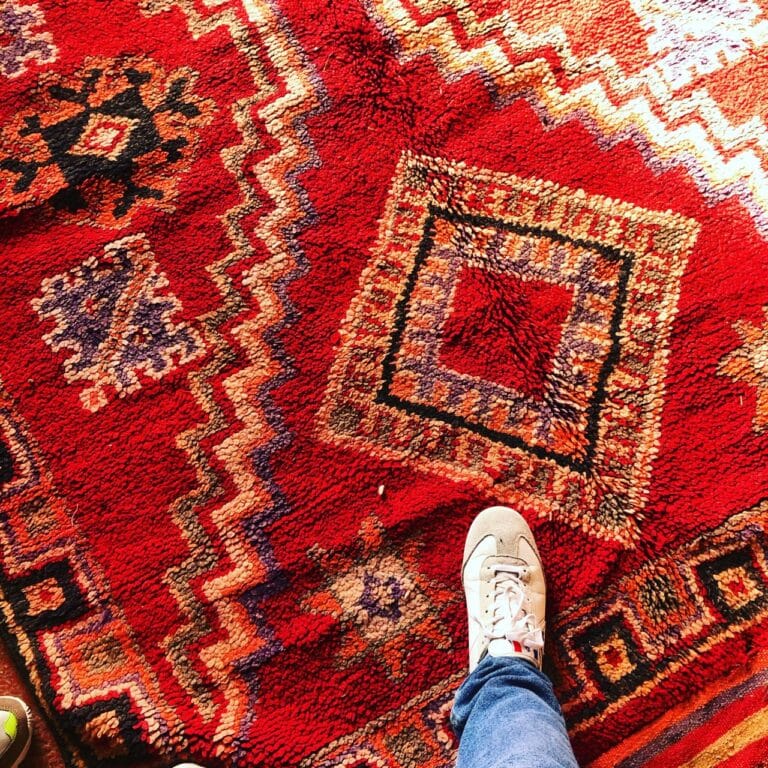
- Colors: Dominated by red, with contrasting white, black, and orange details.
- Technique: Dense pile weave with symmetrical patterns.
- Motifs: Diamonds, crosses, and lattice-like structures.
Symbolism:
The motifs embody fertility, protection, and cosmic balance — the diamond as the eye of life, and the cross as the meeting of elements.
Pigments:
Traditional dyes use madder root, henna, and walnut shell, producing enduring natural tones.
Cultural Context:
Zemmour carpets were traditionally woven for marriage ceremonies and as tribal symbols of status. The symmetry and precision reflect the region’s sense of order and discipline.
7. Aït Bou Ichaouen (Talsint) Carpets – The Desert Geometry
Location:
Produced by the Aït Bou Ichaouen tribes of eastern Morocco, near the Algerian border.
Characteristics:
- Colors: Predominantly reds, oranges, and purples with occasional blue or white accents.
- Technique: Coarse flat-weave with distinctive embroidered embellishments.
- Design: Angular, structured motifs reflecting desert geometry.
Pigments:
- Safflower and madder root: red tones
- Indigo: deep blues
- Local clay and minerals: ochres and browns
Cultural Meaning:
The carpets are narratives of nomadic life, telling stories of migration, survival, and adaptation. Their durability mirrors the resilience of their weavers in the arid lands.
8. Boucherouite Carpets – The Art of Reinvention
Location:
Produced across Morocco, especially in rural areas near Marrakech and the High Atlas.
Characteristics:
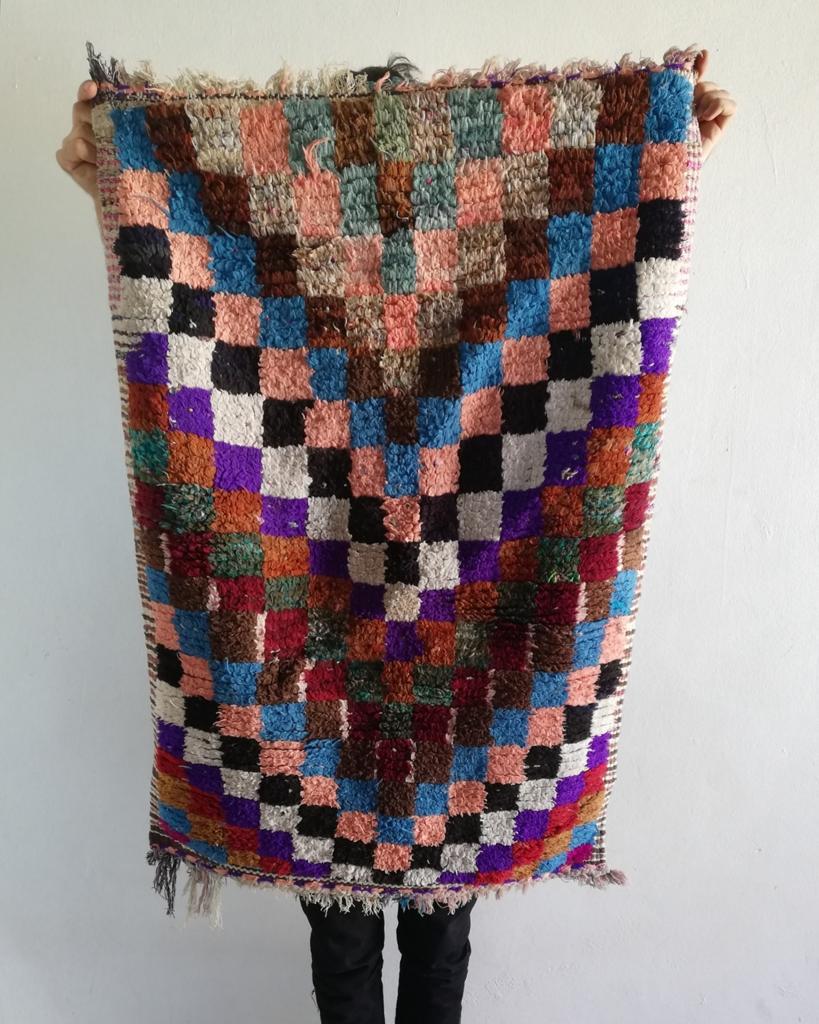
- Materials: Recycled textiles — cotton, nylon, even plastic.
- Technique: Rag-rug style, knotted by hand using traditional looms.
- Colors: Explosive mixtures — blues, pinks, yellows, and greens.
Symbolism and Modern Context:
Born of necessity, Boucherouite carpets (from Arabic bu sharwit, meaning “rag”) symbolize creativity in poverty. They represent sustainability, resilience, and the Amazigh ability to adapt art to life’s changing circumstances.
Cultural Relevance:
Today, Boucherouite rugs are celebrated in global design circles for their eco-conscious artistry and vibrant individuality — a contemporary echo of traditional symbolism.
Techniques of Amazigh Weaving – The Language of Hands and Wool
The Warp and Weft of Tradition
The Amazigh loom is vertical, allowing gravity to aid tension. Weaving techniques vary across regions:
- Flat weave (hanbel/kilim): Lightweight and reversible.
- Pile weave (zrbya): Thick and warm with visible knots.
- Mixed weave: Combining both for texture and depth.
Knotting Methods
- Symmetrical (Turkish) knot: Common in Zemmour and Middle Atlas rugs.
- Asymmetrical (Persian) knot: Found in Taznakht and Azilal carpets for softer designs.
Each knot, tied by hand, carries the rhythm of life — thousands of micro-movements forming one unified story.
Natural Pigments – The Palette of the Earth
The colors of Moroccan carpets are not random but deeply rooted in ecology and spirituality. Weavers use dyes derived from local flora, minerals, and insects:
| Color | Source | Symbolism |
|---|---|---|
| Red | Henna, madder root | Life, energy, and protection |
| Blue | Indigo | Spirit, sky, peace |
| Yellow | Saffron, turmeric | Prosperity, sunlight |
| Brown | Walnut husks, oak bark | Stability, endurance |
| Black | Charred wood, iron oxide | Power, mystery |
| White | Undyed wool | Purity, spiritual clarity |
The dyeing process involves boiling, fermenting, and fixing with natural mordants such as alum or vinegar, a meticulous art passed down through generations.
The Story Behind the Carpet – Weaving Memory and Identity
Every Moroccan carpet is a woven autobiography — a visual narrative of the woman who made it and the land that shaped her. The choice of symbols, colors, and rhythm reflects her life stages, dreams, and social roles.
- Birth and fertility motifs for young brides.
- Protection symbols for mothers.
- Cosmic patterns for wisdom and balance.
In this sense, carpets are textiles of identity, translating oral and emotional history into visual art. They are both personal and communal — an archive of Amazigh memory.
Conclusion – Carpets as Morocco’s Silent Storytellers
In every Moroccan home, a carpet is not merely decoration. It is a storyteller, a prayer, and a witness. From the snowy Middle Atlas to the dunes of the Sahara, these woven creations carry the collective consciousness of the Amazigh people.
The diversity of Moroccan carpets — their textures, techniques, and tones — embodies the diversity of Morocco itself: ancient yet evolving, humble yet profound, simple in material yet infinite in meaning.
To study the types of Moroccan carpets is to trace the thread of Morocco’s soul — a thread spun from wool, dyed by nature, and woven by generations of women who turned silence into beauty, and hardship into art.
FAQs About Types of Moroccan Carpets
Q1: What are the main types of Moroccan carpets?
Moroccan carpets are often named after the geographical region in which they were woven: So there is Beni Ouarain, Azilal, Taznakht, Aït Ouaouzguite, Boujad, Zemmour, Aït Bou Ichaouen (Talsint), and Boucherouite are among the most prominent.
Q2: What determines a carpet’s regional style?
Climate, available wool, natural dyes, and tribal symbolism all shape regional identity.
Q3: Why do Amazigh women weave carpets?
Beyond utility, weaving is a cultural language expressing personal emotion, spirituality, and identity.
Q4: Are natural dyes still used today?
Yes, especially in cooperatives that preserve traditional eco-friendly dyeing methods.
Q5: What makes Moroccan carpets unique globally?
Their symbolism, individuality, and authenticity — each one is an unrepeatable story woven by hand.
Call to Action:
Next time you see a Moroccan carpet, look closer. Each thread is a verse, each color a voice, and each pattern a soul. The story it tells is the story of Morocco itself — woven by hands that remember, and hearts that endure.