Ahwach: History, Symbolism, Anthropology & the Role of Assays in Amazigh Culture.
Introduction
Ahwach is one of the most emblematic cultural expressions of the Amazigh people of Morocco, particularly in the High Atlas, Anti-Atlas, and Souss regions. It is both a collective dance and musical performance that combines rhythm, poetry, and communal participation.
Ahwash is not merely a folkloric art form, but rather a deeply rooted cultural tradition that reflects the values, social structures, and spirituality of the Amazigh community. This article explores the history, symbolism, and anthropology of ahwash, with special focus on the role of the ‘Assays’ — the central communal space where these performances take place. The article also examines how ahwach continues to serve as a living tradition, preserving Amazigh identity while adapting to modern contexts.
Yet Ahwach is not one single standardized performance. Its forms, rhythms, poetry, choreography and social organization can vary considerably from one community to another. This local diversity is one of the most important things to understand when studying Ahwach.
For this reason, Ahwach is better approached as a family of related local performance traditions rather than as one fixed dance with a universal choreography or symbolism.
This article explores Ahwach from that deeper perspective. It examines its historical background, symbolic language, regional and local forms, poetry, rhythm, gender, clothing, performance space, social anthropology and changing place in contemporary Amazigh culture.
It also asks an important question: what does Ahwach actually communicate when a community performs it?
Table of Contents
Historical Background of Ahwash
The origins of ahwach dance date back centuries, with roots in pre-Islamic Amazigh rituals and community gatherings. Historically, ahwach was performed to mark important communal events such as weddings, agricultural festivals, and seasonal celebrations. It served as both an artistic expression and a medium of social cohesion. Many historians and anthropologists link Ahwash to ancient forms of collective ritual performances where poetry, dance, and music played a central role in expressing collective memory and identity. In many villages of the High Atlas, oral traditions preserved by elders indicate that Ahwash was seen as a gift of the ancestors, an intangible heritage that binds past generations with the present.
What Is Ahwach?
Ahwach is a collective Amazigh performance tradition particularly associated with southern Morocco and the High Atlas–Souss cultural area. It commonly combines group movement, percussion, singing or recitation, poetic exchange and coordinated bodily gestures.
The performance is often collective rather than centered on a single professional dancer. Participants may form lines, semicircles, circles or other coordinated arrangements, depending on local practice.
The musical structure can involve percussion instruments such as the bendir, collective voices and a leading singer or poet. However, the exact organization differs between communities.
This variation matters because Ahwach does not exist independently from the society that performs it. Its rhythms, poetry, movements, clothing and social rules are shaped by local traditions.
Anthropological research has therefore treated Ahwash as a form of local village music. Philip D. Schuyler’s influential work on Moroccan Amazigh music distinguished Ahwash from the professional and itinerant tradition of the rwais, emphasizing that Ahwash was closely associated with particular villages and could function as a symbol of collective stability and identity.
Ahwach should therefore not be understood simply as entertainment.
It can also be understood as a form of social communication performed through the body, voice, rhythm and collective participation.
Ahwach Is Not One Single Dance
One of the most common mistakes in popular descriptions of Ahwach is to speak about it as though every community performs exactly the same dance.
The reality is more complex.
Ahwach has developed through local communities, and local communities have their own histories, repertoires, poetic traditions, rhythms and performance conventions. A performance in the Souss may therefore differ noticeably from one in the High Atlas or the Anti-Atlas.
Differences may appear in:
- rhythm and tempo;
- percussion patterns;
- vocal organization;
- poetic forms;
- choreography;
- body movements;
- formation of performers;
- participation of women and men;
- clothing;
- instruments;
- performance space;
- occasion;
- relationship between performers and audience.
For this reason, it is more accurate to speak about local forms and regional expressions of Ahwach than to invent a rigid list of universally recognized “types.”
Schuyler’s research is particularly important here. He described Ahwash as village music composed of local genres differentiated according to the communities that perform them. This local character contrasts with the more mobile musical tradition of the rwais, whose professional performers traveled between communities and regions.
The diversity of Ahwach is therefore not a weakness in the tradition.
It is one of its defining characteristics.
Symbolism and Cultural Significance
Ahwach is rich in symbolism. The circular formation often adopted during performances represents unity, equality, and the cyclical nature of life. The synchronized movements of dancers, accompanied by rhythmic chants and the beating of drums, symbolize harmony between individuals and the community, as well as between humans and nature. The poetry sung during Ahwash often addresses themes of love, bravery, resistance, and spirituality, embedding moral values and collective wisdom in the performance. The symbolism of Ahwach also extends to its role in reinforcing Amazigh identity, particularly in the face of historical marginalization.
The Symbolic Language of Ahwach
The deepest meaning of Ahwach is not found in one symbol alone.
Its symbolism is produced through the interaction of space, bodies, rhythm, poetry, sound, clothing and collective participation.
Rather than asking what one movement “means” in isolation, it is often more useful to ask what the entire performance communicates within its social context.
The Role of Assays in Ahwash Gatherings
Central to ahwash is the ‘Assays,’ the communal open space where villagers gather to perform and witness the event. The Assays is not just a physical location, but also a symbolic space of equality, dialogue, and community. It serves as a platform where everyone — men, women, elders, and youth — can participate, either as performers or as audience. Anthropologically, the Assays represents the heart of Amazigh village life, a place where collective memory is enacted through music and dance. Its openness reflects inclusivity, and its central position in the village underscores the importance of Ahwash in daily life. Symbolically, it is the ‘theatre of Amazigh culture,’ where tradition is preserved and transmitted from generation to generation.
The Circle: Collective Unity and Shared Space
The circular or semi-circular arrangement is one of the most recognizable visual features associated with Ahwach.
It can create a strong impression of unity because performers move and respond collectively rather than appearing as isolated individuals.
The circle can encourage:
- mutual visibility;
- synchronization;
- collective participation;
- social interaction;
- equality within the performance space;
- continuity of movement.
It also changes the relationship between performer and spectator.
In a conventional stage performance, an audience looks toward performers positioned in front of them. In a collective village performance, the boundaries between participants and observers can be much less rigid.
The circle can therefore be interpreted as a social space in which the community temporarily organizes itself through coordinated movement.
However, the symbolism of the circle should not be reduced to a single universal explanation. Claims that every Ahwach circle specifically represents the sun, a cosmic cycle or a particular ancient ritual should be treated cautiously unless they are supported by evidence from the community being studied.
The safest interpretation is that the circular formation can express collectivity, continuity, coordination and shared participation, while its precise meaning may vary by context.
Rhythm as a Symbol of Collective Coordination
Rhythm is one of the most powerful elements of Ahwach.
The percussion does not merely accompany the dancers. It establishes a shared temporal framework within which bodies, voices and movements become coordinated.
A participant must listen to the rhythm and respond to it.
The group must listen to one another.
A movement that begins with one person can become meaningful only when others respond.
This creates an important anthropological dimension: rhythm transforms individual movement into collective action.
The beat can establish anticipation, regulate movement, create pauses and build intensity. Repetition allows participants to remain synchronized while also helping younger generations learn the performance through observation and participation.
The drum therefore becomes more than an instrument.
It becomes a means of organizing the social body.
The Body as a Carrier of Cultural Memory
Ahwach is also an example of embodied cultural memory.
Not all cultural knowledge is transmitted through books or written documents. Some knowledge survives through repeated physical action.
Young people can learn by:
- watching older performers;
- listening to rhythms;
- imitating movements;
- participating gradually;
- memorizing poetic expressions;
- learning local performance rules;
- observing how experienced performers coordinate with one another.
In this sense, the body becomes an archive.
The movement itself can preserve knowledge even when no written explanation exists.
This is one reason why the disappearance of a performance tradition can mean more than the disappearance of a dance. It may also mean the loss of techniques, poetic repertoires, local vocabulary, musical knowledge and forms of social interaction.
UNESCO’s documentation of other Moroccan traditional performance practices, such as Taskiwin, similarly emphasizes informal transmission through direct learning and the importance of preserving the associated oral and material knowledge.
Anthropology of Ahwash: Social and Spiritual Dimensions
From an anthropological perspective, Ahwash is more than an artistic performance. It is a social institution that embodies the values of cooperation, solidarity, and spirituality. The performance often begins with collective prayers or blessings, underscoring its spiritual dimension. Socially, Ahwach creates bonds among participants, facilitating communication and conflict resolution. It also provides a stage for young men and women to interact, historically serving as a context for courtship and social recognition. The anthropology of Ahwash thus reveals how art, ritual, and society intertwine in Amazigh culture.
The Symbolism of Sound, Silence and Collective Voice
Ahwach communicates through sound as much as through movement.
Several elements can interact:
- percussion;
- leading voice;
- collective response;
- repeated phrases;
- changes in intensity;
- pauses;
- silence;
- ululation or other vocal expressions in particular contexts.
A leading singer or poet may introduce an idea, while the group responds.
This creates a dialogue between individual and collective expression.
The individual voice does not necessarily disappear inside the group. Instead, it can become the starting point for a communal response.
The performance can therefore move continuously between:
individual → group → individual → group
This structure is particularly important for understanding the relationship between poetry and society.
A personal feeling can become a collective statement.
A poetic observation can become communal commentary.
A celebration can become a reaffirmation of belonging.
Music, Instruments, and Choreography
Music is central to ahwash. The main instruments used are the ‘tbel’ (large drum) and ‘naqus’ (metal percussion), which create the rhythmic foundation of the performance. The choreography typically involves synchronized steps, hand movements, and collective chanting. Poetry recitation (timnadin) adds another dimension, blending improvisation with traditional verses. The collaborative nature of the performance highlights the importance of harmony and balance, essential values in Amazigh life.
Ahwach Poetry: A Community Speaking Through Performance
Poetry is one of the most important dimensions of Ahwach.
The poetic component is sometimes associated with amarg, a broad Amazigh concept connected with song, poetry, love and emotional expression.
But Ahwach poetry should not be understood only as romantic entertainment.
Depending on the local repertoire and occasion, poetic performance can address:
- love;
- marriage;
- beauty;
- longing;
- separation;
- family;
- honour;
- social behaviour;
- nature;
- mountains;
- community values;
- historical memory;
- injustice;
- migration;
- contemporary social concerns.
This makes Ahwach poetry a form of social commentary.
Regional documentation of Ahwach traditions describes poetry as capable of celebrating joyful occasions while also expressing criticism and commenting on social problems.
The poet can therefore perform several roles at once.
The poet may entertain.
The poet may remember.
The poet may praise.
The poet may criticize.
The poet may challenge.
And sometimes the poet may say publicly what would be difficult to express in ordinary conversation.
Ahwach poetry can consequently function as a community’s public conversation in poetic form.
Call and Response: From Individual Expression to Collective Meaning
One of the most interesting aspects of collective Amazigh performance is the relationship between the leading voice and the group.
The performer who introduces a poetic phrase is not necessarily performing independently.
The response of the group completes the performance.
This creates a social structure in which meaning is produced collectively.
The pattern can be understood as:
statement → response → repetition → rhythm → collective movement
The repeated structure reinforces memory while also allowing participants to remain synchronized.
It also illustrates a broader principle of oral culture: knowledge does not have to be written down to be preserved.
It can survive through repetition.
Ahwash and Amazigh Identity
Ahwash plays a crucial role in reinforcing Amazigh identity. It embodies linguistic heritage through the use of Tamazight poetry, cultural pride through collective performance, and resistance through its preservation in times when Amazigh culture faced suppression. For many communities, performing Ahwach is an act of cultural affirmation, ensuring that traditions remain alive despite external pressures.
Regional Variations of Ahwach Dancing:
Although Ahwash is widely practiced, its form varies by region. In the High Atlas, performances emphasize strong drumbeats and energetic choreography, while in the Souss region, poetic improvisation takes greater prominence. These variations reflect the diversity of Amazigh culture while maintaining the shared core of collective rhythm, poetry, and community spirit.
The Different Local and Regional Forms of Ahwach
There is no single universally accepted academic classification containing a fixed number of Ahwach “types.”
Instead, it is more accurate to discuss regional and local expressions.
The following geographical framework is useful for understanding the diversity of the tradition.
Ahwach in the Souss
The Souss is one of the most important cultural regions associated with Ahwach.
Here, Ahwach has been connected with village life, celebrations, weddings and other communal occasions.
The performance can combine poetry, rhythm, coordinated movement and social interaction.
The local character of Ahwach is particularly important in the Souss because village communities historically developed their own musical and poetic repertoires.
This means that even performances described broadly as “Souss Ahwach” should not automatically be assumed to be identical.
Local identity remains important.
Ahwach in the High Atlas
The High Atlas contains numerous Amazigh communities separated by mountains, valleys and historical routes.
This geography has encouraged considerable cultural diversity.
Ahwach performances in the High Atlas can therefore show differences in:
- rhythm;
- movement;
- costume;
- instruments;
- poetic repertoire;
- gender participation;
- ceremonial context.
The relationship between mountain geography and cultural transmission is particularly important.
Villages may be relatively close geographically while maintaining distinctive performance traditions.
Ahwach in the Anti-Atlas
The Anti-Atlas also contains rich traditions of Amazigh music, poetry and collective celebration.
In this region, Ahwach forms part of a wider cultural environment that includes agricultural communities, pastoral traditions, local markets, religious gatherings and seasonal celebrations.
Regional differences in rhythm and choreography should therefore be understood in relation to local society rather than treated simply as artistic variations.
Ahwach in Tata and the Jbel Bani Region
The wider Tata and Jbel Bani cultural area is especially interesting because local performance traditions display considerable diversity.
Regional documentation describes Ahwach traditions involving different combinations of percussion, poetry, choreography, clothing and gender participation.
This demonstrates why a single national description of Ahwach can be misleading.
The same broad cultural label can contain multiple local performance languages.
Ahwach Around Ouarzazate and the Southern High Atlas
The Ouarzazate region contains numerous Amazigh cultural traditions connected with village life, mountain communities and oasis environments.
Local Ahwach performances can display distinctive costumes, rhythms and choreography.
The surrounding geography also matters.
Oases, mountain valleys, fortified villages and agricultural communities create different social environments in which performance traditions develop.
Ahwach should therefore be studied not only as music and dance but also as culture in place.
Ahwash in Contemporary Amazigh Society
Today, ahwach is both a traditional practice and a cultural performance showcased in festivals and cultural heritage events. In villages, it continues to play its traditional role during weddings and agricultural celebrations. In urban contexts, ahwash is presented as a symbol of Moroccan diversity and Amazigh identity. The challenge remains in balancing its traditional function with its adaptation to modern cultural tourism and media representation.
A Comparative View of Ahwach’s Local Expressions
| Dimension | Possible local variation |
|---|---|
| Rhythm | Slow, moderate or highly energetic patterns |
| Formation | Circle, semicircle, line or other arrangements |
| Percussion | Different combinations and playing techniques |
| Poetry | Different themes, dialectal forms and repertoires |
| Gender | Male, female, mixed or context-specific participation |
| Clothing | Regional garments, textiles and jewelry |
| Occasion | Weddings, celebrations, festivals and community gatherings |
| Choreography | Different steps, gestures and body movements |
| Performance space | Village square, open ground, wedding space or festival stage |
| Social function | Celebration, courtship, identity, memory, commentary or entertainment |
The table should not be interpreted as a universal classification. It is a framework for understanding where local differences can appear.
Women’s Ahwach: Performance, Identity and Voice
Women have an important place in the study of Ahwach.
However, women’s participation is not identical across all communities.
In some contexts women perform separately from men; in others, performance arrangements can be more integrated. The meaning of participation must therefore be studied locally.
One particularly important example is Ahwach Ntfrkhin, sometimes described as girls’ or young women’s Ahwach in the Souss.
Research by Khadija Sekkal examines Ahwach Ntfrkhin as a space in which women can express identity, autonomy and social commentary through performance and lyrics. The study argues that the performance can provide women with opportunities for freedom of expression within the cultural framework of the community.
This is significant because it challenges the idea that women’s participation in traditional performance is merely decorative.
Women can be:
- performers;
- singers;
- poets;
- communicators;
- bearers of cultural memory;
- participants in courtship traditions;
- interpreters of social values;
- creators of collective identity.
Women’s Ahwach therefore deserves to be studied as a cultural and social practice in its own right.
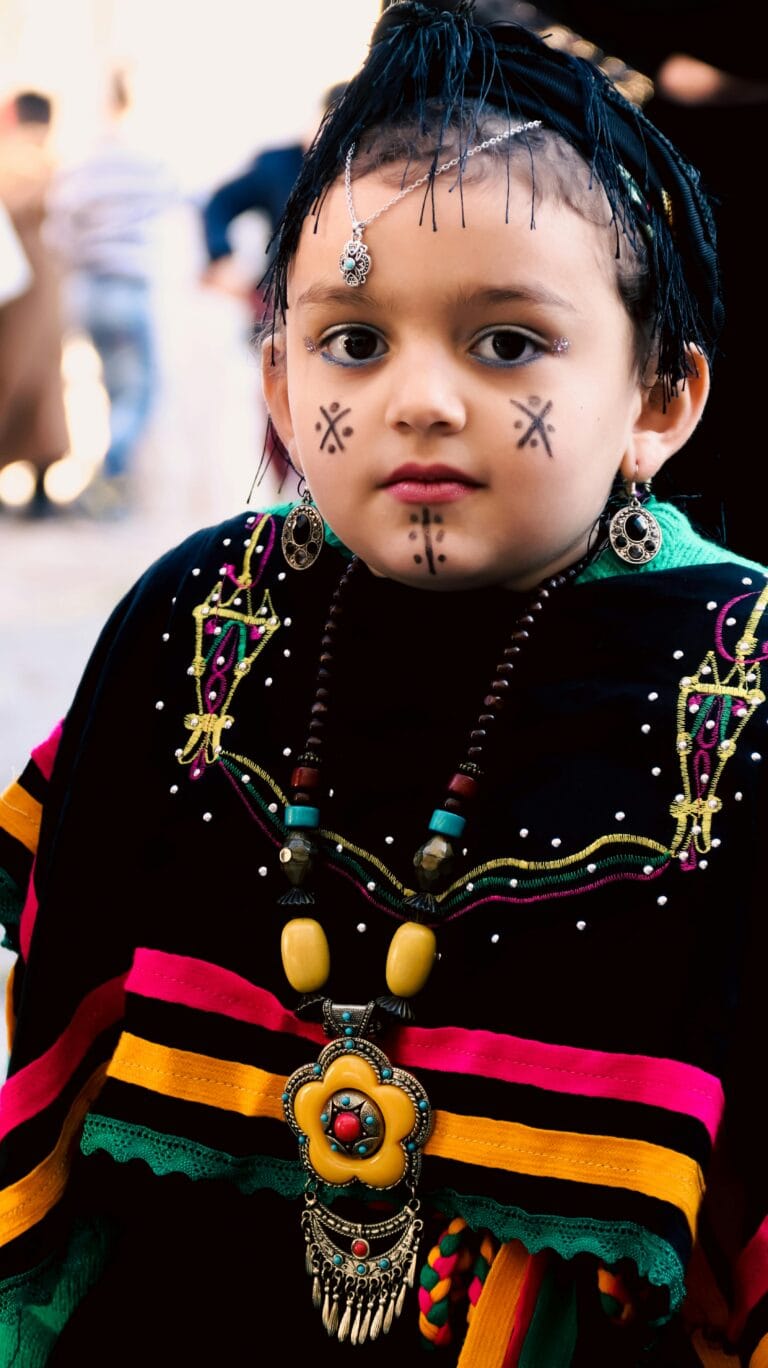
Clothing, Jewelry and Visual Symbolism
Ahwach is also a visual performance.
Clothing and adornment can help identify the cultural and regional background of participants.
Depending on the community, visual elements may include:
- traditional garments;
- woven textiles;
- head coverings;
- jewelry;
- belts;
- embroidered pieces;
- regional hairstyles;
- distinctive colours and patterns.
However, there is no single “Amazigh Ahwach costume.”
A garment worn in one region should not automatically be presented as universal Amazigh dress.
This distinction is particularly important because Amazigh communities across Morocco have developed different textile, jewelry and clothing traditions.
During Ahwach, clothing can therefore operate as a visual language of local belonging.
The performers do not communicate only through movement and sound.
They also communicate through appearance.
The Symbolism of Jewelry in Ahwach
Jewelry can add another layer of cultural meaning to the performance.
Silver ornaments, necklaces, fibulas, bracelets and other forms of adornment can communicate aesthetic preference, regional identity, social status and cultural belonging.
But symbolism should always be interpreted carefully.
A particular geometric design may carry different associations in different communities, and not every decorative form possesses a single ancient symbolic meaning.
The safest approach is to examine jewelry together with:
- regional tradition;
- material;
- method of manufacture;
- occasion;
- wearer;
- family history;
- local interpretation.
This approach also connects Ahwach to the wider symbolic world of Amazigh material culture.
The Assays: When Space Becomes Social
The performance space is essential to understanding Ahwach.
The Assays can be understood as a communal space associated with gathering and performance, although terminology and exact spatial arrangements vary by region.
What matters anthropologically is what happens when an ordinary communal space becomes a place of collective performance.
The space is temporarily transformed.
People gather.
Performers organize themselves.
Musicians establish rhythm.
Poets speak.
The audience responds.
The community watches itself.
In this sense, the performance space becomes a temporary social theatre in which relationships, identities and cultural values are made visible.
Ahwach therefore cannot be separated completely from the village environment in which it developed.
the Social Organization of the Village
Ahwach has historically been closely connected with communal life.
A performance can bring together people who otherwise have different occupations, ages or social roles.
Farmers, artisans, young people, elders, women and men may encounter one another through the event, although the precise organization varies by community.
The performance can reinforce:
- belonging;
- cooperation;
- collective memory;
- intergenerational relationships;
- local identity;
- social recognition.
This helps explain why Schuyler’s analysis described Ahwash as a symbol of village stability and collectivity.
The important point is that Ahwach does not simply represent community.
It can actively create a temporary experience of community.
Ahwach as Embodied Memory
A written archive preserves information through documents.
Ahwach preserves knowledge differently.
Its archive can exist in:
- rhythms;
- melodies;
- poetic phrases;
- gestures;
- choreography;
- costumes;
- instruments;
- performance rules;
- stories;
- memories of older performers.
This is why Ahwach can be described as a form of embodied heritage.
A young participant does not necessarily need to read a manual explaining every movement.
They can learn by watching.
They listen.
They imitate.
They participate.
They gradually develop the ability to perform with others.
This kind of transmission is particularly vulnerable when younger generations stop participating.
Once a movement, rhythm or poetic repertoire disappears from living practice, reconstructing it later may be extremely difficult.
Rwais and Other Amazigh Performance Traditions
Ahwach belongs to a wider world of Moroccan Amazigh performance traditions, but these traditions should not be treated as interchangeable.
Ahwach:
Generally associated with collective village-based performance, coordinated movement, percussion and poetry.
Rwais:
A professional and itinerant musical tradition historically associated with traveling performers. Schuyler’s research contrasts the mobility of the rwais with the local character of Ahwash.
Ahidous:
A collective Amazigh performance tradition particularly associated with the Middle Atlas and other regions, with its own musical, choreographic and social conventions.
Taskiwin:
A distinct martial dance tradition of the western High Atlas. UNESCO inscribed Taskiwin in 2017 on the List of Intangible Cultural Heritage in Need of Urgent Safeguarding. It involves distinctive shoulder movements, percussion, flutes and the decorated Tiskt horn carried by dancers.
These traditions may share certain broad features—collective participation, music, movement, oral expression or community identity—but they should not be collapsed into one category.
Cultural similarity does not mean cultural identity.
How to Read an Ahwach Performance
For anyone watching Ahwach from an anthropological perspective, it is useful to look beyond the obvious movement.
Ask the following questions.
1. Where is the performance happening?
A village square, wedding space, festival stage and tourist venue can produce very different social meanings.
2. Who is performing?
Are the performers villagers, a specialized troupe, women, men, young people, elders or a combination?
3. Who is leading?
Is there a recognizable singer, poet, drummer or coordinator?
4. How is the group organized?
Circle, semicircle, line or another arrangement?
5. What is the rhythm doing?
Is it repetitive, accelerating, alternating or changing in intensity?
6. What is being sung?
Love, celebration, social commentary, memory, humour, morality or contemporary issues?
7. Who responds?
Does the group repeat or answer the leading voice?
8. What do the bodies communicate?
Look at the feet, shoulders, hands, posture and synchronization.
9. What does clothing communicate?
Does it identify a region, community, age group or ceremonial context?
10. What is the relationship between performers and audience?
Are spectators passive observers, or do they participate socially in the event?
These questions allow the viewer to move from simply watching a dance to interpreting a cultural performance.
Traditional vs Festival Ahwach
Modern audiences often encounter Ahwach at cultural festivals rather than inside the village environments where particular traditions developed.
This creates an important distinction.
Community Ahwach
Usually embedded in a social event and connected with the people who maintain the tradition.
Festival Ahwach
Presented as part of a larger cultural program and often adapted to a fixed schedule and public audience.
Stage Ahwach
Reorganized for performance in a formal theatre or festival setting.
Tourism-Oriented Ahwach
May be presented primarily as a representation of local culture for visitors.
These forms are not necessarily “inauthentic.”
Traditions change.
But the change matters.
A performance originally embedded in marriage, community relations or village celebration may acquire a different meaning when transferred to a stage.
The choreography may become shorter.
The audience may become more passive.
Poetry may be reduced.
Costumes may become standardized.
The performance may emphasize visual spectacle.
This process is sometimes described as folklorization: a living social practice becomes increasingly packaged as a cultural spectacle.
The Problem of Folklorization
The term “folklore” can be useful, but it can also hide the social complexity of Ahwach.
When Ahwach is presented only as colorful dancing, several dimensions can disappear:
- poetry;
- social criticism;
- local history;
- gender relations;
- community participation;
- oral transmission;
- religious or ceremonial context;
- regional differences.
Regional heritage documentation has warned about the risks of reducing traditional performances to tourist spectacle detached from their original cultural environment.
The challenge is therefore not to freeze Ahwach in the past.
The challenge is to preserve its cultural meaning while allowing communities to decide how the tradition develops.
Ahwach, Migration and Urban Amazigh Identity
Ahwach has not remained exclusively within mountain and rural villages.
Migration has carried Amazigh cultural practices into Moroccan cities and abroad.
Urban communities can recreate performances in new environments, including cultural associations, festivals, weddings and community events.
This creates an interesting paradox.
Migration can weaken the connection between a performance and its original village context.
But migration can also create new opportunities for cultural transmission.
A young Amazigh person living in a city may encounter Ahwach through:
- family gatherings;
- cultural associations;
- university events;
- festivals;
- social media;
- community celebrations;
- performances organized by migrants from the same region.
Ahwach can therefore become a way of maintaining cultural belonging even when people no longer live in their ancestral villages.
The tradition changes because its social environment changes.
But change does not necessarily mean disappearance.
Ahwach and Amazigh Identity
Ahwach can contribute to Amazigh identity through several interconnected mechanisms.
It provides a space for:
- Tamazight poetry;
- collective memory;
- regional music;
- traditional clothing;
- intergenerational learning;
- public cultural expression;
- community participation.
It also creates a visible connection between cultural identity and place.
A person may recognize a particular rhythm, poetic expression, garment or movement as belonging to their region even when the performance is taking place far from that region.
In this sense, Ahwach can function simultaneously as:
music + dance + poetry + memory + social identity.
That combination is what makes it culturally significant.
Ahwach and the Amazigh Landscape
The geography of southern Morocco is not merely a background to Ahwach.
Mountains, valleys, oases, villages and agricultural landscapes shape the communities that maintain performance traditions.
The Souss Valley, High Atlas, Anti-Atlas and southern oases have different ecological and historical environments.
Those differences can influence:
- settlement patterns;
- agricultural calendars;
- social gatherings;
- migration;
- marriage traditions;
- local clothing;
- poetic themes;
- performance occasions.
This is why Ahwach should be studied as culture in landscape.
The performance carries traces of the society and environment from which it emerged.
Ahwach and the Agricultural Year
Many traditional community celebrations in rural Morocco are connected directly or indirectly with agricultural and seasonal life.
Ahwach can therefore appear within a social calendar shaped by:
- harvest;
- weddings;
- seasonal celebrations;
- religious occasions;
- local festivals;
- community gatherings.
It is important, however, not to claim that every Ahwach performance has an agricultural or fertility function.
The relationship varies according to local context.
A wedding Ahwach should not automatically be interpreted through the same symbolic framework as an agricultural celebration.
Context comes first.
Ahwach and Courtship
Ahwach can also create a social environment in which young people encounter one another.
This is especially significant in performances involving young women and men, although the rules vary widely between communities.
Poetry can provide a culturally accepted language for expressing:
- admiration;
- beauty;
- longing;
- teasing;
- affection;
- social expectations.
The performance therefore creates a controlled social space in which emotions can be expressed publicly through culturally recognized forms.
This is particularly interesting from an anthropological perspective because it shows how artistic performance can also regulate social relationships.
Ahwach and Social Commentary
Traditional performance should not be assumed to be politically or socially passive.
Poetry can address social problems.
A poet may praise good behaviour and criticize bad behaviour.
A performance may comment indirectly on:
- injustice;
- hypocrisy;
- social inequality;
- migration;
- generational conflict;
- relationships;
- changing customs.
This gives Ahwach a role beyond celebration.
It can become a form of community commentary.
The poetic language may be indirect, humorous or metaphorical, allowing difficult subjects to be expressed within a culturally familiar performance.
Ahwach and Generational Change
Every living tradition changes.
Older performers may remember rhythms or poetic repertoires that younger generations no longer know.
Young people may introduce:
- new instruments;
- new clothing;
- new performance spaces;
- new poetic subjects;
- amplified sound;
- stage choreography;
- social-media formats.
Some changes can strengthen visibility.
Others can weaken local diversity if performances become standardized for festivals or tourism.
The question is therefore not simply whether Ahwach is changing.
It is:
Who is controlling the change, and which elements of the tradition remain meaningful to the communities that practice it?
That is a much more useful question for understanding living heritage.
Ahwash as Living Heritage
Ahwach should not be treated as a museum object.
A living cultural tradition changes as communities change.
The important elements may survive through new forms.
A young performer may use modern amplification but still perform an inherited rhythm.
A migrant community may organize Ahwach in a city far from its ancestral village.
A cultural association may document an old poetic repertoire.
A festival may introduce a local form to a new audience.
These developments can create tension, but they can also help traditions remain visible.
The survival of Ahwach therefore depends not only on preserving old choreography.
It depends on maintaining the knowledge, community relationships and cultural meanings that make the performance worth transmitting.
Why Ahwach Matters to Amazigh Cultural Heritage
Ahwash matters because it brings together several dimensions of Amazigh cultural life.
It preserves oral poetry.
It transmits rhythm and musical knowledge.
It provides a space for collective participation.
It communicates regional identity.
It creates intergenerational connections.
It preserves elements of clothing and material culture.
It can express social criticism.
It provides a setting for celebration and courtship.
And it transforms cultural memory into a living performance.
Its importance therefore cannot be measured simply by asking how old the dance is.
A more meaningful question is:
What cultural work does Ahwach continue to perform today?
Is Ahwash an Ancient Pre-Islamic Ritual?
This question deserves a careful answer.
Ahwach is clearly part of a long-standing Amazigh cultural environment, but the exact origin of the contemporary performance cannot be established with certainty through a single historical document.
There are similarities between some collective performances and older Mediterranean or North African ritual traditions.
However, similarity is not proof of direct continuity.
It is therefore better to distinguish between:
- historical evidence;
- oral tradition;
- anthropological interpretation;
- modern cultural narratives.
Claims that Ahwach is simply an unchanged survival of a specific pre-Islamic ritual should be treated cautiously.
The contemporary form of Ahwash has developed through centuries of social, religious, economic and cultural transformation.
Its history is therefore more complex than the idea of a single ancient origin.
Ahwach and Islam
The presence of Islamic culture in Moroccan Amazigh societies also influenced the cultural environment in which performance traditions developed.
Ahwach should not be placed into an overly simple opposition between “ancient Amazigh” and “Islamic” culture.
Amazigh communities have historically incorporated Islamic religious practices into local social life while retaining distinctive linguistic, musical and communal traditions.
The result is not necessarily cultural replacement.
It is often cultural adaptation.
This is one reason why the history of Ahwach should be studied as a process of transformation rather than as a frozen survival from a distant past.
Ahwash and Cultural Safeguarding
Ahwach is part of a much wider Moroccan landscape of intangible cultural heritage.
UNESCO’s current Moroccan inventory includes several performing and cultural traditions, including Gnawa, Tbourida, Malhun and Taskiwin. Taskiwin, the martial dance of the western High Atlas, was placed on the Urgent Safeguarding List in 2017.
Importantly, Ahwach itself should not be described as a UNESCO-inscribed element.
This distinction matters.
The absence of an inscription does not mean that Ahwach lacks cultural importance.
It simply means that its heritage status should not be confused with traditions that have undergone UNESCO inscription.
Safeguarding can also take place through:
- community transmission;
- documentation;
- academic research;
- local associations;
- archives;
- schools;
- cultural events;
- oral-history projects;
- audiovisual recording;
- support for traditional musicians and craftspeople.
The strongest form of preservation is not simply recording a performance.
It is keeping the knowledge alive among the people who practice it.
How Ahwach Can Be Preserved Without Freezing It
Preservation should not mean forcing every community to perform exactly as previous generations did.
A more realistic approach would support:
Community transmission
Young people learning directly from experienced performers.
Documentation
Recording rhythms, poetry, movements, instruments and local terminology.
Academic research
Studying regional differences rather than reducing Ahwach to a single national stereotype.
Women’s traditions
Documenting female repertoires and supporting women’s cultural participation.
Language preservation
Recording Ahwach poetry in Tamazight alongside accurate translations.
Instrument making
Supporting craftspeople who produce traditional percussion and associated objects.
Local archives
Creating collections belonging to communities and cultural institutions.
Responsible tourism
Presenting Ahwach in its cultural context rather than reducing it to spectacle.
Digital preservation
Using websites, documentaries and digital archives to make endangered repertoires accessible to future generations.
A Simple Guide for Understanding Ahwash Symbolism
For readers who want to understand an Ahwash performance more deeply, the following framework can be useful:
| Element | Possible cultural meaning |
|---|---|
| Circle or group formation | Collective participation and social cohesion |
| Rhythm | Coordination and shared temporal experience |
| Repetition | Memory and transmission |
| Collective voice | Communal expression |
| Solo or leading voice | Individual poetic expression within the group |
| Poetry | Memory, emotion and social commentary |
| Body movement | Embodied cultural knowledge |
| Clothing | Regional and social identity |
| Jewelry | Aesthetic and cultural belonging |
| Performance space | Transformation of communal space |
| Audience participation | Relationship between culture and community |
| Occasion | Context that determines meaning |
These interpretations are analytical rather than universal symbolic rules.
The meaning of any particular element should always be interpreted in relation to the community and occasion in which it appears.
Ahwash: Community Tradition or Performing Art?
The answer is both.
Ahwach is an artistic form because it involves:
- rhythm;
- music;
- choreography;
- poetry;
- costume;
- performance.
But it is also a social institution because it can organize relationships between people.
The most interesting aspect of Ahwach is precisely this combination.
It is difficult to separate the artistic from the social.
The rhythm creates the dance.
The poetry creates the message.
The group creates the social meaning.
The space creates the context.
Together, they create Ahwach.
Preservation and Cultural Heritage Efforts
Efforts to preserve Ahwach are ongoing. UNESCO and Moroccan cultural organizations have recognized its importance as intangible cultural heritage. Local associations work to document songs, train younger generations, and organize festivals. Preservation is crucial not only for cultural pride but also for maintaining the social functions that Ahwach serves within Amazigh communities.
Frequently Asked Questions About Ahwash
What is Ahwach?
Ahwach is a collective Amazigh performance tradition associated especially with southern Morocco and the High Atlas–Souss cultural region. It combines elements such as percussion, poetry, singing and coordinated movement.
Is Ahwach a dance or music?
It is both. Ahwach combines music, rhythm, poetry, voice, choreography and collective participation, making the simple category of “dance” too narrow.
What does Ahwach symbolize?
Its symbolism can include collective identity, social cohesion, continuity, memory, celebration and belonging. However, the precise meaning varies according to local tradition and performance context.
Does the Ahwach circle have a universal meaning?
No. The circle can express collective unity and shared participation, but claims that it always represents one specific cosmic or religious symbol should be treated cautiously.
Are there different types of Ahwach?
There are many local and regional forms of Ahwach rather than one universally accepted classification of fixed “types.” Differences can involve rhythm, poetry, choreography, gender participation, clothing and occasion.
Where is Ahwach performed?
Ahwach is particularly associated with the Souss, High Atlas and Anti-Atlas regions and with other communities in southern Morocco.
Is Ahwach practiced in the Ouarzazate region?
Yes. Ouarzazate and surrounding southern regions have their own Amazigh performance traditions and local expressions of Ahwach.
Is Ahwach practiced in Tata?
Yes. Tata and the wider Jbel Bani region contain diverse local performance traditions associated with Amazigh cultural life.
What is Ahwach poetry about?
Ahwach poetry can address love, marriage, beauty, longing, social behaviour, community values, nature, memory and contemporary social issues.
What is Amarg in relation to Ahwach?
Amarg is a broad Amazigh concept associated with poetry, song and emotional expression. In Ahwach, poetic performance can become a major component of the collective performance.
Do women participate in Ahwach?
Yes, although the organization of women’s participation varies by community. Some traditions include distinct female performances, while arrangements differ according to local custom.
What is Ahwach Ntfrkhin?
Ahwach Ntfrkhin is a form of women’s or girls’ Ahwach documented in the Souss. Academic research has examined it as a space for women’s expression, identity and social discourse.
What instruments are used in Ahwach?
Percussion instruments, especially the bendir, are important in many forms, while the exact instruments and musical arrangements vary between local traditions.
Is Ahwach the same as Ahidous?
No. Ahwach and Ahidous are different Amazigh collective performance traditions associated with different regions and cultural contexts.
Is Taskiwin a type of Ahwach?
Taskiwin should be treated carefully as a distinct martial dance tradition of the western High Atlas. UNESCO recognizes it separately and placed it on the Urgent Safeguarding List in 2017.
Is Ahwach the same as the music of the Rwais?
No. Schuyler’s research distinguishes locally rooted Ahwash village music from the more mobile professional tradition of the rwais.
Is Ahwach a pre-Islamic ritual?
Its exact historical origin cannot be established with certainty. Some interpretations connect aspects of Amazigh performance to older traditions, but similarities do not prove an unbroken direct continuity from a particular pre-Islamic ritual.
Is Ahwach a UNESCO heritage tradition?
Ahwach should not currently be described as a UNESCO-inscribed element. UNESCO separately recognizes several Moroccan traditions, including Taskiwin, Gnawa, Tbourida and others.
Why is Ahwach important to Amazigh culture?
Ahwach brings together poetry, music, movement, memory, language, clothing and community participation. It is therefore an important expression of collective cultural identity.
Is modern Ahwach different from traditional Ahwach?
In many contexts, yes. Festival stages, tourism, migration, amplification, cultural associations and social media can transform how Ahwach is performed and experienced.
Is modernization necessarily destroying Ahwach?
Not necessarily. Modernization can weaken some local traditions while also creating new opportunities for documentation, performance and cultural transmission.
Conclusion
Ahwash is more than a performance; it is a living heritage of the Amazigh people. Through its history, symbolism, and anthropology, Ahwash illustrates the deep connection between community, spirituality, and art. The centrality of the Assays highlights the importance of communal spaces in sustaining cultural traditions. As Morocco and the Amazigh people move forward, Ahwach remains a cornerstone of identity, resilience, and collective memory.
read more about ahwach
References and Further Reading
Academic and scholarly sources
- Schuyler, P. D. (1979). Rwais and Ahwash: Opposing Tendencies in Moroccan Berber Music and Society. The World of Music, 21(1), 65–80.
- Sekkal, K. (2020). An Ethnographic Approach to Women’s Identity Celebrating in Folklore: “Ahwash Ntfrkhin” as a Case Study. International Journal of Humanities and Social Science, 7(1), 33–38.
- Schuyler’s research is particularly valuable for understanding Ahwash as local village music and for comparing it with the itinerant professional tradition of the rwais.
UNESCO
- UNESCO. Morocco – Intangible Cultural Heritage. The UNESCO country inventory provides information on Morocco’s internationally recognized intangible heritage and safeguarding projects.
- UNESCO. Taskiwin, Martial Dance of the Western High Atlas. Inscribed in 2017 on the List of Intangible Cultural Heritage in Need of Urgent Safeguarding.
- UNESCO. Morocco – Elements on the Lists of Intangible Cultural Heritage. Useful for distinguishing Ahwach from Moroccan traditions that have received UNESCO inscription.