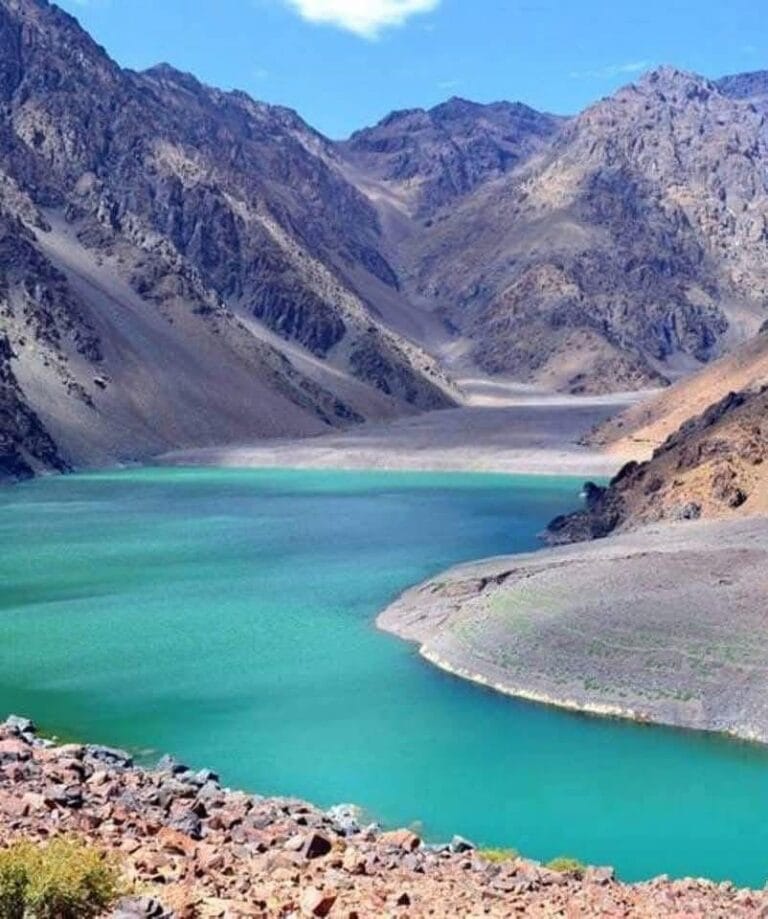
Marrakech: The History of the Old City and the Authentic Spirit of Moroccan and Amazigh People
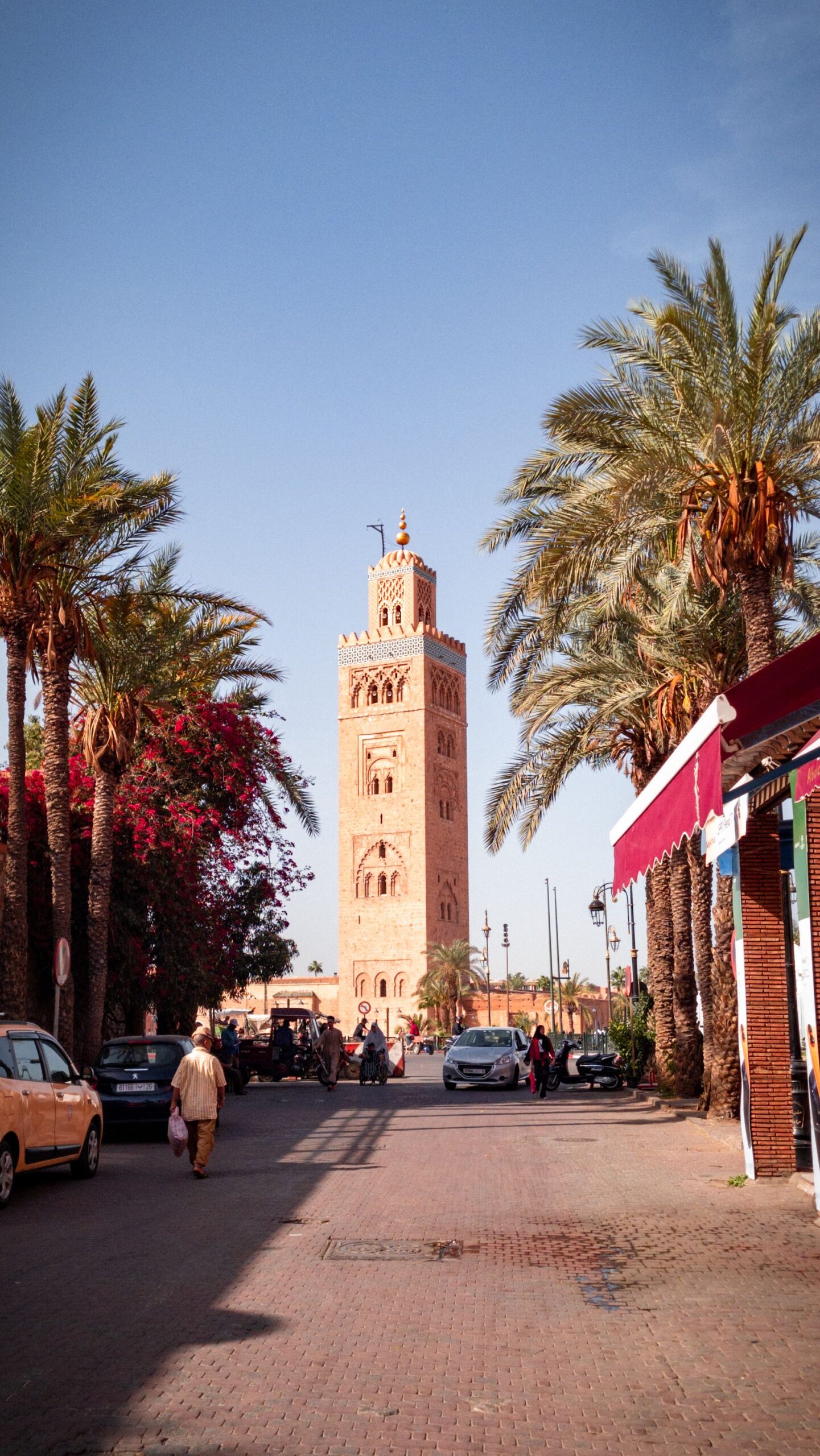
Introduction: Where Ancient Amazigh Heritage Meets the Soul of Morocco
Few cities in the world capture the imagination quite like Marrakech. Rising from the fertile Haouz Plain at the foot of the majestic High Atlas Mountains, the city has fascinated travelers, historians, merchants, and scholars for nearly a thousand years. Its towering red walls, labyrinthine medina, fragrant gardens, lively souks, and magnificent palaces have transformed Marrakech into one of the most recognizable cities in Africa. Yet beneath its vibrant markets and colorful streets lies a far older story—one deeply rooted in Amazigh civilization, indigenous knowledge, and centuries of cultural exchange.
To many visitors, Marrakech is a destination filled with bustling squares, ornate riads, and unforgettable architecture. However, understanding Marrakech solely through the lens of tourism overlooks its profound historical significance. Long before it became one of Morocco’s most visited cities, Marrakesh emerged as the political and spiritual heart of an Amazigh empire that reshaped the western Islamic world. The city’s foundations were laid not by foreign dynasties but by the Almoravids, an Amazigh confederation whose vision transformed a strategic oasis into the capital of an expanding empire stretching from present-day Senegal to southern Spain.
The story of Marrakech is therefore inseparable from the history of the Amazigh people—the indigenous inhabitants of North Africa whose languages, traditions, architectural techniques, agricultural practices, and social institutions have shaped Morocco for millennia. The city’s very name, according to several historical interpretations, became synonymous with the country itself in many European languages, illustrating its extraordinary influence on regional and global history.
Walking through Marrakech today means moving through successive layers of civilization. Every gate in the city walls, every carved cedar ceiling, every courtyard fountain, and every narrow alley bears witness to centuries of political transformation, artistic innovation, religious scholarship, and intercultural dialogue. The city’s monuments preserve the legacy of Amazigh dynasties such as the Almoravids, Almohads, and later the Saadians, while also reflecting Andalusian craftsmanship, Saharan trade networks, sub-Saharan influences, Jewish heritage, and Arab-Islamic scholarship.
Marrakech is equally remarkable because it continues to function as a living city rather than an open-air museum. The medina remains home to thousands of artisans, storytellers, herbalists, metalworkers, leather craftsmen, and textile weavers whose skills have been transmitted across generations. Traditional markets still operate according to rhythms established centuries ago, while the nearby Amazigh villages of the High Atlas maintain close economic and cultural ties with the city, supplying agricultural products, handmade carpets, pottery, and argan oil that continue to define Marrakech’s identity.
Anthropologists often describe Marrakech as a crossroads where mountain communities, desert caravans, Atlantic merchants, and Mediterranean civilizations converged. This unique geographical position transformed the city into an exceptional center of commerce and cultural interaction. Gold from West Africa, spices from the East, manuscripts from Andalusia, and textiles from Europe all passed through its markets, enriching not only its economy but also its intellectual and artistic traditions.
Today, Marrakech occupies a unique position in global heritage. Its historic medina, recognized as a UNESCO World Heritage Site, represents one of the finest surviving examples of medieval Islamic urban planning in North Africa. Meanwhile, Jemaa el-Fnaa Square, celebrated by UNESCO as an element of the Intangible Cultural Heritage of Humanity, preserves oral traditions, music, storytelling, and public performances that continue to animate the city’s cultural life.
Yet perhaps the greatest lesson Marrakech offers is not found within its monumental architecture alone. Instead, it lies in the remarkable ability of its inhabitants to preserve tradition while embracing change. Across centuries of conquest, political transition, environmental adaptation, and globalization, Marrakech has remained a city where Amazigh identity, Moroccan hospitality, and cultural diversity coexist in dynamic balance.
This article explores Marrakech beyond the conventional tourist narrative. Drawing on archaeology, anthropology, linguistics, history, architecture, and cultural studies, it examines how the Red City of Morocco emerged from Amazigh foundations to become one of the greatest urban centers of the Islamic world. By understanding its origins, historical evolution, and enduring cultural significance, you will discover that Marrakech is not merely a destination to visit—it is a living archive of Morocco’s collective memory and one of the most compelling expressions of Amazigh heritage.
Table of Contents
The Origins of Marrakech: From Amazigh Settlement to Imperial Capital
Geography and the Birth of a Strategic City
The location of Marrakech was never accidental. Situated within the fertile Haouz Plain and protected by the snow-capped High Atlas Mountains to the south, the region possessed several geographical advantages that attracted human settlement long before the city’s official foundation in the eleventh century.
Archaeological investigations indicate that prehistoric populations occupied the broader Marrakech region thousands of years before the rise of the medieval city. Nearby caves, lithic artifacts, and evidence of early agricultural communities suggest that the Haouz Plain served as an important transitional zone between the Atlantic coast, the Atlas Mountains, and the Sahara. Seasonal rivers, underground water systems known as khettaras, and productive soils enabled pastoralism and agriculture to flourish, making the region an ideal meeting point for mobile Amazigh communities.
The surrounding landscape also functioned as a natural crossroads connecting northern Morocco with trans-Saharan caravan routes. For centuries, Amazigh tribes moved livestock, agricultural products, and trade goods across these corridors, establishing networks that later contributed to the city’s commercial prosperity.
This environmental setting profoundly influenced Marrakech’s urban development. Rather than emerging in isolation, the city grew within a landscape already shaped by indigenous ecological knowledge, agricultural innovation, and regional mobility.
Amazigh Communities Before the Foundation of Marrakech
Before Marrakech Medina existed as an imperial capital, the Haouz Plain was inhabited by Amazigh tribal groups whose social organization reflected centuries of adaptation to Morocco’s diverse environments. These communities practiced mixed economies combining cereal cultivation, pastoralism, orchard management, and seasonal trade with neighboring mountain and desert populations.
Historical and anthropological evidence suggests that several Masmuda Amazigh confederations occupied much of the High Atlas and surrounding plains. The Masmuda were not a centralized political entity but rather a network of tribes connected through kinship, customary law (azerf), and shared cultural traditions. Their settlements consisted of fortified villages, communal granaries (igoudar), irrigated fields, and seasonal pastoral routes that linked lowland agriculture with high-altitude grazing lands.
These Amazigh societies developed sophisticated systems of water management, including gravity-fed irrigation channels and communal regulations governing access to springs and rivers. Such knowledge later proved essential for the establishment of Marrakech, whose survival depended on carefully engineered hydraulic infrastructure.
Oral traditions preserved among Amazigh communities of the High Atlas continue to emphasize ancestral connections with the plains surrounding Marrakech. While historical narratives often focus on dynasties and rulers, these traditions remind us that the city’s foundation occurred within an already inhabited cultural landscape shaped by indigenous knowledge and social institutions.
The Almoravid Foundation: Yusuf ibn Tashfin’s Vision
The official foundation of Marrakech is generally dated to 1070 CE, during the rise of the Almoravid movement, one of the most influential Amazigh dynasties in North African and Islamic history. The Almoravids emerged among the Sanhaja Amazigh tribes of the western Sahara, combining religious reform, military discipline, and political ambition.
Their leader, Yusuf ibn Tashfin, recognized the strategic importance of the Haouz Plain as a location capable of connecting the Sahara, the Atlas Mountains, and the prosperous cities of northern Morocco. Rather than simply establishing another military camp, he envisioned an entirely new imperial capital capable of administering an expanding transcontinental empire.
The selection of Marrakech reflected several strategic considerations. Its proximity to mountain resources ensured access to timber, stone, water, and agricultural production. Its position along caravan routes facilitated trade with sub-Saharan Africa, where gold, salt, ivory, and enslaved people formed the economic foundation of medieval commerce. Meanwhile, its relative distance from rival political centers allowed the Almoravids to construct an administrative city free from existing urban rivalries.
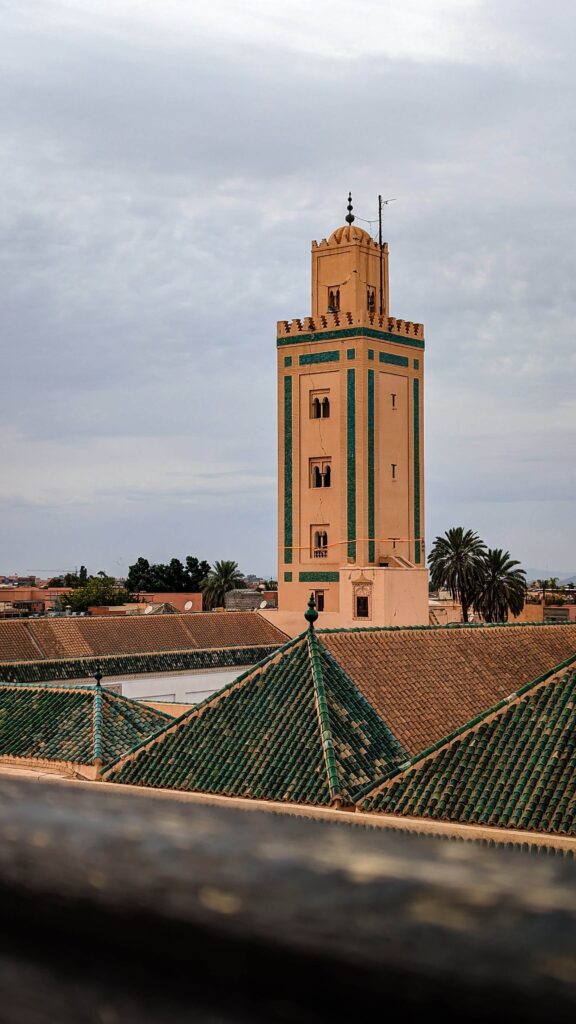
The earliest Marrakech was characterized by defensive walls, mosques, gardens, military compounds, markets, and residential quarters built primarily from rammed earth and local materials. Although many original Almoravid structures disappeared during subsequent centuries, archaeological excavations have revealed foundations, hydraulic systems, and urban layouts that testify to the sophistication of the city’s initial planning.
The Almoravid rulers also introduced advanced irrigation technologies, including the famous khettara underground water channels that transported groundwater across considerable distances without significant evaporation. These hydraulic innovations transformed the surrounding plain into productive agricultural land capable of supporting a rapidly growing urban population.
More than a political capital, Marrakech became a symbol of Amazigh statecraft. It embodied the capacity of indigenous North African societies to establish durable institutions, monumental architecture, and international commercial networks that rivaled many contemporary Mediterranean cities.
Marrakech and the Expansion of the Almoravid Empire
From its new capital, the Almoravids oversaw one of the largest empires in the history of the western Islamic world. Their authority eventually extended across much of present-day Morocco, western Algeria, Mauritania, and large portions of the Iberian Peninsula, where they intervened to defend Muslim territories against advancing Christian kingdoms.
Marrakech quickly evolved into the administrative heart of this vast political network. Diplomatic delegations, scholars, jurists, merchants, architects, and artisans traveled to the city from Andalusia, Ifriqiya, the Sahara, and the broader Islamic world. This circulation of people fostered an extraordinary exchange of artistic styles, legal traditions, architectural techniques, and intellectual currents.
The city’s markets flourished as goods from distant regions converged within its walls. Gold from the Niger River basin, leather from Saharan workshops, textiles from al-Andalus, ceramics from Fez, spices from the eastern Mediterranean, and manuscripts copied in renowned Islamic centers enriched Marrakech’s economic and cultural life.
At the same time, Amazigh traditions remained deeply embedded within the city’s identity. Rural communities surrounding Marrakech continued to maintain close relationships with the capital, supplying agricultural products, livestock, timber, medicinal plants, and skilled labor. Rather than replacing indigenous culture, the imperial city absorbed and transformed it into a broader political and cultural framework.
This synthesis between Amazigh foundations and wider Islamic influences would become one of Marrakech’s defining characteristics throughout its long history.
Marrakech Under the Almohads: The Transformation of an Imperial Metropolis
Although the Almoravids established Marrakech, it was under the Almohad dynasty in the twelfth century that the city reached new heights of architectural, political, and intellectual achievement. Emerging from the Masmuda Amazigh tribes of the High Atlas, the Almohads criticized the religious practices of the Almoravids while preserving Marrakech as the capital of their expanding empire.
The Almohads initiated one of the most ambitious urban transformation programs in medieval North Africa. Monumental construction projects reshaped the city’s skyline and established many of the landmarks that continue to define Marrakech today.
Among the greatest achievements of this period was the construction of the Koutoubia Mosque, whose elegant minaret became the architectural model for later monuments such as the Giralda in Seville and the Hassan Tower in Rabat. Beyond its religious significance, the mosque reflected advances in engineering, geometry, decorative arts, and urban planning that characterized Almohad architecture.
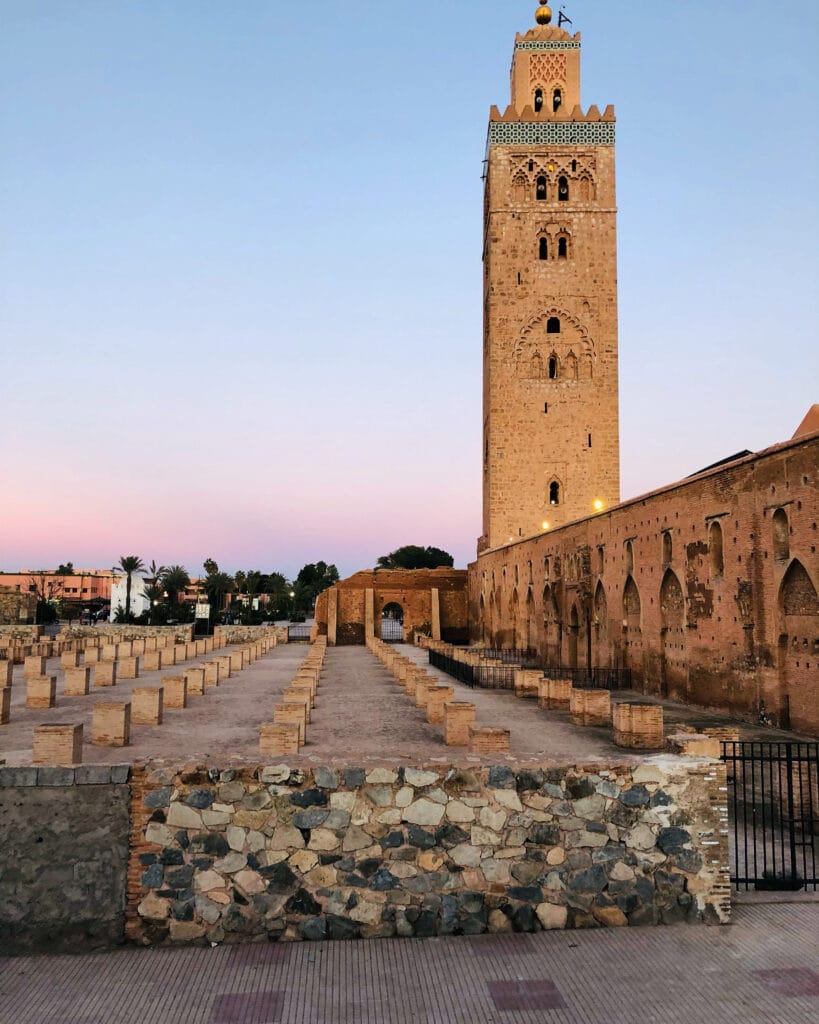
The Almohads also expanded defensive walls, improved hydraulic systems, developed extensive gardens, and encouraged scholarship in theology, philosophy, astronomy, medicine, and mathematics. Marrakech became one of the foremost intellectual centers of the western Islamic world, attracting scholars from across North Africa and al-Andalus.
Perhaps most importantly, the Almohad period reinforced Marrakech’s role as a city where Amazigh political leadership and Islamic civilization converged. Rather than erasing local traditions, the dynasty incorporated Amazigh social structures into a broader imperial vision, demonstrating the adaptability and creativity of indigenous North African governance.
Marrakech Under the Marinids, Saadians, and Alaouites: A City Reimagined Across Dynasties
The history of Marrakech did not end with the Almoravids or Almohads. Like many great imperial capitals, the city experienced periods of political decline, renewal, and transformation that continually reshaped its urban landscape and cultural identity. Each succeeding dynasty left visible traces in its architecture, institutions, artistic traditions, and collective memory, turning Marrakech into a living chronicle of Moroccan history.
Unlike cities that rise and fall with a single empire, Marrakech repeatedly reinvented itself while preserving its Amazigh foundations. The city’s resilience reflects Morocco’s broader historical experience, where indigenous traditions, Islamic scholarship, trans-Saharan commerce, and Mediterranean influences converged over centuries without erasing one another.
The Marinid Era: Political Decline but Cultural Continuity
During the thirteenth century, the Marinid Dynasty, another Amazigh dynasty originating from the Zenata tribal confederation, shifted Morocco’s political center toward Fez. As a result, Marrakech gradually lost its status as the kingdom’s primary capital.
Although this political transition reduced royal investment in the city, Marrakech remained economically and culturally significant. Its strategic position continued to connect northern Morocco with the Sahara and the High Atlas, allowing merchants, pilgrims, scholars, and artisans to sustain vibrant commercial networks.
Rather than disappearing, the city adapted. Local markets flourished, religious institutions continued teaching Islamic sciences, and craft guilds maintained traditions in woodworking, leather production, ceramics, textiles, and metalworking.
Anthropologically, this period demonstrates an important feature of Moroccan urban history: cities often retained their cultural vitality even when political authority shifted elsewhere. Marrakech remained deeply connected to surrounding Amazigh tribes, whose agricultural production and caravan commerce supported the city’s economy.
The Saadian Renaissance: Marrakech Returns as an Imperial Capital
The sixteenth century marked one of the most spectacular revivals in Marrakech’s history.
The Saadian Dynasty, emerging from southern Morocco during a period of political fragmentation and foreign pressure, selected Marrakech once again as the imperial capital. Under rulers such as Ahmed al-Mansur al-Dhahabi, the city entered a new golden age characterized by extraordinary artistic achievement, diplomatic influence, and economic prosperity.
The victory of Moroccan forces at the Battle of the Three Kings (1578) significantly strengthened Saadian authority and transformed Morocco into one of the strongest independent states in North Africa. Wealth generated through trans-Saharan trade—particularly gold from West Africa—financed ambitious construction projects throughout Marrakech.
Among the dynasty’s greatest architectural achievements were:
- The magnificent Saadian Tombs
- The expansion of the Kasbah district
- Royal palaces
- Mosques
- Public fountains
- Gardens
- Advanced hydraulic systems
The Saadian period also witnessed increased diplomatic exchanges with Europe, the Ottoman Empire, and sub-Saharan kingdoms. Marrakech welcomed ambassadors from England, Spain, Portugal, and numerous African states, reflecting its importance within global political and commercial networks.
For historians, the Saadian Renaissance illustrates how Marrakech evolved beyond its Amazigh origins into an international imperial metropolis while continuing to preserve indigenous cultural traditions.
The Alaouite Dynasty and the Evolution of Modern Marrakech
Beginning in the seventeenth century, the Alaouite Dynasty, which continues to rule Morocco today, gradually established Meknes and later Rabat as principal political centers.
Nevertheless, Marrakech never lost its symbolic importance.
Successive Alaouite sultans restored monuments, expanded religious institutions, maintained caravan routes, and reinforced commercial activity. The city continued attracting scholars, Sufi masters, merchants, and pilgrims from across Morocco and beyond.
During the nineteenth century, European travelers frequently described Marrakech as one of North Africa’s most captivating cities, noting its immense walls, crowded markets, vibrant gardens, and remarkable coexistence of diverse communities.
Despite political decentralization, Marrakech remained one of Morocco’s principal cultural capitals.
Archaeological Evidence: Discovering the Ancient Layers of Marrakech
Understanding Marrakech requires more than reading historical chronicles. Archaeology has played a crucial role in reconstructing the city’s earliest phases, revealing aspects of urban planning, engineering, and daily life that written sources only partially describe.
Excavations conducted throughout the twentieth and twenty-first centuries have uncovered evidence confirming the remarkable sophistication of Almoravid and Almohad urban development.
Excavating the Almoravid City
One of the most significant archaeological discoveries concerns the remains of the original Almoravid settlement founded during the eleventh century.
Although later dynasties rebuilt large portions of the city, archaeologists have identified:
- foundations of early defensive walls
- residential quarters
- water distribution systems
- public baths
- workshops
- early mosques
These discoveries demonstrate that Marrakech was carefully planned rather than expanding randomly.
The city’s original design incorporated defensive considerations, commercial circulation, religious institutions, and access to water, reflecting advanced knowledge of urban planning.
The Almoravid Qubba
One of the rare surviving monuments from the Almoravid period is the Almoravid Qubba, discovered beneath later architectural layers near the Ben Youssef Mosque.
This remarkable structure provides invaluable information regarding:
- hydraulic engineering
- decorative plasterwork
- cedar wood craftsmanship
- geometric ornamentation
- urban infrastructure
Its sophisticated water distribution system reveals the importance of cleanliness and ritual purification within medieval Islamic cities.
Architecturally, the Qubba also demonstrates early experimentation with decorative techniques that would later become hallmarks of Moroccan architecture.
Hydraulic Engineering: The Khettara System
Perhaps the greatest engineering achievement associated with medieval Marrakech is the development of the khettara irrigation network.
These underground channels transported groundwater across several kilometers while minimizing evaporation—a vital innovation in Morocco’s semi-arid environment.
Archaeologists and environmental historians recognize the khettara system as an extraordinary example of sustainable engineering.
Its construction required:
- geological knowledge
- precise surveying
- collective labor
- long-term maintenance
- sophisticated understanding of groundwater movement
Many sections of this hydraulic system remained operational for centuries.
The khettaras illustrate how Amazigh environmental knowledge became integrated into the development of one of the Islamic world’s greatest cities.
Anthropology of Marrakech: A Living Crossroads of Civilizations
Anthropologists frequently describe Marrakech not simply as a city but as a meeting point between multiple ecological and cultural worlds.
Its location connected:
- High Atlas mountain communities
- Sahara caravan routes
- Atlantic coastal settlements
- northern Moroccan cities
- Andalusian migrants
- West African merchants
This exceptional position transformed Marrakech into one of North Africa’s most dynamic multicultural environments.
Amazigh Foundations of Urban Society
Although Marrakech eventually welcomed populations from many regions, Amazigh communities remained central to its social organization.
Throughout history, Amazigh tribes supplied the city with:
- cereals
- olives
- argan oil
- livestock
- timber
- medicinal herbs
- skilled craftsmen
The surrounding High Atlas villages developed strong economic interdependence with the urban center.
Even today, many artisans working inside Marrakech’s medina trace their family origins to Amazigh mountain communities.
Traditional weaving, pottery, leatherworking, wood carving, and jewelry production continue to reflect Amazigh aesthetic principles.
Oral Traditions and Collective Memory
One of Marrakech’s greatest cultural treasures lies beyond its monuments.
The city’s oral traditions preserve centuries of historical memory through:
- storytelling
- poetry
- music
- religious chants
- public performances
- family histories
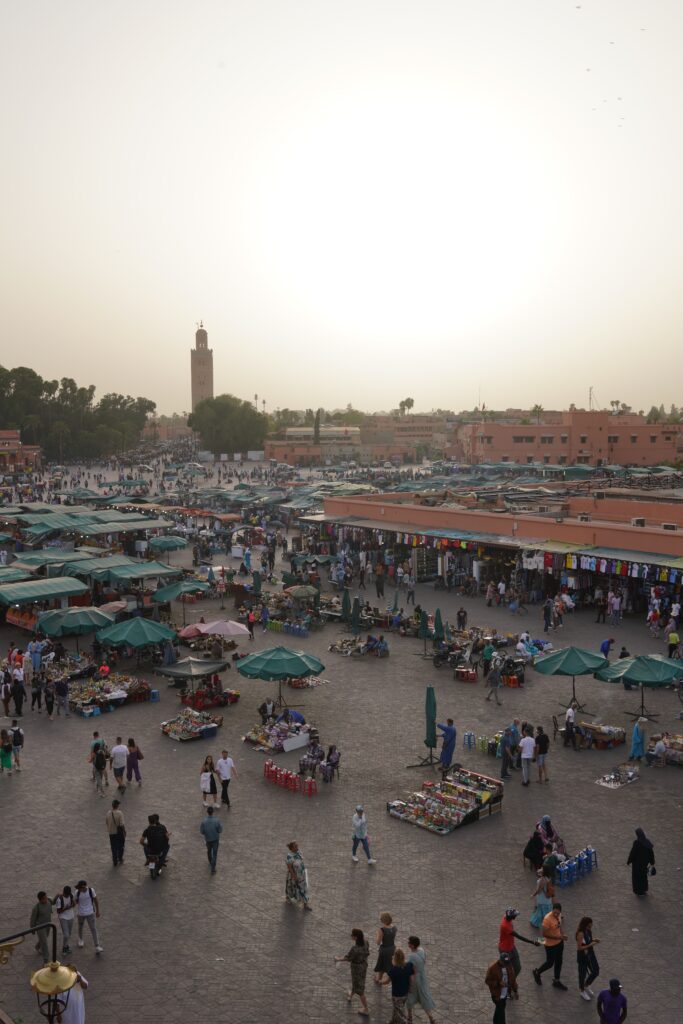
Nowhere is this tradition more visible than Jemaa el-Fnaa, where storytellers have transmitted legends, historical narratives, and moral tales for generations.
Anthropologists consider this living oral heritage one of the city’s most remarkable cultural institutions.
Knowledge here has traditionally been preserved not only through books but through performance.
Berber Hospitality: A Cultural Philosophy
One cannot fully understand Marrakech without appreciating the Amazigh concept of hospitality.
Known throughout Morocco, Berber hospitality extends beyond offering food or tea.
It represents:
- mutual respect
- protection of guests
- generosity
- collective responsibility
- social reciprocity
In many Amazigh communities surrounding Marrakech, welcoming strangers remains a moral obligation deeply rooted in customary law and Islamic ethics.
Visitors frequently encounter this tradition through shared meals, mint tea ceremonies, village festivals, and family guesthouses.

Rather than functioning as commercial performances, these customs reflect enduring social values transmitted across generations.
Linguistic Origins of Marrakech
The origin of the name Marrakech continues to stimulate scholarly discussion.
Although absolute certainty remains elusive, several linguistic theories have emerged.
Amazigh Etymologies
Many scholars associate the city’s name with Amazigh linguistic roots.
One widely discussed interpretation connects Marrakech with the expression:
Amur n Yakush
or related Amazigh constructions meaning:
“Land of God”
Other researchers suggest links with older Amazigh place names referring to settlement, territory, or sacred space.
Although debates continue, the consensus remains that the city’s name possesses strong Amazigh linguistic foundations rather than purely Arabic origins.
Marrakech and the Name “Morocco”
One of the city’s most fascinating linguistic legacies concerns the country’s international name.
During the medieval period, European merchants became so familiar with Marrakech that they began referring to the entire kingdom using variations of the city’s name.
Examples include:
- Morocco (English)
- Maroc (French)
- Marruecos (Spanish)
- Marokko (German)
- Marocco (Italian)
This remarkable linguistic evolution demonstrates the extraordinary influence Marrakech exercised beyond North Africa.
For centuries, the city effectively became synonymous with the kingdom itself.
Tamazight in Marrakech Today
Modern Marrakech remains linguistically diverse.
Visitors commonly hear:
- Moroccan Arabic (Darija)
- Tashelhit (Shilha)
- Central Atlas Tamazight
- Standard Arabic
- French
- English
- Spanish
This multilingual environment reflects centuries of migration, commerce, education, and cultural interaction.
Tamazight continues to play an important role in daily life, especially among families originating from the High Atlas and Souss regions.
The growing visibility of Tifinagh, the Amazigh alphabet officially recognized in Morocco, further reinforces indigenous linguistic heritage within public institutions and cultural initiatives.
Traditional Moroccan and Amazigh Architecture in Marrakech
The architecture of Marrakech represents one of the finest syntheses of Amazigh engineering, Andalusian aesthetics, Islamic geometry, and local environmental adaptation.
Rather than imitating foreign models, Moroccan builders developed architectural solutions specifically adapted to climate, available materials, and social organization.
Earth, lime plaster, cedar wood, palm trunks, carved stucco, and zellige tiles were combined into structures capable of remaining cool during intense summer heat while preserving exceptional artistic beauty.
This architecture expresses more than technical skill—it embodies a worldview in which functionality, spirituality, craftsmanship, and environmental sustainability coexist harmoniously.
The city’s houses, mosques, gardens, caravanserais, palaces, and defensive walls collectively form one of the world’s richest examples of vernacular urban architecture, preserving techniques that continue to inspire architects and conservation specialists today.
The Medina of Marrakech: A Living World Heritage Site
No visit to Marrakech is complete without entering its historic Medina, one of the largest and best-preserved medieval urban centers in the Islamic world. Enclosed by nearly 19 kilometers (about 12 miles) of defensive walls built primarily during the Almoravid and Almohad periods, the Medina remains the historical heart of the Red City.
Unlike many historic districts that function mainly as open-air museums, the Medina continues to thrive as a living urban environment. Tens of thousands of residents still inhabit its labyrinth of narrow alleys, where everyday life unfolds much as it has for centuries. Artisans hammer brass, weave carpets, carve cedar wood, tan leather, prepare spices, and produce traditional crafts using techniques passed down through generations.
In recognition of its exceptional historical and cultural significance, the Medina of Marrakech was inscribed on the UNESCO World Heritage List in 1985. UNESCO highlighted not only its remarkable architecture but also its enduring urban fabric, which preserves the interaction between religious institutions, commercial districts, residential neighborhoods, gardens, and public spaces.
From an anthropological perspective, the Medina represents a living archive of Moroccan society. Every neighborhood (derb), market (souk), mosque, and courtyard reflects centuries of adaptation to environmental conditions, social organization, and cultural exchange. Traditional houses, known as riads, are designed around interior courtyards that provide privacy, natural ventilation, and protection from the intense summer heat—an architectural response that combines Amazigh environmental knowledge with Andalusian and Islamic aesthetics.
Walking through the Medina is therefore much more than a sightseeing experience. It is an immersion into a dynamic cultural landscape where history remains inseparable from daily life.
Jemaa el-Fnaa: Morocco’s Living Stage of Oral Heritage
At the center of the Medina lies Jemaa el-Fnaa, perhaps the most famous public square in Morocco and one of the world’s most extraordinary cultural spaces.
By day, the square hosts fruit vendors, spice merchants, herbalists, orange juice sellers, and artisans. As evening approaches, it transforms into an immense open-air theater where storytellers, musicians, acrobats, poets, comedians, traditional healers, and food vendors gather before large audiences.
Unlike monumental architecture, Jemaa el-Fnaa is celebrated primarily for its intangible heritage. In 2001, UNESCO proclaimed the square a Masterpiece of the Oral and Intangible Heritage of Humanity, recognizing its role in preserving oral traditions, music, storytelling, and public performance. It was later incorporated into UNESCO’s Representative List of the Intangible Cultural Heritage of Humanity.
Anthropologists often describe Jemaa el-Fnaa as a “living university” where knowledge has traditionally been transmitted through speech rather than writing. Before widespread literacy, storytellers (hlayqiya) preserved historical narratives, religious teachings, moral lessons, legends, and local memory by captivating audiences with remarkable performances.
Many of these stories draw upon Amazigh folklore, Islamic traditions, medieval epics, and local legends, illustrating the cultural diversity that has shaped Marrakech over the centuries.
Although globalization and digital entertainment have transformed public life, Jemaa el-Fnaa remains one of the few places where oral storytelling continues to flourish in its traditional setting, making it a unique cultural phenomenon not only in Morocco but worldwide.
Koutoubia Mosque: The Architectural Symbol of Marrakech
Dominating the city’s skyline, the Koutoubia Mosque stands as the most recognizable landmark of Marrakech. Constructed during the twelfth century under the Almohad dynasty, it represents one of the masterpieces of western Islamic architecture.
Its elegant 77-meter (253-foot) minaret became a model for later monuments, including the Giralda of Seville and the Hassan Tower in Rabat. This architectural influence illustrates the extensive cultural exchanges linking Morocco with al-Andalus during the medieval period.
The mosque’s name derives from the Arabic word kutubiyyin, meaning “booksellers,” because manuscript merchants once established their stalls nearby. This association highlights Marrakech’s historical importance as a center of scholarship, education, and intellectual life.
Architecturally, the Koutoubia combines simplicity with mathematical precision. Its carefully proportioned façade, decorative arches, ceramic ornamentation, and harmonious geometry exemplify the Almohad preference for balanced elegance rather than excessive ornamentation.
Although non-Muslims may not enter the prayer hall, the surrounding gardens provide excellent opportunities to appreciate one of Morocco’s greatest architectural achievements.
Bahia Palace: The Art of Moroccan Courtly Architecture
Constructed during the late nineteenth century, Bahia Palace offers a fascinating glimpse into elite Moroccan domestic architecture.
Its name, meaning “Brilliance” or “Splendor,” reflects the ambition of its builders to create one of Morocco’s most beautiful residences.
The palace features:
- intricately carved cedar ceilings
- colorful zellige mosaics
- sculpted stucco decoration
- marble courtyards
- tranquil gardens
- ornamental fountains
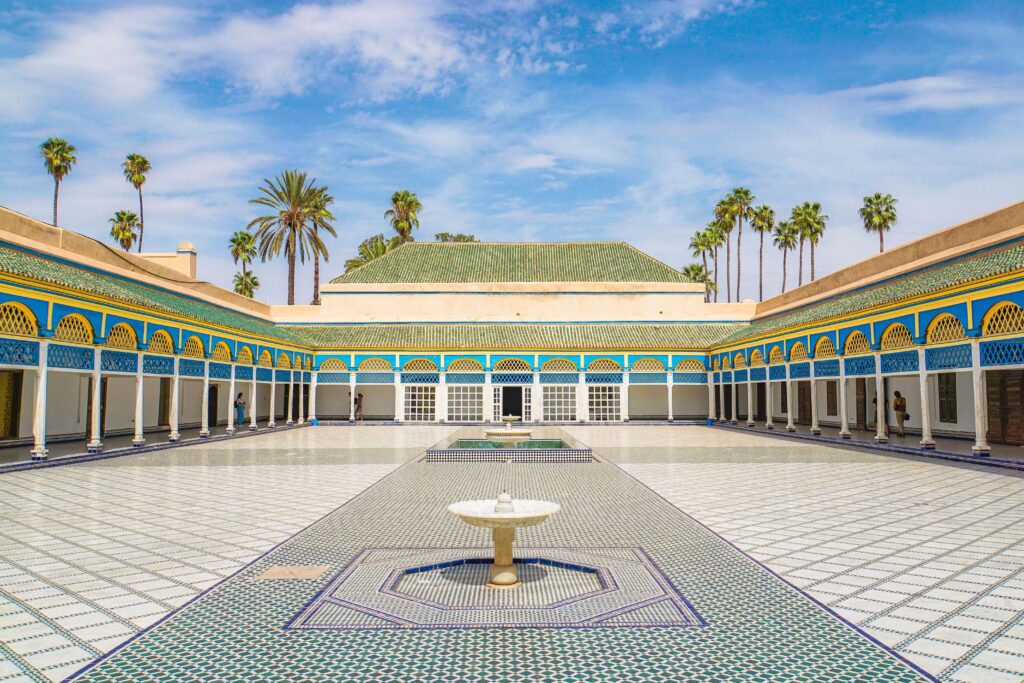
Unlike European palaces designed to impress through monumental façades, Bahia Palace emphasizes inward beauty. Visitors move through successive courtyards, intimate gardens, and richly decorated rooms where architecture encourages contemplation, privacy, and harmony.
The palace also illustrates the remarkable fusion of Amazigh craftsmanship, Andalusian artistic traditions, and Islamic geometric design that characterizes Moroccan architecture.
El Badi Palace: Echoes of a Golden Age
If Bahia Palace celebrates refinement, El Badi Palace evokes imperial grandeur.
Commissioned by Sultan Ahmed al-Mansur shortly after the Moroccan victory at the Battle of the Three Kings in 1578, El Badi was intended to rival the greatest royal palaces of the Mediterranean world.
Historical sources describe extraordinary materials imported for its construction:
- Italian marble
- Sudanese gold
- onyx columns
- precious woods
- richly decorated fountains
Although much of the palace was dismantled during the seventeenth century to provide building materials for other royal projects, its vast courtyards and monumental walls continue to inspire visitors with the scale of Saadian ambition.
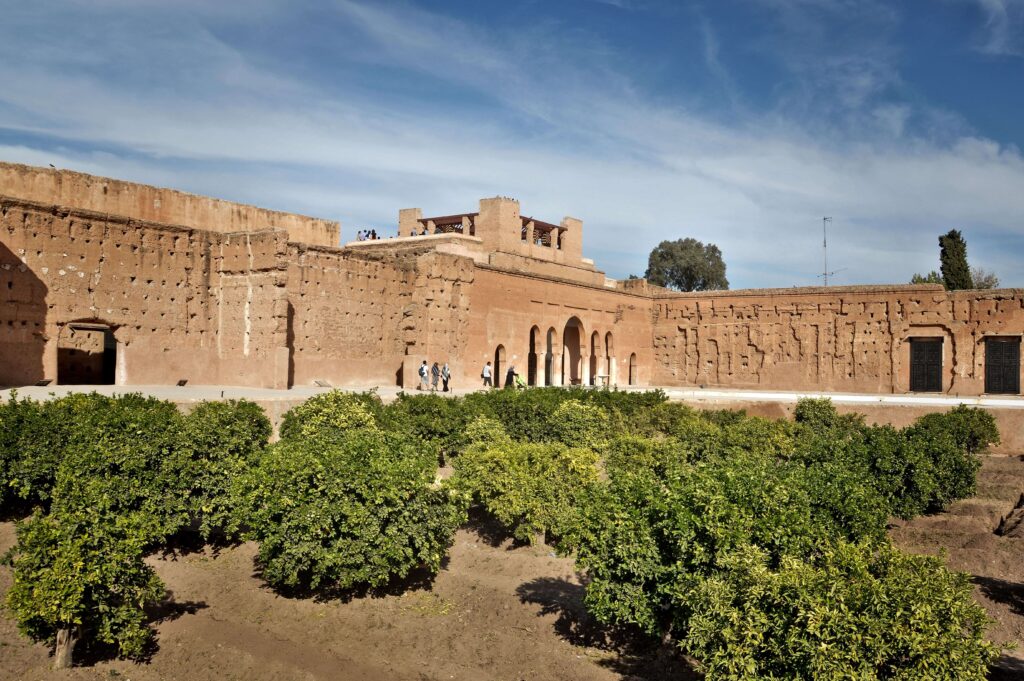
Archaeologists regard El Badi as an essential source for understanding Morocco’s political power and artistic sophistication during the sixteenth century.
Ben Youssef Madrasa: A Monument to Knowledge
For centuries, Ben Youssef Madrasa ranked among the most prestigious centers of Islamic learning in North Africa.
Founded during the Marinid period and later enlarged by the Saadians, the madrasa educated thousands of students in:
- Islamic jurisprudence
- theology
- grammar
- mathematics
- astronomy
- literature
Its architecture represents one of the finest surviving examples of Moroccan educational institutions.
Visitors admire:
- elaborate cedar wood carving
- stucco calligraphy
- geometric mosaics
- symmetrical courtyards
- student dormitories
Beyond its architectural beauty, the madrasa symbolizes Marrakech’s historical role as a center of scholarship connecting Morocco with broader intellectual traditions across the Islamic world.
The Saadian Tombs: Royal Memory Preserved
Hidden behind high walls near the Kasbah Mosque lie the Saadian Tombs, one of Marrakech’s most remarkable historical sites.
Constructed during the sixteenth century, these mausoleums served as the burial place of Saadian rulers and members of the royal family.
For centuries the tombs remained largely forgotten after being sealed off by later rulers, contributing to their exceptional preservation.
Today, visitors encounter:
- finely carved marble
- colorful zellige
- cedar ceilings
- Quranic inscriptions
- exquisite stucco decoration
The Chamber of the Twelve Columns, housing the tomb of Sultan Ahmed al-Mansur, ranks among the masterpieces of Moroccan funerary architecture.
Majorelle Garden: A Dialogue Between Nature and Art
Although considerably younger than Marrakech’s medieval monuments, Majorelle Garden has become one of the city’s most beloved attractions.
Originally designed by French artist Jacques Majorelle during the twentieth century and later restored by fashion designers Yves Saint Laurent and Pierre Bergé, the garden combines botanical diversity with striking architectural color.
The famous Majorelle Blue, vibrant exotic plants, reflective pools, bamboo groves, and cacti create an atmosphere unlike any other place in Morocco.
Adjacent to the gardens, the Berber Museum presents one of Morocco’s finest collections of Amazigh jewelry, textiles, clothing, ceremonial objects, and traditional craftsmanship, helping visitors appreciate the extraordinary diversity of Amazigh material culture.
For readers interested in the broader cultural context, this museum provides an excellent complement to visits to Morocco’s historic monuments.
The Souks of Marrakech: Living Workshops of Traditional Craftsmanship
The winding souks of Marrakech constitute one of the largest traditional marketplaces in North Africa.
Rather than functioning solely as commercial spaces, these markets preserve centuries-old systems of artisanal production organized by specialized guilds.
Visitors can observe craftsmen producing:
- handwoven Amazigh carpetshttps://www.iwziwn.com/moroccan-amazigh-weaving-symbolism/
- leather goods
- brass lamps
- ceramics
- carved cedar furniture
- silver jewelry
- embroidered textiles
- herbal remedies
- traditional musical instruments
Many workshops continue employing techniques transmitted through family lineages for generations.
Anthropologists regard the souks as examples of intangible cultural heritage where technical knowledge, apprenticeship, and social organization remain deeply interconnected.
Purchasing directly from local artisans also contributes to preserving these endangered craft traditions.
The Mellah: Marrakech’s Historic Jewish Quarter
Marrakech has long been home to diverse religious and cultural communities.
Established during the sixteenth century, the Mellah served as the city’s historic Jewish quarter.
Its narrow streets, synagogues, traditional houses, and cemeteries reflect centuries of coexistence between Jewish and Muslim communities within Moroccan society.
The beautifully restored Lazama Synagogue and the nearby Jewish cemetery provide valuable insights into a community that played important roles in trade, diplomacy, craftsmanship, and cultural exchange.
The Mellah reminds visitors that Marrakech’s identity has always been shaped by diversity rather than cultural isolation.
Menara Gardens: Engineering Beauty Through Water
Located just outside the historic walls, the Menara Gardens illustrate the extraordinary importance of hydraulic engineering in Moroccan civilization.
Originally developed during the Almohad period, the gardens center around a vast reservoir supplied by sophisticated irrigation channels drawing water from the High Atlas Mountains.
The surrounding olive groves, pavilion, and reflecting basin create one of Marrakech’s most iconic landscapes.
Beyond their aesthetic beauty, the Menara Gardens demonstrate how Amazigh environmental knowledge and medieval hydraulic engineering supported agriculture in an otherwise semi-arid environment.
They stand as enduring evidence that water management has always been central to the city’s survival and prosperity.
Best Places to Visit in Marrakech: Exploring the Red City Beyond the Tourist Trail
For many travelers, Marrakech serves as the gateway to Morocco. Yet the city’s greatest strength lies in the diversity of experiences it offers. Within a single day, you can wander through nearly a thousand years of imperial history, admire masterpieces of Islamic architecture, explore vibrant traditional markets, and enjoy authentic encounters with Amazigh communities whose customs continue to shape the region.
The best places to visit in Marrakech are therefore not only its famous monuments but also the living cultural landscapes that surround them. Together, they reveal why the city remains one of the most compelling destinations in North Africa.
1. Wander Through the Historic Medina
The Medina remains the most rewarding place to begin any exploration of Marrakech.
Beyond its celebrated landmarks, the old city invites visitors to slow down and discover hidden courtyards, neighborhood bakeries, artisan workshops, and quiet residential streets that rarely appear in guidebooks. Every turn offers another glimpse into centuries of urban life, where architecture, commerce, religion, and community continue to coexist within an extraordinary medieval environment.
Rather than following a rigid itinerary, allow yourself time to explore the Medina on foot. Its true beauty often lies in unexpected discoveries: an elderly craftsman carving cedar wood by hand, the scent of freshly baked bread drifting from a communal oven, or a peaceful riad hidden behind an unassuming doorway.
2. Experience Sunrise or Sunset at Jemaa el-Fnaa
Although Jemaa el-Fnaa is lively throughout the day, it undergoes a remarkable transformation as evening approaches.
The fading sunlight casts warm colors across the surrounding buildings while storytellers, musicians, food vendors, and performers gradually fill the square. The atmosphere becomes both theatrical and deeply rooted in centuries of oral tradition.
Watching this daily transformation provides insight into why UNESCO considers the square one of humanity’s most important examples of intangible cultural heritage. It is not simply a place to eat or shop—it is where collective memory is performed in public.
3. Explore the Hidden Riads of Marrakech
Among the architectural treasures of Marrakech are its traditional riads, many of which remain hidden behind modest exterior walls.
Designed around central courtyards filled with fountains, citrus trees, and geometric gardens, riads illustrate Morocco’s distinctive approach to domestic architecture. Their inward-facing layouts ensure privacy while creating cool, tranquil spaces protected from the city’s intense summer climate.
Many historic riads have been carefully restored as guesthouses, allowing visitors to experience traditional Moroccan design while supporting the preservation of historic buildings.
4. Discover the Kasbah District
Located south of the Medina, the historic Kasbah preserves an atmosphere distinct from the city’s more commercial neighborhoods.
Here, visitors encounter:
- ancient defensive walls
- quieter residential streets
- traditional bakeries
- local markets
- historic mosques
- access to the Saadian Tombs
The Kasbah also reflects Marrakech’s long history as an imperial capital, where military, administrative, and religious functions once converged.
5. Visit the Museums of Marrakech
Beyond its monuments, Marrakech offers numerous museums dedicated to Moroccan history, Amazigh culture, photography, textiles, music, and contemporary art.
Among the most rewarding are:
- Museum of Marrakech
- Dar Si Said Museum of Moroccan Arts
- Yves Saint Laurent Museum
- Museum of Confluences
- Berber Museum
These institutions provide valuable historical context, allowing visitors to appreciate the broader cultural traditions that shaped the city over many centuries.
Beyond the City Walls: Marrakech as the Gateway to Amazigh Morocco
While Marrakech itself is extraordinary, its surrounding landscapes reveal another essential dimension of Moroccan identity.
Within a short distance of the city, the fertile Haouz Plain gradually rises toward the High Atlas Mountains, where Amazigh villages preserve traditions that have endured for centuries.
These mountain communities continue to practice forms of agriculture, architecture, craftsmanship, and social organization that reflect deep historical continuity.
For travelers interested in authentic cultural experiences rather than mass tourism, the High Atlas offers some of Morocco’s richest opportunities for meaningful encounters.
The High Atlas Mountains: Homeland of the Amazigh People
Towering above Marrakech, the High Atlas Mountains have long served as both a natural barrier and a cultural refuge.
For centuries, Amazigh communities adapted to this demanding environment through remarkable ingenuity.
Terraced agriculture transformed steep mountain slopes into productive farmland. Irrigation channels carried precious water across rocky landscapes. Villages built from rammed earth blended harmoniously into the surrounding mountains, minimizing environmental impact while maximizing thermal efficiency.
These landscapes demonstrate how traditional ecological knowledge enabled human communities to flourish under challenging conditions.
Today, many mountain villages remain closely connected to Marrakech through trade, seasonal migration, and family networks.
Imlil: Gateway to Mount Toubkal
Among the most popular excursions from Marrakech is the village of Imlil, situated approximately sixty-five kilometers south of the city.
Nestled within the High Atlas, Imlil serves as the principal gateway to Mount Toubkal, the highest peak in North Africa.
Yet the village offers much more than hiking opportunities.
Visitors encounter:
- traditional Amazigh stone houses
- terraced orchards
- walnut groves
- community irrigation systems
- local markets
- family-operated guesthouses
Spending time in Imlil allows travelers to appreciate everyday Amazigh life beyond the urban environment of Marrakech.
Ourika Valley: Nature and Living Tradition
The Ourika Valley combines spectacular scenery with rich cultural heritage.
Flowing from the High Atlas toward the Haouz Plain, the valley supports numerous Amazigh villages where agriculture remains central to community life.
Visitors frequently observe:
- saffron cultivation
- fruit orchards
- traditional water mills
- weekly rural markets
- pottery workshops
- carpet weaving
The valley also illustrates how mountain communities continue adapting traditional practices to contemporary economic realities while preserving cultural identity.
Ouirgane: Sustainable Tourism in the Atlas
Less crowded than other mountain destinations, Ouirgane has emerged as an excellent example of sustainable rural tourism.
The surrounding landscapes feature olive groves, juniper forests, traditional villages, and scenic walking trails.
Many local cooperatives encourage responsible tourism by promoting:
- handmade crafts
- traditional cuisine
- ecological agriculture
- cultural exchange
- community-based accommodation
For visitors seeking a quieter experience, Ouirgane offers exceptional opportunities to engage respectfully with Amazigh communities.
Berber Hospitality: The Human Heart of Marrakech
Architecture and monuments explain only part of Marrakech’s enduring appeal.
Equally important is the remarkable hospitality extended by its people.
Across Morocco, Amazigh hospitality represents a deeply rooted cultural value emphasizing generosity, respect, and mutual responsibility.
Guests are traditionally welcomed with mint tea, fresh bread, olive oil, seasonal fruits, and home-cooked meals—not merely as acts of politeness but as expressions of social ethics.
Within many Amazigh communities, refusing hospitality would historically have been considered dishonorable.
Although tourism has introduced commercial relationships into many aspects of local life, genuine hospitality remains one of Morocco’s defining cultural characteristics.
For visitors willing to engage respectfully with local communities, conversations often become the most memorable aspect of the journey.
Traditional Amazigh Cuisine Around Marrakech
Food provides another window into the cultural history of the region.
Many dishes associated with Marrakech reflect centuries of interaction between Amazigh agriculture, Arab culinary traditions, Andalusian influences, and trans-Saharan trade.
Among the most representative foods are:
Tagine
Prepared in distinctive earthenware vessels, tagine combines slow cooking with aromatic herbs, preserved lemons, olives, vegetables, meat, or seasonal fruits.
The cooking technique itself reflects traditional methods adapted to limited fuel resources.
Couscous
Often prepared on Fridays and during celebrations, couscous remains one of Morocco’s most symbolic communal meals.
Its preparation involves collective family participation, reinforcing social bonds across generations.
Amlou
Originating in the Souss region, Amlou combines roasted almonds, argan oil, and honey into a nutritious spread deeply connected to Amazigh culinary traditions.
Mint Tea
Frequently described as Morocco’s national drink, mint tea symbolizes hospitality more than refreshment.
The careful preparation and ceremonial pouring of tea continue to play important roles in social interaction throughout Marrakech and surrounding villages.
Traditional Crafts: Preserving Centuries of Knowledge
Marrakech remains one of Morocco’s foremost centers of traditional craftsmanship.
Generations of artisans continue producing:
- Amazigh carpets
- leather slippers (babouches)
- brass lanterns
- cedar furniture
- silver jewelry
- pottery
- woven textiles
- carved gypsum
- embroidered garments
These crafts preserve technical knowledge accumulated across centuries.
Supporting local artisans not only provides meaningful souvenirs but also contributes directly to safeguarding Morocco’s intangible cultural heritage.
Why Marrakech Continues to Inspire the World
Few cities possess the ability to remain historically authentic while continuously reinventing themselves.
Marrakech succeeds because it never abandoned its cultural foundations.
Its Amazigh heritage, Islamic scholarship, architectural innovation, commercial vitality, artistic creativity, and extraordinary hospitality have collectively shaped a city that belongs simultaneously to the past and the present.
Visitors arrive seeking beautiful monuments, yet they often leave remembering conversations shared over tea, the sounds of evening storytellers, the scent of cedar wood workshops, or the quiet beauty of mountain villages beyond the city walls.
These human experiences ultimately define Marrakech more profoundly than any monument alone.
Marrakech in the Twenty-First Century: Preserving Heritage in a Globalized World
Today, Marrakech stands at the intersection of tradition and modernity. As one of Africa’s most visited cities, it welcomes millions of travelers every year while continuing to function as a vibrant home for local communities. This dual identity presents both remarkable opportunities and significant challenges.
On one hand, international tourism has contributed substantially to the restoration of historic riads, monuments, gardens, and traditional craft workshops. The city’s hospitality industry has created employment for thousands of residents, while cultural festivals, museums, and artistic initiatives have introduced new audiences to Morocco’s rich heritage.
On the other hand, the rapid growth of tourism has increased pressure on the historic Medina. Rising property values, commercialization of traditional neighborhoods, and the transformation of historic homes into tourist accommodations have altered aspects of daily life. Conservation specialists therefore emphasize the importance of balancing economic development with the preservation of the city’s social fabric.
Marrakech demonstrates that heritage conservation extends beyond protecting monuments. It also involves safeguarding the living traditions, crafts, languages, oral histories, and community relationships that give meaning to those monuments.
UNESCO and the International Recognition of Marrakech
The global importance of Marrakech has been formally recognized through several UNESCO designations that acknowledge both its tangible and intangible cultural heritage.
In 1985, the Medina of Marrakech was inscribed on the UNESCO World Heritage List, recognizing its exceptional urban planning, monumental architecture, and historical continuity. The city’s network of mosques, palaces, gardens, riads, markets, and defensive walls represents one of the finest surviving examples of medieval Islamic urbanism in North Africa.
UNESCO’s recognition extends beyond architecture. Jemaa el-Fnaa, with its storytellers, musicians, performers, and traditional healers, became one of the first cultural spaces proclaimed a Masterpiece of the Oral and Intangible Heritage of Humanity in 2001. This acknowledgment highlighted the importance of preserving living traditions alongside physical monuments.
These international recognitions underscore Marrakech’s role as a city where architecture, memory, performance, and everyday life remain deeply interconnected.
The Amazigh Cultural Revival and Marrakech’s Contemporary Identity
Over recent decades, Morocco has witnessed a renewed appreciation of Amazigh language, history, and cultural heritage. Constitutional recognition of Tamazight as an official language, the growing visibility of the Tifinagh alphabet, and expanding academic research have contributed to a broader understanding of the country’s indigenous foundations.
Marrakech has played an important role in this cultural revival. Museums, universities, cultural associations, and festivals increasingly highlight Amazigh contributions to Moroccan architecture, music, literature, craftsmanship, and environmental knowledge.
Nearby regions such as the High Atlas, Souss, and Iwziwn (Ouzioua), an example of a small village, continue to strengthen these connections by promoting traditional weaving, music, oral poetry, and agricultural practices through cooperatives and community initiatives. Visitors can now engage with Amazigh heritage not as a static relic of the past but as a living culture that continues to evolve while remaining rooted in ancestral traditions.
Sustainable Tourism: Protecting Marrakech for Future Generations
The long-term preservation of Marrakech depends upon responsible tourism and thoughtful conservation.
Visitors can contribute positively by:
- respecting local customs and religious practices;
- supporting independent artisans rather than mass-produced souvenirs;
- choosing locally owned guesthouses and cooperatives;
- minimizing environmental impact through responsible water and waste management;
- learning about Amazigh history and Moroccan culture before visiting;
- engaging respectfully with local communities and traditions.
Likewise, continued investment in heritage conservation, traditional craftsmanship, and cultural education will help ensure that future generations inherit a city whose authenticity remains intact.
The story of Marrakech has always been one of adaptation. Sustainable tourism offers another opportunity to balance continuity with change.
Comparison Tables
Comparison Between Ancient Marrakech vs. Modern Marrakech
| Feature | Ancient Marrakech | Modern Marrakech |
|---|---|---|
| Primary Function | Imperial capital and caravan hub | Global cultural and tourism destination |
| Population | Dynastic court, merchants, scholars, artisans | Diverse urban population with international visitors |
| Economy | Trans-Saharan trade, agriculture, craftsmanship | Tourism, services, commerce, traditional crafts |
| Architecture | Rammed earth, mosques, kasbahs, riads | Restored heritage with modern infrastructure |
| Transportation | Camel caravans and foot traffic | Cars, trains, buses, bicycles, and walking |
| Communication | Oral traditions and manuscripts | Digital media alongside oral heritage |
| Cultural Identity | Amazigh dynasties and Islamic scholarship | Amazigh heritage within a multicultural global city |
Comparison Between Marrakech and Fez
| Aspect | Marrakech | Fez |
|---|---|---|
| Foundation | Almoravid (11th century) | Idrisid (8th–9th centuries) |
| Historical Identity | Imperial Amazigh capital | Religious and scholarly center |
| Landscape | Haouz Plain near the High Atlas | Saïs Plain surrounded by hills |
| Architectural Character | Monumental open spaces and gardens | Dense medieval urban fabric |
| Major Influence | Almoravid, Almohad, Saadian | Idrisid, Marinid |
| UNESCO Recognition | Medina and Jemaa el-Fnaa | Medina of Fez |
| Tourism Focus | Culture, architecture, gardens, nearby mountains | Scholarship, historic neighborhoods, traditional crafts |
Comparison Between Amazigh and Andalusian Influences on Marrakech
| Amazigh Heritage | Andalusian Influence |
|---|---|
| Indigenous settlement patterns | Decorative artistic traditions |
| Rammed-earth construction techniques | Refined courtyard design |
| Mountain irrigation knowledge | Advanced geometric ornamentation |
| Tribal social organization | Calligraphy and ornamental plaster |
| Oral traditions and communal customs | Musical and literary influences |
| Agricultural adaptation | Garden aesthetics and water features |
Frequently Asked Questions (FAQ) About Marrakech City
What is Marrakech best known for?
Marrakech is best known for its historic Medina, Jemaa el-Fnaa, traditional souks, magnificent palaces, Amazigh heritage, and vibrant cultural atmosphere. It is one of Morocco’s four imperial cities and one of the country’s most popular travel destinations.
Why is Marrakech called the Red City?
Marrakech is known as the Red City because many of its historic buildings, walls, and houses are constructed from locally sourced red clay and sandstone, giving the city its distinctive reddish appearance.
Is Marrakech an Amazigh city?
Yes. Marrakech was founded in the eleventh century by the Almoravids, an Amazigh dynasty. Its origins, architecture, surrounding communities, and many cultural traditions remain deeply connected to Amazigh history and identity.
What are the best places to visit in Marrakech?
Some of the best places to visit in Marrakech include the Medina, Jemaa el-Fnaa, Koutoubia Mosque, Bahia Palace, El Badi Palace, Ben Youssef Madrasa, Saadian Tombs, Majorelle Garden, the souks, the Mellah, and the Menara Gardens. Nearby destinations such as the High Atlas Mountains, Imlil, and the Ourika Valley offer additional opportunities to experience Amazigh culture.
How many days should you spend in Marrakech?
Most travelers find that three to five days provide enough time to explore the city’s major historical sites, museums, gardens, markets, and nearby mountain landscapes while also enjoying its culinary and cultural experiences.
What makes Marrakech unique among Morocco’s imperial cities?
Marrakech combines Amazigh imperial history, exceptional architecture, vibrant oral traditions, extensive gardens, trans-Saharan heritage, and direct access to the High Atlas Mountains, creating a cultural landscape unlike any other Moroccan city.
Is Marrakech a UNESCO World Heritage Site?
Yes. The Medina of Marrakech has been a UNESCO World Heritage Site since 1985, while Jemaa el-Fnaa has received international recognition for its outstanding intangible cultural heritage.
How does Amazigh culture influence Marrakech today?
Amazigh culture continues to shape Marrakech through language, traditional crafts, music, cuisine, architecture, mountain agriculture, hospitality, oral traditions, and festivals. Many artisans and families in the city trace their origins to nearby Amazigh communities.
What traditional foods should visitors try in Marrakech?
Visitors should experience tagine, couscous, tanjia marrakchia, amlou, msemen, harira, rfissa, and Moroccan mint tea to appreciate the city’s rich culinary traditions.
What is the best time to visit Marrakech?
Spring (March to May) and autumn (September to November) generally offer the most comfortable temperatures for exploring Marrakech and the surrounding Atlas Mountains.
Conclusion: Marrakech as the Living Heart of Morocco’s Cultural Memory
Few cities have shaped the identity of a nation as profoundly as Marrakech has shaped Morocco. From its foundation by the Almoravids in the eleventh century to its continued role as one of the world’s most celebrated cultural destinations, Marrakech has remained a place where history is not confined to monuments but woven into the rhythms of everyday life.
Its red walls have witnessed the rise and fall of empires, the movement of caravans across the Sahara, the flourishing of scholarship and craftsmanship, and the coexistence of diverse communities whose traditions collectively enriched Moroccan civilization. Behind every carved doorway, every bustling market, every tranquil riad, and every mountain path leading toward the High Atlas lies a story of resilience, creativity, and cultural continuity.
Understanding Marrakech means looking beyond its famous landmarks. It requires recognizing the Amazigh foundations upon which the city was built, appreciating the ingenuity of its hydraulic systems and architecture, listening to the voices preserved through oral traditions, and acknowledging the generations of artisans, scholars, farmers, and merchants who transformed a strategic settlement into one of the greatest urban centers of the western Islamic world.
Today, Marrakech continues to inspire visitors not simply because of its beauty but because it remains a living city where heritage is actively practiced rather than merely displayed. Its enduring vitality demonstrates that cultural preservation succeeds when communities remain connected to their traditions while embracing thoughtful change.
For anyone seeking to understand Morocco, Marrakech offers more than an unforgettable destination. It provides a gateway into the country’s Amazigh heritage, historical depth, artistic excellence, and remarkable capacity to preserve the past while shaping the future. In every sense, the Red City of Morocco stands as one of humanity’s great cultural landscapes—a place where memory, identity, and hospitality continue to define Morocco’s spirit.
References (APA Style)
Below is a curated list of reliable academic references suitable for your article. You can expand this to 40–60 entries if desired for an even more comprehensive bibliography.
- Abun-Nasr, J. M. (1987). A History of the Maghrib in the Islamic Period. Cambridge University Press.
- Bennison, A. K. (2016). The Almoravid and Almohad Empires. Edinburgh University Press.
- Brett, M., & Fentress, E. (1996). The Berbers. Blackwell Publishers.
- Camps, G. (1980). Berbères: Aux marges de l’histoire. Éditions des Hespérides.
- Deverdun, G. (1959). Marrakech: Des origines à 1912. Éditions Techniques Nord-Africaines.
- Eickelman, D. F. (1976). Moroccan Islam. University of Texas Press.
- El Faïz, M. (2005). Jardins de Marrakech. Actes Sud.
- Ennaji, M. (2005). Multilingualism, Cultural Identity, and Education in Morocco. Springer.
- Hoffmann, K. E. (2008). We Share Walls: Language, Land, and Gender in Berber Morocco. Wiley-Blackwell.
- Lightfoot, D. R. (1996). Syrian Qanat Romani: History, Ecology, Abandonment. Journal of Arid Environments.
- Miller, S. G. (2013). A History of Modern Morocco. Cambridge University Press.
- Pennell, C. R. (2013). Morocco: From Empire to Independence. Oneworld.
- Terrasse, H. (1949). Histoire du Maroc. Atlantides.
- UNESCO. (1985). Medina of Marrakesh. UNESCO World Heritage Centre.
- UNESCO. (2001). Jemaa el-Fnaa Square. UNESCO Intangible Cultural Heritage Programme.