
The History of Amazigh People in Morocco: The Living Roots of Identity, Culture, and Continuity
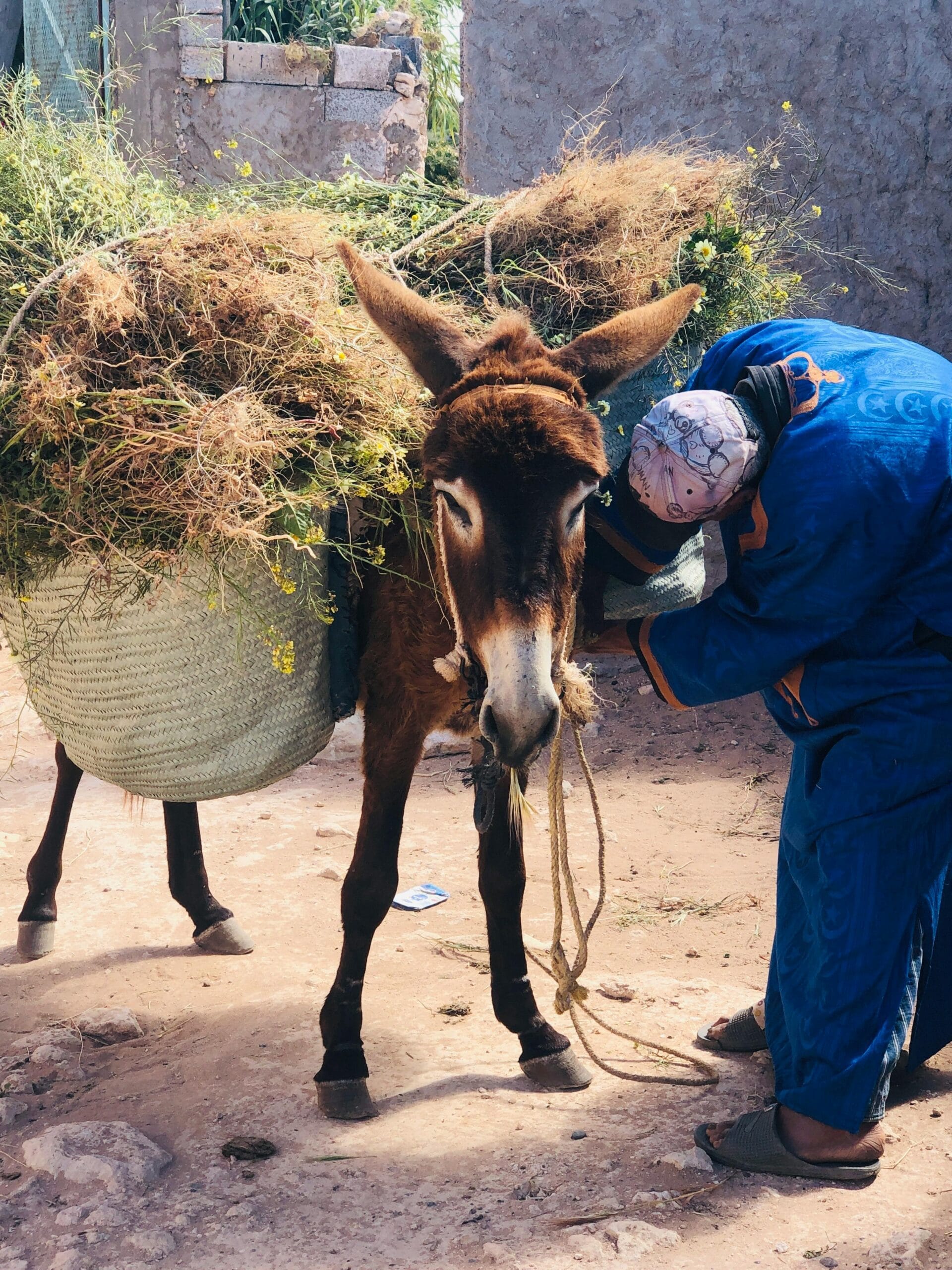
Introduction – The Eternal Soul of the Atlas
When you stand before the Atlas Mountains — their rocky silhouettes rising like ancient guardians of time — you are not merely witnessing geography. You are standing in the heartland of History of Amazigh people, Morocco’s indigenous population, whose story stretches back more than 12,000 years. To understand Morocco is to understand its Amazigh soul — a civilization that survived empires, deserts, invasions, and modernity without losing its rhythm, voice, or essence.
The Amazighs, meaning “free people”, are the first inhabitants of North Africa, predating Arab arrival by millennia. Their history is woven into everything Moroccan — from the curves of a ksar’s wall to the melodies of ahwach dance, from the silver glint of jewelry to the warm texture of handwoven carpets.
This article traces the Amazigh journey — a living story of resilience, creativity, and belonging — through their history, traditions, arts, and enduring cultural symbols.
Table of Contents
Who Are the Amazigh People? Understanding Morocco’s Indigenous Heritage
The Amazigh are the Indigenous peoples of North Africa, with communities whose histories, languages, and cultural traditions extend across Morocco and the wider Maghreb. In Morocco, Amazigh identity is expressed through language, family and community relationships, artistic traditions, historical memory, knowledge of the environment, and diverse ways of organizing everyday life. Yet the Amazigh should not be understood as a single community with one uniform culture. They comprise many regional communities whose experiences have been shaped by different landscapes, political histories, economic activities, and linguistic traditions.
The word Amazigh is commonly associated with meanings such as “free person,” while Imazighen is the plural form. The term Berber is also widely encountered in historical scholarship and older literature, although many people prefer Amazigh because it reflects their own identity and terminology. These words have different historical contexts, and their use should be considered carefully when reading sources written in different periods.
Amazigh identity is not defined by ancestry alone. It can also involve belonging to a linguistic community, participating in cultural practices, maintaining relationships with a particular territory, and identifying with a shared history. The importance of each element varies from person to person. Some Amazigh people speak Tamazight as their first language, while others have grown up primarily speaking Moroccan Arabic or other languages but continue to identify strongly with their Amazigh heritage.
In Morocco, Amazigh communities are found across the Rif, Middle Atlas, High Atlas, Anti-Atlas, Souss, and southeastern regions, as well as in towns and cities throughout the country. Their experiences cannot be reduced to mountain villages or rural traditions. Amazigh people have participated in agriculture, pastoralism, commerce, scholarship, religious life, political movements, urban employment, migration, and modern cultural production.
Understanding who the Amazigh are therefore requires more than a list of traditional customs. It requires attention to a living Indigenous heritage that has developed through historical encounters, regional diversity, adaptation, and continuity.
Amazigh Society: Family, Lineage, Village and Community
The history of Amazigh people in Morocco was not shaped only by rulers, dynasties, and major political events. It was also shaped by households, villages, agricultural territories, pastoral routes, and networks of families that organized everyday life. These social structures were never identical throughout Morocco, but in many rural communities, family relationships and local institutions played important roles in production, resource management, cooperation, and conflict resolution.
The household was often both a social and an economic unit. Family members could contribute to cultivating fields, caring for animals, preparing food, maintaining buildings, producing textiles, gathering natural resources, and transmitting practical knowledge. Children learned many skills by observing and participating in daily activities. The household was consequently a place where economic responsibilities, language, social expectations, and cultural knowledge were learned together.
Beyond the household, relationships among relatives and neighboring families could shape access to land, irrigation water, grazing areas, and shared resources. These relationships were supported by obligations of mutual assistance, hospitality, reciprocal labor, and participation in family or community events. Marriage could also connect households and strengthen social networks, although its arrangements and meanings differed among communities and historical periods.
In some rural areas, larger social groupings included lineages, village communities, tribal fractions, and confederations. These terms should not be treated as interchangeable, nor should they be assumed to describe every Amazigh community in the same way. Their significance depended on local histories, political relationships, resource rights, and forms of collective identity.
Local institutions helped communities manage matters that affected their members. Some High Atlas communities, for example, maintained assemblies commonly known as the jmaâ or by related local terms. These assemblies could deliberate on shared resources, community obligations, disputes, and customary rules. Their procedures and membership varied, and formal participation was not necessarily equal for everyone.
Understanding these social structures reveals an important dimension of Amazigh history: cultural continuity depended not only on individual traditions but also on the relationships and institutions through which people organized their lives. At the same time, those institutions changed in response to state authority, economic pressures, migration, legislation, and shifting expectations across generations.
Ancient Origins: From Prehistory to Early Kingdoms
The Prehistoric Amazigh Roots
Archaeological evidence places Amazigh ancestors in North Africa as early as 10,000 BCE. Prehistoric cave paintings in Taforalt, Aïn Halla, and Oukaïmeden depict hunting scenes, rituals, and domestic life — the earliest cultural imprints of a people who would later form the backbone of the Maghreb.
These early Amazigh communities practiced pastoralism and early agriculture, cultivating barley, wheat, and olives while domesticating goats and sheep — the foundations of Morocco’s later rural economy.
Libyan Tribes and Carthaginian Contact
By 1000 BCE, Amazigh tribes — known in ancient texts as “Libu” or “Numidians” — established trade and political ties with Phoenician and Carthaginian settlements along the North African coast. These interactions brought writing (notably the Libyco-Berber script) and early urban culture to Amazigh lands.
Regional Diversity: Why There Is No Single Amazigh Lifestyle
Amazigh culture in Morocco is diverse because communities have developed within different ecological, linguistic, historical, and economic settings. Mountain agriculture, pastoralism, oasis cultivation, coastal trade, forest use, urban employment, and migration have created different ways of living. Even neighboring communities may differ in their language varieties, artistic traditions, social organization, and relationship with the wider economy.
The Rif
The Rif contains Amazigh-speaking communities with distinctive linguistic and cultural histories. Agriculture, livestock keeping, commerce, migration, and other economic activities have contributed to livelihoods in different parts of the region. Tarifit is an important Amazigh language variety associated with the Rif, although multilingualism and language use vary between communities and generations.
The Middle Atlas
The Middle Atlas includes communities whose livelihoods have historically combined forms of pastoralism, agriculture, and use of forest and mountain resources. Central Atlas Tamazight is associated with many communities in this region. The balance between farming, livestock, seasonal movement, and other work varies according to altitude, access to land, and local economic conditions.
The High Atlas
In the High Atlas, steep slopes, seasonal water availability, and differences in altitude have shaped settlement and livelihood systems. In some areas, households combine irrigated terraces, rainfed cultivation, livestock, transhumance, and the collection or sale of natural resources. Local institutions may regulate access to pasture and water. Tachelhit and Central Atlas Tamazight are both relevant to different parts of the broader Atlas region, so linguistic boundaries should not be assumed to match mountain ranges perfectly.
The Souss
The Souss has a long history of agriculture, commerce, market exchange, and connections between rural settlements and towns. Tachelhit is widely associated with the region. Argan landscapes, where present, contribute to particular local economies, while agricultural production, trade, migration, and other forms of employment shape household livelihoods.
The Anti-Atlas
The Anti-Atlas includes communities whose histories are linked to agriculture, livestock, trade, and the management of scarce water in varied landscapes. Tachelhit is spoken in many communities, but local practices and livelihoods differ. The region’s history also includes distinctive systems of collective storage and fortified or communal architecture in some localities.
Southeastern Morocco and the Oases
In southeastern and oasis regions, livelihoods may combine date cultivation, irrigated agriculture, livestock, trade, and wage employment. Settlement patterns and building traditions reflect the particular conditions of oasis environments and historic routes of movement and exchange. Amazigh-speaking communities in this broad area are themselves diverse and cannot be described through one single cultural model.
These regional examples are starting points rather than rigid classifications. People migrate, marry across regions, change languages, and maintain relationships with cities and communities elsewhere. Regional identity can remain important while also changing through education, employment, media, and family experience.
Recognizing this diversity makes the history of Amazigh people more accurate. It prevents a single practice from being presented as universal and allows each community’s traditions to be understood in relation to its own history and environment.
Land and Amazigh Identity: More Than a Place to Live
For many Amazigh communities, land has historically been much more than a physical setting for houses and agricultural fields. It has provided the basis for livelihood, family memory, community relationships, and a sense of belonging. Mountains, valleys, plateaus, forests, springs, pastures, and cultivated terraces have shaped the possibilities and limitations of everyday life.
Land can also connect generations. A field may be associated with a family’s history, inherited responsibilities, or long-standing arrangements with neighboring households. A grazing area may be linked to seasonal movements and community rules. A spring or irrigation channel may depend on agreements that determine how water is distributed. The landscape is therefore both a material resource and a setting in which social relationships are maintained.
In the High Atlas, traditional land-use systems developed in response to steep terrain, variable rainfall, cold winters, and limited cultivable land. Agricultural terraces made it possible to cultivate slopes, while pastoral movement allowed livestock to use different grazing areas throughout the year. These practices required knowledge of local conditions and, in many places, cooperation among households.
Land rights, however, cannot be understood as a simple division between private and communal ownership. Different forms of ownership, access, and use may overlap. A household might own livestock or particular trees while relying on collective or publicly administered land for grazing or other resources. The details differ according to local history, Moroccan legislation, and the type of resource involved.
These relationships have also been affected by changing laws, development projects, migration, tourism, environmental pressures, and shifts in the rural economy. Traditional land rights may be difficult to maintain when local institutions lose authority or when communities face external demands on their territories.
Studying land helps explain why Amazigh identity cannot be reduced to language, clothing, or artistic symbols. For many people, identity is also connected to the places where their families have worked, cultivated, grazed animals, collected resources, built homes, and maintained relationships over generations.
The Classical Era: The Amazigh in the Mediterranean World
Numidia and Mauretania: Kingdoms of the Free
Between the 3rd century BCE and the 1st century CE, powerful Amazigh kingdoms emerged, including Numidia (under King Massinissa) and Mauretania (under King Juba II). These states became cultural bridges between Africa, Rome, and the Mediterranean world.
The Amazigh elites adopted Roman architecture and literature but preserved their indigenous identity, language, and tribal autonomy. Traces of this synthesis are visible in sites such as Volubilis near Meknes.
Romanization and Resistance
Rome annexed much of North Africa, but Amazigh resistance was constant. Figures like Tacfarinas (1st century CE) became symbols of defiance against imperial domination. The mountains — especially the Atlas — remained sanctuaries of independence.
The Coming of Islam and the Amazigh Kingdoms
Islamization and Arabization
Islam reached Morocco in the 7th–8th centuries CE, but Amazigh conversion was gradual and self-directed. Unlike other regions conquered militarily, the Amazigh embraced Islam through spiritual adaptation, blending it with indigenous customs.
They shaped Sufi brotherhoods, zawiyas (spiritual lodges), and a distinct religious architecture that merged desert spirituality with mountain endurance.
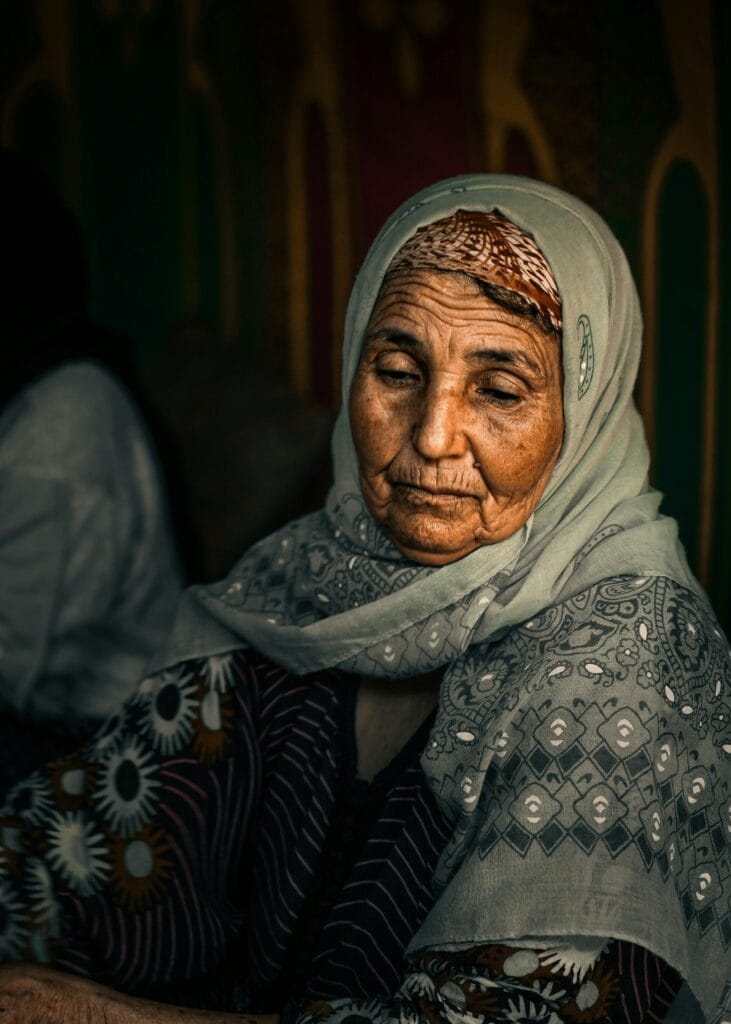
The Rise of Amazigh Dynasties
From the 8th to the 16th centuries, Amazigh dynasties ruled Morocco and beyond:
- The Idrisids (788–974) — first Islamic state in Morocco, founded with Amazigh support.
- The Almoravids (1040–1147) — desert warriors who spread Islam from the Sahara to Spain, founding Marrakesh.
- The Almohads (1121–1269) — mountain reformers from the High Atlas who built monumental architecture such as the Koutoubia Mosque.
- The Marinids (13th–15th centuries) — patrons of education, responsible for Fez’s madrasas.
These dynasties fused Amazigh values of justice, solidarity, and piety with Islamic law, forming the Moroccan identity we know today.
Amazigh Language and Identity
Tamazight: The Voice of the Mountains
The Tamazight language (ⵜⴰⵎⴰⵣⵉⵖⵜ) — written in Tifinagh script — is one of the oldest linguistic systems still alive today. It unites multiple dialects:
- Tachelhit (spoken in Souss & High Atlas),
- Tamazight of the Middle Atlas,
- Tarifit (in the Rif region).
Each dialect preserves oral poetry, proverbs, and history, transmitted from mothers to children — a living archive of the nation’s memory.
Cultural Revival
In 2011, Morocco officially recognized Tamazight as a national language, and the Royal Institute of Amazigh Culture (IRCAM) was established to promote it in education and media.
Amazigh Traditions: Dance, Music, and Celebration
Ahwach and Ahidus: The Rhythm of the Mountains
Dance and music are the pulse of Amazigh communal life.
Ahwach, in the High Atlas and Souss, and Ahidus, in the Middle Atlas, are collective performances that blend poetry, rhythm, and choreography.
Each movement, each drumbeat, symbolizes unity and identity — a living metaphor for Amazigh resilience. These performances often accompany weddings, harvest festivals, and moussems (spiritual gatherings).
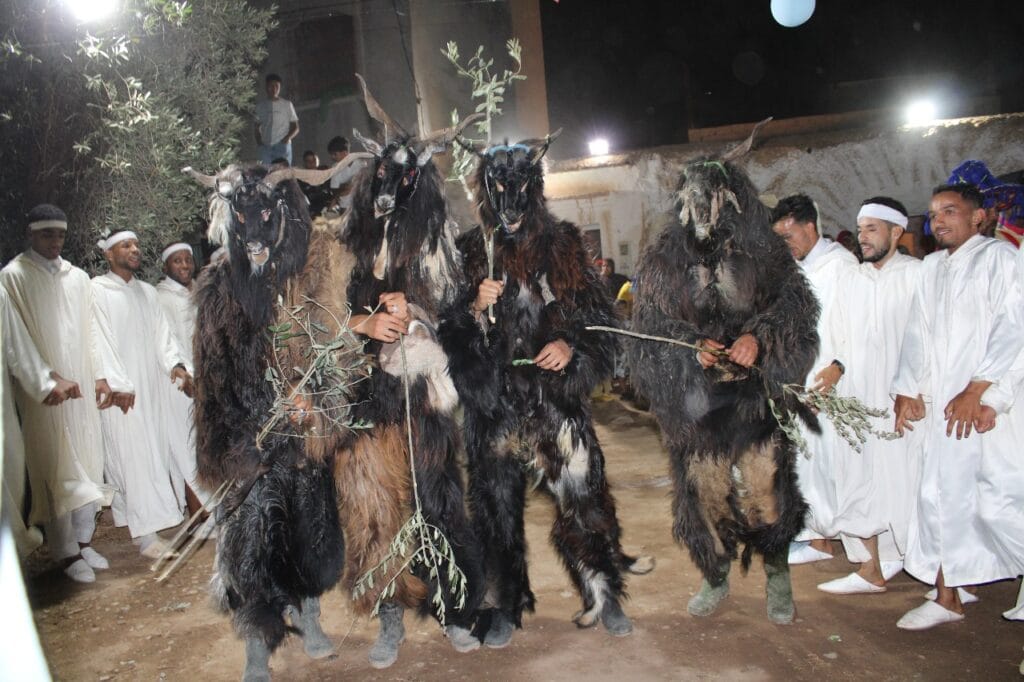
Amazigh Weddings: A Rite of Love and Continuity in history of Amazigh people
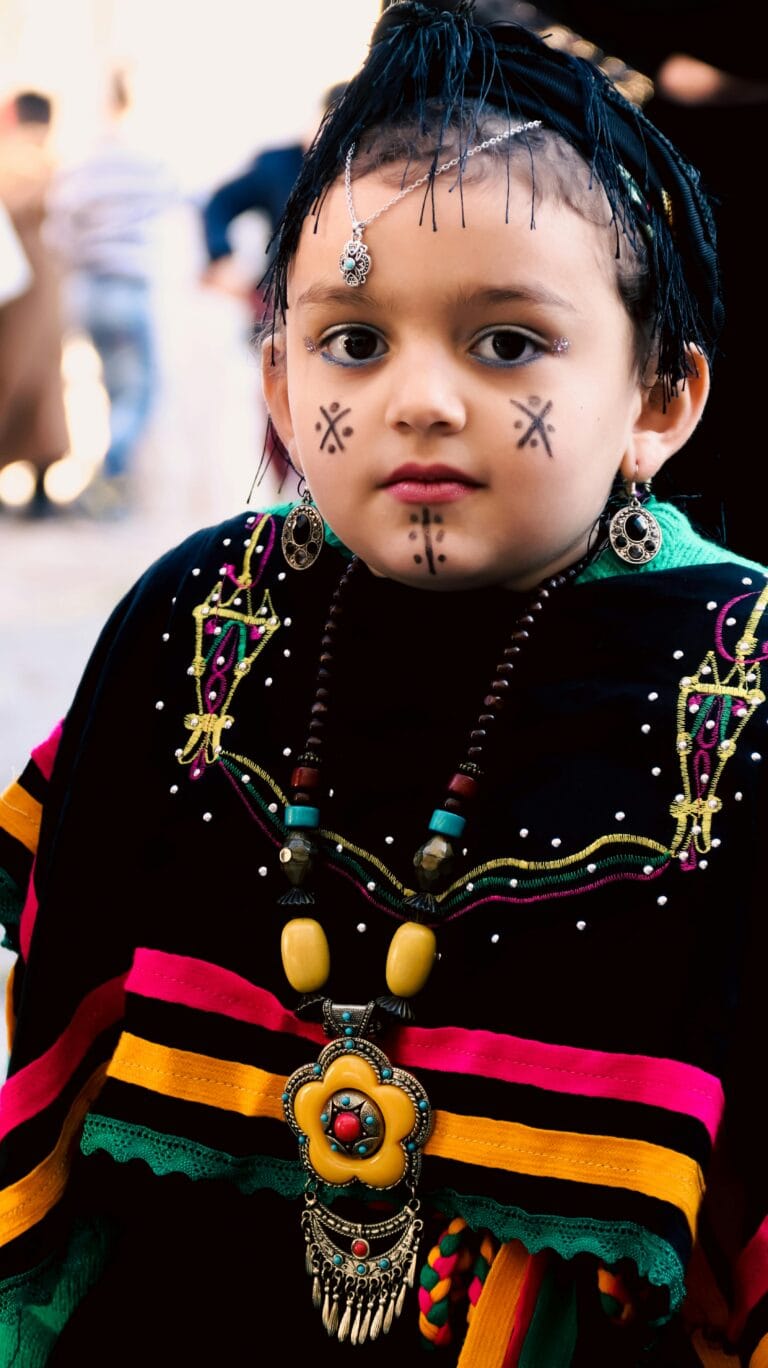
Amazigh weddings last several days, filled with symbolic rituals — henna ceremonies, traditional songs, and the bride’s adornment with silver jewelry and colored veils. The celebration represents the union of families and the reaffirmation of cultural belonging.
The Artistic Soul of the Amazigh People
Weaving and Textiles: Patterns of Memory
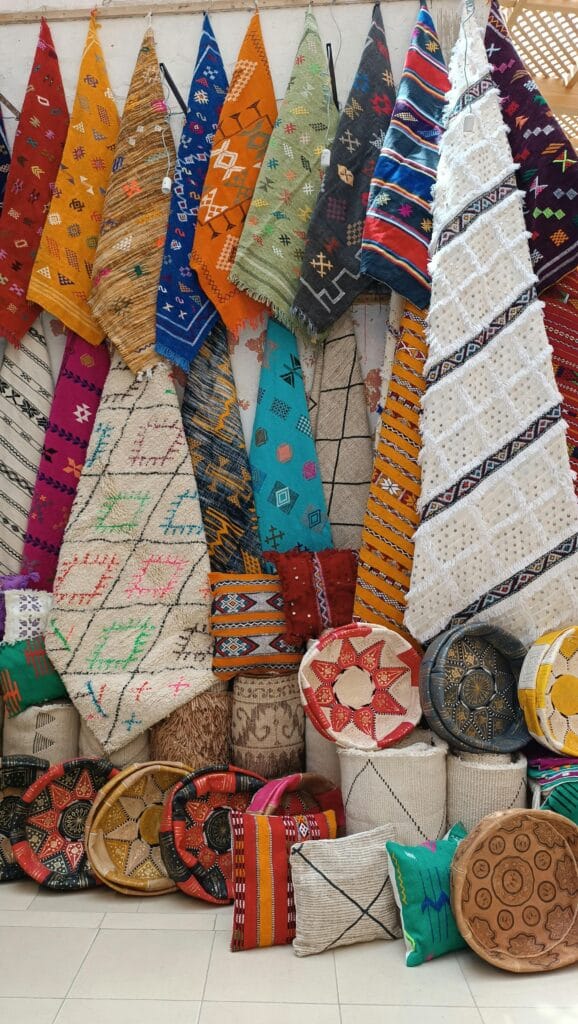
Amazigh women are the keepers of heritage through weaving.
Each carpet — whether from Aït Ouaouzguite, Beni Ourain, or Zemmour — tells a story of fertility, protection, and community.
Symbols like diamonds, lozenges, and zigzags represent life, femininity, and the cosmos. Natural dyes from saffron, pomegranate, and indigo connect art to the land.
Jewelry: Silver and Symbolism
Amazigh jewelry, particularly from the Sous and Anti-Atlas, is more than adornment. Each piece — a fibula (tizerzai) or necklace (tighremt) — carries tribal identity and spiritual protection.
The heavy silver reflects purity, while motifs like hands, triangles, and suns express cosmic balance.
Architecture: Homes of Clay and Spirit
Amazigh architecture reflects harmony with the environment:
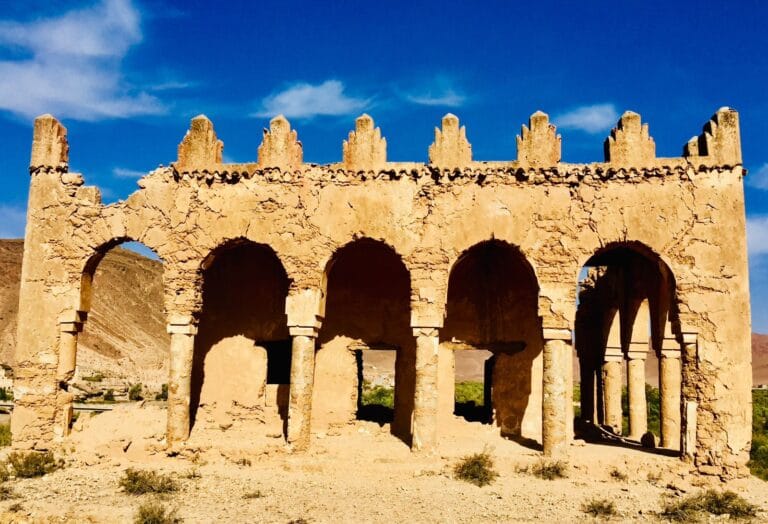
- Kasbahs and Ksour: fortified homes of the valleys.
- Agadirs: collective granaries symbolizing community trust.
- Earthen materials like clay, stone, and timber embody sustainability.
Structures like Aït Ben Haddou or Tizourgane stand as living museums of Amazigh ingenuity.
Amazigh Economy and Agriculture
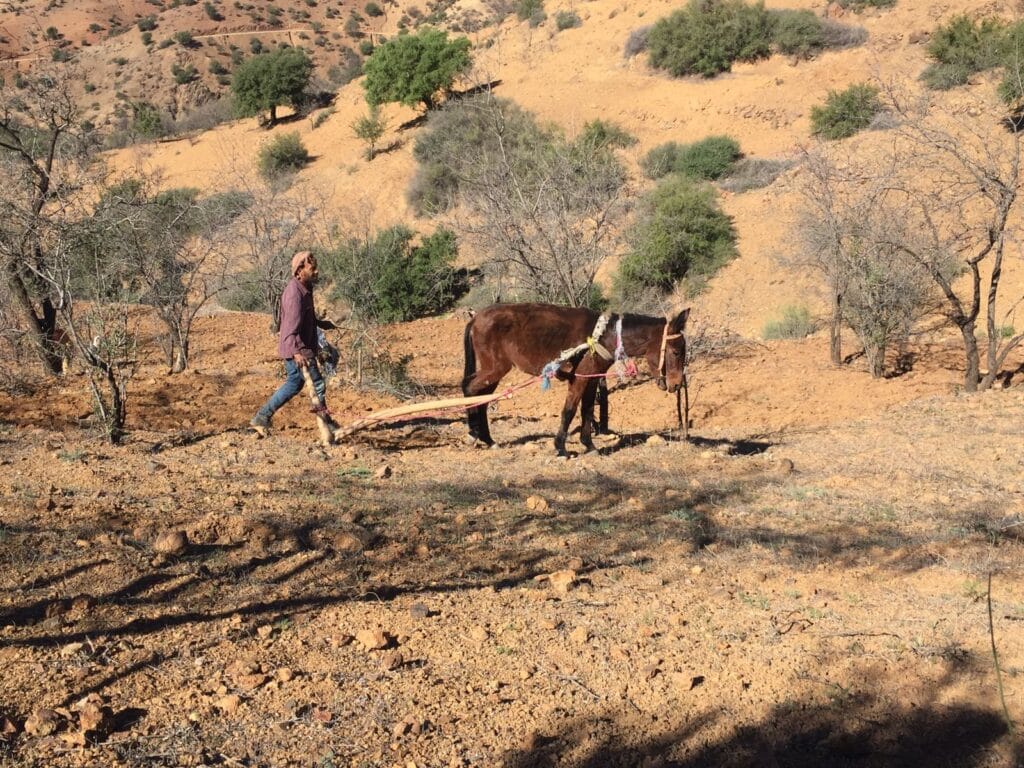
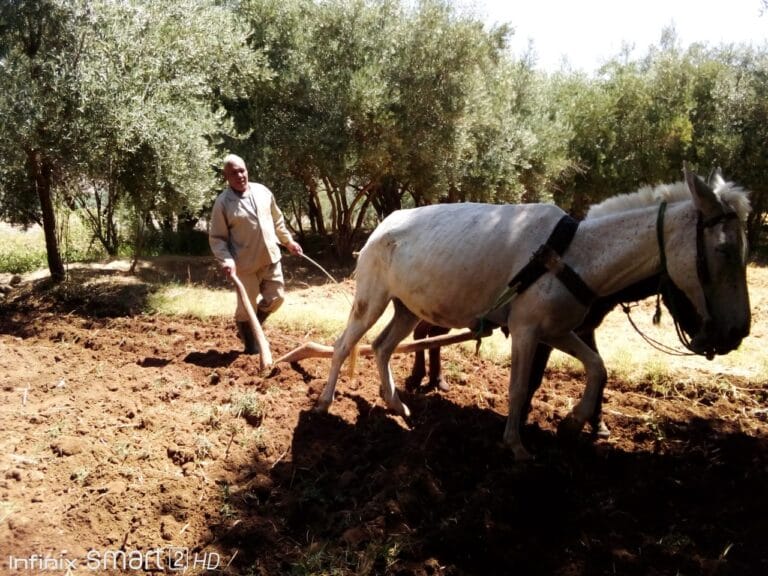
Amazigh communities have sustained mountain life for centuries through terraced agriculture, olive and argan cultivation, and pastoralism.
Their sustainable practices reflect deep ecological wisdom: water conservation, seasonal rotation, and collective work (known as tawiza).
The Argan tree, unique to southwestern Morocco, symbolizes this bond — a sacred tree that sustains both life and economy, primarily through women’s cooperatives.
Agdal: Customary Resource Governance in the High Atlas
The agdal is an important example of how some Amazigh communities have organized access to natural resources. In parts of the High Atlas, agdal systems have regulated the use of resources such as pastures, forests, and other communal or locally managed areas. Their rules may restrict access during particular periods, allowing vegetation to recover or protecting resources during sensitive stages of the seasonal cycle.
An agdal should not be understood as one standardized institution operating identically throughout Morocco. The term refers to related customary arrangements whose rules, boundaries, participants, and purposes differ from place to place. Some systems are associated particularly with pastoral grazing, while others involve different types of resources and local management practices.
These arrangements are significant because they connect environmental management with community organization. Decisions about when livestock can enter a pasture, who may collect particular resources, or how access is distributed can affect household income, agricultural planning, and relationships among community members. Rules may be transmitted orally and enforced through local institutions and recognized obligations.
Agdal systems also demonstrate that environmental knowledge is not merely a collection of individual skills. It can be embedded in collective agreements, customary law, seasonal calendars, and shared responsibilities. Resource management depends not only on knowing when plants grow or animals graze but also on coordinating the actions of people who depend on the same landscape.
Nevertheless, it would be inaccurate to describe every agdal system as perfectly sustainable or unchanged over centuries. Research documents both the resilience of customary governance and its degradation or disappearance in some places. Legal uncertainty, changing land administration, migration, economic pressures, and environmental change can weaken the institutions that support collective management.
The agdal therefore provides a valuable case study in the relationship between Amazigh culture, land rights, and environmental governance. It demonstrates how local communities have developed ways of managing scarce resources while also showing why the future of such systems depends on changing social, legal, and ecological conditions.
Water in Amazigh Society: A Foundation of Rural Life
In Morocco’s mountains and drylands, water availability has influenced settlement, agriculture, livestock keeping, and cooperation between households. For many rural Amazigh communities, access to water has been essential to the survival of crops, the maintenance of animals, and the preparation of food. It has also shaped the location of villages and the organization of cultivated land.
In parts of the High Atlas, agricultural terraces are irrigated through channels known locally in many areas as seguias. Springs, streams, and water derived from seasonal precipitation can supply these systems. The availability of water changes throughout the year, and irrigation arrangements must respond to differences in terrain, rainfall, snowmelt, and the needs of crops.
Water distribution can also require collective rules. Communities may establish arrangements concerning access, maintenance, timing, and responsibilities for irrigation infrastructure. These rules are not identical everywhere, but they illustrate how water management can become a social institution rather than simply a technical task.
Maintaining an irrigation channel may require labor, coordination, and agreement among users. Disagreements over timing or access can affect livelihoods and relationships between households. Water management consequently brings together practical knowledge, customary rules, local authority, and cooperation.
Today, many rural communities face additional pressures associated with drought, changing precipitation, declining water availability, migration, and shifts in agricultural activity. Research in High Atlas villages has documented households reducing the area cultivated or abandoning particular crops when irrigation water becomes unreliable. Such changes can also influence livestock numbers, household income, and the willingness of younger generations to remain in agriculture.
Water therefore provides a powerful way to understand the interaction between history and contemporary change. It reveals how Amazigh communities have adapted to local environments, how collective institutions have supported rural livelihoods, and how environmental pressures are now transforming the conditions under which traditional knowledge can be used.
Amazigh Agriculture and Food Systems
Agriculture has been central to the livelihoods of many Amazigh communities, although its importance varies by region and household. Mountain farming, oasis agriculture, dryland cultivation, pastoralism, trade, and wage employment have combined in different ways across Morocco. Rather than representing a single traditional system, Amazigh livelihoods reflect adaptation to diverse environments and changing economic circumstances.
In parts of the High Atlas, irrigated terraces allow households to cultivate crops on steep slopes. Depending on altitude, water availability, and local conditions, cultivated fields may produce cereals, legumes, vegetables, and fruit or nut trees. Rainfed cultivation can complement irrigated agriculture, while livestock provide additional resources and economic value.
Agriculture requires more than planting and harvesting. It involves selecting crops, maintaining soil, managing water, storing seeds, organizing labor, preserving food, and deciding how much production should be consumed, stored, exchanged, or sold. These decisions are influenced by household size, available labor, weather, market access, and expectations about future harvests.
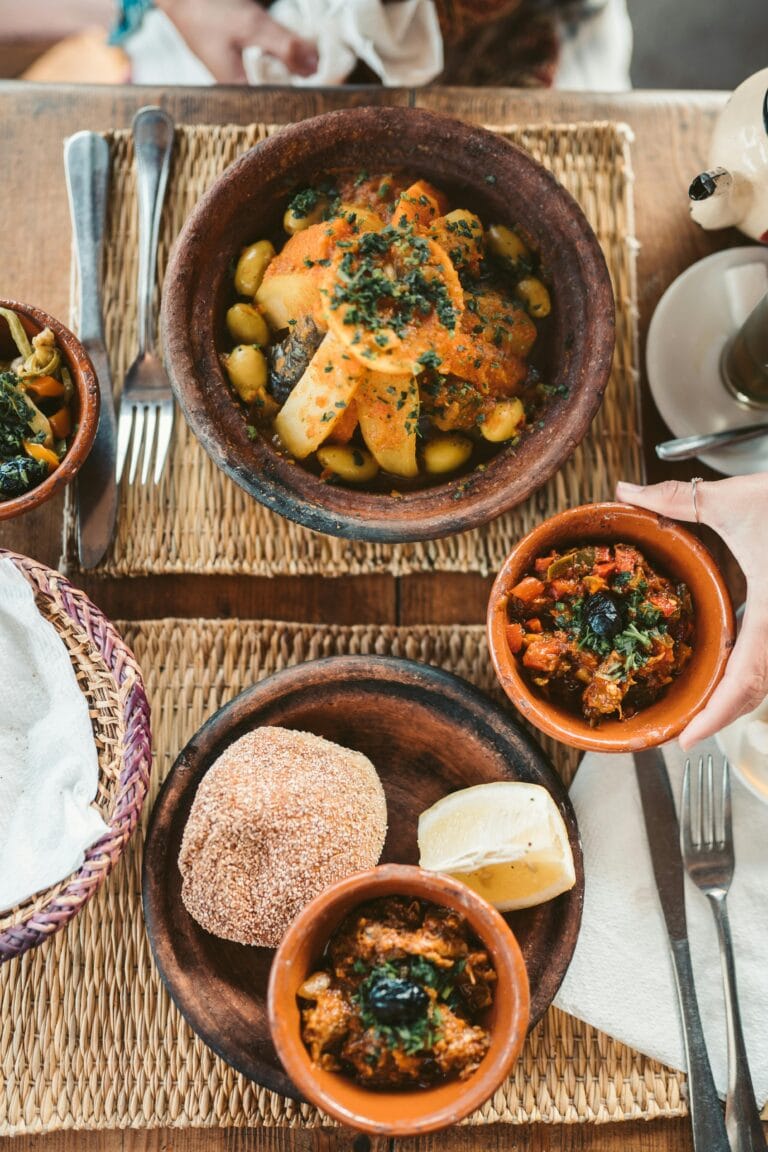
Food systems connect agriculture with cultural knowledge. Local meals depend on the crops and animals available, seasonal cycles, preservation techniques, and the skills required to process ingredients. Knowledge of wild edible plants, herbs, seeds, cereals, dairy products, and traditional storage practices can be part of the practical knowledge transmitted within families.
Agriculture also connects rural households to wider economies. Some households sell produce, purchase food, receive remittances from relatives, or combine farming with tourism and other employment. A family may continue cultivating its land even when agriculture is no longer its principal source of income. In other cases, water shortages and limited labor can make cultivation increasingly difficult.
It is therefore misleading to describe Amazigh agriculture as a completely self-sufficient or unchanging way of life. Historically, communities have traded, exchanged resources, migrated, and adapted their production to changing conditions. Today, drought, labor shortages, market pressures, and rural-urban connections are reshaping these systems. Their history is a story of practical knowledge and adaptation, not simply of traditional techniques preserved unchanged.
Pastoralism and Transhumance: Living With Seasonal Landscapes
Pastoralism has played an important role in many Amazigh communities, particularly in mountain and dryland environments where cultivated land is limited or rainfall is unreliable. Sheep, goats, and other livestock can provide food, materials, income, and a form of economic security. The importance of each animal and the organization of herding differ between regions and households.
In some mountain communities, livestock use different grazing areas according to the season. This movement can be part of transhumance, a system in which herds move between complementary seasonal pastures. Transhumance is not the same as unrestricted nomadism: it often involves recurring routes and relationships between established settlements and particular grazing areas.
Seasonal movement requires detailed knowledge of vegetation, water sources, weather, terrain, and the condition of animals. Herders must consider when pastures are available, how long resources will last, and how grazing can be coordinated with other users. Such decisions are also influenced by customary rights, family labor, access to animals, and the availability of alternative income.
Livestock are connected to more than the production of meat or milk. Wool can provide material for textiles, while dairy products contribute to household food systems. Animals may also represent savings that can be sold when money is needed. Their importance can therefore extend across food security, craft production, household finances, and social obligations.
Pastoral livelihoods are changing. Drought and reduced pasture productivity can make seasonal movement more difficult. Migration can reduce the labor available for herding, while education and off-farm employment may change the aspirations of younger family members. Some households reduce their herds or abandon particular routes; others continue pastoralism alongside farming and wage work.
Pastoralism should thus be understood as a complex livelihood system shaped by environmental conditions, knowledge, mobility, and social institutions. Its history helps explain how Amazigh communities have made use of landscapes that cannot be understood solely through permanent settlement or cultivation.
10. Tiwizi and Collective Labor: Cooperation in Everyday Life
The term tiwizi is used in some Amazigh contexts for forms of collective help or cooperative labor. The precise meaning, pronunciation, and practices associated with the term can vary by locality. In communities where reciprocal labor arrangements have been important, people may help one another with tasks that would be difficult for a household to complete alone.
Collective labor can be useful during agricultural work, harvesting, the maintenance of irrigation channels, building activities, or preparations for major family and community events. Its form depends on local circumstances. In some cases, help may be reciprocated directly; in others, participation may reflect broader expectations of solidarity and mutual responsibility.
These arrangements have practical value. Agricultural work is often seasonal, and a delay at a critical moment can affect the harvest. A household with limited labor may benefit from assistance from relatives or neighbors. Similarly, maintaining shared infrastructure can require contributions from several users rather than the effort of a single family.
Reciprocal work also reinforces social relationships. Cooperation creates opportunities to maintain trust, exchange information, strengthen ties between households, and demonstrate commitment to a community. These relationships can become particularly important when people face illness, poor harvests, construction needs, or other difficult circumstances.
However, collective labor should not be romanticized as an equal or universal practice. Participation depends on available time, resources, social relationships, and local expectations. Such arrangements can change when wage labor becomes more common, people migrate, or agricultural work declines.
The importance of tawiza lies in showing how community life can be organized through practical cooperation as well as formal institutions. It provides a way to understand the connection between work, reciprocity, and belonging in some Amazigh communities, while recognizing that contemporary economic changes are reshaping the conditions under which collective labor operates.
The Amazigh Household as an Economic and Cultural Unit
The household is one of the most useful starting points for understanding everyday Amazigh life. In many rural communities, it has historically brought together production, consumption, childcare, education, social relationships, and cultural transmission. The household was not simply a private place separated from the economy; it could be a working environment in which many activities essential to family life took place.
Depending on the region, household activities might include cultivating land, caring for livestock, processing grain, preparing and preserving food, maintaining buildings, producing textiles, gathering plants, or preparing goods for exchange and sale. These tasks were distributed according to local expectations, age, ability, resources, and family circumstances. The organization of labor was not identical in every household.
The household was also an environment of informal learning. Children could acquire language through everyday conversation, learn practical skills by observing relatives, and become familiar with local food, plants, animals, and social expectations through participation in routine activities. Stories, proverbs, songs, instructions, and family memories helped connect knowledge with everyday experience.
Economic and cultural functions were therefore closely connected. A weaving technique could be both a productive skill and a form of artistic knowledge. Food preparation could involve knowledge of crops, seasons, preservation, and hospitality. Caring for animals could transmit information about breeding, pasture conditions, and household resources.
This does not mean that household life was always harmonious or that responsibilities were shared equally. Domestic labor could be demanding, and expectations varied according to gender, age, household position, and economic circumstances. Unpaid work was often essential to family survival even when it was not recorded as formal economic activity.
Today, education, wage employment, migration, technology, and changing household structures are transforming these patterns. Some activities move from the household to markets or specialist workplaces; others remain important but are performed differently. The household remains a valuable lens through which to examine how Amazigh people connect economic survival, social relationships, and cultural continuity.
Gender, Work and Social Responsibilities in Amazigh Communities
Amazigh livelihoods have often depended on the contributions of women and men, but the distribution of work and authority has varied considerably between communities, households, and historical periods. Agriculture, livestock care, food production, construction, commerce, textiles, childcare, and community responsibilities cannot be described through one universal gender arrangement.
In some rural contexts, women have played important roles in agricultural work, food processing, household management, textile production, and the transmission of language and practical knowledge. Men may have been more involved in particular forms of herding, construction, external trade, wage labor, or formal community representation, depending on local circumstances. These are broad patterns, not fixed rules, and actual responsibilities often overlap.
The distinction between work and authority is particularly important. A person may contribute substantially to a household’s economy without having equal access to property, public decision-making, or formal leadership. Similarly, cultural visibility does not automatically demonstrate social equality. The existence of women’s songs, crafts, or ceremonial roles should not be treated as proof that women and men have always enjoyed equal rights.
Gender relations have also changed over time. Education, migration, paid employment, cooperatives, legal reforms, media, and activism have created new opportunities and new pressures. Some women have gained greater economic independence or public visibility, while other women continue to face barriers related to resources, mobility, employment, or household expectations.
The history of Amazigh society becomes more accurate when it recognizes both cooperation and inequality. Families and communities have relied on many forms of labor and knowledge, but the distribution of recognition, resources, and decision-making has not necessarily been equal.
For a fuller discussion of women’s daily lives, cultural production, economic participation, and changing social roles, this article should be read alongside Iwziwn’s dedicated study of Women in Amazigh Society. That specialist article can explore women’s experiences in greater detail without requiring the present historical overview to repeat the same material.
Amazigh Knowledge: Plants, Animals, Seasons and Landscapes
Knowledge is an essential but sometimes overlooked part of Amazigh heritage. In many rural communities, people have developed detailed practical knowledge of local environments through work, observation, experience, and the transmission of information between generations. This knowledge may concern plants, livestock, soil, water, weather, food, construction materials, and the timing of seasonal activities.
Knowledge of plants can include recognizing edible species, identifying plants used in household remedies, collecting fodder, selecting materials for domestic use, and understanding where particular species grow. Such knowledge is often local because plant availability changes with altitude, rainfall, soil, and habitat. A plant familiar in one region may be uncommon or used differently elsewhere.
Agricultural knowledge can involve observing seasonal conditions, selecting crops, maintaining terraces, managing irrigation, storing seeds, and adjusting work to rainfall and temperature. Pastoral knowledge may include recognizing grazing conditions, understanding animal behavior, identifying water sources, and planning seasonal movement. These skills are practical responses to particular environments rather than a single, uniform body of knowledge shared identically by all Amazigh people.
Knowledge can also be social. Information about access to pasture, water distribution, communal responsibilities, or the appropriate timing of particular activities may be embedded in customary agreements and local institutions. In this sense, knowledge is not simply something individuals possess; it can be maintained through community relationships and shared practices.
This heritage should not be portrayed as infallible or unchanging. Knowledge systems evolve as environments change, new tools become available, and people encounter new scientific, educational, and economic opportunities. Some practices remain useful, others are adapted, and still others become less relevant when the conditions that supported them disappear.
Documenting Amazigh knowledge requires listening to local people, identifying the particular community and environment involved, and distinguishing documented practice from general assumptions. It also requires respect for the people who maintain and transmit this knowledge, rather than treating it merely as material for tourism or cultural display.
Tamazirt: Land, Home and Belonging
In discussions of Amazigh life, the relationship between land and home can carry meanings that extend beyond physical residence. The Tamazight word tamazirt has meanings associated with homeland, country, land, or home depending on linguistic and contextual use. Its meaning should therefore be explained within the particular variety of Tamazight and the situation in which it is used, rather than assigned one universal definition.
For some rural Amazigh communities, belonging is closely connected to a specific territory: the village where a family lives, the fields it cultivates, the pasture used by its animals, or the landscape associated with ancestors and family memories. These places are not simply backgrounds to daily life. They can be linked to language, work, social relationships, and a sense of responsibility toward the community.
Migration can change the relationship between people and their home region without necessarily ending it. A person may live in a city or another country while maintaining connections through family visits, financial support, participation in ceremonies, investment in a house, or involvement in community affairs. For others, migration may weaken everyday contact with the landscape and language associated with earlier generations.
This relationship is not the same for everyone. Some people experience their identity primarily through language and family, while others emphasize a village, region, cultural practice, or broader Amazigh identity. Urban Amazigh people and members of the diaspora may develop new ways of expressing belonging that combine regional heritage with contemporary life.
The idea of home therefore helps explain how identity can remain meaningful even when lifestyles change. Belonging does not require every person to live in the same place or maintain every inherited practice. It can be sustained through relationships, memory, language, and the ways people choose to remain connected to their heritage.
Modern Amazigh Identity: Continuity Through Change
Today, the history of Amazigh people identity thrives across Morocco and North Africa, balancing modernity and tradition.
Movements advocating cultural preservation, language teaching, and economic empowerment have revitalized ancient pride.
Amazigh art now influences Moroccan design, tourism, and education, while youth reinterpret traditions through film, fashion, and digital media.
What Has Changed—and What Has Survived?
The history of Amazigh people in Morocco is neither a story of complete cultural disappearance nor one of traditions preserved without change. It is a history of adaptation, reinterpretation, and continuity under changing political, economic, environmental, and social conditions.
Some practices have declined where the conditions that supported them have changed. Migration, new employment patterns, reduced agricultural activity, language shift, and changing household structures can affect the transmission of particular skills and traditions. A craft may become less common when it no longer provides a viable income, while a local word or oral tradition may be used less frequently when daily communication changes.
Other practices have adapted. Traditional designs may appear in contemporary fashion; songs and musical forms may reach new audiences through recordings and digital platforms; local products may enter wider markets; and Amazigh language may gain new spaces through education, publishing, media, and public events. These developments do not preserve every original context, but they demonstrate that cultural practices can acquire new meanings and functions.
Continuity also depends on people and institutions. Families transmit language and knowledge, artists reinterpret inherited forms, researchers document oral histories, associations organize cultural activities, and communities negotiate access to resources and places. Public recognition and legal protection can support this work, although they cannot replace the participation of the people whose heritage is being maintained.
It is equally important to recognize that cultural change is not always experienced positively. Commercialization may reduce the control artisans have over their work, environmental pressures can undermine traditional livelihoods, and public representations may simplify the diversity of Amazigh communities. Preservation therefore involves questions of ownership, recognition, economic fairness, and the right of communities to represent themselves.
Amazigh heritage is best understood as a living process. Its continuity lies not in keeping every practice unchanged, but in the capacity of people to maintain meaningful relationships with language, place, memory, knowledge, and community while responding to new circumstances.
Conclusion – The Future Rooted in the Past
The history of the Amazigh people in Morocco is not confined to museums or textbooks — it’s alive in every song, symbol, and stone wall of the Atlas. It is the history of Morocco itself: diverse, spiritual, creative, and unbroken.
When you hear the echo of a drum in the mountains or trace your fingers along a woven line on a carpet, you touch a civilization that has never stopped breathing.
The history of Amazigh people in Morocco reaches far beyond a chronological account of ancient populations, political dynasties, and major historical events. It is also the history of communities that developed languages, livelihoods, social institutions, artistic traditions, environmental knowledge, and relationships with the landscapes in which they lived.
Amazigh heritage cannot be reduced to a single language, region, or collection of customs. The experiences of the Rif, Middle Atlas, High Atlas, Anti-Atlas, Souss, and southeastern regions reveal different ways of responding to geography, resources, political change, and economic opportunity. Their diversity is part of the wider Amazigh story.
Understanding this history also requires attention to everyday life. Families, agricultural terraces, irrigation channels, pastoral routes, community assemblies, local crafts, and oral traditions can reveal aspects of the past that political chronicles alone cannot explain. They show how people organized work, maintained relationships, passed on knowledge, and adapted to changing conditions.
The history of Amazigh people is also continuing in the present. Tamazight recognition, education, migration, digital media, contemporary art, changing rural economies, and environmental pressures are reshaping the ways people express their identity and maintain connections with their heritage.
For Iwziwn, documenting Amazigh culture means treating it not as a vanished past or an unchanging tradition, but as a living and diverse inheritance. Its significance lies in the relationship between memory and daily life, between local communities and wider historical forces, and between the knowledge passed down through generations and the choices people make today.
To understand the Amazigh is therefore to understand both continuity and change: a deep North African history whose cultural expressions remain part of Morocco’s present and its future.
To understand Morocco’s future, you must listen to its oldest voice — the voice of the Amazigh, the “free people.”
References
- Brett, M. & Fentress, E. (1996). The Berbers. Blackwell.
- Ennaji, M. (2005). Multilingualism, Cultural Identity, and Education in Morocco. Springer.
- Laroui, A. (1977). The History of the Maghrib: An Interpretive Essay. Princeton University Press.
- Hart, D. (2000). Tribes and Modern States in the Middle East. University of California Press.
- Maherzi, A. (2018). Amazigh Architecture and Symbolism. Rabat: IRCAM Publications.
- IRCAM (Royal Institute of Amazigh Culture), Rabat.
- UNESCO Intangible Heritage Lists, “Ahwach”, “Amazigh Weaving”, and “ArganTree Ecosystem”.
- El Azzouzi, H. (2022). Amazigh Women and the Preservation of Cultural Heritage.
One Comment