
Anti-Atlas Mountains: Ancient Secrets of Morocco’s Hidden Heritage
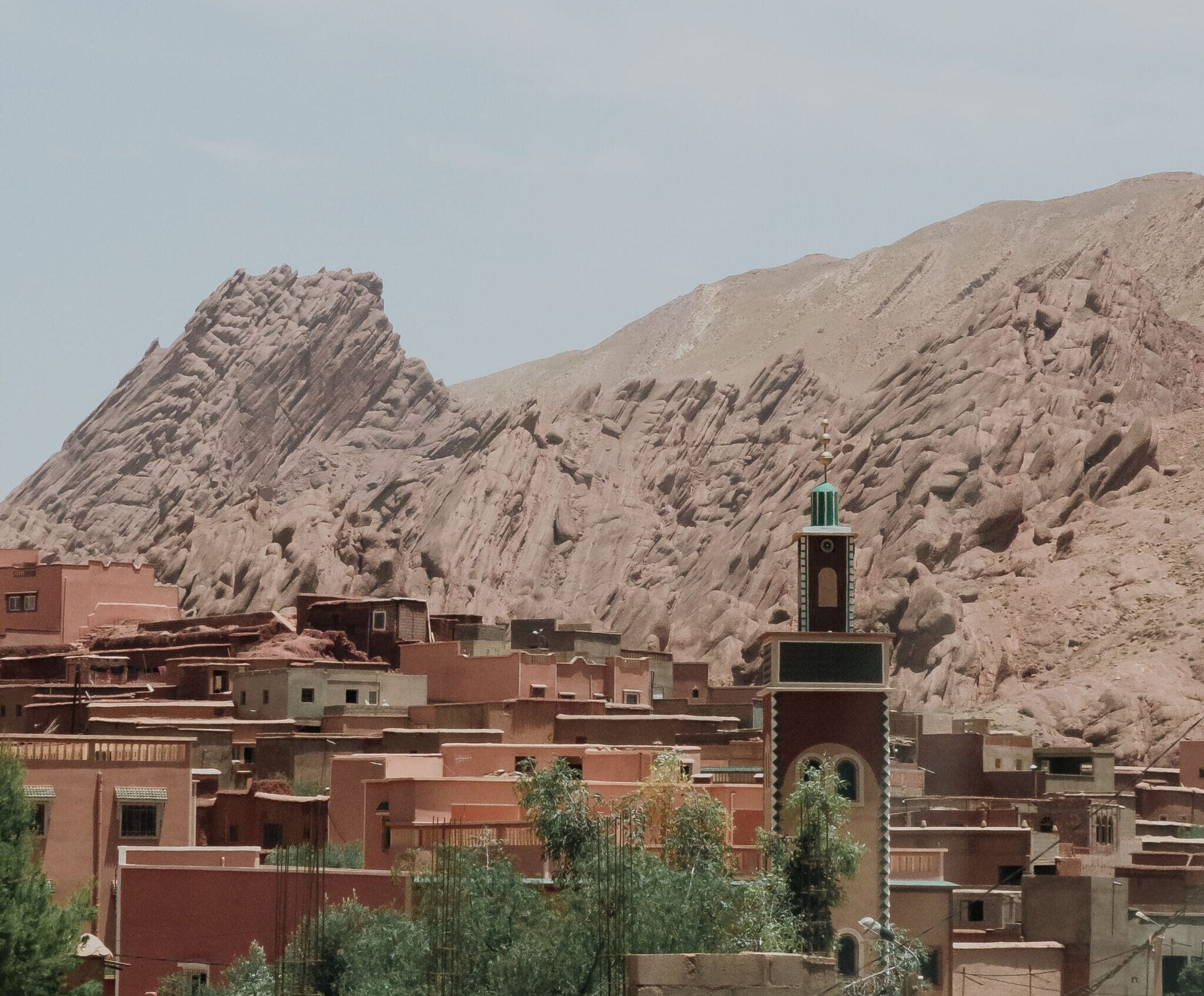
Introduction: The Mountains Beyond the Familiar Morocco
When travelers imagine Morocco’s great mountain landscapes, their minds often go immediately to the snow-covered summits of the High Atlas mountain or the cedar forests of the Middle Atlas mountain. Yet farther south lies a different mountain world—older in geological structure, quieter in appearance, and extraordinarily rich in cultural memory.
The Anti-Atlas Mountains form one of Morocco’s most distinctive mountain regions. Their landscapes extend across a vast territory of rugged ridges, granite formations, dry valleys, oases, plateaus, palm groves, argan forests, fortified villages, and ancient caravan corridors. Here, mountains do not simply dominate the horizon. They organize settlement, agriculture, water management, architecture, mobility, and social life.
For the traveler, the Anti-Atlas mountain can initially appear austere. Its slopes are often dry, its vegetation sparse, and its valleys dramatically exposed to the sun. But this apparent barrenness conceals a remarkable concentration of human adaptation.
Across the region, Amazigh communities developed systems for surviving in an environment where water could determine the fate of an entire settlement. They constructed the Agadir, or communal fortified granaries, developed sophisticated irrigation practices, cultivated oasis agriculture, maintained terraced fields, organized pastoral mobility, and created villages whose architecture responded closely to the surrounding geology.
The Anti-Atlas moutain is therefore not simply a destination for mountain scenery.
It is a landscape in which geology, ecology, economy, architecture, language, memory, and Amazigh identity have interacted for centuries.
This makes the region particularly important for understanding Morocco beyond its imperial cities and major tourist destinations.
The Anti-Atlas mountain also occupies a fascinating position within the broader Atlas system. While the High Atlas forms the country’s great central mountain barrier, the Anti-Atlas represents a more southerly mountain domain that gradually connects the interior of Morocco with the pre-Saharan landscapes and the Sahara. Its valleys and passes historically provided routes between the Souss, the Drâa, the oasis regions, and territories farther south.
To travel through the Anti-Atlas is therefore to encounter a Morocco shaped not only by cities and dynasties but also by mountain communities, agricultural knowledge, pastoral systems, trade, oral traditions, and indigenous institutions.
And perhaps most importantly, the Anti-Atlas demonstrates that a mountain does not need to possess Morocco’s highest summit to possess extraordinary historical depth.
Table of Contents
Where Are the Anti-Atlas Mountains?
The first step toward understanding the Anti-Atlas mountain is geographical precision.
The Anti-Atlas Mountains occupy southwestern Morocco, south of the High Atlas and north of the broader Saharan and pre-Saharan landscapes. Their territory stretches across several provinces and ecological zones and interacts with the Souss-Massa, Drâa-Tafilalet, Guelmim-Oued Noun, and other regional areas.
Rather than imagining the Anti-Atlas mountains as one continuous wall of mountains comparable to the High Atlas, it is more accurate to understand it as a complex system of ranges, massifs, plateaus, valleys, and transitional landscapes.
This geographical structure is one reason why descriptions of the Anti-Atlas mountains can sometimes appear inconsistent. Different geographic classifications divide its component ranges differently, while local communities may use their own place names and regional distinctions.
Among the best-known landscapes and ranges associated with the Anti-Atlas are areas around:
- Tafraoute and the Jbel Lkest massif
- Jbel Sirwa
- Jbel Bani
- Tata and its surrounding valleys
- Akka
- Amtoudi
- Aït Mansour
- Igherm
- Guelmim’s eastern and southeastern hinterlands
- the Drâa-facing southern zones
The Anti-Atlas should therefore be understood as a regional mountain complex rather than a single narrow ridge.
The Position of the Anti-Atlas mountains Within Morocco’s Mountain Geography
The relationship between the Anti-Atlas and the other Moroccan mountain systems is particularly important.
The High Atlas occupies a more northerly position and contains Morocco’s highest elevations, including Jbel Toubkal. The Middle Atlas forms another major mountain system farther northeast, while the Rif dominates northern Morocco.
The Anti-Atlas occupies a more southerly position.
This location gives it an important ecological and cultural role because it lies between the more humid mountain environments of northern and central Morocco and the increasingly arid environments approaching the Sahara.
In geographical terms, the Anti-Atlas is therefore part of a transition zone.
That transition can be observed in vegetation, agriculture, settlement architecture, pastoralism, and water management.
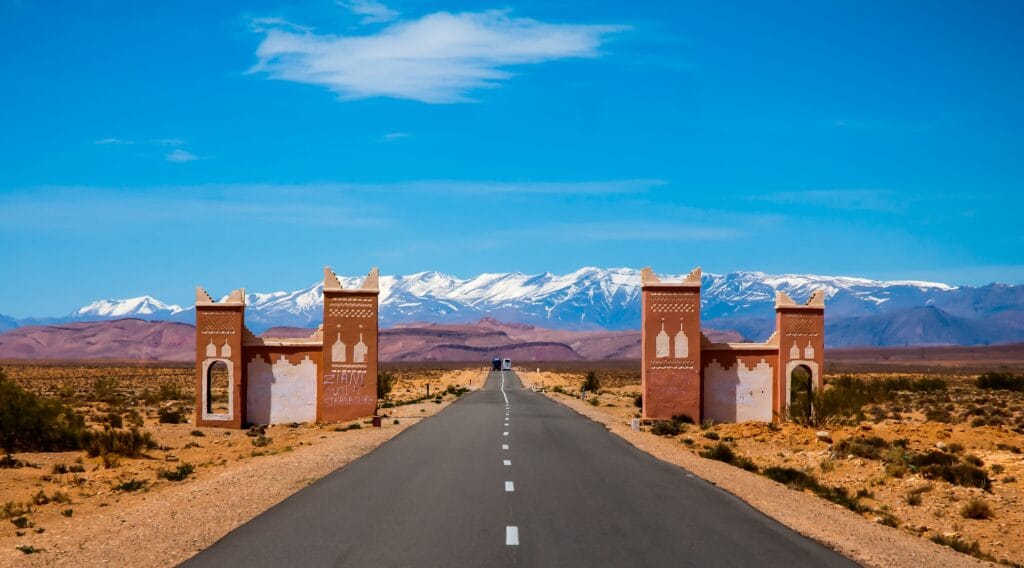
The Borders of the Anti-Atlas mountains : Why They Are Not Simple Lines
One of the most important things to understand about mountain geography is that natural regions rarely follow political boundaries.
The Anti-Atlas is a good example.
Administrative Morocco is divided into provinces and regions, but mountain systems are defined by geology, geomorphology, drainage patterns, elevation, and ecological relationships.
Consequently, asking where the Anti-Atlas “ends” does not always produce a single universally accepted answer.
The northern boundary is broadly associated with the transition toward the High Atlas and the Souss basin, while the southern side gradually approaches pre-Saharan landscapes.
To the southwest, the mountains interact with the landscapes around Guelmim and the Atlantic-facing regions. Farther east and southeast, the Anti-Atlas connects with increasingly arid terrain and mountain chains associated with the Jbel Bani system.
This complexity is not merely academic.
It explains why the Anti-Atlas contains such a remarkable diversity of environments.
Within relatively short distances, a traveler can encounter:
mountain ridges → dry valleys → oasis agriculture → argan woodland → palm groves → desert-edge plateaus.
The Anti-Atlas is therefore best understood as a gradient rather than a single landscape.
A Geological Journey Through Deep Time
Perhaps the most extraordinary characteristic of the Anti-Atlas is hidden beneath its surface.
The region contains some of the oldest geological formations exposed in Morocco and among the most significant Precambrian geological terrains in North Africa.
This gives the Anti-Atlas a scientific importance extending far beyond tourism.
A Mountain System Older Than Many Familiar Landscapes
The geological history of the Anti-Atlas mountain reaches deep into Precambrian time.
The Anti-Atlas contains exposures of the West African Craton and its surrounding geological domains, together with younger sedimentary sequences and tectonic structures that record several stages in the geological evolution of North Africa.
This means that when visitors walk through the rocky landscapes around Tafraoute, Tata, or other Anti-Atlas regions, they are not simply observing “old mountains.”
They are moving through a geological archive.
Rocks preserve evidence of ancient environments, tectonic activity, sedimentation, erosion, and changing climatic conditions.
The Anti-Atlas mountains as a Geological Archive
The geological significance of the Anti-Atlas has made the region important for researchers studying:
- Precambrian geology
- plate tectonics
- mineral deposits
- sedimentary evolution
- structural geology
- paleoenvironments
- geomorphology
This geological complexity also helps explain the extraordinary visual character of the region.
Granite formations, dark mountain ridges, deeply eroded valleys, exposed rock surfaces, and sedimentary formations create landscapes dramatically different from the greener mountain environments farther north.
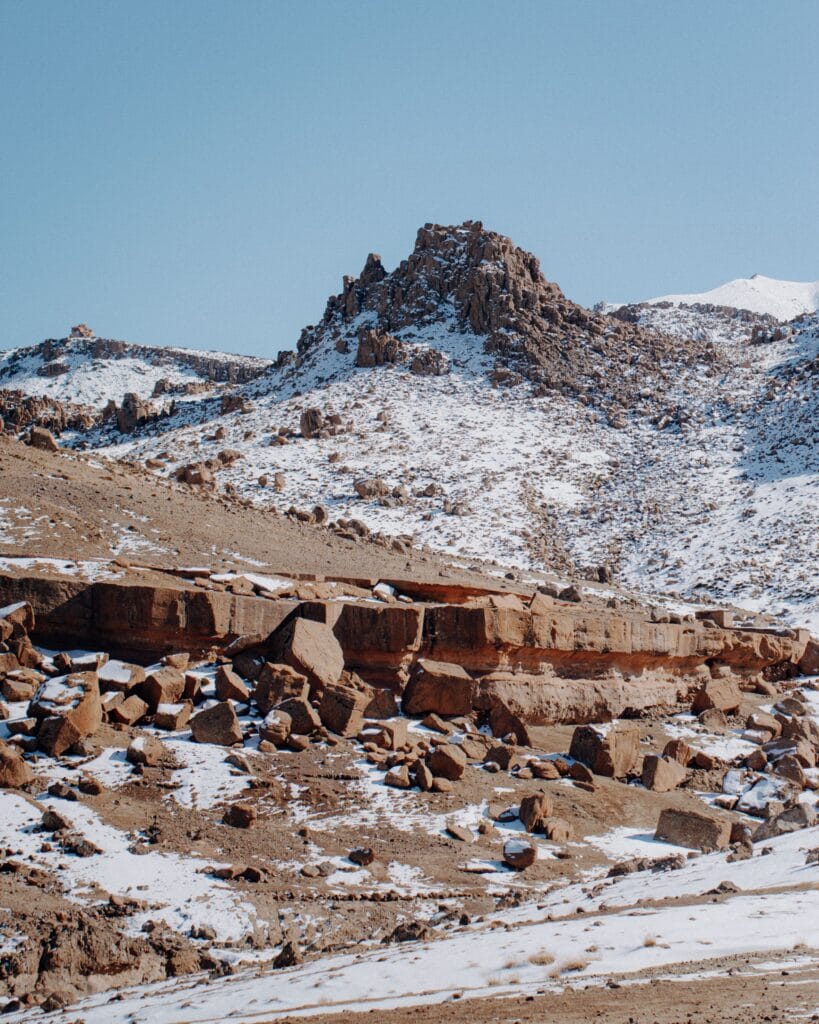
Jbel Sirwa: A Mountain Between Worlds
One of the most fascinating peaks associated with the southern Moroccan mountain landscape is Jbel Sirwa, sometimes written as Siroua.
Situated in the transition between the High Atlas and Anti-Atlas systems, Jbel Sirwa occupies an important geographical position.
It is not simply a summit.
It represents a transition between ecological and cultural worlds.
The mountain is associated with high plateaus, pastoral landscapes, volcanic geology, seasonal movement, and Amazigh communities.
The Sirwa region also illustrates an important principle in Moroccan geography: mountain systems should not always be understood as isolated units.
The boundaries between the High Atlas and Anti-Atlas are often zones of interaction.
For this reason, a serious Anti-Atlas article should mention Jbel Sirwa carefully rather than simply assigning every surrounding landscape to one mountain chain.
Tafraoute and the Granite Landscapes of the Anti-Atlas
Among the best-known destinations of the Anti-Atlas is Tafraoute.
The town is surrounded by dramatic granite landscapes that have become one of the visual signatures of southern Morocco.
Massive rock formations rise from the valleys, sometimes appearing almost sculpted by human hands.
But the landscape should not be understood only aesthetically.
The granite terrain influences settlement, agriculture, transportation, and local perceptions of place.
Tafraoute as an Amazigh Mountain Town
Tafraoute is deeply associated with the Amazigh cultural landscape of the western Anti-Atlas.
The surrounding communities have historically relied on combinations of agriculture, pastoralism, trade, migration, and local commerce.
The region’s built environment reflects adaptation to a dry mountain climate.
Stone, earth, and locally available materials have traditionally played important roles in construction.
The architecture is therefore not simply decorative.
It is environmental knowledge expressed through buildings.
The Anti-Atlas and Amazigh Settlement
The Anti-Atlas cannot be understood without studying its human geography.
Many communities in the region have historically spoken varieties of Tashelhit (Tachelhit), one of the major Amazigh language varieties of Morocco.
Language here is more than a communication system.
It carries:
- place names
- agricultural terminology
- kinship vocabulary
- oral history
- poetry
- proverbs
- ecological knowledge
- religious expressions
- traditional institutions
The linguistic landscape therefore provides an additional layer for understanding the region.
Place Names as Cultural Archives
Mountain place names often preserve information about how communities understood their environment.
A name may refer to:
- water
- vegetation
- animals
- geological formations
- agricultural activity
- a historical event
- a saint or religious figure
- a tribal or family association
For researchers, toponyms can therefore function as small fragments of historical evidence.
They do not provide a complete history on their own, but when combined with oral traditions, archival sources, archaeology, and linguistic analysis, they can reveal how communities conceptualized territory.
The Anti-Atlas as a Guardian of Amazigh Culture
The phrase “guardian of Amazigh culture” should not be understood literally.
Mountains do not preserve culture automatically.
People preserve culture.
The importance of the Anti-Atlas lies in the way its geography historically supported forms of community organization that allowed local knowledge to survive.
Remote valleys, dispersed settlements, difficult terrain, and strong local institutions could contribute to cultural continuity.
But cultural continuity was always active.
Parents taught children.
Artisans transmitted techniques.
Farmers passed down agricultural knowledge.
Elders preserved oral histories.
Women transmitted textile traditions.
Religious specialists maintained ritual knowledge.
Poets preserved historical memory.
In this sense, the Anti-Atlas functioned as a cultural environment rather than a passive container.
The Agadir: Fortified Granaries of the Anti-Atlas
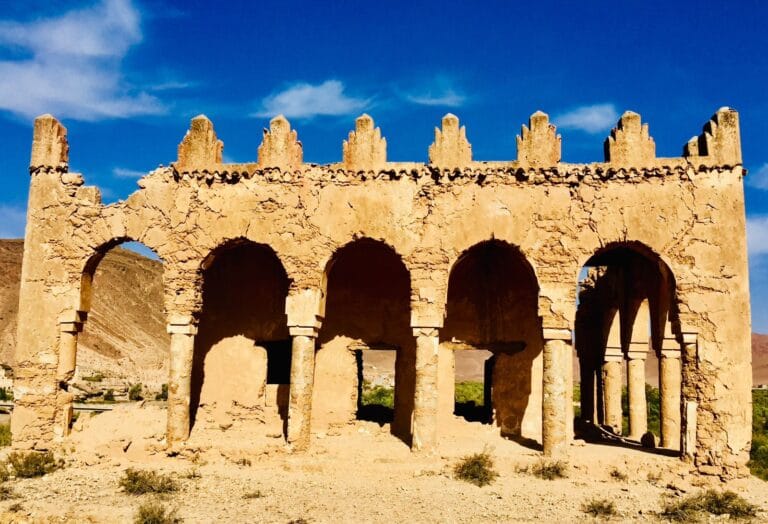
Few structures demonstrate the relationship between architecture and social organization more clearly than the Agadir.
In many southern Amazigh communities, an Agadir traditionally functioned as a communal fortified granary.
It could contain individual storage compartments belonging to families or households while being protected collectively.
This system reveals something fundamental about Amazigh society:
food security was also a social institution.
More Than a Storehouse
An agadir protected grain, agricultural products, documents, valuables, and sometimes other important possessions.
Its defensive architecture reflected historical concerns about security.
But its significance extended beyond defense.
The institution could embody:
- collective responsibility
- property rights
- community law
- cooperation
- social memory
- territorial identity
This makes the agadir especially valuable to anthropologists studying indigenous institutions in Morocco.
Agadir and Collective Governance
The existence of communal storage required rules.
Who could store goods?
Who possessed each compartment?
Who controlled access?
Who repaired the structure?
Who could enter?
What happened during conflict?
What sanctions existed for violating community regulations?
Such questions demonstrate that the agadir was embedded within a broader institutional framework.
It was architecture combined with governance.
Water: The Real Currency of the Anti-Atlas
If the agadir represented collective food security, water represented the foundation upon which that security depended.
The Anti-Atlas receives far less rainfall than Morocco’s wetter northern and mountainous regions.
Rainfall can be highly seasonal and irregular.
As a result, communities developed detailed strategies for capturing, storing, distributing, and conserving water.
Oasis Agriculture
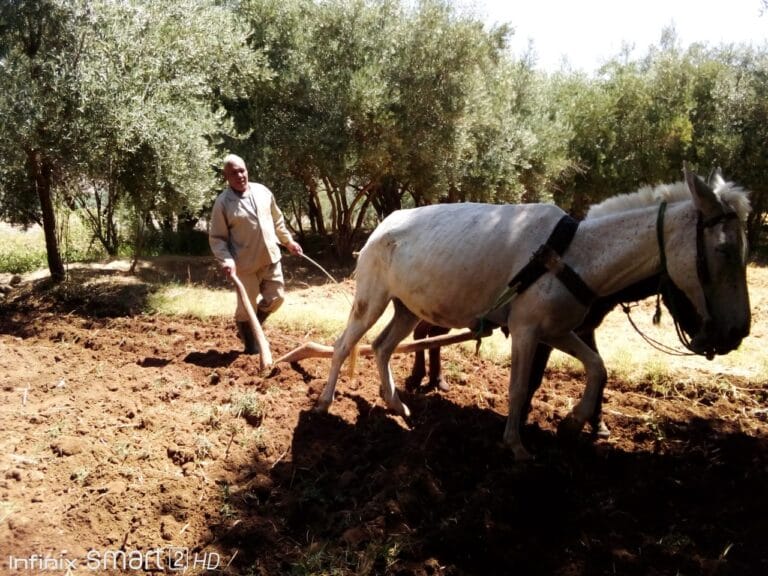
In valleys and suitable depressions, irrigation allowed communities to cultivate crops that would otherwise struggle in the arid environment.
Oasis agriculture can involve several vertical layers of vegetation.
Tall palms provide shade.
Fruit trees occupy intermediate levels.
Lower crops grow closer to the soil.
This structure creates a microenvironment that reduces exposure to extreme heat and allows more efficient use of water.
The agricultural system therefore represents a form of ecological engineering developed through generations of local experience.
The Aït Mansour Valley: Water, Agriculture, and Mountain Life
The Aït Mansour Valley is among the Anti-Atlas mountains landscapes that demonstrate how dramatic the relationship between water and mountain geography can become.
Within an otherwise dry environment, water supports palm groves and agricultural settlements.
The contrast is striking.
Outside the irrigated zones, the landscape can appear rocky and dry.
Inside the valley, vegetation creates a different ecological world.
This transformation demonstrates why water must be considered a central historical factor in Anti-Atlas civilization.
A settlement was never merely located near a mountain.
It was located according to:
water + soil + pasture + security + routes + agricultural possibility.
Argan Trees and the Ecology of the Anti-Atlas mountains
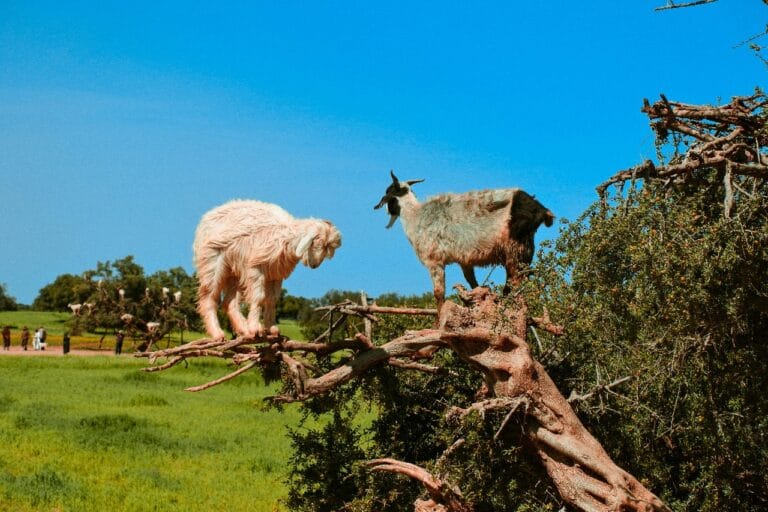
The argan tree is one of the most important elements of southwestern Morocco’s cultural landscape.
Argania spinosa is particularly adapted to semi-arid conditions and has historically provided communities with multiple resources.
The tree produces fruit used for oil production and has also supported livestock systems.
Its importance is therefore ecological and economic at the same time.
Argan as a Cultural Resource
Traditional Moroccan argan oil production involves considerable knowledge.
The process includes harvesting, processing, grinding, and extracting oil.
Women have historically played important roles in many stages of this production.
This makes argan production relevant to studies of:
- women’s work
- household economies
- food systems
- rural entrepreneurship
- cooperative movements
- ecological conservation
- cultural heritage
The contemporary commercialization of argan oil has also transformed the economic significance of the tree.
Women and the Anti-Atlas mountains Rural Economy
Any serious study of Anti-Atlas culture must avoid presenting mountain society as exclusively male.
Women have historically participated in the economic and cultural life of rural communities in numerous ways.
Their work has included:
- agriculture
- livestock management
- food processing
- textile production
- household economy
- argan processing
- childcare
- oral transmission of knowledge
- ritual and ceremonial practices
In many communities, women’s labor is essential to household resilience even when it is not formally recorded in economic statistics.
Textiles and Cultural Memory
Textiles can communicate information about identity, regional aesthetics, social status, and family traditions.
Patterns and techniques vary across Morocco.
It is therefore dangerous to claim that every geometric pattern has one universal symbolic meaning.
A more academically responsible approach is to examine patterns within their specific regional and social context.
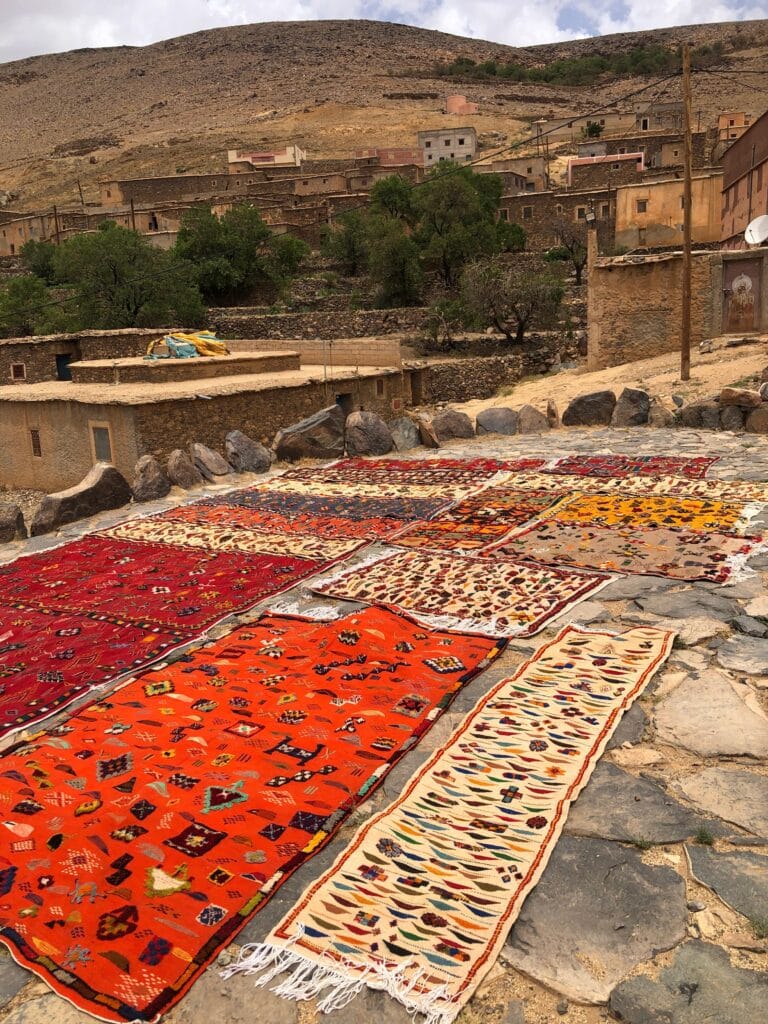
Anti-Atlas mountains Carpets and Textile Traditions
The Anti-Atlas participates in the wider Moroccan tradition of weaving and textile production, while maintaining regional characteristics.
Textiles can function simultaneously as:
objects of use + works of art + economic goods + markers of identity.
A carpet may provide warmth and protection, but its patterns and colors can also carry aesthetic and cultural significance.
The production process itself can transmit knowledge.
A young weaver learns not only how to manipulate wool and thread but also how to participate in a social tradition.
This is one reason craft should be studied as a form of intangible cultural heritage.
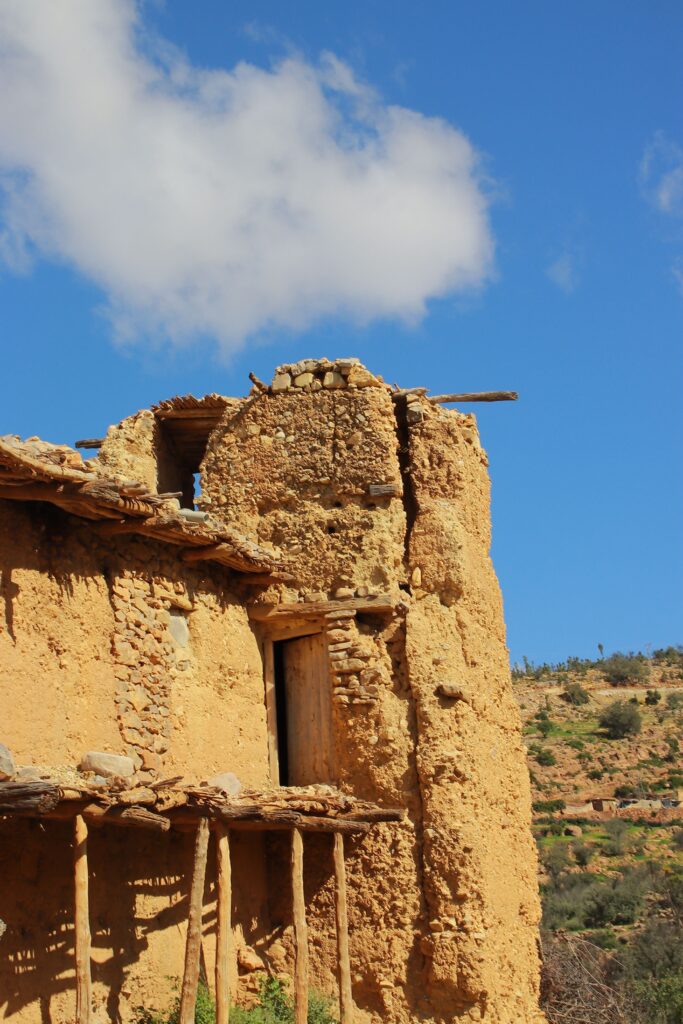
Traditional Architecture of the Anti-Atlas
Architecture in the Anti-Atlas is shaped by environmental constraints.
The climate encourages building strategies that can reduce heat exposure and make efficient use of locally available materials.
Traditional settlements frequently demonstrate:
- compact organization
- earthen construction
- stone construction
- shaded spaces
- narrow passages
- fortified structures
- agricultural integration
The resulting architecture is often visually harmonious with the landscape because it emerges from local materials rather than being imposed upon the environment.
Architecture as Environmental Knowledge
A traditional house can be viewed as a technological system.
Its walls provide thermal mass.
Its orientation affects sunlight.
Its openings regulate air and light.
Its relationship with neighboring buildings creates shade.
Its materials reflect local availability.
This means traditional architecture should not simply be described as “beautiful.”
It should also be studied as indigenous environmental engineering.
Amtoudi and the Cliffside Landscape
Amtoudi is another remarkable Anti-Atlas destination.
Its landscape combines dramatic cliffs, valleys, traditional settlements, agricultural spaces, and historic fortified structures.
The region illustrates how communities used elevated terrain for defensive purposes.
From a strategic perspective, elevated structures provided visibility across surrounding landscapes.
But these sites also became part of local cultural geography.
Today they attract travelers interested in architecture and hiking, but their original meaning was embedded in the economic and social realities of mountain life.
Rock Art and the Prehistoric Anti-Atlas
The Anti-Atlas and surrounding southern Moroccan landscapes are also important for prehistoric archaeology.
Rock art provides evidence that humans interacted with these environments long before the emergence of modern towns.
Images of animals, hunting scenes, geometric forms, and other motifs appear across the broader southern Moroccan archaeological landscape.
However, interpretation requires caution.
A rock engraving cannot automatically be assigned to a specific ethnic group or modern cultural identity.
Archaeologists must consider:
- chronology
- technique
- stylistic comparison
- environmental context
- associated archaeological evidence
- regional patterns
This distinction is essential.
The prehistoric inhabitants of southern Morocco should not simply be labeled “Amazigh” in the modern ethnolinguistic sense without archaeological evidence supporting such a claim.
Caravan Routes and the Anti-Atlas
The Anti-Atlas historically occupied an important position within the wider network connecting southern Morocco with the Sahara and the Atlantic-facing regions.
Trade routes moved through mountain passes, valleys, and oasis settlements.
Goods could include:
- salt
- dates
- cereals
- livestock
- leather
- textiles
- metals
- agricultural products
The Anti-Atlas was therefore not isolated from the wider Moroccan economy.
Its mountain communities participated in regional networks.
From Mountain Valley to Sahara
Routes connecting the Souss, Anti-Atlas, Drâa, and Saharan regions allowed people, goods, information, and cultural practices to circulate.
This movement contributed to cultural exchange.
Languages interacted.
Religious ideas traveled.
Marriage networks expanded.
Craft techniques circulated.
Commercial relationships developed.
The Anti-Atlas should therefore not be imagined as a cultural island.
It was part of a larger North African network of movement and exchange.
The Anti-Atlas mountains and the Souss
The relationship between the Anti-Atlas and the Souss Valley is especially important.
The Souss has historically functioned as one of southern Morocco’s major agricultural and commercial regions.
The mountains surrounding and south of the Souss helped shape its ecological and economic systems.
People moved between mountain and valley environments.
Pastoralists depended on seasonal landscapes.
Farmers traded agricultural products.
Merchants connected settlements.
This created a relationship of complementarity.
The Anti-Atlas supplied resources and access to mountain territories, while the Souss offered broader agricultural and commercial connections.
Language: Tashelhit and the Cultural Geography of the Anti-Atlas
Tashelhit is one of Morocco’s major Amazigh language varieties and is particularly important in southwestern Morocco.
Its distribution extends across areas associated with the Souss, Anti-Atlas, and surrounding regions.
Studying Tashelhit provides insight into:
- local identity
- oral literature
- place names
- agricultural vocabulary
- social organization
- poetry
- proverbs
- historical memory
Oral Poetry
Amazigh oral poetry has historically played an important role in southern Moroccan communities.
Poetry can preserve:
- love
- social criticism
- religious devotion
- historical memory
- political commentary
- moral teaching
In societies where written documentation was historically limited or uneven, oral traditions can become valuable sources for understanding how communities interpreted their own history.
They should not, however, be treated as straightforward chronological records.
Oral tradition is memory, interpretation, performance, and history at the same time.
The Spiritual Landscape of the Anti-Atlas mountains
Religion in the Anti-Atlas has historically been intertwined with local geography.
Shrines, saints’ tombs, mosques, cemeteries, sacred springs, and other religious sites can become important landmarks.
The cultural landscape therefore contains multiple layers of meaning.
A mountain may be:
- a physical landmark
- a source of water
- a pastoral territory
- a place of memory
- a religious site
- a boundary
- a reference point in oral history
This layered understanding of landscape is central to cultural anthropology.
Amazigh Hospitality in the Anti-Atlas
Hospitality is frequently presented in tourism writing as a simple characteristic of Moroccan culture.
A more serious interpretation recognizes hospitality as a social institution.
In rural mountain communities, welcoming a traveler historically involved expectations concerning:
- food
- shelter
- protection
- social reciprocity
- reputation
- community responsibility
Hospitality could therefore become particularly significant in difficult environments where travelers depended upon local communities.
The concept should not be romanticized, but neither should it be reduced to a tourism slogan.
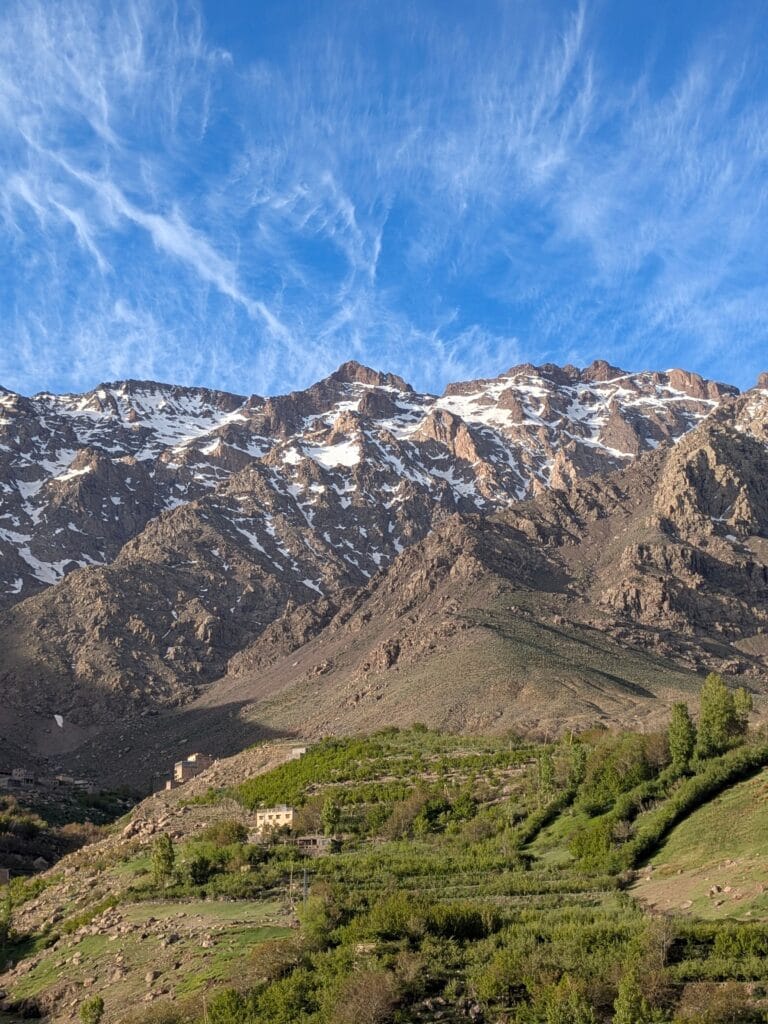
The Anti-Atlas and the Idea of Resilience
Perhaps the most important cultural lesson of the Anti-Atlas is resilience.
But resilience here does not mean merely “surviving difficult conditions.”
It means developing systems capable of adapting to environmental uncertainty.
Communities developed:
- water management
- agricultural diversification
- communal storage
- pastoral mobility
- trade networks
- architectural adaptation
- social cooperation
These practices demonstrate a sophisticated relationship between society and environment.
The Anti-Atlas therefore offers a valuable case study in human adaptation to semi-arid mountain environments.
Ancient Knowledge in a Modern Economy
The Anti-Atlas is not frozen in the past.
Its communities participate in contemporary Morocco.
Migration, education, roads, tourism, telecommunications, modern agriculture, cooperatives, and international markets have transformed local life.
A young person from an Anti-Atlas village may simultaneously participate in:
- Amazigh cultural traditions
- Moroccan national culture
- global digital culture
- modern education
- international labor markets
This creates a new form of cultural identity.
Tradition does not necessarily disappear when modernity arrives.
Instead, traditions can be reinterpreted.
Tourism and the New Anti-Atlas
Tourism is increasingly interested in landscapes that offer something different from Morocco’s most famous destinations.
The Anti-Atlas provides:
- hiking
- geological tourism
- cultural tourism
- village tourism
- architectural exploration
- oasis experiences
- photography
- bird and wildlife observation
- heritage tourism
- road-trip itineraries
But tourism also creates challenges.
If cultural heritage becomes merely a commodity, its social meaning can be weakened.
The most responsible tourism model is therefore one that allows local communities to participate economically while maintaining control over how their heritage is represented.
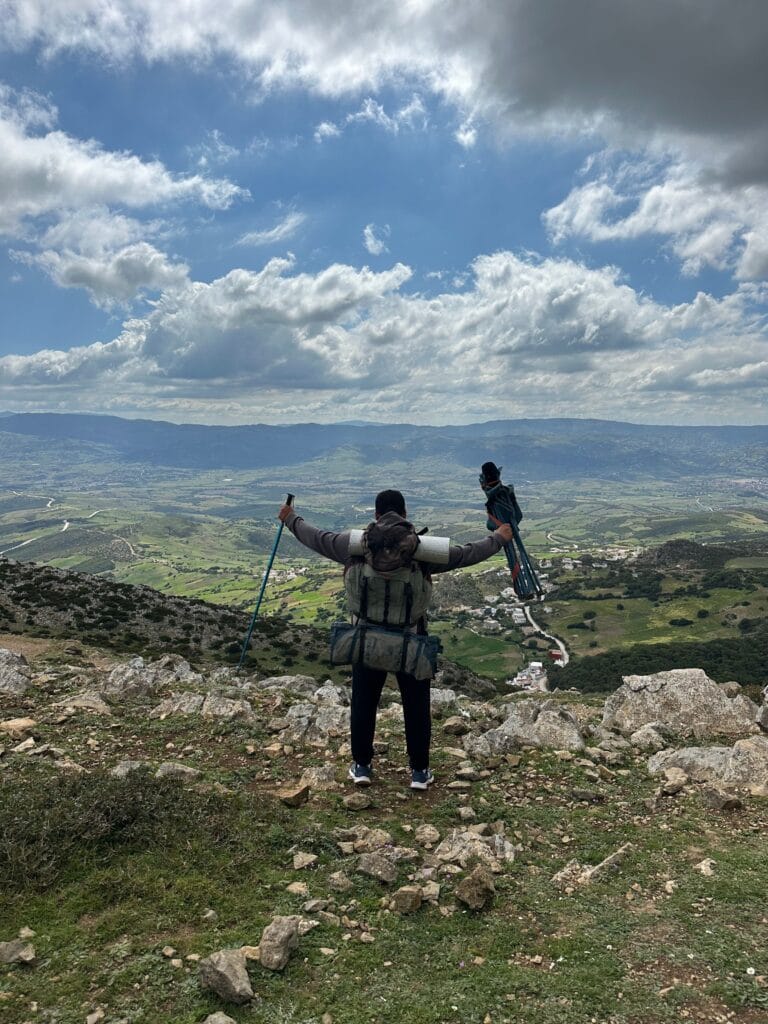
Hiking in the Anti-Atlas mountains
The Anti-Atlas offers a very different hiking experience from the High Atlas.
The landscape is generally characterized by:
- dry valleys
- rocky ridges
- plateaus
- isolated villages
- palm-filled valleys
- dramatic geological formations
Hikers should not underestimate the environment simply because elevations are lower than Morocco’s highest mountains.
Heat, limited water, remoteness, and navigation can create serious challenges.
A responsible traveler should plan around:
water availability + season + route conditions + local guidance + transportation + emergency access.
Best Places to Discover the Anti-Atlas
Several destinations can serve as gateways to understanding the region.
Tafraoute
Known for its granite landscapes, Amazigh cultural environment, surrounding valleys, and access to the western Anti-Atlas.
Aït Mansour Valley
Important for understanding the relationship between water, oasis agriculture, palm groves, and mountain settlements.
Amtoudi
Notable for its dramatic landscapes and historic fortified structures.
Tata
A major gateway toward the eastern Anti-Atlas and pre-Saharan landscapes, with important oasis environments.
Igherm
A mountain town associated with the Anti-Atlas interior and surrounding Amazigh communities.
Jbel Lkest
An important mountain landscape near Tafraoute and a destination for hiking and panoramic views.
Jbel Sirwa
A major transitional mountain landscape between the High Atlas and Anti-Atlas systems.
Anti-Atlas Compared With the High and Middle Atlas
Understanding the differences between Morocco’s mountain systems is essential for your Atlas Mountains pillar-cluster architecture.
| Feature | High Atlas | Middle Atlas | Anti-Atlas |
|---|---|---|---|
| General position | Central Morocco | Central-northern Morocco | Southwestern Morocco |
| Major character | High alpine mountains | Forests, plateaus and mountains | Ancient geological formations and arid mountain landscapes |
| Highest elevations | Very high | Moderate to high | Generally lower |
| Climate | Strongly varied; alpine at highest elevations | Generally cooler and wetter | Predominantly semi-arid to arid |
| Major vegetation | Alpine, juniper, oak and other zones | Cedar, oak and mountain vegetation | Argan, palms, shrubs and drought-adapted vegetation |
| Major Amazigh language areas | Tamazight and Tashelhit zones | Central Atlas Tamazight | Mainly Tashelhit-speaking areas |
| Architecture | Mountain villages, kasbahs and terraces | Stone/earth villages and forest settlements | Agadirs, fortified villages, oasis architecture |
| Major economic traditions | Agriculture, pastoralism, tourism | Pastoralism, agriculture, forestry | Oasis agriculture, pastoralism, trade, argan economy |
| Geological importance | Major mountain-building structures | Complex limestone and volcanic landscapes | Exceptional Precambrian geological exposures |
| Cultural landscape | High mountain Amazigh communities | Central Atlas Amazigh communities | Southwestern Amazigh communities and oasis societies |
The purpose of this comparison is not to rank the mountain ranges.
It is to demonstrate that Morocco’s Atlas system contains multiple ecological and cultural worlds.
Anti-Atlas mountains vs Sahara: A Cultural Transition Zone
The Anti-Atlas is sometimes described as a gateway toward the Sahara.
This description is useful but incomplete.
The region is better understood as a transition zone between mountain, oasis, pre-Saharan, and Saharan environments.
As one travels south and southeast, vegetation becomes increasingly sparse, settlement patterns change, and water becomes more decisive.
Yet cultural networks continue across these ecological boundaries.
Trade, language, kinship, religion, and migration have historically connected communities living in very different environments.
The Anti-Atlas mountains in Moroccan History
The history of the Anti-Atlas cannot be separated from the broader political history of Morocco.
Different dynasties exercised authority through varying mechanisms.
But political authority was not always equivalent to direct control over every mountain community.
Local communities maintained their own institutions, property arrangements, customary practices, religious structures, and social networks.
This is one reason the history of Morocco should not be written solely through dynastic chronology.
A complete history must also examine:
villages, tribes, markets, agricultural systems, mountain institutions, religious networks, and oral traditions.
Colonial Encounters and the Anti-Atlas
During the French colonial period, the southern Moroccan mountain regions became subject to military, administrative, economic, and infrastructural interventions.
Colonial authorities sought to expand control over territories that had previously operated through complex combinations of local authority and Moroccan state structures.
Roads, administrative centers, military posts, mapping projects, and economic interventions changed relationships between communities and the state.
The colonial period also generated a substantial body of ethnographic and administrative documentation.
Such sources can be valuable for historians, but they must be read critically because colonial observers interpreted Moroccan societies through their own political and intellectual frameworks.
Postcolonial Transformation
After independence in 1956, the Anti-Atlas experienced major transformations.
Road construction improved connectivity.
Education expanded.
Migration accelerated.
Urban centers grew.
Agricultural practices changed.
New administrative structures became more important.
Telecommunications connected previously isolated communities to national and global networks.
These developments created both opportunities and challenges.
Greater connectivity can improve access to education, healthcare, markets, and employment.
At the same time, it can accelerate the decline of certain traditional practices.
Cultural Change Does Not Mean Cultural Death
One of the greatest mistakes in heritage writing is to assume that culture exists only in its “traditional” form.
Culture changes.
Amazigh communities of the Anti-Atlas today are not living exactly as their ancestors did centuries ago.
That does not make their culture less authentic.
A young person speaking Tashelhit on a smartphone is participating in a contemporary form of Amazigh cultural life.
A cooperative selling argan products internationally is not necessarily abandoning tradition.
A renovated agadir used as a heritage site has acquired a new function.
The question is therefore not:
“Is the tradition still exactly the same?”
The more useful question is:
“How is the tradition being transformed, negotiated, and transmitted?”
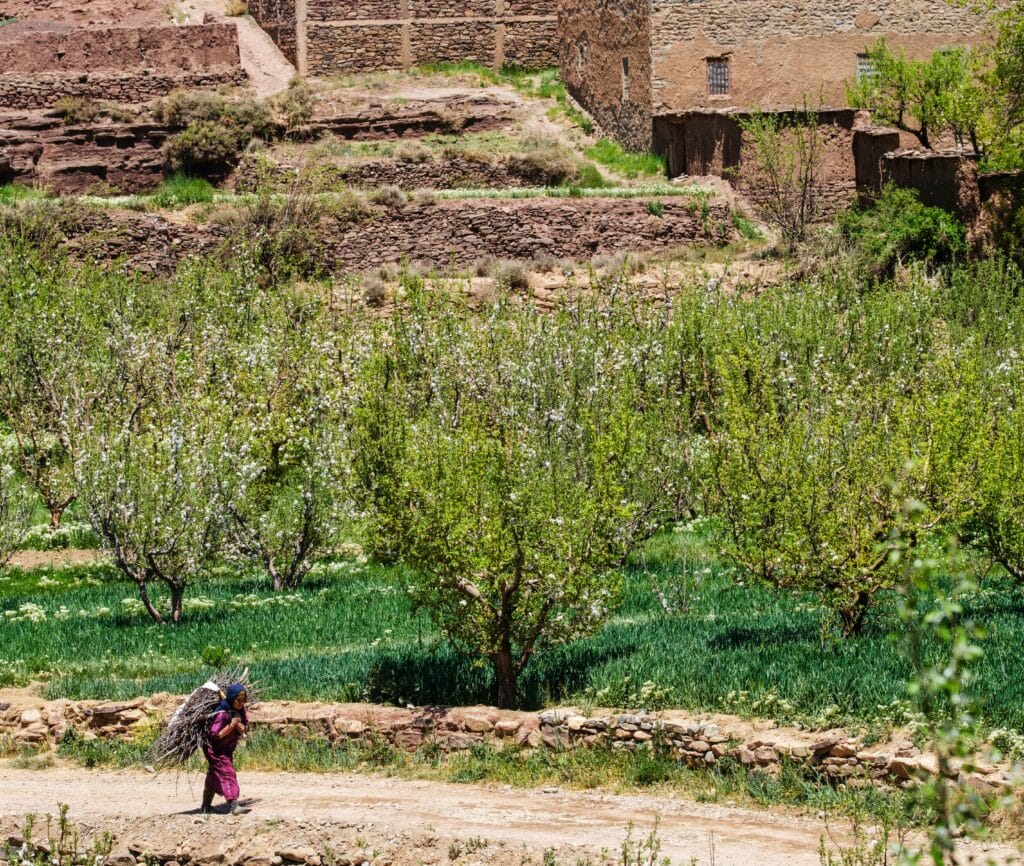
The Anti-Atlas mountains and Amazigh Cultural Revival
The recognition of Amazigh identity in contemporary Morocco has created new opportunities for cultural preservation.
The adoption of Tamazight as an official language in Morocco’s 2011 Constitution represented a significant institutional development.
Since then, language education, cultural organizations, publishing, broadcasting, music, festivals, and digital content have contributed to the visibility of Amazigh culture.
The Anti-Atlas is particularly important in this context because it remains a major living environment for Tashelhit.
Digital Technology and the Anti-Atlas mountains
The digital age is changing how mountain communities represent themselves.
Previously, outsiders often controlled the written representation of remote regions.
Today, local residents can create:
- videos
- photographs
- podcasts
- social-media pages
- digital archives
- online businesses
- language content
This changes the relationship between heritage and representation.
The Anti-Atlas is increasingly able to tell its own story.
The Challenge of Heritage Tourism
Heritage tourism can help preserve architecture and generate income.
But it can also create pressure.
Traditional buildings may be renovated according to tourist expectations rather than historical authenticity.
Cultural performances can become standardized.
Local traditions may be simplified for visitors.
Amazigh identity can be reduced to decorative motifs.
Responsible heritage tourism should therefore prioritize:
local participation, historical accuracy, community benefit, environmental sustainability, and cultural dignity.
Climate Change and the Future of the Anti-Atlas mountains
Climate change represents one of the most important challenges facing the region.
For a landscape already characterized by water scarcity, changes in precipitation patterns and increasing temperatures can have major consequences.
Agriculture depends on reliable water.
Oases require careful management.
Pastoral systems depend on vegetation.
Argan ecosystems face environmental pressures.
Migration may increase when rural livelihoods become more difficult.
The future of the Anti-Atlas therefore requires combining traditional ecological knowledge with contemporary climate science.
Traditional Knowledge as a Resource for the Future
Traditional knowledge should neither be romanticized nor dismissed.
Some traditional practices can offer useful principles for modern sustainability.
Water conservation, crop diversification, local materials, communal management, and adaptation to climatic variability represent forms of knowledge developed through long experience.
Modern science can test and refine such knowledge.
The most productive approach is therefore not:
traditional versus modern.
It is:
traditional knowledge + scientific research + local participation.
Fifteen Ancient Secrets of the Anti-Atlas mountains
The phrase “ancient secrets” in a travel context should not imply mysterious or supernatural claims.
The real secrets of the Anti-Atlas are historical and ecological.
They include:
- Its exceptionally ancient geological foundations.
- Its role as a transition between mountain and pre-Saharan environments.
- The survival of Amazigh linguistic traditions.
- The communal institution of the agadir.
- Sophisticated water-management practices.
- Oasis agriculture in extremely dry environments.
- The ecological importance of argan landscapes.
- The cultural importance of oral poetry.
- Historic caravan connections.
- Traditional mountain architecture.
- Prehistoric archaeological evidence.
- Long-standing pastoral traditions.
- The relationship between mountains and collective identity.
- The transformation of heritage through modern tourism.
- The continuing ability of local communities to reinterpret tradition.
These are more meaningful than the romantic idea of a “lost Morocco.”
The Anti-Atlas is not lost.
It is alive.
FAQ: Anti-Atlas Mountains
What are the Anti-Atlas Mountains?
The Anti-Atlas Mountains are a major mountain system in southwestern Morocco, south of the High Atlas. They contain ancient geological formations, dry valleys, oasis landscapes, Amazigh communities, and important cultural heritage sites.
Where are the Anti-Atlas Mountains located?
The Anti-Atlas extends across southwestern Morocco, including landscapes around Tafraoute, Tata, Igherm, Amtoudi, Jbel Bani and areas toward the Souss and pre-Saharan regions.
Are the Anti-Atlas Mountains part of the Atlas Mountains?
Yes. The Anti-Atlas is generally treated as one of the major mountain systems associated with Morocco’s broader Atlas region, although it has a distinct geological, ecological, and cultural character.
What is the highest mountain in the Anti-Atlas?
The answer depends on the geographic classification used for the Anti-Atlas and its transitional ranges. Jbel Sirwa, associated with the High Atlas–Anti-Atlas transition, is one of the region’s major high summits.
What language is spoken in the Anti-Atlas mountains?
Tashelhit, a major Amazigh language variety of Morocco, is widely associated with the Anti-Atlas and surrounding southwestern Moroccan regions.
What is the Anti-Atlas mountain famous for?
The Anti-Atlas is known for its ancient geology, Tafraoute’s granite landscapes, Amazigh villages, agadir granaries, oasis valleys, argan landscapes, rock art, historic trade routes, and distinctive mountain architecture.
What are the best places to visit in the Anti-Atlas mountains?
Important destinations include Tafraoute, Aït Mansour Valley, Amtoudi, Tata, Igherm, Jbel Lkest, and the wider Jbel Sirwa region.
Is the Anti-Atlas mountain good for hiking?
Yes. The Anti-Atlas offers hiking opportunities through dry valleys, granite landscapes, mountain villages, oases, and rugged plateaus. However, heat, water scarcity, remoteness, and route conditions require careful preparation.
What is an agadir in the Anti-Atlas mountains?
An agadir is a traditional fortified communal granary found particularly in southern Moroccan Amazigh regions. It could protect grain and other valuable possessions while functioning within a system of community rules and collective governance.
Why is the Anti-Atlas important to Amazigh culture?
The Anti-Atlas remains an important living environment for Amazigh communities, particularly Tashelhit-speaking populations. Its language, architecture, agricultural practices, oral traditions, agadir institutions, crafts, and social customs contribute to the cultural heritage of southwestern Morocco.
Comparison: The Four Moroccan Mountain Clusters
| Mountain cluster | Geographic character | Cultural emphasis | Major landscape |
|---|---|---|---|
| High Atlas mountains | Highest Moroccan mountain system | High-mountain Amazigh cultures | Alpine peaks, valleys, terraces |
| Middle Atlas mountains | Forested uplands and plateaus | Central Atlas Amazigh traditions | Cedar forests, lakes, plateaus |
| Anti-Atlas mountains | Ancient, arid mountain system | Tashelhit-speaking Amazigh heritage | Granite, oases, argan, agadir |
| Rif mountains | Northern Mediterranean mountain system | Northern Moroccan cultural traditions | Forests, Mediterranean valleys, coast |
This distinction is particularly important for understanding the relationship between this article and your main Atlas Mountains pillar.
The pillar provides the broad geographic and cultural framework.
The Anti-Atlas article goes deeper into one specific mountain system.
Conclusion: The Anti-Atlas Is a Living Archive
The Anti-Atlas Mountains are easy to underestimate.
They do not possess the dramatic snowy profile of Jbel Toubkal. They do not have the vast cedar forests associated with the Middle Atlas. Their landscapes can appear dry, austere, and almost silent.
But that silence is deceptive.
Beneath the rocks lies an extraordinary geological history.
Within the valleys are agricultural systems shaped by scarce water.
Inside villages are architectural traditions adapted to climate and security.
Within agadir granaries survives evidence of communal organization.
In the languages spoken by local communities are memories of landscapes, agriculture, kinship, poetry, and place.
In oasis gardens is knowledge accumulated across generations.
And in contemporary Anti-Atlas communities, these traditions continue to change.
The Anti-Atlas therefore challenges us to reconsider what heritage means.
Heritage is not simply an ancient building placed behind glass.
It is not merely a carpet pattern, a traditional song, or an archaeological artifact.
Heritage is also knowledge that remains useful, language that remains spoken, landscapes that remain cultivated, and communities that continue to reinterpret their past.
For anyone seeking to understand Morocco beyond its famous imperial cities, the Anti-Atlas offers a remarkably different perspective.
It reveals a Morocco of mountains and oases, of fortified granaries and caravan routes, of argan trees and dry valleys, of oral poetry and ancient rocks.
Most importantly, it reveals that the country’s Amazigh heritage is not a relic of the past.
It is part of the living present.
And perhaps this is the deepest lesson of the Anti-Atlas: a mountain does not preserve a culture by standing still; culture survives because people continue to give meaning to the landscape in which they live.
References — APA Style
- Brett, M., & Fentress, E. (1996). The Berbers. Blackwell.
- Camps, G. (1980). Berbères: Aux marges de l’histoire. Hespérides.
- Chaker, S. (1989). Berbères aujourd’hui. L’Harmattan.
- Ennaji, M. (2005). Multilingualism, cultural identity, and education in Morocco. Springer.
- Hoffman, K. E. (2008). We share walls: Language, land, and gender in Berber Morocco. Wiley-Blackwell.
- Hart, D. M. (1984). The Aith Waryaghar of the Moroccan Rif: An ethnography and history. University of Arizona Press.
- Hammoudi, A. (1997). Master and disciple: The cultural foundations of Moroccan authoritarianism. University of Chicago Press.
- Pennell, C. R. (2000). Morocco since 1830: A history. New York University Press.
- Rosenberger, B. (1978). Le Maroc au XVIe siècle: Au seuil de la modernité. Éditions Universitaires de France.
- Miller, S. G. (2013). A history of modern Morocco. Cambridge University Press.
- Naciri, S. (2016). Patrimoine culturel amazigh au Maroc. Publications académiques marocaines.
- Rodrigue, D. (2005). The geography and geology of the Anti-Atlas. Geological studies of southern Morocco.
- Thomas, M. C., & others. Studies of the Precambrian geology and tectonic evolution of the Anti-Atlas, southern Morocco.
- Ennouchi, E. (2000). Studies concerning traditional Moroccan architecture and rural settlement patterns.
- Ilahiane, H. (2004). The power of symbols: The evolution of Moroccan rural society. Lexington Books.
- Rachik, H. (2003). Comment rester nomade?. Éditions Afrique Orient.
- Skounti, A. (2009). The transmission of intangible heritage. International cultural heritage studies.
- UNESCO. Studies and documentation concerning Moroccan intangible cultural heritage, traditional knowledge, and cultural landscapes.


One Comment