Amazigh (Berber) Tattoo Meanings: Symbols, Identity, and Embodied Memory in Amazigh Culture
Introduction: Tattooing as an Indigenous System of Knowledge
Among Amazigh (Berber) societies of North Africa, tattooing was never a superficial or decorative practice. Rather, it constituted a complex indigenous system of knowledge, inscribed directly onto the human body. To study Amazigh (Berber) tattoo meanings is therefore to engage with questions of identity, cosmology, gender, power, and memory, all embedded within a visual language that predates writing in many Amazigh regions.
In premodern Amazigh societies, the body functioned as a living archive. Tattoos transformed skin into a semiotic surface where genealogy, spiritual protection, social belonging, and cosmological beliefs converged. These markings were neither random nor purely aesthetic; they followed inherited patterns governed by communal norms, ritual timing, and symbolic coherence.
This article approaches Amazigh (Berber) tattooing as:
- A cultural text
- A gendered ritual practice
- A form of visual anthropology
- A mode of resistance and continuity
By examining historical origins, symbolic structures, regional diversity, and modern transformations, this study situates Berber tattoo meanings within the broader framework of Amazigh cultural heritage and North African anthropology.
Table of Contents
1. Historical Origins of Amazigh Tattooing in North Africa
1.1 Prehistoric and Protohistoric Foundations
Archaeological evidence suggests that tattoo-like symbols were part of North African symbolic systems long before recorded history. Parallels between tattoo motifs and:
- Rock engravings
- Prehistoric ceramics
- Weaving patterns
- Jewelry designs
indicate a shared visual grammar rooted in early Amazigh cosmology.
These symbols often emphasized:
- Geometry over figuration
- Abstraction over realism
- Repetition and symmetry
Such characteristics point to a worldview in which order, balance, and cyclical time were central.
1.2 Continuity Through Antiquity
Classical sources describing Libyco-Berber populations mention body markings associated with tribal distinction and ritual identity. While Greco-Roman authors often exoticized these practices, their accounts nonetheless confirm tattooing as an established Amazigh tradition.
Unlike imperial tattoos used for punishment or ownership elsewhere, Amazigh tattoos were self-affirming and socially sanctioned, embedded in communal life rather than imposed authority.
2. Tattooing as an Anthropological Phenomenon
2.1 The Body as Cultural Territory
In Amazigh societies, the body was not conceived as a private, autonomous entity but as:
- A social surface
- A spiritual vessel
- A site of collective meaning
Tattooing marked the body as socially legible. Through tattoos, individuals became readable within their community, signaling maturity, marital status, lineage, or protection.
2.2 Gender and the Centrality of Women
Berber tattooing was overwhelmingly a female-centered practice:
- Women received tattoos
- Women performed tattooing
- Women transmitted symbolic knowledge
This made tattooing one of the few domains in which Amazigh women exercised ritual authority and symbolic power.
The tattooed female body embodied:
- Fertility
- Continuity of lineage
- Protection of the household
Far from being marginal, women were the custodians of this visual tradition.
3. Symbolic Language of Berber Tattoos
3.1 Geometry as Meaning
Amazigh tattoo symbolism relies primarily on geometric forms, each carrying layered meanings.
The Triangle
- Symbol of femininity and fertility
- Evocation of the womb
- Representation of mountain forms
Often associated with life-giving forces and maternal power.
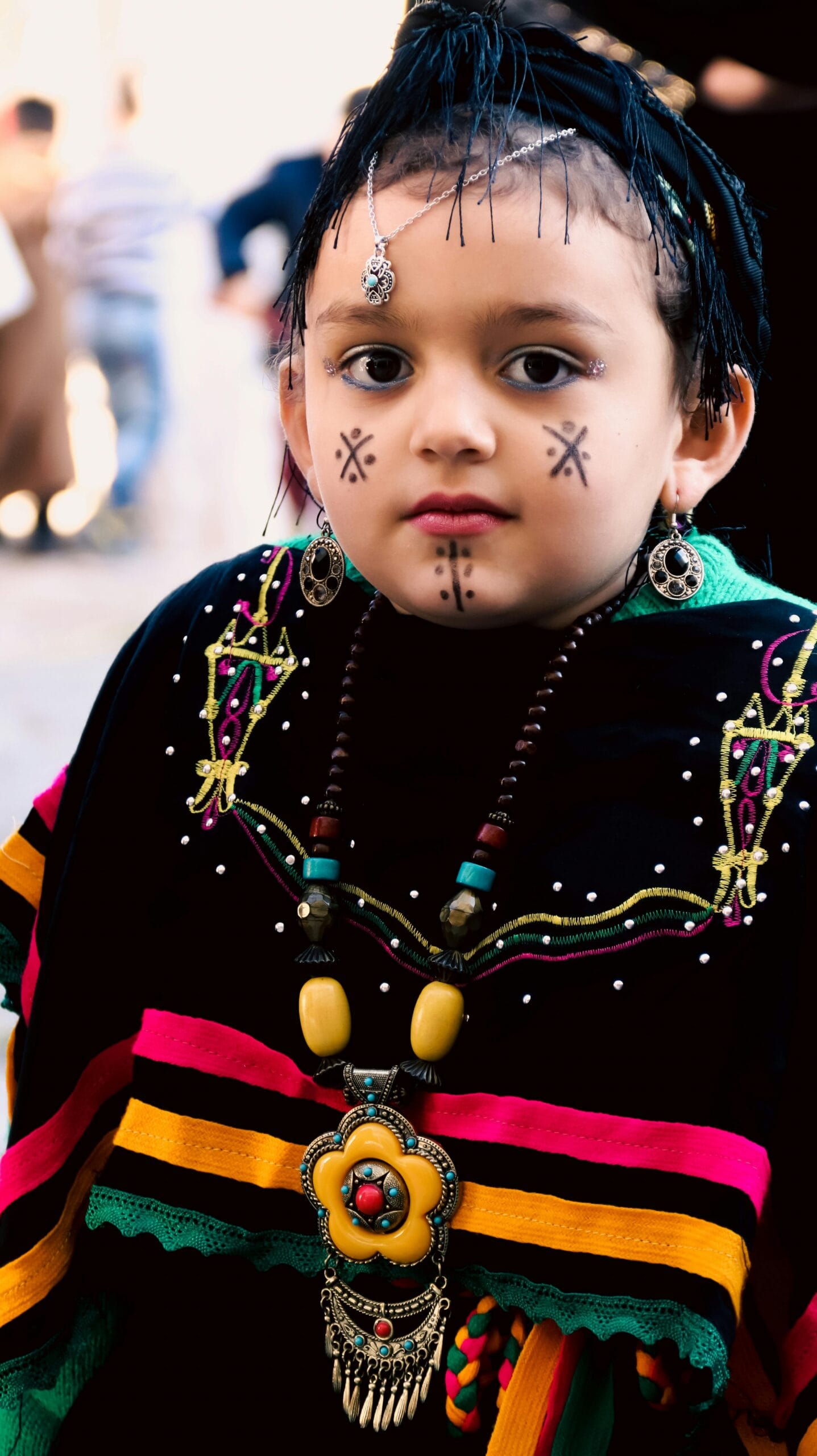
The Cross (ⵣ-like forms)
- Balance between cosmic forces
- The four cardinal directions
- Protection against chaos
Contrary to later religious interpretations, this symbol predates Christianity and Islam in Amazigh contexts.
Lines and Chevrons
- Continuity of life
- Movement through time
- Pathways between worlds
3.2 Solar and Lunar Symbols
- Sun motifs expressed vitality, endurance, and cosmic order
- Moon symbols reflected femininity, cyclical time, and protection
These elements reveal a cosmology grounded in natural rhythms rather than abstract theology.
4. Placement of Tattoos and Their Meanings
Tattoo placement was never arbitrary.
| Body Area | Symbolic Meaning |
|---|---|
| Forehead | Spiritual protection |
| Chin | Identity, beauty, adulthood |
| Hands | Labor, productivity |
| Ankles | Connection to earth |
| Abdomen | Fertility, motherhood |
Each location corresponded to specific life functions and social roles.
5. Regional Diversity in Morocco
5.1 High Atlas
- Dense tattoo patterns
- Strong geometric symbolism
- Emphasis on fertility and protection
5.2 Middle Atlas
- Finer, linear tattoos
- Tribal differentiation
- Subtle symbolic variation
5.3 Sous and Anti-Atlas
- Minimalist designs
- Integration with jewelry symbolism
- Agricultural and seasonal meanings
Regional variation demonstrates that Amazigh tattooing was plural rather than uniform, adapting to ecology, economy, and social structure.
6. Spiritual, Medicinal, and Protective Functions
Tattooing was often believed to:
- Protect against the evil eye
- Prevent illness
- Enhance fertility
- Restore balance
In this sense, tattoos functioned as embodied medicine, combining symbolism with ritual practice.
7. Decline, Transformation, and Modern Reappropriation
7.1 Causes of Decline
- Religious reformism
- Colonial moral frameworks
- Medicalization of the body
- Urbanization
Tattooing came to be stigmatized, especially among younger generations.
7.2 Contemporary Revival
Today, Amazigh tattoo symbols are:
- Reinterpreted in modern tattoo culture
- Used in graphic design and art
- Reclaimed as markers of identity
This revival raises ethical questions about appropriation versus continuity, particularly when symbols are detached from their cultural context.
Conclusion: Amazigh Tattoos as Cultural Memory Inscribed on Skin
Berber tattoos are not relics of a vanished past. They are archives of meaning, bearing witness to Amazigh resilience, creativity, and worldview. Though the practice has declined, its symbolic language persists—woven into textiles, carved into jewelry, and now studied as a vital component of Morocco’s intangible heritage.
To document and analyze Berber tattoo meanings is not merely an academic exercise; it is an act of cultural preservation and historical justice.
Cultural Disclaimer
This article is written with full respect for Amazigh heritage and aims to document, not appropriate, traditional knowledge. Meanings may vary by region and oral tradition.
References & Further Reading
- Hamdaoui, J. Tattooing in Amazigh Culture: A Socio-Semiotic Approach
- Amazigh Arts in Morocco: Women Shaping Berber Identity
- Mernissi, F. (Gender and cultural expression in North Africa)
- Oral Amazigh traditions (Atlas and Sous regions)