Amazigh Tribes: Society, Culture, Lifestyle & History of the Amazigh
Introduction: Democracy in the Mountains
The history of the Amazigh peoples of Morocco cannot be understood through political organization alone. Long before modern administrative boundaries divided the country into provinces and regions, Amazigh communities developed complex ways of organizing family life, villages, agriculture, pastoralism, trade, land, water, religious practice, craftsmanship, and collective responsibility.
When most people think of democracy, they imagine the Greek city-states or modern parliaments. Yet high in the Atlas Mountains, far from Athens or Paris, Amazigh tribes practiced their own form of self-government for centuries. These were the republics of the Amazigh, small but resilient political communities where councils of elders ruled collectively, and decisions were made through discussion and consensus.
The expression “Amazigh tribes” is therefore much broader than the idea of a political tribe or a group defined only by genealogy. In different parts of Morocco, belonging could involve ancestry, territory, alliances, shared resources, customary institutions, language, religious networks, and mutual obligations. A community in the High Atlas could organize its life differently from one in the Souss, Anti-Atlas, Rif, or the southern oases.
This diversity is important because there has never been a single Amazigh lifestyle. Amazigh societies have always adapted to their environments. Mountain agriculture, pastoral mobility, oasis cultivation, argan landscapes, transhumance, weekly markets, craft production, and long-distance trade created different forms of community life.
Unlike feudal systems based on lords and vassals, Amazigh tribes & republics were egalitarian and participatory, rooted in a culture that valued independence, solidarity, and justice. Though they faced constant challenges from rival tribes, powerful chiefs, and outside empires, these mountain republics remain a fascinating chapter of human political history.
Table of Contents
Who Were the Amazigh Communities?
The Amazigh peoples are Indigenous peoples of North Africa whose historical presence extends across Morocco, Algeria, Tunisia, Libya, parts of the Sahara, and other areas of the Maghreb.
In Morocco, Amazigh-speaking communities have historically occupied highly diverse environments, from the Rif and Middle Atlas to the High Atlas, Anti-Atlas, Souss, Atlantic plains, and Saharan transition zones.
The term Amazigh describes a broad cultural and linguistic identity rather than a single historical community. Within Morocco, important Amazigh linguistic varieties include Tachelhit, Central Atlas Tamazight, and Tarifit, alongside numerous local varieties and identities.
This linguistic diversity reflects geographical and historical diversity.
An Amazigh community in the High Atlas could depend heavily on mountain terraces, irrigation channels, forests, and seasonal grazing. In the Souss, agricultural production, argan landscapes, irrigation, commercial networks, and access to markets could play a larger role. In the Anti-Atlas and southern regions, pastoralism, oasis agriculture, caravan routes, and tribal confederations shaped other forms of social organization.
Consequently, speaking about Amazigh culture requires recognizing both shared cultural features and substantial regional differences.
There were common institutions and values—such as collective responsibility, kinship, hospitality, reciprocal labor, customary norms, and attachment to territory—but their practical forms varied.
What Did “Amazigh Tribes” Mean?
The word tribe can be misleading if it is understood as nothing more than a large family.
An Amazigh tribal community could contain multiple lineages, villages, fractions, households, and allied groups. Political belonging did not always correspond perfectly to biological descent.
A tribe could provide several forms of social organization:
- protection and security;
- access to territory and resources;
- mechanisms for resolving disputes;
- political representation;
- obligations of mutual assistance;
- marriage networks;
- access to grazing areas;
- participation in collective institutions;
- and a framework for relations with neighboring communities.
In some regions, tribes were further divided into fractions and sub-fractions, while several tribes could form larger confederations.
David Hart’s work on the Aït ‘Atta and Aït Yafalman, for example, illustrates how tribal organization could operate through multiple levels of social segmentation and political relationship rather than through a simple hierarchy.
This means that an Amazigh tribe was simultaneously a social network, territorial community, political structure, and system of mutual obligations.
The importance of territory was particularly strong.
Mountains, valleys, springs, forests, grazing grounds, agricultural terraces, and water channels were not merely physical landscapes. They were connected to memory, ancestry, economic rights, collective responsibilities, and community identity.
The Amazigh Canton: The Ajmuɛ
The basic political unit was the canton, known in Tamazight as the ajmuɛ. Each canton united several villages, often grouped within a valley. It functioned as a mini-republic, with rules for justice, collective defense, and resource management.
- Councils of Notables: Each village sent respected men — often elders, sometimes religious figures — to represent them.
- Consensus over Authority: Decisions were made through debate, not by force. The goal was always collective agreement (tawmat).
- Customary Law (Azref): Justice was guided not by outside rulers but by local traditions, proverbs, and ancestral law.
This structure reflected the Amazigh worldview: freedom was valued, but so was responsibility toward the community.
The Leff System: Alliances and Rivalries
One of the most unique features of Amazigh tribes & republics was the leff system — a network of alliances that united or divided tribes.
- Leff means “side” or “party.” In times of conflict, villages would align into two opposing blocs.
- These alliances were not permanent; they shifted depending on disputes over land, water, or honor.
- The system created both stability (since everyone had allies) and instability (because rivalries could reignite at any time).
Anthropologists often describe the leff as a kind of balance of power, similar to modern international politics. It kept any one tribe from becoming too dominant.
Equality and Justice in Amazigh Societies
Unlike monarchies or feudal systems, Amazigh tribes & republics prided themselves on equality. Every free man in the community had a voice. Wealthy families did not automatically dominate councils; reputation, wisdom, and fairness mattered more.
Justice was usually restorative rather than punitive:
- If a crime occurred, councils sought compensation rather than punishment.
- Blood feuds could be settled through mediation and payments.
- Collective sanctions ensured that no individual could ignore community law.
This system encouraged cooperation and preserved peace in a difficult environment where survival depended on solidarity.
Weaknesses and Limitations
While Amazigh tribes and republics were admirable in many ways, they were not perfect. Their weaknesses included:
- Fragmentation: Each canton was independent, making it difficult to unite against powerful outsiders (such as sultans or invading armies).
- Internal Conflicts: The leff system often led to endless cycles of rivalry.
- Rise of Strongmen: Ambitious leaders (amghars or caïds) sometimes seized power, undermining equality.
Despite these flaws, the Amazigh republics endured for centuries, proving their resilience and adaptability.
From Family to Community: The Social Structure
One of the most useful ways to understand Amazigh traditional society is to move outward from the household.
A simplified model can be represented as:
Household → Lineage → Village → Fraction → Tribe → Confederation
This should not be treated as a universal hierarchy. Different Amazigh regions used different terms, structures, and political arrangements.
Nevertheless, the model helps explain how individual households could become part of increasingly wider networks of cooperation and political responsibility.
The Household
The household was the basic environment of everyday life.
Family members shared responsibilities connected with food production, livestock, agriculture, childcare, domestic work, construction, storage, and craft production.
Work was strongly influenced by season.
Spring could bring agricultural activity and animal care. Summer might involve harvesting, food preservation, grazing, or transhumance. Autumn could involve harvesting fruit and preparing fields. Winter often brought greater emphasis on household work, livestock care, weaving, repair, and storytelling.
The household was therefore not simply a private residence.
It was also a productive economic unit and a place where cultural knowledge was transmitted.
Lineage and Kinship
Beyond the household, kinship connected families to wider networks.
Lineages could influence marriage, inheritance, political relationships, mutual assistance, and territorial belonging.
Kinship did not eliminate conflict. Families could disagree over land, water, marriage, inheritance, or other matters. But kinship networks also created mechanisms for mediation and support.
Village
The village brought households together in a shared physical and social environment.
Its residents could share:
- water infrastructure;
- paths;
- agricultural land;
- grazing resources;
- communal buildings;
- religious spaces;
- marketplaces;
- storage facilities;
- and collective responsibilities.
This is why the Amazigh village should not be viewed simply as a collection of houses.
It was a social, economic, ecological, and political system.
Amazigh Tribes & Republics and Modern Democracy
Historians often overlook the fact that Amazigh tribes republics were functioning long before colonial powers introduced “modern” councils or municipal governments. In many ways, they anticipated democratic values:
- Rule by councils.
- Collective decision-making.
- Equality before law.
- Checks on power through alliances.
Though they eventually declined under the pressure of central dynasties and colonial rule, their spirit survives in Amazigh traditions of communal solidarity, village councils, and collective work (tawiza).
The Amazigh Village: More Than a Settlement
A traditional Amazigh village was often closely adapted to its environment.
In mountain regions, settlements were frequently positioned according to access to water, agricultural terraces, grazing areas, transportation routes, and defensible terrain.
Architecture reflected this relationship.
Homes, granaries, pathways, courtyards, mosques, communal spaces, and agricultural areas formed interconnected parts of village life.
The settlement could also reflect social relationships.
Where families lived, how houses were connected, where livestock were kept, and how people accessed water or communal facilities were not accidental matters. They developed through generations of adaptation.
In some mountain villages, agricultural terraces below or around the settlement were connected to irrigation systems that required collective maintenance.
A damaged irrigation channel could affect numerous households.
Consequently, infrastructure created social obligations.
Water connected people to one another just as strongly as it connected fields to rivers and springs.
Jmaâ and Local Community Decision-Making
The institution commonly described as jmaâ or related local terms is important in the history of many Moroccan rural communities.
It refers broadly to forms of community assembly or collective decision-making.
However, the exact composition, authority, terminology, and functions of these assemblies varied considerably from one region to another.
Assemblies could be involved in questions concerning:
- agricultural resources;
- water distribution;
- communal grazing;
- maintenance of infrastructure;
- collective work;
- disputes;
- community obligations;
- sanctions;
- and relations with neighboring groups.
It is useful to distinguish this historical institution from the modern concept of a representative parliament.
A village assembly was embedded within a particular social order based on kinship, local status, customary norms, religious authority, property relations, and community obligations.
Its significance lies less in whether it fits a modern definition of democracy and more in the fact that local communities possessed mechanisms through which collective affairs could be discussed and regulated.
Azref: Customary Law and Social Order
Another important concept is azref, commonly used to describe customary norms or customary law in several Amazigh contexts.
Azref was not one universal legal code shared identically by every Amazigh community.
Rather, customary rules developed locally and could address questions such as:
- land;
- water;
- grazing;
- compensation;
- communal obligations;
- property;
- marriage;
- inheritance;
- conflict;
- and social conduct.
These norms existed alongside Islamic law and other sources of authority.
Their relationship with religious institutions, political authorities, and state structures differed according to time and place.
For this reason, it is more accurate to speak of regional Amazigh customary legal traditions rather than a single timeless “Amazigh law.”
Agdal: Community Conservation Before Modern Environmentalism
One of the most remarkable examples of Amazigh environmental institutions is the Agdal system.
Agdal refers to a community-based system in which access to a particular natural resource or territory is restricted temporarily or seasonally so that it can regenerate.
The principle can apply to pastures, forests, agricultural resources, argan landscapes, and other communal resources.
The system demonstrates that environmental management was not necessarily separated from social organization.
A community could establish rules determining:
- when grazing was permitted;
- when access was restricted;
- which areas could be used;
- who had rights and responsibilities;
- and what happened when rules were violated.
UNESCO has highlighted Agdal as a traditional community system associated particularly with the High Atlas, Anti-Atlas, and Souss landscapes.
The system is significant because it connects ecology, customary law, community authority, and livelihood security.
It also demonstrates why traditional ecological knowledge should not be reduced to folklore.
For communities living directly from land and natural resources, environmental knowledge could be a practical survival system.
Tiwizi: The Culture of Mutual Assistance
Another important dimension of Amazigh community life is tiwizi, a form of collective or reciprocal labor.
Its meaning and application can vary by region, but the underlying principle is cooperation.
People may come together to perform work that would be difficult for one household to complete alone.
Examples can include:
- repairing irrigation channels;
- maintaining agricultural infrastructure;
- building or repairing houses;
- harvesting crops;
- maintaining paths;
- assisting families during major events;
- or helping communities respond to urgent needs.
Tawiza illustrates an important characteristic of rural society:
community cooperation could function as an economic resource.
Labor itself became a form of social capital.
A household contributed to collective life with the expectation that cooperation would be reciprocated when necessary.
This principle also strengthened relationships between households and helped maintain infrastructure on which everyone depended.
Land, Water and the Amazigh Economy
For many Amazigh communities, land was not simply property.
It was the foundation of livelihood, identity, inheritance, and social relationships.
The importance of land was particularly evident in mountain regions where cultivable areas were limited.
A small terrace could represent years of labor.
A spring could sustain an entire settlement.
A grazing area could determine whether livestock survived a difficult season.
An irrigation channel could connect multiple villages and generations.
This explains why disputes concerning land and water could become socially significant.
Rights were connected to obligations.
Someone who benefited from an irrigation system might also be expected to participate in its maintenance.
Someone with access to communal grazing could be subject to rules governing when and how animals entered the area.
Traditional resource management therefore created a relationship between rights, responsibilities, and collective survival.
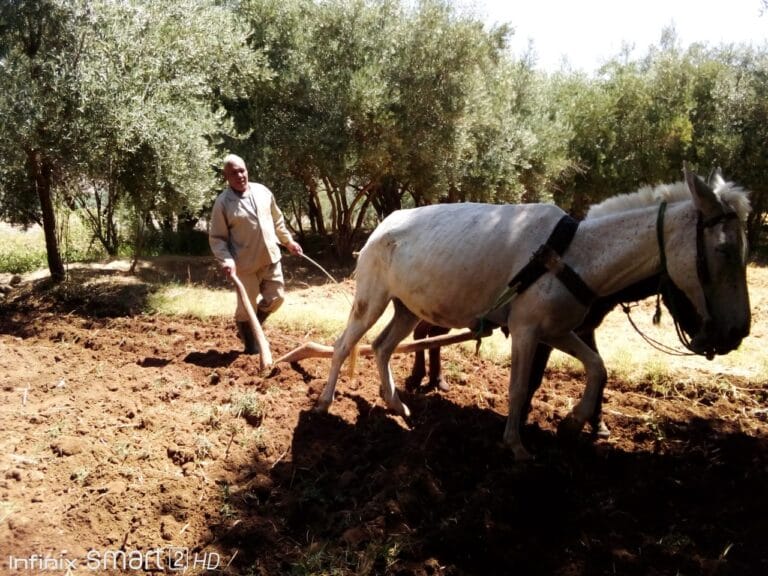
Agriculture in Amazigh Mountain Life
Agriculture was one of the foundations of many Amazigh communities.
In the High Atlas, cultivation often required considerable adaptation to steep terrain, limited water, altitude, and seasonal climatic variation.
Terraces allowed communities to cultivate slopes that would otherwise be difficult to farm.
Common crops in different Moroccan mountain and pre-mountain environments included cereals, legumes, fruit trees, and other locally adapted plants.
Agriculture was closely connected to livestock.
Animal manure could enrich agricultural soils.
Crop residues could feed animals.
Animals could provide milk, meat, wool, hides, and traction.
Trees could provide food, fuel, fodder, shade, and other resources.
This produced an integrated system in which agriculture, forestry, livestock, and household production supported one another.
Modern ecological research in the High Atlas continues to document the importance of such agro-sylvo-pastoral systems.
Pastoralism and Transhumance
Not all Amazigh communities were primarily agricultural.
Pastoralism has historically played an important role in many mountain and southern communities.
Sheep, goats, cattle, and other livestock could be moved according to seasonal availability of pasture and water.
Transhumance allowed communities to exploit different ecological zones during different times of the year.
A mountain environment can change dramatically over short distances.
A valley may be warm and dry while higher elevations remain cooler and greener.
Seasonal movement allowed pastoralists to make use of this ecological diversity.
Pastoralism also created relationships between communities.
Access to routes, grazing areas, water, and seasonal camps could require agreements and negotiations.
In this way, pastoral mobility was not simply an economic activity.
It was also a form of territorial knowledge and social organization.
Amazigh Commons and Collective Resources
The idea of the commons is particularly useful when studying traditional Amazigh communities.
A communal resource is not necessarily “owned by everyone” in an unrestricted sense.
Instead, communities could develop detailed rules determining who could use a resource, when it could be used, and what responsibilities accompanied that access.
Examples include:
- grazing areas;
- forests;
- springs;
- irrigation systems;
- village paths;
- communal ovens;
- storage facilities;
- and certain agricultural or pastoral lands.
Such systems required rules because resources were limited.
The existence of commons therefore depended on institutions capable of coordinating behavior.
This is one reason why social organization and environmental management cannot be studied separately.
Markets, Trade and Mobility
Amazigh communities were never completely isolated mountain societies.
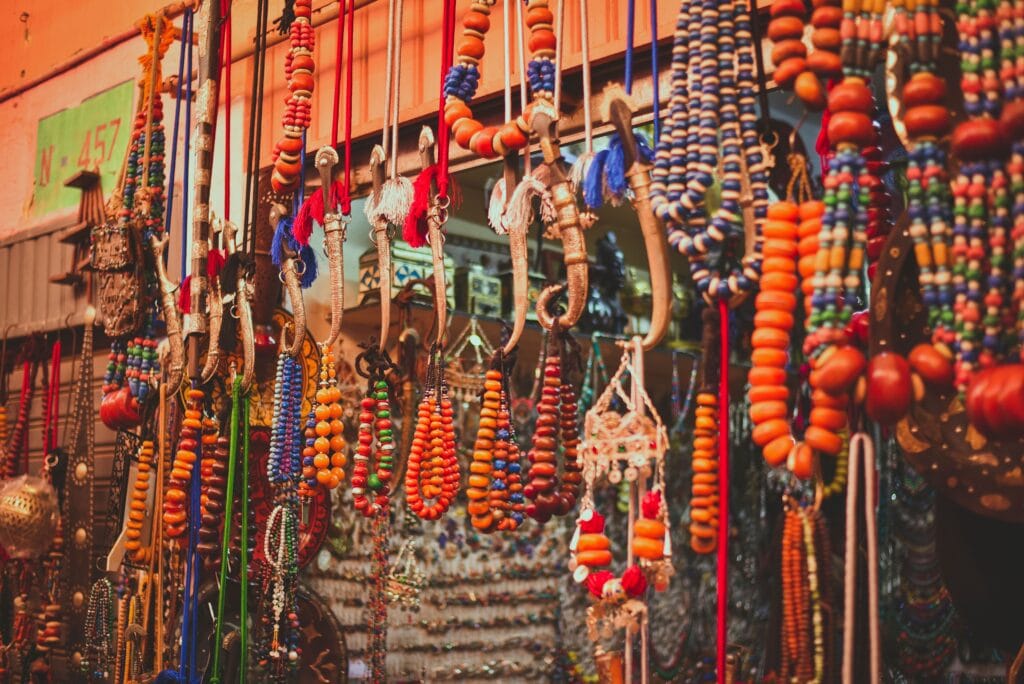
Markets connected villages to towns, plains, oases, and major commercial routes.
Weekly souks could become important centers of exchange.
People traded agricultural products, livestock, wool, leather, tools, pottery, textiles, food products, and other goods.
Markets also transmitted information.
A souk was not only a place to buy and sell.
It could be a place where people learned about:
- marriages;
- political developments;
- prices;
- weather;
- migration;
- regional news;
- agricultural conditions;
- and opportunities for work or trade.
Mountain communities were therefore connected to wider economic networks even when transportation was difficult.
Family, Marriage and Household Life
Marriage was both a family relationship and a social institution.
Traditional marriage practices varied widely between Amazigh regions and historical periods.
Marriage could connect families and strengthen relationships between households or wider kinship groups.
It could also involve questions of property, inheritance, residence, labor, and social responsibility.
The household itself was often an intergenerational environment.
Children learned practical skills from parents and grandparents.
They learned how to prepare food, care for animals, recognize plants, work agricultural land, weave, make crafts, speak local varieties of Tamazight, observe religious customs, and participate in community life.
Much of this education happened without formal classrooms.
Knowledge was embedded in everyday work.
A child helping with agriculture was simultaneously learning ecology, seasonal rhythms, tools, food production, and family responsibility.
Women and the Amazigh Community Economy
Women have played essential roles in the economic and cultural life of Amazigh communities.
The nature of women’s work differed according to region, household, class, ecology, and historical period, so generalized statements should be treated cautiously.
In many rural communities, women participated in activities including:
- food preparation;
- agricultural work;
- livestock care;
- dairy processing;
- gathering plants;
- weaving;
- spinning;
- pottery;
- embroidery;
- household production;
- argan processing in relevant regions;
- and the transmission of cultural knowledge.
Textiles provide an especially clear example.
A woven textile was not simply an object.
The production process could involve knowledge of wool, spinning, dyeing, patterns, symbolism, household organization, and intergenerational teaching.
Likewise, food preparation preserved agricultural knowledge.
Women could know which plants were edible, how grains were stored, how foods were preserved, and which products were associated with particular seasons or ceremonies.
This makes women’s work central to understanding Amazigh lifestyle and cultural continuity.
Food as a Reflection of Amazigh Life
Traditional Amazigh foodways developed from local environments.
The ingredients available to a mountain household were influenced by altitude, rainfall, agriculture, livestock, forests, markets, and seasonal availability.
Cereals, legumes, dairy products, meat, fruits, nuts, oils, herbs, and wild plants could all contribute to regional diets.
Food also had a social dimension.
Meals brought families together.
Hospitality created obligations between hosts and guests.
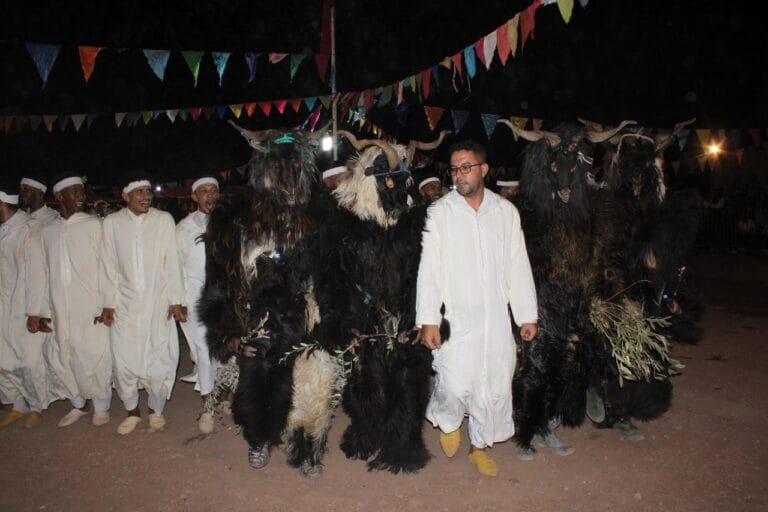
Festive foods marked weddings, religious occasions, seasonal celebrations, harvests, and communal events.
In this sense, cuisine should not be treated merely as a collection of recipes.
Food is a record of ecology, economy, family organization and cultural memory.
Crafts as Everyday Knowledge
Amazigh crafts developed within everyday life rather than existing solely as decorative arts.
Weaving could provide blankets, clothing, floor coverings, storage textiles, and ceremonial objects.
Pottery could serve cooking, water storage, food preparation, and household needs.
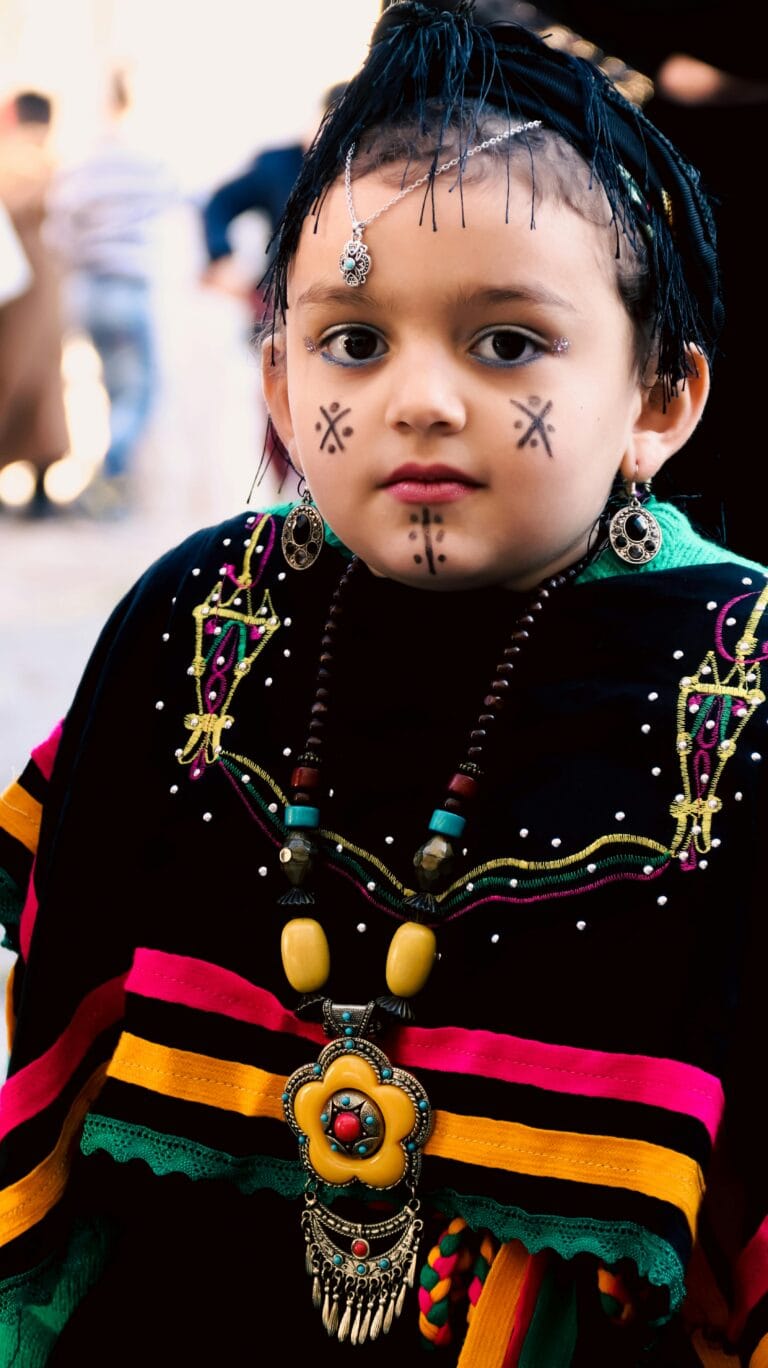
Jewelry could combine adornment with social identity, wealth, symbolism, and family heritage.
Leatherworking, woodworking, metalwork, basketry, and other crafts fulfilled practical needs while also expressing regional aesthetics.
Craft knowledge was traditionally transmitted through observation and apprenticeship.
A young person learned not only how to produce an object but also when it should be used, how materials were obtained, and what certain forms or motifs meant within their community.
This is why Amazigh handicrafts are also archives of knowledge.
Architecture as Social Organization
Amazigh architecture reveals how people organized their relationship with family, resources, security, and community.
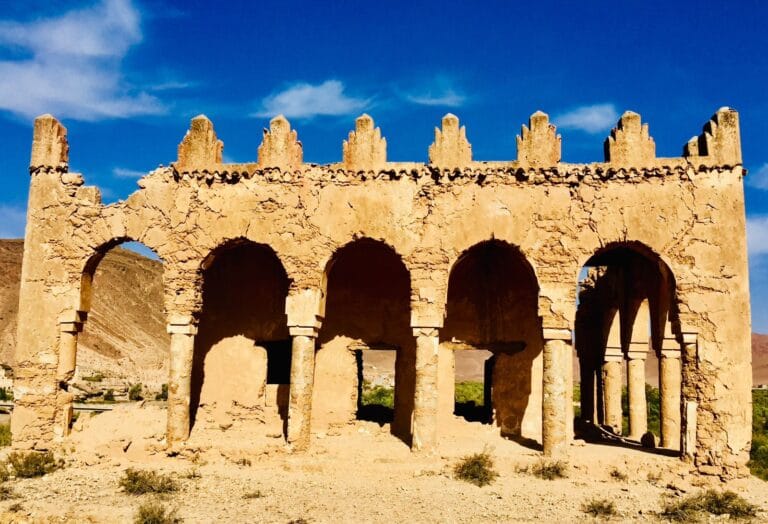
In different regions, forms such as fortified communal granaries, village houses, earthen settlements, kasbahs, and mountain compounds developed according to local environments and social needs.
The agadir or communal granary is particularly significant in several southern Moroccan contexts.
Such structures could protect stored agricultural resources and demonstrate the importance of collective organization.
Likewise, fortified settlements and multi-family structures reflected concerns about security, storage, climate, and social relationships.
Architecture therefore tells us something about society.
A building can reveal:
- who lived together;
- how resources were stored;
- how families interacted;
- how communities responded to environmental conditions;
- and how security was organized.
For a deeper architectural study, see Iwziwn’s related work on Amazigh architecture, homes and villages.
Religion, Saints and Community Authority
Amazigh communities in Morocco became deeply integrated into Islamic civilization over many centuries.
Islam shaped religious practice, education, law, architecture, festivals, burial traditions, and concepts of morality.
At the same time, local religious institutions developed distinctive forms.
In some areas, igurramen or saintly figures and zawiyas could have considerable social influence.
Ernest Gellner’s study of the High Atlas examined the role of saints and religious authority in local social organization.
Religious figures could become associated with:
- mediation;
- education;
- hospitality;
- religious ceremonies;
- arbitration;
- protection;
- and community prestige.
Religion therefore formed another layer of authority alongside family, customary institutions, and political structures.
It is important, however, not to reduce Amazigh religious life to pre-Islamic survivals.
Moroccan Amazigh societies have been Muslim societies for centuries, and Islamic practice became deeply integrated into local cultural life.
Leff, Alliances and Political Balance
The leff system deserves a place in any serious discussion of Amazigh political organization, but it should not be presented as a universal institution shared identically by every Amazigh community.
In regions where it existed, a leff could function as an alliance or political grouping.
Such alliances could influence:
- conflict;
- defense;
- political negotiations;
- marriage relationships;
- mediation;
- and relations between communities.
Robert Montagne devoted significant attention to political organization, tribal divisions, alliances, and the development of political power in southern Morocco.
Later anthropological work approached tribal organization through other analytical frameworks.
The important point is that Amazigh political life was rarely static.
Alliances could change.
Power could move between families.
Communities could cooperate in one situation and compete in another.
Political organization was therefore a process of negotiation, alliance, obligation, and competition.
How Communities Managed Conflict
Conflict was an ordinary possibility in any society.
Amazigh communities were not peaceful utopias.
Disputes could concern:
- land;
- water;
- grazing;
- property;
- marriage;
- inheritance;
- political authority;
- honor;
- or relations between kin groups.
Communities developed different mechanisms to manage such conflicts.
Depending on the region and period, these could involve:
- mediation by respected individuals;
- family negotiation;
- assemblies;
- customary rules;
- religious figures;
- compensation;
- collective sanctions;
- alliances;
- or, in more serious cases, prolonged conflict.
This is important because institutions should not be judged only by their ideals.
Their real historical significance lies in how communities attempted to maintain social order despite competing interests.
Amazigh Tribes and the Makhzen
The relationship between Amazigh communities and the Moroccan Makhzen was considerably more complicated than a simple opposition between “independent tribes” and a centralized state.
Robert Montagne’s Les Berbères et le Makhzen dans le Sud du Maroc remains an important historical source for understanding how tribal organization and central authority interacted in southern Morocco.
However, Montagne wrote during the French colonial period, and his analytical framework must therefore be read critically.
Modern scholarship has questioned and reassessed aspects of colonial anthropology and Montagne’s interpretation of precolonial Moroccan political structures.
Relations between communities and the Makhzen could include:
- taxation;
- political recognition;
- negotiation;
- alliances;
- appointments;
- military relationships;
- local autonomy;
- mediation;
- incorporation;
- and resistance.
The historical reality was therefore not a permanent binary conflict.
Different communities could negotiate with central authorities while maintaining significant local institutions.
This complexity is essential for understanding the political history of Morocco.
Montagne, Gellner and Hart: Three Ways of Reading Amazigh Society
Three major bodies of scholarship are particularly useful for understanding Amazigh social organization.
Robert Montagne
Montagne’s 1930 study examined tribal organization and the political transformation of southern Moroccan Berber communities.
His work is especially useful for historical descriptions of:
- tribal organization;
- confederations;
- political alliances;
- local institutions;
- and relationships with the Makhzen.
But his colonial context means his categories should not be treated as neutral or definitive.
Ernest Gellner
Gellner’s Saints of the Atlas focused on the Central High Atlas and examined relationships among tribal organization, saints, religious authority, and social order.
His work became influential in anthropological discussions of segmentary organization and political authority.
However, later anthropology has questioned the tendency to treat segmentary models as universally applicable.
David Hart
David Hart’s research on communities including the Aït ‘Atta and Aït Yafalman provides detailed studies of tribal organization, political institutions, kinship, and social relationships.
His work is particularly valuable because it brings attention to the complexity of particular communities rather than assuming that all Amazigh societies followed one model.
Taken together, these scholars demonstrate an important lesson:
There is no single theory capable of explaining every Amazigh community.
Why “Amazigh Republic” Should Be Used Carefully
The expression “Amazigh republics” is attractive because some historical Amazigh communities developed institutions in which political authority was distributed among councils, kin groups, local leaders, alliances, and customary institutions.
However, calling these communities “republics” can create a misleading impression.
They were not modern constitutional republics with universal suffrage, written constitutions, modern citizenship, political parties, and contemporary representative institutions.
Montagne himself used the expression “organisation républicaine” in his analysis of certain southern Moroccan communities.
The historically safer interpretation is that some communities possessed forms of local self-government and distributed political authority.
This distinction matters.
Historical societies should be understood on their own terms rather than being transformed into modern political categories.
There Was No Single Amazigh Lifestyle
One of the biggest mistakes in discussions of Amazigh culture is the assumption that all Amazigh people lived in the same way.
They did not.
An Amazigh farmer in the Souss did not necessarily share the same livelihood as a pastoralist in the High Atlas.
A Rif community developed within a different ecological and historical environment from a High Atlas village.
An Anti-Atlas settlement could have different land-use practices from an Aït ‘Atta community in the south.
Differences existed in:
- language;
- clothing;
- architecture;
- agriculture;
- pastoralism;
- marriage customs;
- music;
- food;
- political organization;
- religious institutions;
- crafts;
- and relationships with markets.
What connects these communities is not uniformity.
It is a broad historical and cultural family shaped by shared Amazigh heritage and centuries of regional interaction.
Regional Diversity Across Morocco
High Atlas
The High Atlas contains numerous Amazigh-speaking communities whose livelihoods historically combined agriculture, livestock, forestry, gathering, trade, and seasonal mobility.
Terrace agriculture and irrigation are especially important in many valleys.
Souss
The Souss has long been associated with agriculture, commercial networks, argan landscapes, irrigation, and major settlements.
Its history demonstrates the importance of connections between rural communities, markets, religious institutions, and long-distance commerce.
Anti-Atlas
The Anti-Atlas contains diverse Amazigh communities adapted to relatively dry environments.
Water management, agriculture, pastoralism, oasis systems, argan landscapes, and migration have all played important roles in different localities.
Middle Atlas
The Middle Atlas has historically supported both agricultural and pastoral economies.
Seasonal mobility and livestock production have been particularly important in some areas.
Rif
Amazigh-speaking communities in the Rif developed within a distinctive Mediterranean mountain environment with their own linguistic, agricultural, architectural, and social traditions.
These regions should therefore be studied as related but distinct cultural landscapes.
A Day in the Life of an Amazigh Mountain Community
A typical day in an Amazigh mountain village cannot be reconstructed as one universal routine.
Daily life changes according to altitude, season, occupation, household composition, age, gender, and economic circumstances.
Nevertheless, imagine a farming village during an active agricultural season.
The day may begin early.
Household members prepare food and organize the day’s work. Livestock require attention. Water must be collected or managed. Fields need cultivation, irrigation, harvesting, or maintenance.
Some family members may work in agricultural terraces while others care for animals or perform household tasks.
Children may participate in small responsibilities while learning through observation.
Later, villagers may meet neighbors, visit a local market, maintain an irrigation channel, or exchange information.
In the evening, domestic spaces become important centers of family interaction.
Food is prepared.
Stories may be told.
Older generations transmit knowledge to younger ones.
Music, poetry, religious practice, or informal conversation can reinforce social bonds.
The important point is that work and culture were not separate categories.
Agriculture could transmit ecological knowledge.
Craft production could transmit artistic knowledge.
Food preparation could transmit cultural memory.
Family life could transmit language.
Community work could transmit social responsibility.
Oral Tradition and Cultural Knowledge
For communities whose knowledge was transmitted largely through speech, memory was an important cultural institution.
Amazigh oral traditions include:
- poetry;
- songs;
- proverbs;
- stories;
- genealogical knowledge;
- historical narratives;
- place names;
- agricultural knowledge;
- ecological knowledge;
- and practical instruction.
Music and poetry could preserve historical memory while also commenting on social life.
Proverbs could transmit ethical and practical lessons.
Place names could preserve information about geography, ancestry, vegetation, water, or historical events.
Amazigh oral culture should therefore not be dismissed as entertainment.
It is also a system of knowledge transmission.
Modern documentation through writing, audio recording, archives, and digital media is increasingly important because oral knowledge can be weakened when younger generations move away from rural communities or shift toward other languages and occupations.
From Tribal Communities to Modern Morocco
Amazigh communities did not remain frozen in a premodern world.
Over the nineteenth and twentieth centuries, and particularly during the colonial and postcolonial periods, roads, schools, administrative institutions, markets, wage labor, migration, telecommunications, and state services transformed rural life.
The expansion of national institutions changed the relationship between local communities and political authority.
Modern property law and administrative structures also affected customary resource management.
Education created new opportunities while encouraging migration toward cities.
Markets expanded.
Crafts increasingly became commercial products.
Traditional agricultural systems encountered new economic pressures.
Yet transformation does not necessarily mean disappearance.
Many institutions changed rather than simply vanished.
Migration, Urbanization and Social Change
Migration has become one of the most visible forces shaping contemporary Amazigh communities.
Young people may move from mountain villages to:
- nearby towns;
- Agadir;
- Marrakech;
- Casablanca;
- Rabat;
- Europe;
- or other destinations.
Migration can reduce the number of people available for agricultural labor.
At the same time, migrants may send money to families and invest in houses, education, agriculture, businesses, or community infrastructure.
Urbanization therefore produces both loss and connection.
A mountain village may have fewer permanent residents while remaining closely connected to a large diaspora.
This creates a new form of Amazigh social geography in which villages, cities, and diaspora communities are interconnected.
Climate Change and the Future of Mountain Livelihoods
Environmental change is becoming increasingly important for Amazigh rural communities.
High Atlas livelihoods depend on relationships among water, agriculture, livestock, forests, and seasonal climate.
Drought can reduce crop production.
Water scarcity can increase pressure on irrigation systems.
Changes in vegetation can affect livestock.
Migration can increase when agricultural livelihoods become less reliable.
Recent research in the Moroccan High Atlas has documented how drought, socioeconomic change, migration, and changing livelihood strategies are reshaping rural communities.
This makes traditional environmental institutions particularly relevant.
Agdal, collective water management, local ecological knowledge, diversified agriculture, and pastoral strategies may offer valuable historical examples of adaptation.
However, traditional systems should not be romanticized as complete solutions to modern climate change.
Contemporary environmental pressures occur at a different scale and interact with national water policy, markets, infrastructure, population change, and global climate patterns.
What Survives of Traditional Amazigh Community Institutions?
Traditional Amazigh institutions have changed considerably, but elements of them continue to influence community life.
Their legacy can be seen in:
- village cooperation;
- collective labor;
- community assemblies;
- customary norms;
- environmental management;
- oral traditions;
- agricultural knowledge;
- crafts;
- architecture;
- family networks;
- seasonal celebrations;
- music;
- language;
- and relationships with ancestral territories.
Some institutions have been incorporated into new legal or administrative environments.
Others survive mainly as cultural practices.
Still others have weakened or disappeared.
The important point is that cultural continuity does not require institutions to remain unchanged.
A culture survives partly by adapting.
Amazigh Society as Living Heritage
The study of Amazigh tribes should therefore move beyond romantic images of isolated mountain communities.
Amazigh societies were neither timeless villages untouched by outside influences nor perfectly egalitarian “republics.”
They were complex human communities.
They contained cooperation and competition, equality in some relationships and hierarchy in others, collective institutions and individual ambition, agricultural knowledge and commercial activity, religious authority and customary practice.
Their strength as a subject of study lies precisely in this complexity.
Amazigh community life connected people to land, water, family, livestock, agriculture, markets, religion, architecture, language, music, and memory.
The Amazigh tribe was therefore not simply a political unit.
It could be a framework through which people understood belonging, obligation, territory, protection, cooperation, and identity.
Today, many of these relationships continue in transformed forms.
Village assemblies may coexist with state administration.
Traditional agricultural knowledge can coexist with modern education.
Amazigh crafts can move from household production into cooperatives and international markets.
Migration can connect remote mountain villages with global cities.
Tamazight can move from oral transmission into schools, books, media, and digital platforms.
This is why Amazigh heritage should be understood as living heritage rather than a museum artifact.
Did You Know?
- Amazigh communities developed diverse forms of local organization rather than following one universal political model.
- Traditional village institutions could regulate water, grazing, agriculture, disputes, and collective responsibilities.
- Agdal demonstrates how community rules could be used to manage natural resources and allow ecological regeneration.
- Tawiza reflects traditions of reciprocal community labor and mutual assistance.
- Amazigh societies historically combined agriculture, pastoralism, craft production, trade, and seasonal mobility in different proportions.
- Weekly markets were important not only for commerce but also for social communication.
- Traditional crafts often carried practical, economic, artistic, and symbolic functions simultaneously.
- Oral traditions preserved ecological, agricultural, historical, linguistic, and social knowledge.
- Robert Montagne’s work on southern Moroccan tribal organization remains historically important but should be read critically because it was produced in a colonial context.
- Modern research shows that Amazigh rural communities continue to adapt to migration, changing economies, drought, and environmental pressures.
Amazigh Tribes and Traditional Society: Key Concepts
| Concept | General meaning | Social significance |
|---|---|---|
| Household | Family-based domestic and productive unit | Food, work, childcare and knowledge |
| Lineage | Kinship group | Identity, inheritance and mutual support |
| Village | Local settlement community | Shared resources and collective life |
| Fraction | Subdivision of a wider tribal organization in some regions | Political and social coordination |
| Tribe | Territorial and social community | Belonging, protection and political organization |
| Confederation | Association of several tribal groups | Wider alliances and political coordination |
| Jmaâ | Community assembly in various local forms | Collective decision-making |
| Azref | Regional customary norms/law | Regulation of social and resource relations |
| Agdal | Regulated temporary restriction on resource use | Environmental conservation and community management |
| Tiwizi | Reciprocal collective labor | Mutual assistance |
| Leff | Alliance or political grouping in certain regions | Balance, defense and negotiation |
| Souk | Periodic market | Trade, information and social interaction |
| Zawiya | Religious institution | Religious, educational and sometimes social authority |
Frequently Asked Questions About Amazigh Tribes
What were Amazigh tribes?
Amazigh tribes were complex social and territorial communities found across North Africa. In Morocco, tribal organization could involve households, lineages, villages, fractions, tribes, and confederations, although the exact structure varied considerably by region.
Were Amazigh tribes republics?
Some historical Amazigh communities developed institutions involving collective decision-making and distributed political authority. However, describing them as modern “republics” can be misleading because they did not possess modern constitutional systems or universal political citizenship. The term is best used cautiously when discussing historical forms of local self-government.
What was the role of the jmaâ?
Jmaâ refers broadly to community assemblies found in various Moroccan local contexts. Their functions could include regulating resources, settling disputes, organizing collective responsibilities, and making decisions affecting the community.
What is Amazigh azref?
Azref generally refers to customary norms or customary law in several Amazigh contexts. These rules varied regionally and could concern land, water, property, compensation, marriage, grazing, and communal obligations.
What is Agdal in Amazigh culture?
Agdal is a traditional community-based resource-management system involving temporary or seasonal restrictions on access to certain resources so they can regenerate. It has been documented particularly in parts of the High Atlas, Anti-Atlas, and Souss.
What is tiwizi?
Tiwizi refers to traditions of collective or reciprocal assistance. Community members may cooperate on agricultural work, infrastructure, construction, harvesting, or other tasks that benefit households and the wider community.
What did Amazigh people traditionally eat?
Traditional diets varied according to region and ecology but could include cereals, legumes, dairy products, meat, fruits, nuts, oils, herbs, and locally gathered plants. Food traditions were closely connected to agriculture, livestock, seasonality, and household production.
What role did women play in Amazigh society?
Women’s roles varied across regions and historical periods, but women have traditionally contributed substantially to agriculture, livestock care, food processing, weaving, pottery, household production, and cultural knowledge transmission.
Did Amazigh communities practice agriculture?
Yes. Agriculture has historically been central to many Amazigh communities, particularly in valleys and mountain terraces where irrigation and careful water management made cultivation possible.
Did Amazigh tribes practice pastoralism?
Yes. Pastoralism was especially important in many mountain and southern communities. Seasonal livestock movement allowed pastoralists to exploit different grazing environments.
What is the relationship between Amazigh culture and the Atlas Mountains?
The Atlas Mountains have been one of the major historical environments of Amazigh settlement in Morocco. Mountain geography influenced agriculture, architecture, pastoralism, water management, mobility, political organization, and cultural practices.
Were all Amazigh communities organized in the same way?
No. Amazigh communities were highly diverse. Political organization, language, economy, architecture, marriage customs, religious institutions, and environmental practices differed between regions.
Did Amazigh tribes oppose the Moroccan state?
The historical relationship between Amazigh communities and the Makhzen was complex. It included negotiation, taxation, alliances, political recognition, local autonomy, incorporation, and conflict. It should not be reduced to permanent opposition.
Who was Robert Montagne?
Robert Montagne was a French anthropologist whose 1930 study Les Berbères et le Makhzen dans le Sud du Maroc examined tribal organization and political change in southern Morocco. His work remains an important historical source but should be interpreted critically in light of its colonial context.
What did Ernest Gellner study in Morocco?
Ernest Gellner’s Saints of the Atlas examined social and religious organization in the Central High Atlas, including relationships among tribes, saints, religious authority, and local political structures.
What did David Hart study?
David Hart conducted detailed research on Moroccan tribal communities, including the Aït ‘Atta and Aït Yafalman confederacies. His work examined social organization, kinship, political institutions, and community relationships.
Is Amazigh culture still alive today?
Yes. Amazigh languages, music, oral traditions, crafts, architecture, festivals, foodways, community practices, and cultural identities continue to exist, although they have changed significantly through education, migration, urbanization, state institutions, tourism, markets, and digital media.
Conclusion: Understanding Amazigh Tribes Through Community Life
The history of Amazigh tribes in Morocco is ultimately a history of communities.
It is a history of families cultivating difficult mountain terraces, herders moving animals between seasonal pastures, women transforming wool into textiles, farmers maintaining irrigation systems, artisans producing objects for daily life, traders traveling between villages and markets, elders transmitting oral knowledge, communities managing shared resources, and families adapting to changing political and economic realities.
Institutions such as jmaâ, azref, Agdal, tawiza, and—where historically applicable—leff demonstrate that community life involved sophisticated systems of cooperation, regulation, negotiation, and authority.
But these institutions should not be turned into romantic symbols of a perfect ancient society.
Amazigh communities were diverse human societies containing cooperation, conflict, hierarchy, negotiation, inequality, religious authority, economic competition, and political change.
Their importance lies precisely in this complexity.
Studying Amazigh tribes therefore means studying much more than tribal politics.
It means studying land and water, family and kinship, agriculture and pastoralism, women and crafts, markets and migration, religion and oral tradition, architecture and environmental knowledge.
It also means recognizing that Amazigh culture did not disappear when traditional political structures changed.
It continues to evolve.
From mountain villages to Moroccan cities, from traditional weaving to contemporary cooperatives, from oral poetry to digital archives, from ancestral agricultural knowledge to modern environmental research, Amazigh heritage continues to adapt to new circumstances.
The story of Amazigh tribes is consequently not only a story about the past.
It is also a story about community, resilience, cultural memory, and the continuing transformation of Amazigh life in Morocco.
References and Further Reading
- Berdouzi, M. (n.d.). Structures du Maroc précolonial : critique de Robert Montagne. Conseil National des Droits de l’Homme, Morocco.
- Gellner, E. (1969). Saints of the Atlas. Weidenfeld & Nicolson.
- Hart, D. M. (1978). Notes on the socio-political structure and institutions of two tribes of the Ait Yafalman confederacy: The Ait Murghad and the Ait Hadiddu. Hespéris-Tamuda.
- Hart, D. M. (1981). Dadda ‘Atta and His Forty Grandsons: The Socio-Political Organization of the Ait ‘Atta of Southern Morocco. Middle East & North African Studies Press.
- Montagne, R. (1930). Les Berbères et le Makhzen dans le Sud du Maroc: Essai sur la transformation politique des Berbères sédentaires (groupe chleuh). Paris: Félix Alcan.
- UNESCO. (2025). The Agdal system: Sustaining landscapes and livelihoods in the Arganeraie Biosphere Reserve.
- Youssefi, M. (2026). From empire to encounter: The evolution of American anthropological writing in Morocco. International Journal of Anthropology and Ethnology.
Further Reading
For readers interested in Amazigh social organization, the following subjects provide useful complementary perspectives:
- Amazigh architecture and fortified granaries
- Amazigh agriculture and traditional irrigation
- Agdal and Indigenous resource management
- Amazigh women’s economic and cultural roles
- Aït ‘Atta social organization
- High Atlas pastoralism and transhumance
- Amazigh customary law
- Amazigh oral literature and poetry
- Tachelhit and other Amazigh languages
- Amazigh weaving and textile symbolism
- Amazigh jewelry and social identity
- Amazigh village architecture
- Souss history and agrarian society
- The history of the Moroccan Makhzen
- Contemporary Amazigh cultural revival