Fez Morocco: A Journey Through the Ancient Medina and the Spiritual Heart of the Kingdom
Introduction: A City Where Every Stone Preserves a Chapter of History
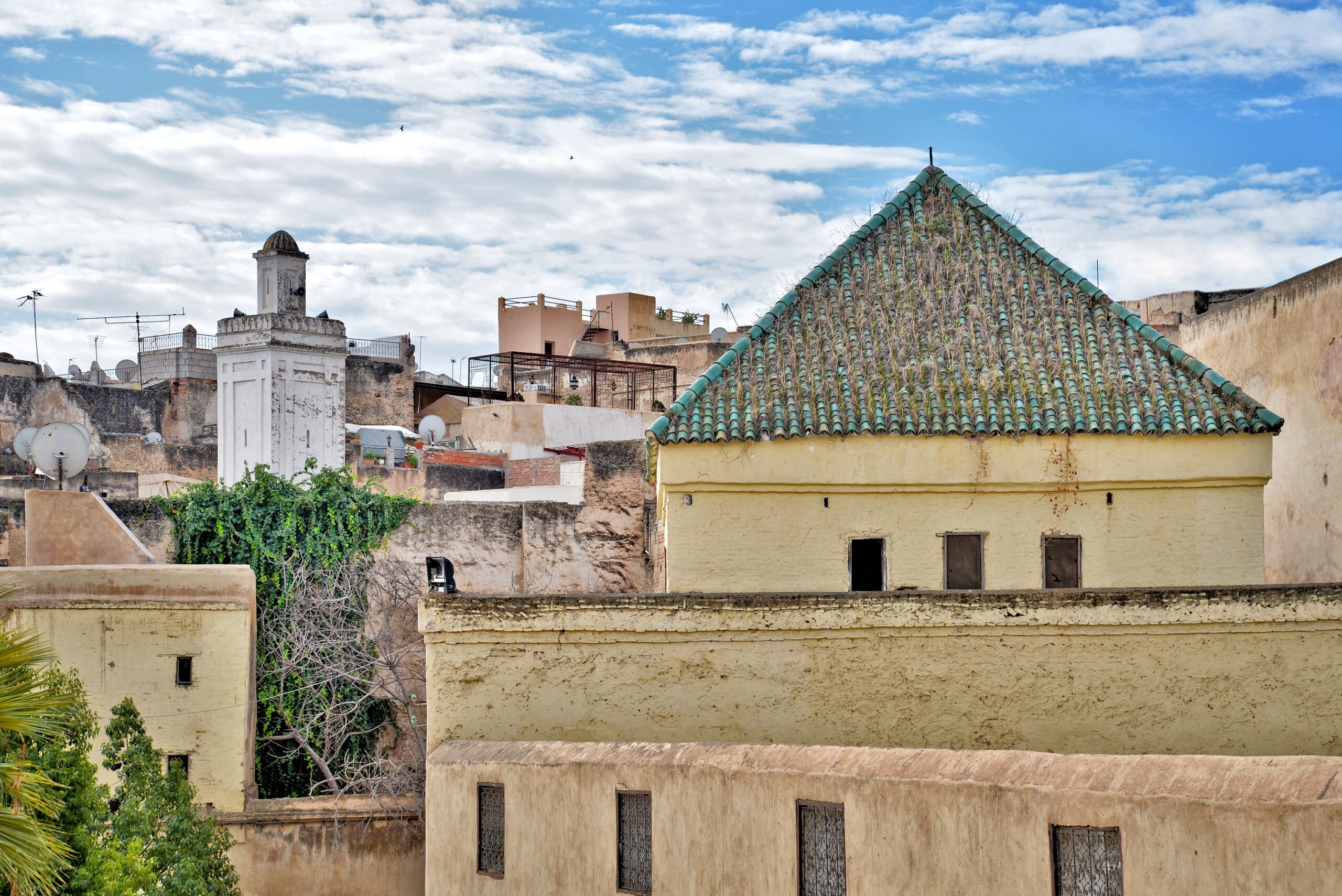
Some cities impress with monumental skylines, and others reveal themselves slowly, rewarding those willing to wander beyond the obvious. Fez Morocco, belongs unmistakably to the second category. Behind its monumental gates lies a labyrinth where every alley, courtyard, workshop, and mosque preserves centuries of intellectual achievement, artistic excellence, and cultural exchange. Walking through ancient Fez medina is less like visiting a historical monument than entering a living archive whose pages continue to be written every day.
For more than twelve centuries, Fez has served as one of Morocco’s principal centers of learning, spirituality, craftsmanship, and urban civilization. Its influence extends far beyond its walls. Scholars crossed deserts and seas to study within its institutions. Artisans refined techniques that became synonymous with Moroccan craftsmanship. Pilgrims, merchants, diplomats, and travelers transformed the city into one of the Mediterranean world’s most cosmopolitan centers during the Middle Ages.
Yet the story of Fez cannot be understood solely through dynasties or monuments. It is also the story of rivers that sustained early settlements, Amazigh tribes who shaped the surrounding landscape, migrants from Al-Andalus and Kairouan who enriched its urban culture, Jewish communities who contributed to its commercial vitality, and generations of craftspeople whose knowledge continues to define the city’s identity.
Unlike many historic cities that have become museums of the past, Fez remains profoundly alive. Its ancient medina continues to function as a place where families live, artisans work, students study, and religious traditions remain intertwined with daily life. This continuity has earned the Medina of Fez recognition as one of the world’s most significant historic urban landscapes, preserving an extraordinary concentration of architecture, craftsmanship, and intangible cultural heritage.
For today’s visitor, Fez offers far more than famous monuments. It invites you to understand Morocco through its deepest historical layers, where Amazigh traditions, Islamic scholarship, Andalusian refinement, African trade networks, and Mediterranean exchanges converge within one remarkable city.
Table of Contents
Where Is Fez? Geography and the Landscape That Shaped a Civilization
Fez is located in northern inland Morocco, approximately 180 kilometers east of Rabat and about 320 kilometers northeast of Marrakech. Nestled within the fertile Saïss Plain between the Middle Atlas Mountains to the south and the Rif Mountains to the north, the city occupies one of Morocco’s most strategic geographical settings.
This location proved decisive long before Fez became an imperial capital. The surrounding plains offered fertile agricultural land, while nearby mountain regions supplied timber, grazing lands, freshwater springs, and mineral resources. At the same time, caravan routes connecting the Mediterranean, the Atlantic coast, the Middle Atlas, and the Saharan interior converged naturally in this region.
The Oued Fès (Fez River), which flows through the city, provided abundant water that sustained agriculture, powered mills, supplied public fountains, and supported industries such as leather tanning, textile production, papermaking, and metalworking. Medieval engineers developed sophisticated systems of canals and underground channels that distributed water throughout the medina, creating one of the most advanced hydraulic networks of the Islamic world.
Rather than merely occupying a convenient location, Fez grew because geography offered exceptional opportunities for commerce, agriculture, scholarship, and political administration.
Before Fez: The Ancient Landscape of Zerhoun and Volubilis
The history of Fez begins long before the foundation of the city itself.
Long before Idris II established the urban settlement in the early ninth century, the surrounding region formed part of a thriving cultural landscape inhabited primarily by Amazigh communities. Archaeological evidence from the nearby Zerhoun Massif demonstrates continuous human occupation stretching back to prehistoric times, while caves, burial sites, and rock shelters reveal thousands of years of interaction between people and the environment.
Perhaps the most significant neighboring archaeological site is Volubilis, located roughly thirty kilometers west of modern Fez. Known in Arabic as Walili, this remarkable Roman city flourished between the first and third centuries CE, serving as one of the westernmost urban centers of the Roman Empire.
Yet Volubilis was never exclusively Roman. Archaeological research demonstrates that indigenous Amazigh populations actively participated in the city’s economic and political life. Rather than replacing local societies, Roman administration interacted with existing Amazigh elites who maintained significant influence throughout the region.
Following the gradual decline of Roman authority, Amazigh communities continued to inhabit the surrounding countryside, preserving agricultural systems, trade networks, and local political structures that later shaped the emergence of the Idrisid state.
Thus, when Fez was founded, it did not arise in an empty landscape. It inherited centuries of indigenous knowledge, agricultural development, and regional connectivity.
The Amazigh Foundations of Fez
Popular histories often emphasize Idris II as the founder of Fez, a description that is historically accurate but incomplete.
No city emerges solely through the vision of a single ruler. Fez developed because it was established within a region already inhabited by powerful Amazigh tribes whose agricultural production, political alliances, and territorial knowledge made urban development possible.
Among the most influential were the Awraba, an Amazigh confederation that played a decisive role in supporting Idris I after his arrival in Morocco during the late eighth century. Their alliance provided political legitimacy, military protection, and access to regional resources, allowing the Idrisid dynasty to establish itself within northern Morocco.
The surrounding countryside continued to be populated by Amazigh-speaking communities whose relationship with the city remained mutually beneficial. Rural populations supplied cereals, livestock, wool, timber, and agricultural products, while Fez offered markets, religious institutions, and administrative services.
This reciprocal relationship between city and countryside remained one of the defining characteristics of Fez throughout the medieval period.
Understanding Fez therefore requires recognizing it not merely as an Islamic city but as an urban center deeply rooted in an Amazigh cultural landscape.
Idris II and the Birth of a New Capital
Around 808 CE, Idris II established the city that would become the political and intellectual center of the Idrisid dynasty.
Unlike many medieval capitals created primarily for military purposes, Fez developed as both an administrative center and a place of scholarship, commerce, and religious learning. Its location allowed the Idrisids to strengthen political authority while maintaining close relationships with surrounding tribal confederations and commercial routes.
Initially, the city consisted of separate settlements located on opposite sides of the Fez River. Each community developed distinct neighborhoods, markets, and religious institutions before gradually becoming integrated into a larger urban organism.
This dual structure influenced the city’s later social organization, contributing to the remarkable diversity that characterized medieval Fez.
Migration and the Making of a Cosmopolitan City
One of the most remarkable aspects of Fez’s early history is the arrival of successive migrant communities whose knowledge transformed the city.
During the ninth century, significant numbers of Muslim families from Kairouan in present-day Tunisia settled on one side of the river, while refugees from Al-Andalus established communities on the opposite bank following political upheavals in the Iberian Peninsula.
These migrations enriched Fez enormously.
The newcomers introduced architectural traditions, legal scholarship, commercial expertise, agricultural techniques, literary culture, music, and artisanal knowledge that blended with existing Amazigh traditions rather than replacing them.
Anthropologically, Fez represents an outstanding example of cultural synthesis. Instead of producing separate parallel societies, interaction among Amazigh populations, Arab migrants, Andalusi refugees, Jewish communities, and trans-Saharan merchants generated a remarkably dynamic urban culture.
Many characteristics now considered distinctly “Fassi” emerged precisely through this process of long-term cultural interaction.
Fez as a Crossroads of Civilizations
By the tenth century, Fez had become one of the most important cities of the western Islamic world.
Its merchants traded with Al-Andalus, Ifriqiya, sub-Saharan Africa, and Mediterranean ports. Scholars exchanged manuscripts with centers of learning stretching from Córdoba to Cairo. Pilgrims traveling toward Mecca often passed through the city, while diplomatic missions connected Fez with kingdoms across Europe and North Africa.
This cosmopolitan environment fostered remarkable intellectual openness without erasing local identity.
Rather than existing at the edge of civilization, medieval Fez occupied one of its principal crossroads.
Ideas traveled alongside merchants.
Books accompanied caravans.
Architectural innovations crossed mountains and seas.
Languages influenced one another.
Craft traditions evolved through continuous exchange.
The result was a city whose identity became defined not by isolation but by connectivity.
The River That Built a City
The Oued Fès is often overlooked in popular histories, yet without it, the city could never have reached its extraordinary level of development.
Water powered flour mills, supplied public fountains, irrigated gardens, sustained hammams, and enabled industries requiring constant access to running water. Tanneries, textile workshops, paper production, and metalworking all depended upon this carefully managed hydraulic system.
Medieval engineers constructed an intricate network of canals, channels, reservoirs, and distribution systems that directed water throughout the medina with remarkable efficiency.
This hydraulic infrastructure represents one of the great engineering achievements of medieval Morocco and illustrates how environmental management contributed directly to urban prosperity.
From Idrisid Capital to the Intellectual Heart of Morocco
The early success of Fez did not guarantee its permanence. Like many medieval cities, it experienced periods of political rivalry, economic fluctuation, and dynastic change. Yet unlike many of its contemporaries, Fez repeatedly reinvented itself. Each ruling dynasty left visible marks on the city while preserving its role as a center of scholarship and commerce.
During the Almoravid period (11th–12th centuries), the previously separate settlements on either side of the Fez River were unified through major urban works. Defensive walls were strengthened, bridges linked neighborhoods more efficiently, and markets expanded to accommodate increasing commercial activity. Rather than creating an entirely new city, the Almoravids consolidated existing districts into a coherent urban organism.
The Almohads subsequently reinforced the city’s fortifications and encouraged administrative reforms that integrated Fez more closely into an empire stretching across much of North Africa and al-Andalus. Although Marrakech served as the political capital during much of the Almohad era, Fez continued to flourish as an intellectual and commercial center.
The city’s greatest architectural transformation occurred under the Marinid dynasty (13th–15th centuries). Recognizing the symbolic importance of Fez, the Marinids invested heavily in religious institutions, educational complexes, public fountains, bridges, hospitals, and caravanserais. They also founded Fes Jdid (“New Fez”) in 1276, creating a royal administrative district that complemented the older medina now known as Fes el-Bali.
This dual-city structure remains one of Fez’s defining characteristics today.
Fes el-Bali and Fes Jdid: Two Cities, One Living Heritage
Few historic cities possess an urban organization as distinctive as Fez.
Fes el-Bali, the original medieval settlement, developed organically over centuries. Its narrow streets, winding alleys, neighborhood mosques, artisan workshops, and residential quarters reflect gradual adaptation rather than centralized planning. Every district evolved according to topography, water access, commercial activity, and communal life.
By contrast, Fes Jdid emerged as a planned royal city. Constructed under the Marinids, it housed administrative buildings, military installations, gardens, palaces, and later the historic Mellah, Morocco’s first purpose-built Jewish quarter.
Anthropologically, the coexistence of these two urban forms demonstrates different conceptions of city-building. One grew through everyday interaction among residents; the other reflected dynastic authority and state administration. Together, they illustrate how political power and community life shaped one another across successive centuries.
Walking from one district to the other today allows visitors to experience this remarkable dialogue between organic urban evolution and deliberate architectural planning.
Al-Qarawiyyin: A Beacon of Knowledge Across Continents
No institution has shaped the identity of Fez more profoundly than Al-Qarawiyyin.
Founded in 859 CE by Fatima al-Fihri, the daughter of a prosperous merchant originally from Kairouan, Al-Qarawiyyin began as a mosque before gradually developing into one of the world’s most influential centers of higher learning.
Centuries before the establishment of many European universities, scholars gathered here to study theology, law, astronomy, mathematics, medicine, grammar, philosophy, geography, and logic. Students traveled from across North Africa, al-Andalus, sub-Saharan Africa, and the eastern Islamic world, transforming Fez into a crossroads of intellectual exchange.
While historians continue to debate comparisons with later European universities, there is broad scholarly agreement that Al-Qarawiyyin functioned as one of the oldest continuously operating educational institutions in the world.
Its influence extended far beyond Morocco. Manuscripts copied in Fez circulated throughout the Islamic world, while scholars trained in its classrooms contributed to legal, scientific, and literary traditions across North Africa and beyond.
The legacy of Fatima al-Fihri also remains remarkable in the history of education. Her patronage demonstrates the important role women played in supporting scholarship and public institutions within medieval Islamic societies.
Manuscripts, Libraries, and the Preservation of Knowledge
The intellectual prestige of Fez rested not only on its teachers but also on its extraordinary manuscript culture.
Before the invention of printing transformed the circulation of books, knowledge depended upon painstaking manual copying. Teams of scribes, calligraphers, illuminators, and bookbinders worked within the medina to reproduce religious texts, legal commentaries, scientific treatises, poetry, historical chronicles, and philosophical works.
Libraries attached to mosques, madrasas, and private residences accumulated thousands of manuscripts over the centuries. These collections reflected the cosmopolitan nature of Fez, containing works produced in Morocco, al-Andalus, Egypt, Ifriqiya, and the wider Islamic world.
The historic library of Al-Qarawiyyin, restored in recent years, preserves invaluable manuscripts that continue to attract historians, philologists, conservators, and researchers from around the world.
For archaeologists and historians, these manuscripts represent more than literary achievements. They provide evidence for trade networks, legal practices, scientific knowledge, linguistic development, and everyday urban life across medieval Morocco.
The Medina as a Living Laboratory of Urban Anthropology
The Medina of Fez is often described as one of the world’s largest car-free urban areas. Yet this statistic alone fails to capture its deeper significance.
From an anthropological perspective, the medina represents a sophisticated social ecosystem in which neighborhoods, markets, religious institutions, public baths, fountains, and workshops developed according to principles of proximity, cooperation, and specialization.
Rather than separating commercial, residential, and religious functions into isolated zones, medieval planners integrated them within walkable neighborhoods that encouraged daily interaction.
Each quarter traditionally possessed its own mosque, bakery, hammam, fountain, and small market, enabling residents to meet most daily needs within a short walking distance. This decentralized organization strengthened neighborhood identity while reducing dependence on centralized authority.
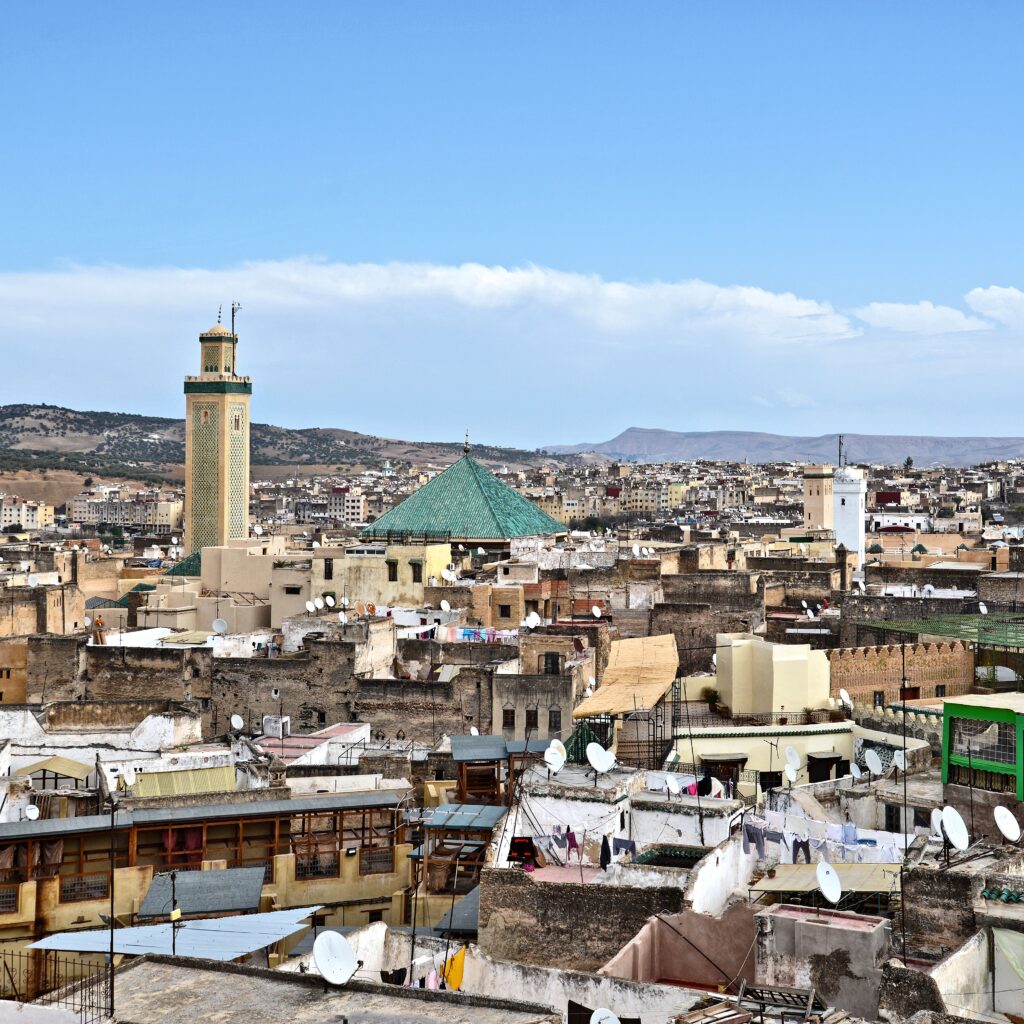
Contemporary urban planners increasingly recognize such historic neighborhoods as valuable models for sustainable, human-scale urban development.
Guilds, Crafts, and the Economy of Knowledge
The prosperity of Fez depended as much upon craftsmanship as scholarship.
Throughout the medieval and early modern periods, artisans organized themselves into professional guilds responsible for maintaining quality standards, regulating apprenticeships, resolving disputes, and preserving specialized knowledge.
Each profession occupied distinct areas of the medina. Metalworkers, woodcarvers, leather tanners, ceramic artisans, weavers, silk embroiderers, coppersmiths, and manuscript binders clustered together, creating neighborhoods where practical skills passed from master to apprentice over generations.
This concentration of expertise fostered innovation while ensuring continuity.
Even today, visitors can observe craftsmen using techniques whose origins extend back hundreds of years. Although modern technologies have influenced production, many workshops continue to rely upon hand tools, traditional materials, and inherited methods.
These artisanal traditions remain among Fez’s most significant forms of intangible cultural heritage.
Traditional Moroccan Architecture in Fez
Architecture in Fez reflects a remarkable synthesis of Amazigh building traditions, Andalusian aesthetics, Islamic geometry, and local environmental adaptation.
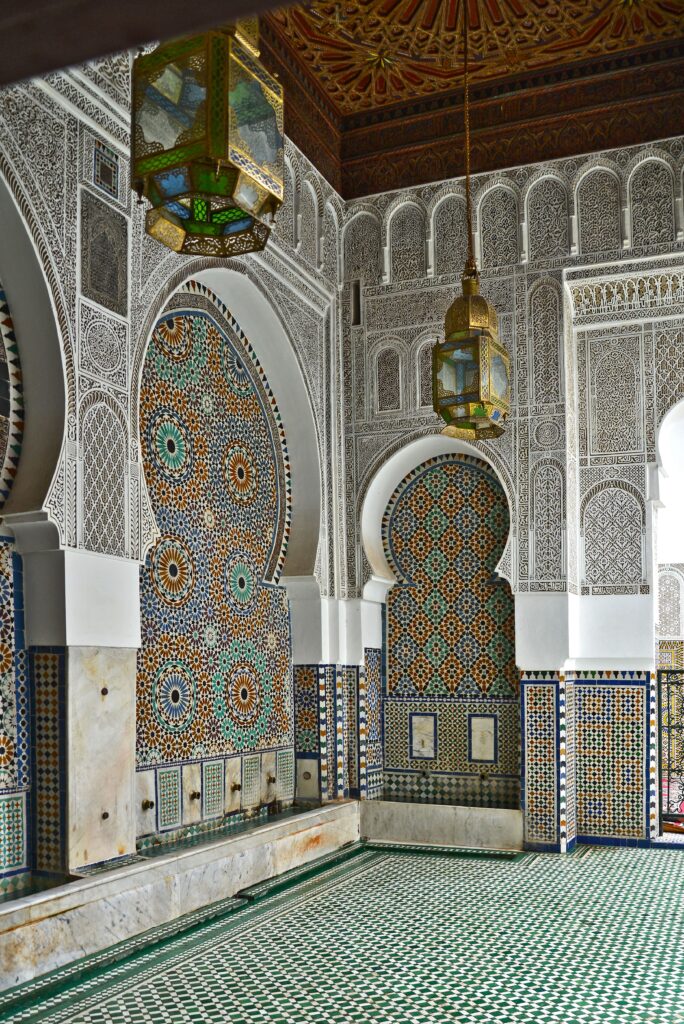
Unlike monumental architecture designed primarily for display, many structures within the medina emphasize inward beauty. Exterior walls often appear simple, protecting privacy and reducing exposure to heat, while interior courtyards reveal elaborate carved cedar ceilings, intricate zellij mosaics, sculpted plasterwork, and finely crafted wooden screens.
This architectural philosophy expresses important cultural values. Privacy, hospitality, family life, and climatic comfort take precedence over external display.
Among the city’s most celebrated architectural forms are:
Madrasas
Marinid madrasas such as Bou Inania, Al-Attarine, and Sahrij combined educational functions with extraordinary decorative artistry. Their courtyards exemplify the harmonious integration of geometry, calligraphy, water, and light.
Riads
Traditional riads center around gardens or fountains that provide natural cooling while creating peaceful domestic environments separated from the busy streets outside.
Caravanserais (Fondouks)
These multifunctional buildings accommodated merchants, animals, warehouses, and commercial exchanges, illustrating Fez’s importance within transregional trade networks.
Mosques and Zawiyas
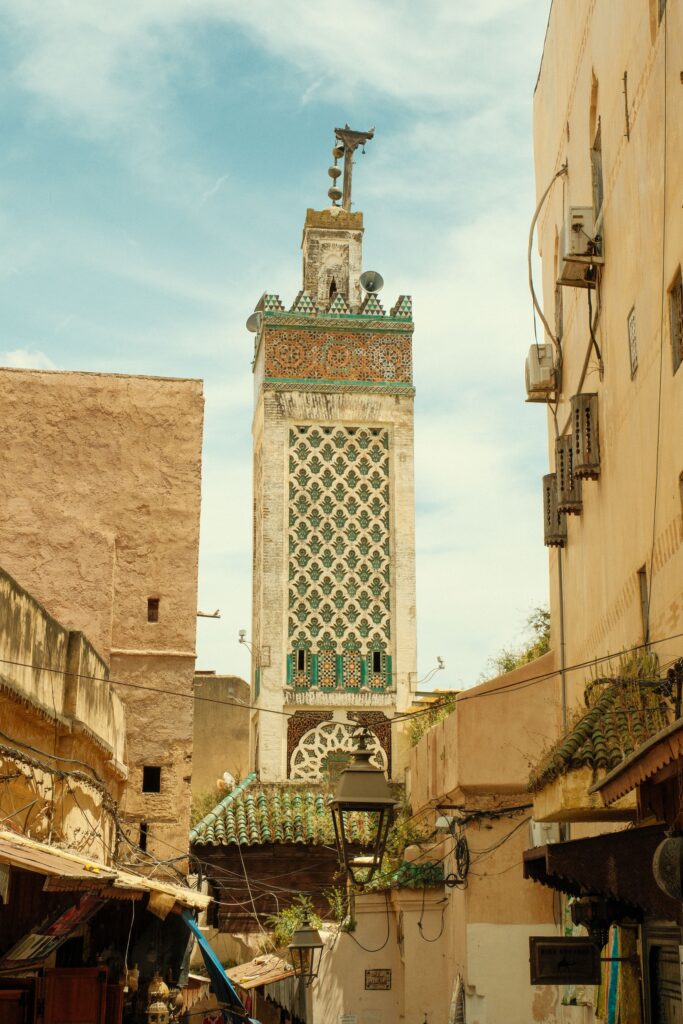
Religious architecture throughout Fez reflects successive historical periods while maintaining continuity in spatial organization and artistic expression. Mosques served not only devotional purposes but also educational, judicial, and communal functions.
Archaeological Evidence and the UNESCO World Heritage Designation
Archaeological investigations within and around Fez continue to reveal important evidence concerning urban development, hydraulic engineering, ceramics, metallurgy, domestic architecture, and commercial activity.
Excavated materials demonstrate the city’s long participation in regional and international trade networks, with imported ceramics, coins, glassware, and luxury goods reflecting commercial connections across the Mediterranean and sub-Saharan Africa.
In 1981, the Medina of Fez was inscribed on the UNESCO World Heritage List in recognition of its outstanding universal value. UNESCO identified the medina as one of the best-preserved historic cities of the Arab-Muslim world, noting its exceptional architecture, urban organization, educational institutions, and living cultural traditions.
This designation has encouraged conservation projects aimed at restoring monuments, preserving traditional craftsmanship, and maintaining the medina as a living urban environment rather than transforming it into an open-air museum.
Walking Through the Medina of Fez: An Academic Cultural Guide
Experiencing Fez Morocco is not about checking landmarks off a list. The city reveals itself gradually. Its narrow streets, hidden courtyards, workshops, fountains, and religious schools form an intricate urban landscape that rewards curiosity rather than speed.
Unlike many modern cities designed around broad avenues and automobiles, the Medina of Fez developed according to the rhythms of walking. Every street reflects centuries of adaptation to commerce, climate, religion, and neighborhood life. The absence of cars is not simply a historical curiosity—it preserves a human-scale environment where architecture and daily activity remain intimately connected.
A meaningful visit begins at one of the great gates before entering the maze of streets that have remained continuously inhabited for more than twelve centuries.
Bab Bou Jeloud: The Ceremonial Gateway to Fez
For most visitors, the journey begins at Bab Bou Jeloud, often called the Blue Gate.
Although frequently mistaken for a medieval structure, the present gate dates largely to the early twentieth century, built during the French Protectorate while respecting traditional Moroccan architectural forms. Its famous blue ceramic tiles facing the modern city symbolize Fez, while the green tiles on the interior represent the sacred color traditionally associated with Islam.
Passing beneath the gate creates a powerful transition between two worlds. Behind you lies the modern city; ahead stretches one of the largest and most intact medieval urban landscapes on Earth.
From this point onward, every step carries you deeper into centuries of Moroccan history.
Talaa Kebira and Talaa Seghira: The Two Historic Arteries
Two principal streets organize much of the western medina:
Talaa Kebira (The Great Slope) and Talaa Seghira (The Small Slope).
These ancient routes have served merchants, scholars, pilgrims, and residents since the early medieval period. Walking along them reveals how commerce and daily life continue to coexist within historic spaces.
Rather than becoming tourist corridors alone, these streets remain filled with bakeries, spice merchants, tailors, booksellers, traditional pharmacies, cafés, and family-owned workshops. This continuity distinguishes Fez from many historic cities where local commercial life has largely disappeared.
Every intersection opens onto smaller lanes leading toward residential quarters, neighborhood mosques, artisan workshops, and hidden courtyards rarely noticed by hurried visitors.
Al-Qarawiyyin Mosque and University
At the heart of the medina stands Al-Qarawiyyin, one of the most influential educational institutions in Islamic history.
Although non-Muslim visitors cannot enter the prayer hall, several surrounding viewpoints provide excellent opportunities to appreciate the architectural harmony of the complex.
As you walk through neighboring streets, it becomes evident that Al-Qarawiyyin was never an isolated monument. The mosque functioned as the intellectual center of an entire urban ecosystem that included libraries, manuscript workshops, student residences, markets, and religious schools.
For centuries, debates on theology, mathematics, astronomy, medicine, jurisprudence, and philosophy animated these surrounding neighborhoods.
Today, students still pursue Islamic scholarship here, preserving an educational tradition spanning more than eleven centuries.
Al-Attarine Madrasa: Geometry, Light, and Knowledge
Only a short distance from Al-Qarawiyyin stands the magnificent Al-Attarine Madrasa, widely regarded as one of the masterpieces of Marinid architecture.
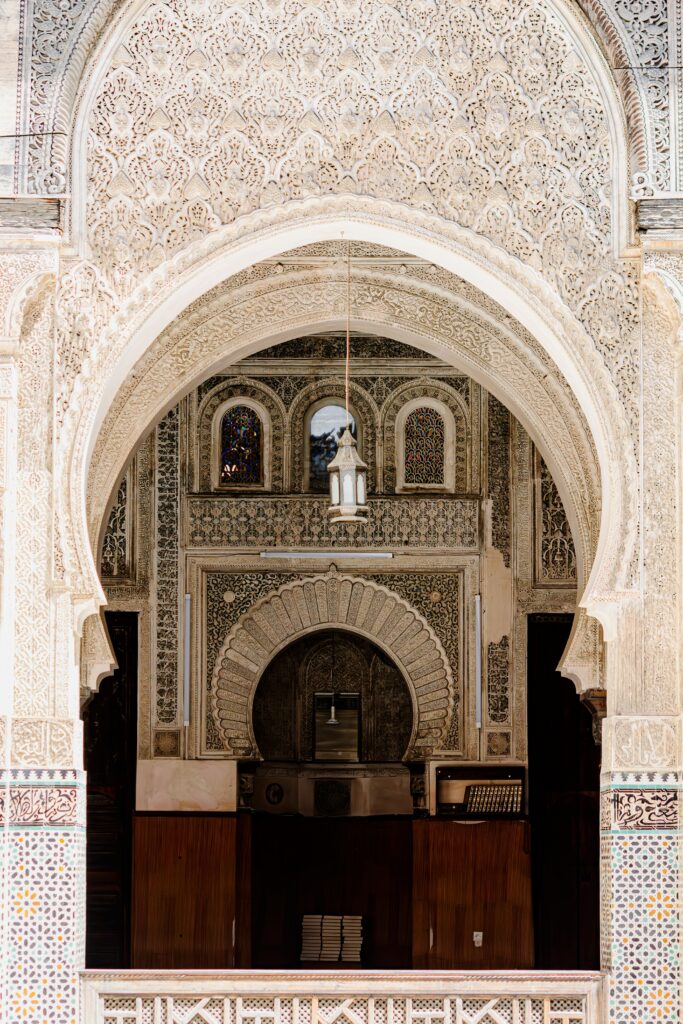
Constructed in the early fourteenth century, the madrasa demonstrates extraordinary refinement in decorative arts. Intricately carved cedar wood, delicate stucco ornamentation, colorful zellij mosaics, and elegant Arabic calligraphy combine to create a space that reflects both intellectual aspiration and artistic excellence.
Unlike monumental palaces built primarily for rulers, madrasas served students. Their beauty expressed the idea that education itself possessed sacred value.
For historians of architecture, Al-Attarine illustrates the remarkable synthesis of Amazigh craftsmanship, Andalusian aesthetics, and Islamic geometric design.
Bou Inania Madrasa: The Crown Jewel of Marinid Architecture
Among all educational institutions in Fez, Bou Inania Madrasa occupies a unique position.
Completed during the reign of Sultan Abu Inan in the fourteenth century, it functioned not only as a theological college but also as a congregational mosque, making it architecturally exceptional.
Visitors are immediately struck by the balance of proportions. Every decorative element—wood carving, marble columns, mosaic panels, carved plaster, and inscriptions—contributes to an atmosphere of harmony rather than excess.
Perhaps its greatest lesson lies in restraint. The building demonstrates how Moroccan architecture often achieves grandeur through proportion, craftsmanship, and light instead of monumental scale alone.
Chouara Tanneries: The Living Heritage of Leather Craft
Few places in Fez are more instantly recognizable than the Chouara Tanneries.
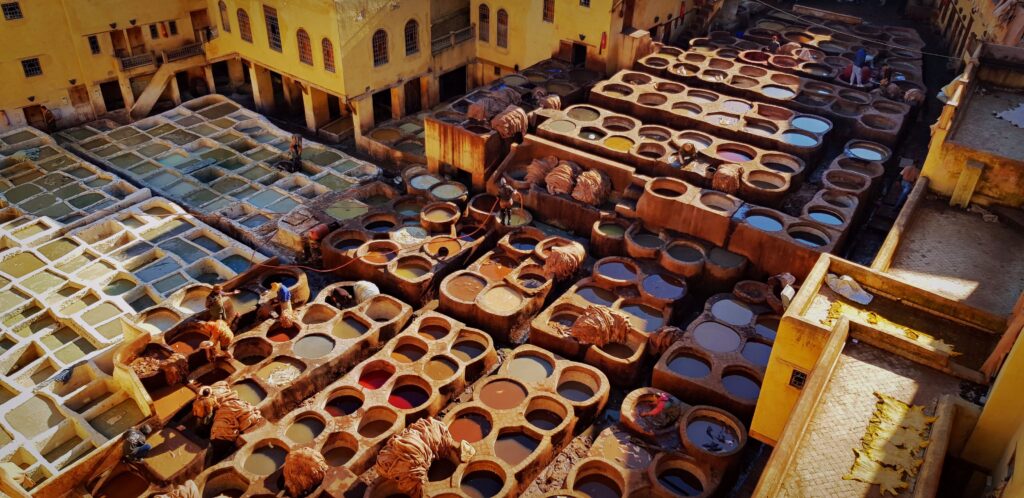
Viewed from surrounding terraces, the colorful dyeing vats create one of Morocco’s most iconic urban landscapes. Yet behind this visual spectacle lies an extraordinary example of industrial continuity.
Leather production has taken place here for many centuries using techniques passed from one generation to another. Workers continue to process hides through a sequence of washing, softening, tanning, dyeing, and drying that relies heavily on traditional materials and manual expertise.
The process remains physically demanding, requiring extensive practical knowledge developed through apprenticeship rather than formal education.
For anthropologists, the tanneries illustrate how intangible heritage survives through lived practice. Their importance lies not only in the finished leather goods but also in the preservation of specialized knowledge accumulated across centuries.
The Souks of Fez: Commerce as Cultural Memory
The markets of Fez represent far more than places of exchange.
Historically, the souks functioned as centers where economic activity, social relationships, legal institutions, and craftsmanship converged. Guild regulations maintained quality standards, apprentices learned from experienced masters, and neighborhood identities developed around particular trades.
Today, many traditional specializations remain visible.
Visitors encounter streets devoted primarily to brasswork, ceramics, textiles, spices, perfumes, woodworking, musical instruments, embroidery, leather goods, and jewelry.
Walking slowly through these markets allows one to appreciate how commercial organization helped shape the social geography of the medieval city.
Unlike shopping malls designed through centralized planning, the souks evolved organically according to centuries of practical experience.
The Mellah: Jewish Heritage in Fez
The Mellah of Fez, established during the Marinid period, became Morocco’s first purpose-built Jewish quarter.
For centuries, Jewish communities contributed significantly to the city’s commercial, diplomatic, intellectual, and artisanal life. Merchants connected Morocco with Mediterranean markets, scholars participated in religious learning, while skilled craftsmen enriched local industries.
Architecturally, the Mellah differs subtly from neighboring districts. Houses often feature balconies overlooking streets—a characteristic less common within the traditional Muslim medina.
Nearby lies the historic Jewish Cemetery, where white tombs extending across the hillside provide a poignant reminder of centuries of coexistence between Morocco’s diverse religious communities.
Understanding Fez requires recognizing this pluralistic history rather than reducing the city to a single cultural narrative.
The Royal Palace (Dar al-Makhzen)
Although visitors cannot enter the Royal Palace itself, its monumental bronze gates remain among the finest examples of ceremonial Moroccan architecture.
The palace complex reflects centuries of royal patronage, combining Andalusian, Amazigh, and Islamic artistic traditions within an ensemble of gardens, courtyards, and administrative buildings.
Standing before the ornate gates, one gains an appreciation for the symbolic role architecture plays in expressing political authority and cultural continuity.
Borj Nord and the Museum of Arms
Overlooking the city from higher ground stands Borj Nord, a sixteenth-century fortress constructed during the Saadian period.
Today it houses one of Morocco’s most important collections of historical weapons, illustrating the military technologies that shaped North African history across many centuries.
Equally impressive are the panoramic views across the medina.
From this elevated position, the remarkable urban organization of Fez becomes immediately apparent. Minarets, rooftops, gardens, and winding streets form an almost uninterrupted historical landscape stretching toward the horizon.
For photographers and historians alike, Borj Nord offers one of the finest perspectives on the city’s development.
The Marinid Tombs
Above the northern hills lie the Marinid Tombs, whose surviving ruins overlook the entire city.
Although only fragments remain, the site possesses immense symbolic significance. It reminds visitors that dynasties rise and fall, yet cities often outlive their rulers.
At sunset, the panorama from the tombs is particularly striking. As the call to prayer echoes across countless minarets, the medina appears much as it would have centuries ago.
This view encapsulates the enduring relationship between landscape, architecture, and spirituality that defines Fez.
Jnan Sbil Gardens: Nature Within the Historic City
Between the old medina and the royal district lies Jnan Sbil, one of Morocco’s most beautiful historic gardens.
Originally established during the eighteenth century and later restored, the gardens combine flowing water, shaded pathways, palms, citrus trees, bamboo groves, and ornamental plants into a peaceful refuge from the bustling streets nearby.
Historically, such gardens represented more than recreational spaces. They embodied philosophical ideals of harmony, balance, and the relationship between humanity and nature that permeated Islamic landscape design.
Today they continue to provide residents and visitors alike with an oasis of calm.
Traditional Cuisine of Fez
The culinary traditions of Fez reflect the city’s cosmopolitan history.
Centuries of interaction among Amazigh communities, Andalusian migrants, Arab scholars, Jewish families, and trans-Saharan merchants created one of Morocco’s richest gastronomic traditions.
Among the city’s signature dishes are:
- Pastilla, combining delicate pastry with savory fillings and aromatic spices.
- Rfissa, often prepared for family celebrations.
- Harira, the nourishing soup closely associated with Ramadan.
- Khlii, preserved meat prepared according to traditional methods.
- Slow-cooked lamb with prunes and almonds.
- Seasonal couscous served on Fridays.
- Fresh pastries flavored with orange blossom water.
- Traditional mint tea symbolizing Moroccan hospitality.
These recipes illustrate how food serves not merely nutritional purposes but also expresses memory, identity, hospitality, and regional history.
Fez in Contemporary Morocco: Preserving a Living Heritage
Modern Fez is often described as a city suspended between tradition and change. Yet this description oversimplifies a far more dynamic reality. Rather than existing outside modernity, Fez has continuously adapted while preserving institutions, crafts, and cultural practices that remain deeply embedded in everyday life.
The city today is divided into several distinct urban zones. Fes el-Bali continues to function as the historic heart, Fes Jdid retains its royal and administrative significance, while the Ville Nouvelle, established during the French Protectorate, reflects twentieth-century urban planning. Together these districts illustrate successive chapters of Moroccan history rather than competing identities.
Economic life has also diversified. Traditional crafts remain important, but universities, tourism, education, services, and modern commerce increasingly contribute to the city’s economy. This diversity allows Fez to remain both a historic destination and a vibrant contemporary metropolis.
For visitors, the experience is unique: within a single day you may explore medieval alleys, attend a modern university lecture, enjoy contemporary Moroccan cuisine, and witness artisans practicing techniques transmitted across generations.
Amazigh Identity in the Cultural Fabric of Fez
Although Fez is widely associated with Islamic scholarship and Arabic literary traditions, its cultural identity has always been intertwined with Amazigh history.
The city’s growth depended upon continuous interaction with Amazigh communities of the Middle Atlas, Rif, and neighboring regions. Rural families supplied food, livestock, timber, wool, medicinal plants, and agricultural products that sustained urban life. Seasonal migration strengthened economic and social ties between the city and surrounding mountains.
These relationships continue today.
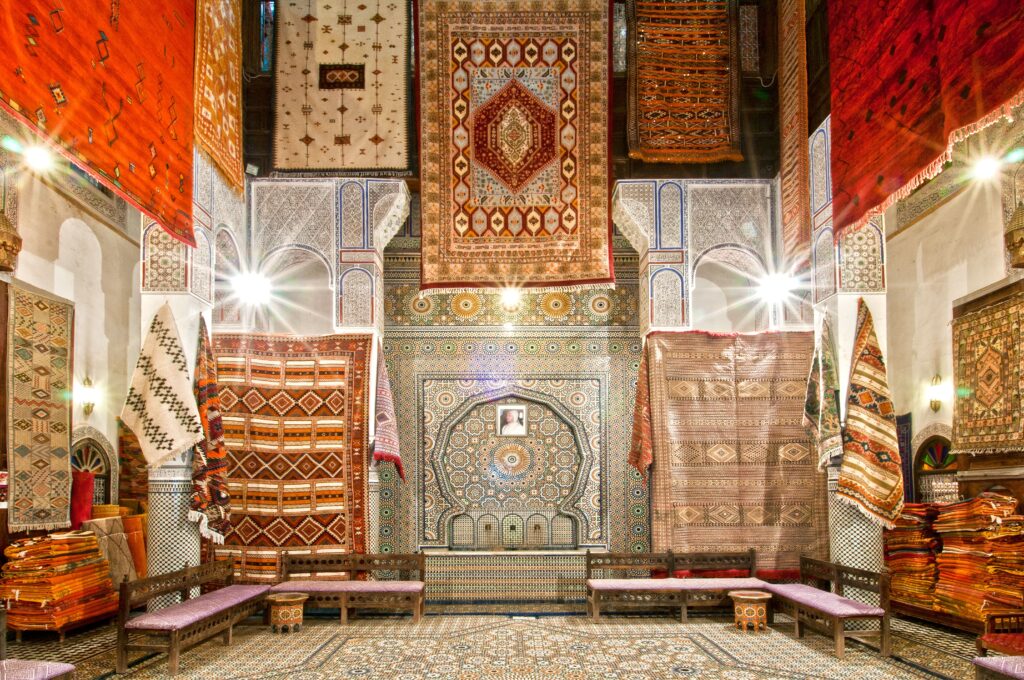
Markets throughout Fez still feature carpets woven in Amazigh villages, cedar wood from Middle Atlas forests, pottery inspired by indigenous traditions, silver jewelry reflecting Amazigh symbolism, and agricultural products cultivated by mountain communities.
Linguistically, many residents understand or speak Tamazight, particularly those with family origins in nearby rural provinces. Contemporary cultural festivals increasingly celebrate Amazigh music, poetry, and craftsmanship alongside the city’s Arab-Andalusian heritage.
Understanding Fez therefore requires recognizing it as a meeting place where multiple Moroccan identities have interacted for more than twelve centuries.
UNESCO, Conservation, and the Future of the Medina
Preserving a living city presents challenges very different from preserving an archaeological site.
The Medina of Fez contains thousands of historic buildings, many of which remain occupied by families whose daily needs must be balanced with architectural conservation. Restoring monuments while maintaining affordable housing, modern sanitation, and sustainable economic activity requires careful long-term planning.
UNESCO’s designation has increased international awareness of these challenges, encouraging partnerships among Moroccan institutions, conservation specialists, universities, and local communities.
Recent restoration projects have focused not only on major monuments but also on traditional markets, fountains, bridges, schools, libraries, and residential neighborhoods. Increasing attention has also been devoted to safeguarding intangible heritage, including craftsmanship, oral traditions, culinary practices, music, and artisanal knowledge.
The future of Fez ultimately depends not only upon preserving buildings but also upon sustaining the communities whose lives continue to give meaning to those spaces.
Responsible Travel in Fez
Visitors contribute most positively when they approach Fez as a living community rather than an outdoor museum.
Choosing locally owned riads, purchasing directly from artisans, respecting religious customs, dressing appropriately near sacred sites, and learning about the city’s history all help support sustainable cultural tourism.
Walking slowly through neighborhoods, engaging respectfully with residents, and appreciating craftsmanship beyond simple souvenir shopping allow travelers to experience the deeper rhythms of the medina.
Responsible tourism transforms travel into cultural exchange, benefiting both visitors and local communities.
Comparison Table: Fez, Marrakech, and Taroudant
| Feature | Fez | Marrakech | Taroudant |
|---|---|---|---|
| Historic role | Intellectual and religious capital | Imperial and commercial capital | Historic capital of the Souss |
| UNESCO status | Medina listed in 1981 | Medina listed in 1985 | Historic walls on Morocco’s heritage lists |
| Urban character | Medieval scholarly city | Imperial cosmopolitan center | Authentic regional market city |
| Main architectural style | Marinid, Idrisid, Andalusian | Almoravid, Almohad, Saadian | Saadian and Souss earthen architecture |
| Traditional strengths | Scholarship, manuscripts, crafts | Palaces, gardens, commerce | Agriculture, Amazigh culture, caravan trade |
| Tourism atmosphere | Cultural immersion | International destination | Quiet heritage experience |
Comparison Table: Fez and Other Historic Cities of North Africa
| City | Country | Historical Importance | Distinctive Feature |
|---|---|---|---|
| Fez | Morocco | Medieval intellectual center | Al-Qarawiyyin, UNESCO Medina |
| Tlemcen | Algeria | Zayyanid capital | Andalusian architecture |
| Kairouan | Tunisia | Early Islamic center | Great Mosque of Kairouan |
| Tunis | Tunisia | Mediterranean trade hub | Medina and Hafsid heritage |
| Cairo | Egypt | Imperial metropolis | Al-Azhar and Islamic monuments |
Frequently Asked Questions About Fez Morocco
Where is Fez in Morocco?
Fez is located in northern inland Morocco, between the Rif Mountains and the Middle Atlas. Its strategic position connected Mediterranean trade routes with the interior of Morocco and the Sahara.
Why is Fez famous?
Fez is famous for its UNESCO-listed medina, Al-Qarawiyyin University, traditional crafts, medieval architecture, leather tanneries, and its long history as Morocco’s intellectual and spiritual center.
Is Fez worth visiting?
Absolutely. Fez offers one of the most authentic cultural experiences in Morocco, combining history, architecture, scholarship, traditional craftsmanship, and vibrant daily life within one of the world’s best-preserved medieval cities.
How many days should you spend in Fez?
Most travelers benefit from spending three to four days in Fez. This allows sufficient time to explore the medina, museums, gardens, nearby viewpoints, and surrounding cultural attractions without rushing.
What are the best places to visit in Fez?
Among the city’s highlights are Bab Bou Jeloud, Al-Qarawiyyin, Bou Inania Madrasa, Al-Attarine Madrasa, Chouara Tanneries, the Mellah, the Royal Palace gates, Borj Nord, the Marinid Tombs, and Jnan Sbil Gardens.
Can non-Muslims visit Al-Qarawiyyin Mosque?
Non-Muslims may admire the complex from surrounding streets and selected viewpoints, but access to the mosque’s prayer hall remains restricted.
What language do people speak in Fez?
Residents primarily speak Moroccan Arabic (Darija) and Modern Standard Arabic, while French is widely used in education and business. Many families also speak Tamazight, especially those with Amazigh origins.
Is Fez safe for tourists?
Yes. Fez is generally considered safe for visitors. As in any large historic city, travelers should remain aware of their surroundings, safeguard personal belongings, and use licensed guides if navigating the medina for the first time.
What food should visitors try in Fez?
Traditional specialties include pastilla, harira, rfissa, couscous, lamb with prunes, khlii, Moroccan pastries, and fresh mint tea.
Why is the Medina of Fez a UNESCO World Heritage Site?
UNESCO recognized the medina because it preserves one of the world’s finest examples of medieval Islamic urban planning, architecture, education, craftsmanship, and living cultural heritage.
Conclusion: Fez, Where Morocco’s Memory Still Lives
Few cities preserve the continuity of history as completely as Fez. Its streets are not relics abandoned to time but living spaces where scholarship, craftsmanship, spirituality, and community continue to shape everyday life.
From the Idrisid foundation through the Marinid flowering, from Amazigh rural networks to Andalusian intellectual traditions, Fez developed through encounters rather than isolation. Its greatness lies in the ability to absorb diverse influences while maintaining a distinctive identity rooted in Morocco.
Walking through the medina today reveals more than monuments. It reveals systems of knowledge transmitted across generations, architectural wisdom adapted to climate, artisanal traditions sustained through apprenticeship, and neighborhoods where social relationships remain central to urban life.
For historians, Fez offers one of the richest archives of medieval North Africa. For anthropologists, it demonstrates the resilience of living heritage. For travelers, it provides an opportunity to encounter Morocco beyond postcard images, discovering a city whose greatest treasures are found not only in its monuments but also in its people, traditions, and enduring cultural memory.
To visit Fez is therefore not simply to explore an ancient city. It is to enter one of the world’s great centers of civilization, where every alley, fountain, workshop, and courtyard reminds us that heritage is most meaningful when it continues to be lived.
References (APA Style)
- Abun-Nasr, J. M. (1987). A History of the Maghrib in the Islamic Period. Cambridge University Press.
- Bazzana, A. (1992). Maisons d’al-Andalus. Casa de Velázquez.
- Brett, M., & Fentress, E. (1996). The Berbers. Blackwell Publishers.
- Camps, G. (1980). Berbères: Aux marges de l’histoire. Éditions des Hespérides.
- Ennaji, M. (2005). Multilingualism, Cultural Identity, and Education in Morocco. Springer.
- Eustache, D. (1975). Corpus des dirhams idrisites. Rabat.
- Hoffman, K. (2008). We Share Walls: Language, Land, and Gender in Berber Morocco. Wiley-Blackwell.
- Laroui, A. (1977). The History of the Maghrib. Princeton University Press.
- Le Tourneau, R. (1949). Fès avant le Protectorat. Casablanca.
- Miller, S. G. (2013). A History of Modern Morocco. Cambridge University Press.
- Pennell, C. R. (2013). Morocco: From Empire to Independence. Oneworld.
- Terrasse, H. (1968). La civilisation hispano-mauresque. Arts et Métiers Graphiques.
- UNESCO. Medina of Fez. World Heritage Centre.
- Valérian, D. (2015). Ports et réseaux d’échanges au Maghreb médiéval. Publications de la Sorbonne.