
Amazigh Weddings and Traditions (الأعراس والتقاليد): Rituals of Love, Community, and Identity.
Introduction
You’ve probably attended weddings that blend joy, music, and tradition — but an Amazigh wedding is not just a celebration; it’s a living story. It’s a week-long journey where the past and present embrace, where each song, color, and gesture carries the memory of ancestors who lived close to the earth, the seasons, and the spirits of community.
Imagine standing in a village of the High Atlas Mountains, the air crisp with the scent of cedar and wild herbs. Drums echo from a distance, women chant ancient songs, and a bride’s hands are painted with henna that tells her lineage. Each rhythm and ritual connects generations — not as a performance for outsiders, but as a sacred act of love and belonging.
Through this article, you’ll travel deep into Amazigh wedding traditions, exploring how these celebrations intertwine with nature, spirituality, gender roles, and identity. You’ll see how they evolve — from remote villages to modern cities — while remaining rooted in Amazigh values: community, respect, and continuity.
Table of Contents
Historical Roots of Amazigh Weddings
Ancient Marriage Customs in Amazigh Culture
- The Amazigh people, one of North Africa’s oldest civilizations, have celebrated marriage for millennia as a social contract and a spiritual bond.
- Historically, marriage served to preserve tribal alliances and strengthen kinship ties within the Ait (clans).
- Anthropological sources (like Jacques Berque and Ernest Gellner) describe how marriages were negotiated by elders, reflecting a deep communal sense rather than individual choice.
Symbolism of Fertility and Continuity
- Fertility is central: wheat, milk, and honey symbolize life, purity, and prosperity.
- The bride’s white garments and silver jewelry express both virginity and divine blessing.
- Songs often invoke Tislit n Ayt Hdidou and Isli, the legendary Amazigh lovers turned into stars — a myth representing eternal love and reunion.
Wedding as a Reflection of Amazigh Identity
- The Amazigh wedding is an expression of freedom and endurance, shaped by the mountains’ isolation and resilience.
- Each tribe (e.g., Ait Atta, Ait Hdidou, Ait Souab) preserves distinct symbols — from music rhythms to dance patterns — that tell stories of their history and environment.
- In contrast to urban Moroccan weddings influenced by Arab-Andalusian traditions, Amazigh weddings remain collective and participatory, rooted in shared cultural expression rather than spectacle.
The Structure of an Amazigh Wedding Ceremony
A traditional Amazigh wedding isn’t a one-day event. It unfolds like a ritualized story, often lasting three to seven days, involving both spiritual purification and community participation.
| Stage | Description | Symbolism |
|---|---|---|
| Preparation (Abrid n Tamezgida) | Families agree on dowry, prepare gifts, and perform cleansing rituals. | Purity, readiness, and family honor. |
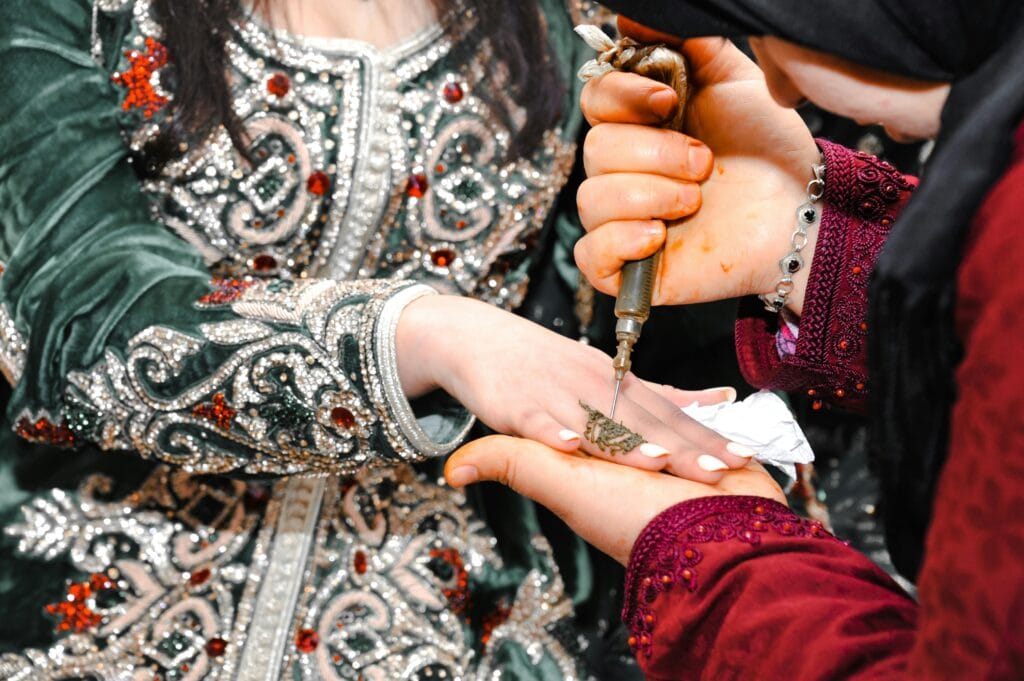
| Henna Ceremony (Asi n Lḥinna) | Women sing ancient songs while applying henna to the bride’s hands and feet. | Protection against evil, fertility, and transition. |
| Procession (Amersi n Tislit) | The bride rides a mule or horse, escorted by music and ululations. | Movement from childhood to womanhood. |
| Wedding Night (Aslelli n Tislit d Isli) | Private ritual marking union. Often symbolized with milk and dates. | Purity, unity, and divine blessing. |
| After-Celebrations (Tamedyazt) | Poetry, songs, and dances (Ahwach or Ahidus). | Community cohesion and collective joy. |
The Role of Music, Poetry, and Dance in Amazigh Weddings
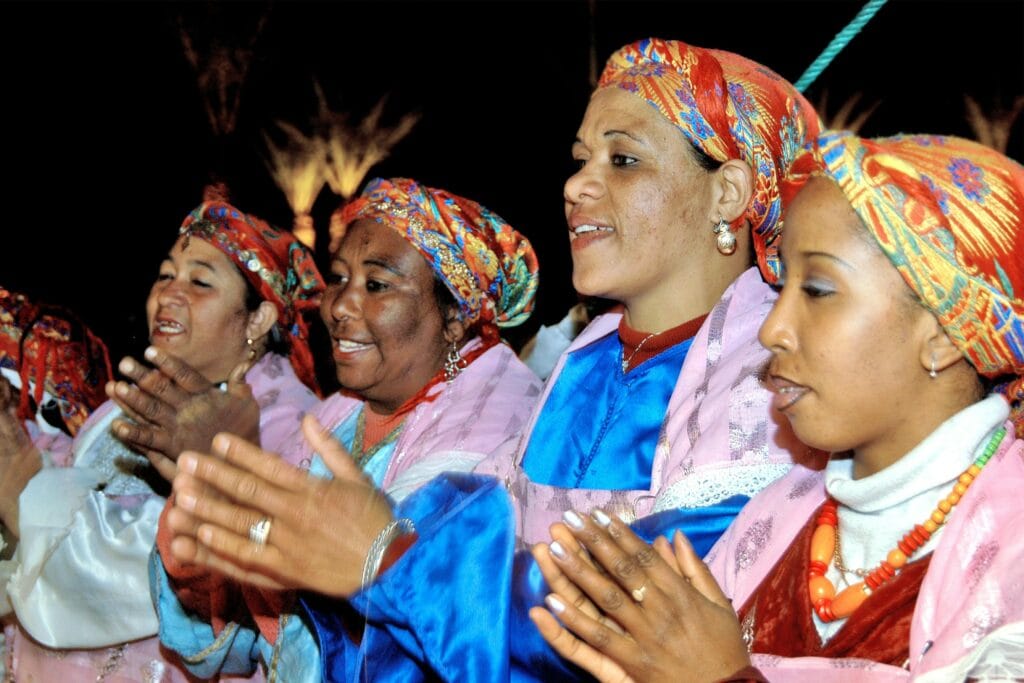
Music and poetry are the heartbeat of Amazigh celebrations. In every valley of the High Atlas, Anti-Atlas, and Rif, wedding sounds echo differently — yet they all share a spiritual purpose: to bless, protect, and unite.
Ahwach and Ahidus — The Collective Spirit
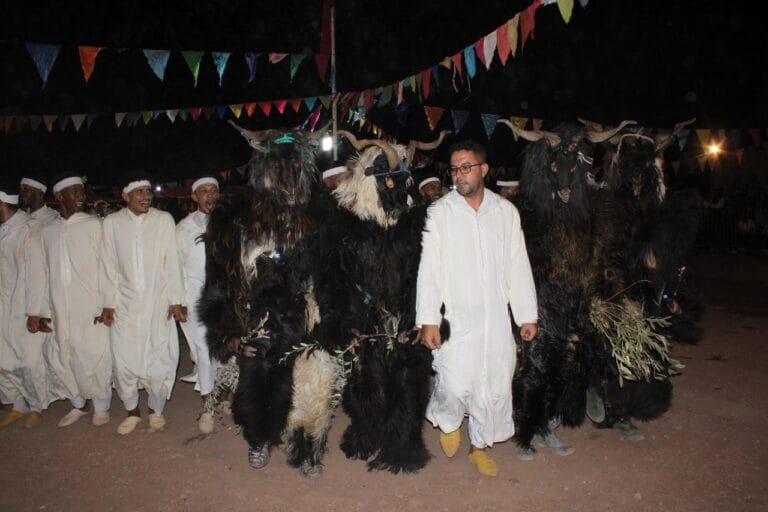
You cannot imagine an Amazigh wedding without Ahwach (in the south) or Ahidus (in the Middle and High Atlas).
- These are collective dances that blend rhythm, poetry, and movement into one act of harmony.
- The circle formation of dancers symbolizes unity, equality, and continuity — no one leads or dominates.
- The synchronized steps, drums (tbel), and flutes (aẓemmar) echo ancient agricultural rhythms, connecting the community to the earth and seasons.
In Ahwach, women’s voices often lead, chanting improvised verses that express joy, nostalgia, or social commentary — a sign of the Amazigh woman’s poetic power.
The Power of Poetry — Amarg and Tamedyazt
- Poetry (Amarg) is recited or sung by imdyazen — local poets who use metaphor and rhythm to praise love, nature, and ancestors.
- Poems carry blessings for the couple, but also advice and wisdom.
- In some regions, poetry duels take place — men and women respond to one another in witty verse, showing the deep literary skill of rural Amazigh communities.
Music Instruments and Symbolism
| Instrument | Name (Tamazight) | Symbolism in Weddings |
|---|---|---|
| Drum | Tbel / Bendir | Represents heartbeat and vitality. |
| Flute | Aẓemmar | Guides the bride spiritually during procession. |
| Hand claps | Ighirran | Synchronize collective energy and unity. |
| Voice | Tamedyazt | The soul of Amazigh oral art — storytelling, identity, blessing. |
Symbolism in Dress and Adornment
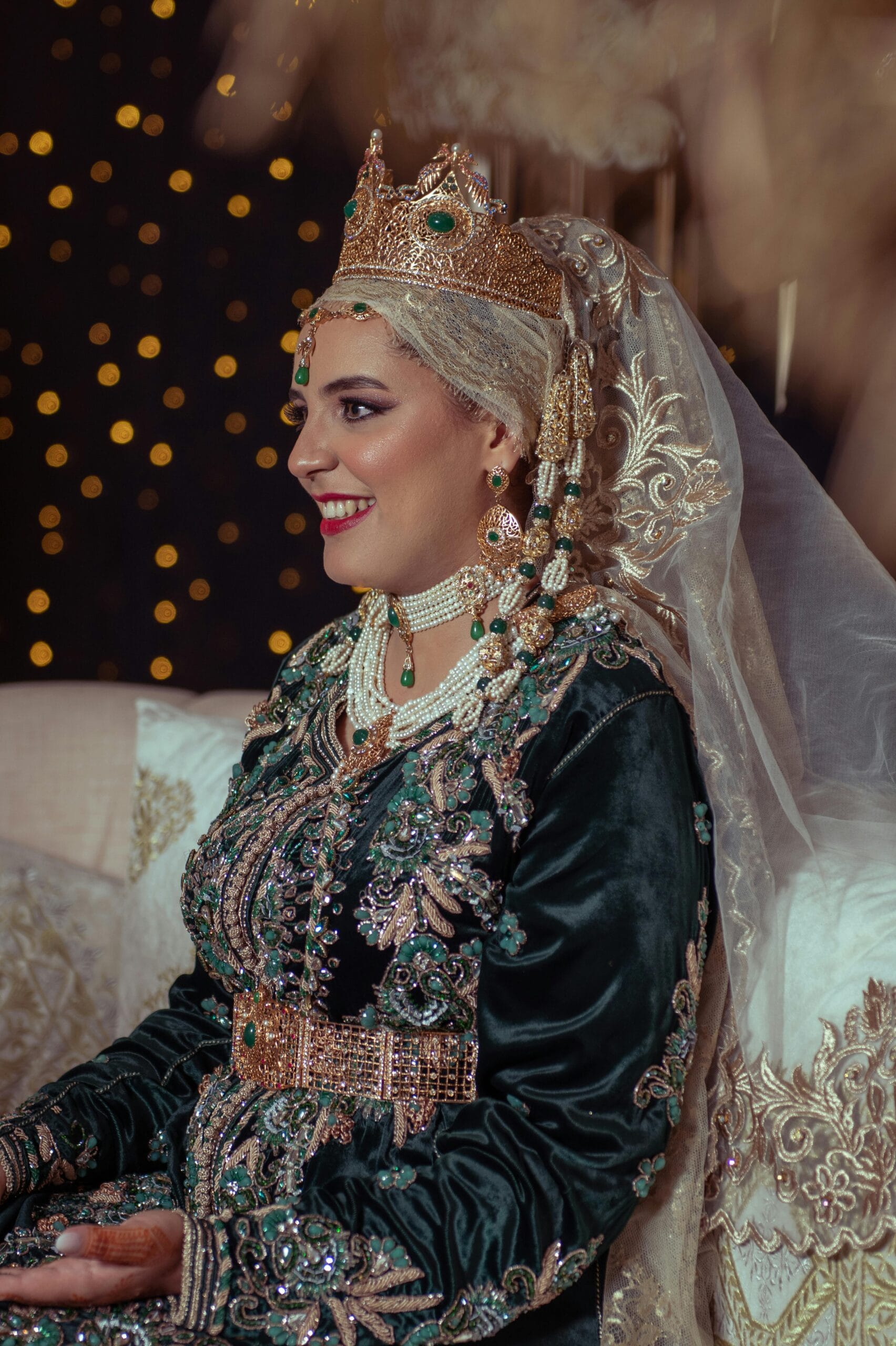
Amazigh clothing during weddings is far more than decoration — it’s a coded language of identity, beauty, and protection.
The Bride’s Attire (Tislit n Tamezgida)
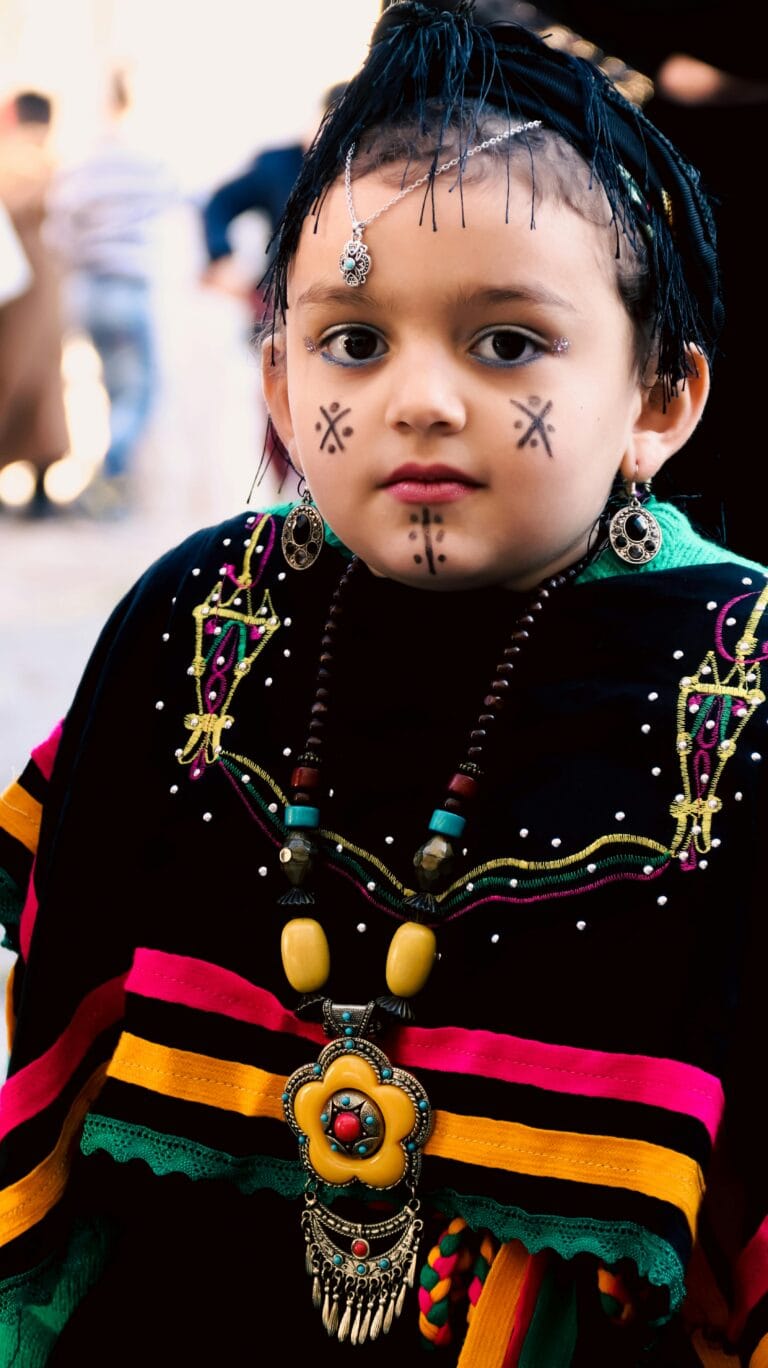
- The bride (tislit) wears a bright wool dress (akhnif or tahendirt), richly embroidered with tribal patterns.
- Her jewelry — heavy silver pieces, amber beads, and coins — act as both ornaments and amulets against evil spirits.
- The iconic tabzimt (crescent-shaped pendant) represents fertility and the lunar cycle.
- The head covering (tazerzit) and veil (akhnif n tislit) signal modesty and transition into married life.
The Groom’s Symbolism
- The groom (isli) wears a white djellaba or burnous, symbolizing purity.
- He often carries a traditional dagger (koummiya) — both a symbol of strength and a spiritual protector.
- The color white also reflects Amazigh cosmology: a color of beginnings, snow, and peace.
Tattoos and Henna as Sacred Art
- Henna marks fertility and protection; its designs often contain zigzags, eyes, and geometric Amazigh motifs.
- Traditional tattoos, now less common, once identified lineage, tribe, and spiritual status.
- Anthropologists (e.g., H. Claudot-Hawad, 1993) have noted that Amazigh women’s tattoos were “scripts of identity written on the body.”
Food, Hospitality, and Symbolism in Amazigh Weddings
No Amazigh wedding exists without food as ritual — every dish tells a story of generosity and connection.
Communal Meals
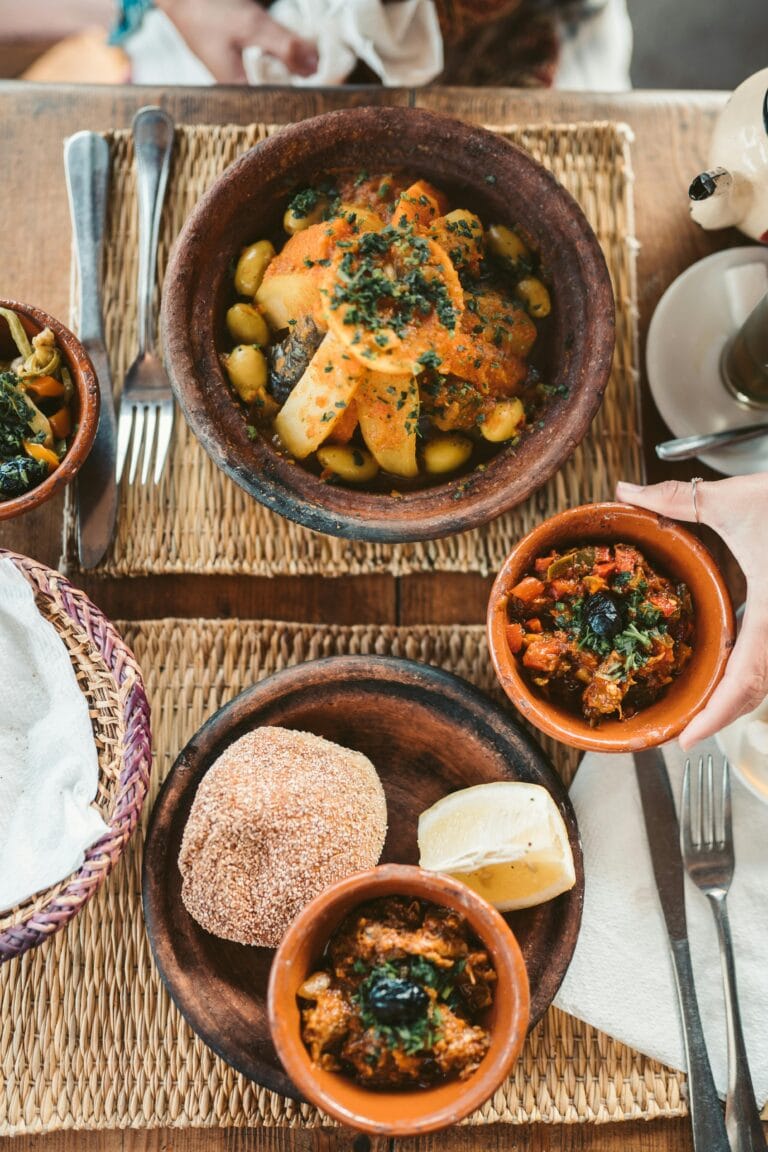
- Guests share couscous, tagine, amlo (almond-argan-honey paste), and tea, all prepared collectively by village women.
- Meals are served on shared platters — a physical expression of solidarity and equality.
The Sacred Ingredients
| Dish / Item | Meaning | Symbolism |
|---|---|---|
| Milk and Dates | Served to the couple during wedding night. | Purity, sweetness, and blessings. |
| Couscous with Seven Vegetables | Common in southern weddings. | Harmony, fertility, the seven blessings. |
| Honey | Used in tea and desserts. | Eternal love and divine favor. |
| Argan Oil | Offered to guests. | Amazigh connection to nature, generosity, sacred economy. |
Hospitality as a Moral Duty
In Amazigh culture, the act of feeding others — even strangers — is considered a sacred duty (tizzwawin).
The bride’s family gains honor not through wealth, but through how generously they feed the community.
Regional Variations in Amazigh Weddings
Each Amazigh region — from the Rif to Souss to the Atlas — carries its own local colors while sharing the same spiritual core.
The Rif (Tarifit-speaking Regions)
- Weddings here feature Ahidus and bendirs with high-pitched singing.
- Women wear colorful headscarves and silver crowns (tajalt).
- Olive branches and henna are major fertility symbols.
The Middle Atlas (Tamazight-speaking Regions)
- The ceremony emphasizes tribal poetry (amarg) and horse parades.
- Brides wear embroidered red wool and amber jewelry.
- The wedding procession resembles a pilgrimage, accompanied by collective chants.
The Souss and High Atlas (Tachelhit-speaking Regions)
- Weddings last up to seven days.
- The famous Ahwach dance dominates, with poetic dialogues between men and women.
- Argan oil and saffron play symbolic roles.
- The bride is sometimes carried in a decorated palanquin (tafraout), surrounded by ululations and drums.
Social and Spiritual Roles of Amazigh Women in Marriage
The Woman as Cultural Guardian
- The Amazigh woman carries the knowledge of rituals, songs, and symbolic gestures.
- She’s the memory of the tribe — preserving oral literature, recipes, weaving motifs, and spiritual customs.
- Even though weddings celebrate a union, they also reaffirm matrilineal cultural transmission.
Marriage as a Rite of Passage
- For both men and women, marriage marks the transition to social maturity.
- The rituals of purification, henna, and clothing all signal transformation and integration into the collective identity.
The Role of the Mother and Elder Women
- Elder women (tamtutin) guide the bride through rituals, offering symbolic advice.
- Their songs blend religious and cultural elements — invoking God (Rabbi), saints (igurramen), and ancestral spirits (iḥuriyen).
Modern Transformations and Cultural Preservation
Modern Amazigh weddings are evolving — influenced by urbanization, media, and migration — yet they continue to carry ancestral essence.
From Village to City
- In cities, weddings have become shorter, yet families still incorporate traditional songs, henna, and dress.
- Modern Amazigh artists (e.g., Fatima Tihihit, Ammouri Mbarek) reintroduce these traditions through music and festivals.
Revival Through Cultural Associations
- Cultural NGOs and Amazigh associations are working to document, film, and teach wedding traditions in schools and museums.
- UNESCO’s recognition of Ahwach and Ahidus as intangible heritage has brought new global attention.
Balancing Identity and Modernity
- Young Amazigh couples today often choose a hybrid wedding — modern in logistics but traditional in spirit.
- This reflects the Amazigh philosophy of tamurt d tafukt — “land and light” — the coexistence of roots and renewal.
What makes Amazigh weddings unique in Morocco?
They emphasize community, poetry, and symbolism. Every gesture — from henna to songs — carries meaning beyond beauty.
How long does an Amazigh wedding last?
Traditionally 3–7 days, though modern versions often last two days.
Are Amazigh weddings religious or cultural?
They are both — blending Islamic blessings with ancestral Amazigh spirituality and nature symbolism.
Do wedding customs vary by region?
Yes. The Rif, Atlas, and Sous regions have unique variations
Why is music important in Amazigh weddings?
Because it binds the community — rhythm and poetry are the voices of collective memory.
Are modern and traditional practices blended today?
Many weddings blend traditional rituals with modern influences.
Conclusion: A Celebration Beyond Time
When you witness an Amazigh wedding, you’re not just seeing a marriage — you’re watching history dance. You’re hearing the heartbeat of a people who survived through poetry, art, and love.
Each chant, each drumbeat, is a whisper from centuries past reminding you that culture isn’t preserved in museums — it lives in your songs, in your gestures, and in how you honor your roots.
If you ever attend one, don’t just observe. Listen, dance, and feel the continuity — because Amazigh weddings are more than tradition; they’re the living pulse of identity itself.
📚 Suggested External References
- UNESCO Intangible Cultural Heritage Lists — Ahwach & Ahidus Traditions
- Claudot-Hawad, H. (1993). Ecriture sur le corps: les tatouages féminins amazighs.
- Berque, J. (1955). Structures sociales du Haut Atlas.
- Gellner, E. (1969). Saints of the Atlas.
- National Institute of Archaeology and Heritage, Rabat.
- Moroccan Ministry of Culture, Amazigh Heritage Archives.
✅ Call to Action:
If you’ve ever experienced or documented an Amazigh wedding, share your story or photos with iwziwn.com.
Your memories help preserve the rhythm of a culture that belongs to all of us. 🌿
One Comment