Eternal Rhythms of the Atlas: The Untold History of Ahidous Dance in Morocco
Introduction — When the Mountains Begin to Speak
Among the ancient peaks of Morocco, where the High, Middle, and Eastern Atlas rise like guardians over millennia of Amazigh memory, a dance continues to echo through valleys and cedar forests: Amazigh Ahidous Dance History. More than a musical expression, Ahidous is a living archive, a philosophy of harmony, and a spiritual performance rooted in Amazigh identity. Its stories move through the synchronized steps of men and women, its poetry flies on the rhythm of the bendir, and its emotion shines in the circle that symbolizes unity, cooperation, and collective life.
This article traces the complete academic history of Amazigh Ahidous across the Atlas Mountains — its origins, evolutions, symbolism, clothing, musical techniques, regional variations, themes, and the communities that preserve it.
Table of Contents
1. Origins of Ahidous — A Dance as Old as Amazigh Civilization
Amazigh Ahidous is considered one of the oldest communal dance traditions in North Africa. Archaeological and anthropological evidence suggests that its earliest forms appeared among proto-Amazigh tribes more than 2,000 years ago. It emerged as a ritual of cohesion, performed during:
- harvest celebrations,
- weddings,
- seasonal transitions,
- war victories and tribal alliances,
- rites for rain and fertility.
Its circular structure symbolizes the Amazigh cosmology, where the circle reflects:
- protection of the community,
- unity between men and women,
- continuity of life,
- the infinite rhythm of nature.
2. Geographic Heartlands — Where Ahidous Lives
Amazigh Ahidous is not a single dance; it is a family of regional Amazigh performances practiced across:
📍 The Middle Atlas (the strongest and most iconic form)
Home of the Ait Mgouna, Ait Yahia, Ait Hadidou, Ait Ayache, and Ait Ouaouzguit tribes.
This region is considered the birthplace of classical Ahidous, known for:
- large dancing circles,
- powerful bendir rhythms,
- poetic duels improvising amarg (Amazigh poetry),
- mixed-gender participation.
📍 Eastern High Plateaus (Oujda, Taza, Ait Bouguemmaz area)
Here Amazigh Ahidous becomes faster and more energetic, influenced by eastern Amazigh traditions.
The singing is often higher pitch, with strong antiphonal exchanges.
📍 The High Atlas (Zayanes & Ait Atta territories)
Mountain tribes tend to emphasize:
- warrior foot-stomping,
- long drawn-out melodies,
- the use of symbolic clothing,
- heavy ceremonial styles for weddings and migration seasons.
In each region, the fundamental elements remain the same — the circle, the poetry, the drums — but the rhythm, social meaning, and gestures change.
3. Social Function — The Dance as a Community Institution
Traditionally, Amazigh Ahidous was not just entertainment; it served key social purposes:
A. Courtship & Marriage
Ahidous often acted as a public matchmaking platform.
Young men and women met in dance circles, exchanging:
- glances,
- poetic compliments,
- subtle rhythmic gestures.
A skilled dancer or poet was seen as cultured, intelligent, and desirable.
B. Tribal Unity & Diplomacy
When tribes formed alliances, Amazigh Ahidous celebrated the peace treaty, acting as a symbolic handshake through synchronized steps.
C. Agricultural Celebration
Performances during the:
- almond blossom season,
- wheat harvest,
- summer festivals,
- first rains (tagrest),
represent gratitude toward the land.
D. Oral Education & Memory
Through izlan (sung poems), communities passed:
- moral values,
- tribal history,
- heroic stories,
- myths and metaphors.
4. Music of Ahidous — The Voice of the Bendir
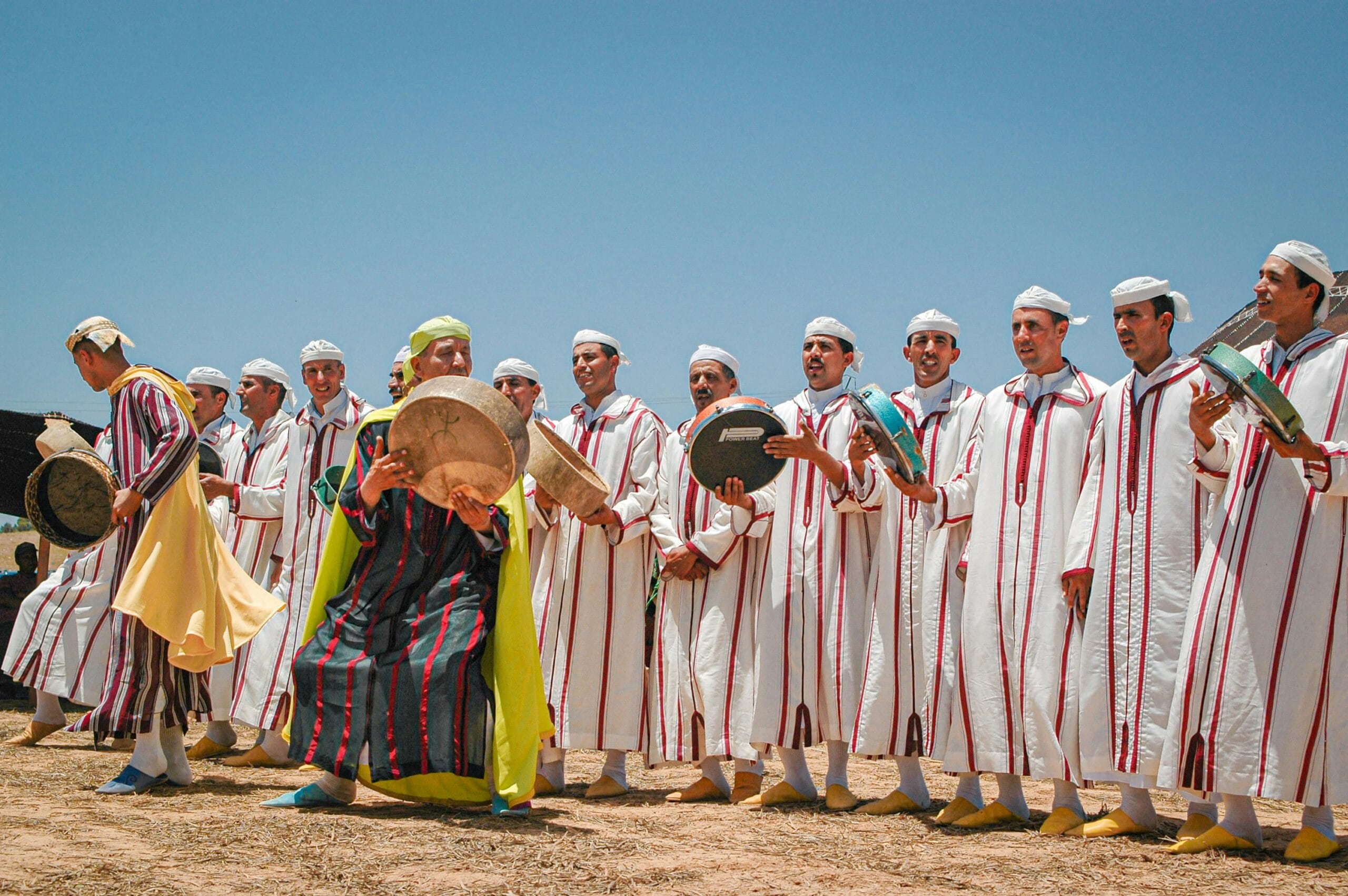
The bendir (a large hand drum with natural skin) is the heart of Ahidous. Its deep, resonant sound imitates:
- thunder,
- rainfall,
- horse hooves on dry earth.
Musical Characteristics
- Repetitive rhythmic cycles that induce collective trance
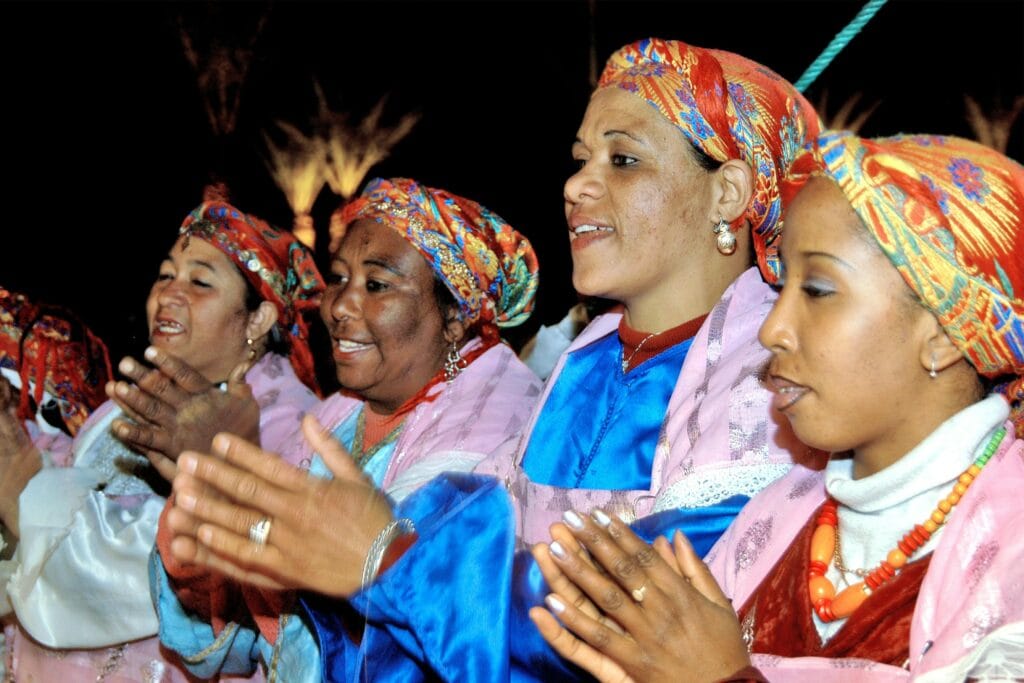
- Call-and-response singing between men and women
- Rich harmonization using Amazigh pentatonic scales
- Poetic improvisation (timawayin)
- A progressional increase in tempo leading to emotional climax
The musical structure is designed to mirror the movement of the community — calm beginnings, unity, intensity, and release.
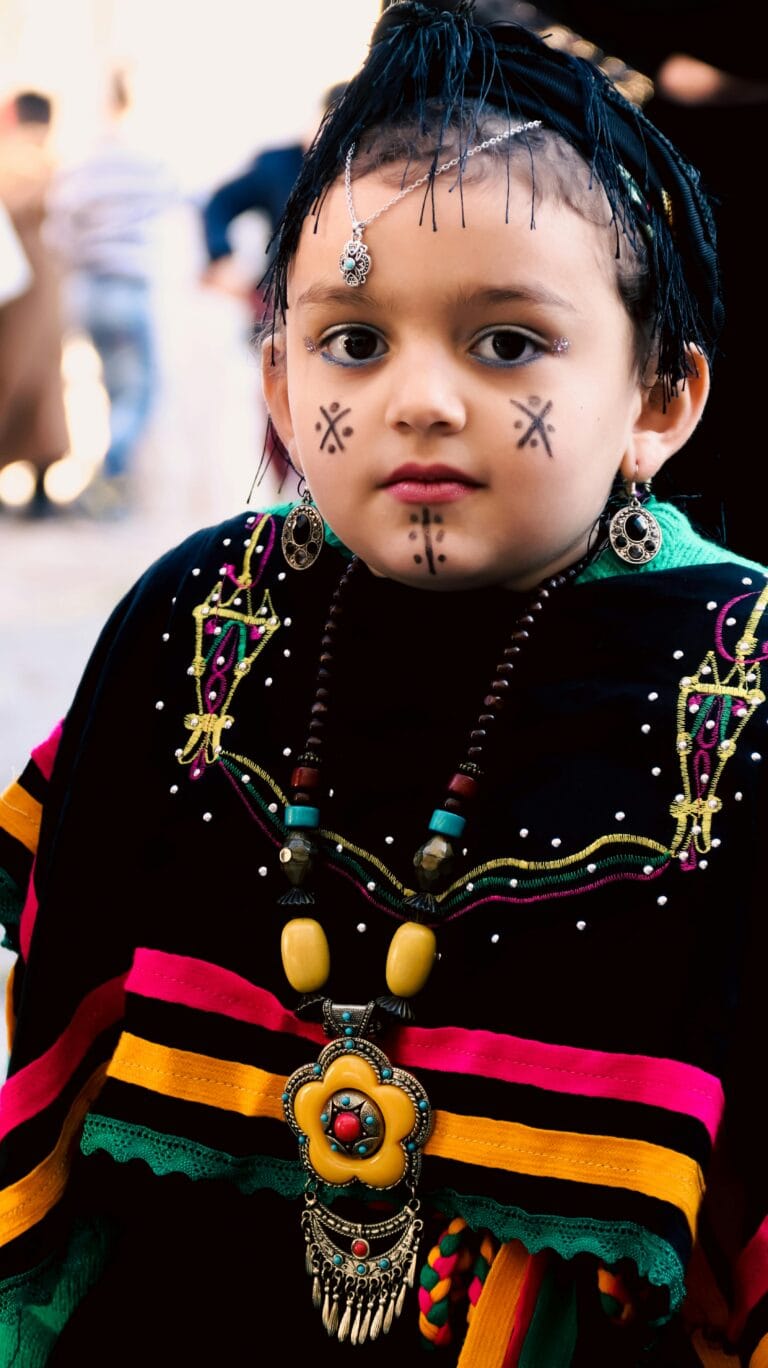
5. Costumes and Aesthetics — The Language of Color and Identity
Women’s Clothing
- White or pastel dresses representing purity
- Silver jewelry (fibulae, necklaces, head adornments)
- Colorful belts woven with geometric meanings
- Intricate embroidery specific to each tribe
Men’s Clothing
- White djellaba and turban
- Sometimes a black burnous, symbol of dignity
- Wooden sticks (aissar) in some tribes, used to mark rhythmic accents
Each costume transmits:
- tribal identity,
- social status,
- regional history,
- seasonal symbolism.
6. Structure of the Dance — The Circle, the Rhythm, the Message
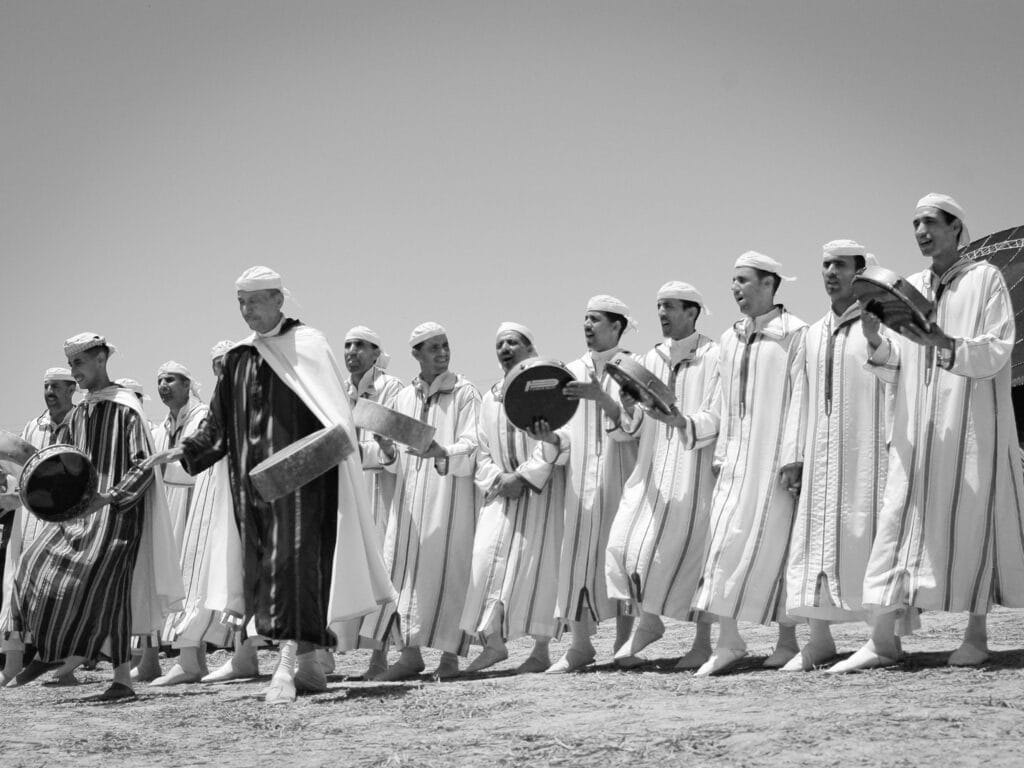
The Circle
A symbol of Amazigh cosmology:
- no hierarchy,
- no beginning or end,
- shared energy,
- unity of purpose.
Gestures
- synchronized shoulder movements,
- rhythmic stepping,
- fluid arm motions,
- expressive head gestures.
These reflect the relationship between people and nature, mirroring:
- wind,
- birds,
- water flow,
- mountain movement.
7. Themes of Amazigh Ahidous Poetry — The Heart of Amazigh Philosophy
Ahidous lyrics (izlan) cover a wide spectrum:
Love & Emotion
Often indirect, metaphorical, shy, and deeply poetic.
Nature & Seasons
Amazigh culture sees humans as part of the natural world; poetry celebrates:
- mountains,
- rivers,
- cedar forests,
- rain,
- flowers.
Heritage & Pride
Violins, heroes, kings, ancient stories, and tribal identity.
Wisdom & Philosophy
Proverbs, moral lessons, reflections on time and resilience.
Resistance & Freedom
Amazigh identity has long emphasized autonomy, dignity, and freedom.
8. Regions Where Ahidous is Most Celebrated Today
Ait Mgouna (Valley of Roses)
Famous for majestic festival performances.
Ait Hadidou (Imilchil)
Known for the iconic Imilchil wedding festival.
Ait Ayache & Ait Yahia (Middle Atlas)
Classical, scholarly Ahidous schools.
Ait Bouguemmaz (High Atlas)
Mountain variants with powerful warrior rhythms.
Ait Atta (Southeast Morocco)
Known for epic poetry mixed with dance.
Each region has refined different tempos, poetic styles, and performance contexts — making Ahidous not one dance, but a cultural universe.
9. Contemporary Evolution — Ahidous in Modern Morocco
Today, Ahidous continues to evolve:
- incorporated in national festivals,
- performed on international stages,
- recorded by Amazigh artists,
- taught in cultural associations,
- revitalized by youth movements,
- preserved in mountain villages.
Despite modernization, Ahidous remains a spiritual anchor for Amazigh identity.
10. Threats and Preservation Efforts
Challenges include:
- urban migration,
- globalization,
- loss of linguistic heritage (Tamazight dialects),
- decreasing transmission between generations.
But preservation efforts are growing:
- cultural festivals,
- documentaries,
- academic research,
- community associations,
- teaching programs for children.
Conclusion — The Eternal Legacy of Ahidous
Ahidous is not merely a dance; it is the voice of Morocco’s mountains, the heartbeat of Amazigh communities, and a living testimony of thousands of years of artistic intelligence. Through synchronized bodies, vibrating drums, and mountain-born poetry, Amazigh people continue to narrate their identity, protect their unity, and celebrate life.
To understand Ahidous is to understand the soul of Amazigh culture.