The Hidden Language of Beauty: The Meaning of Moroccan Geometric Designs and Abstract Patterns in Amazigh Art
The Hidden Language of Beauty: Berber Symbols in Moroccan Art
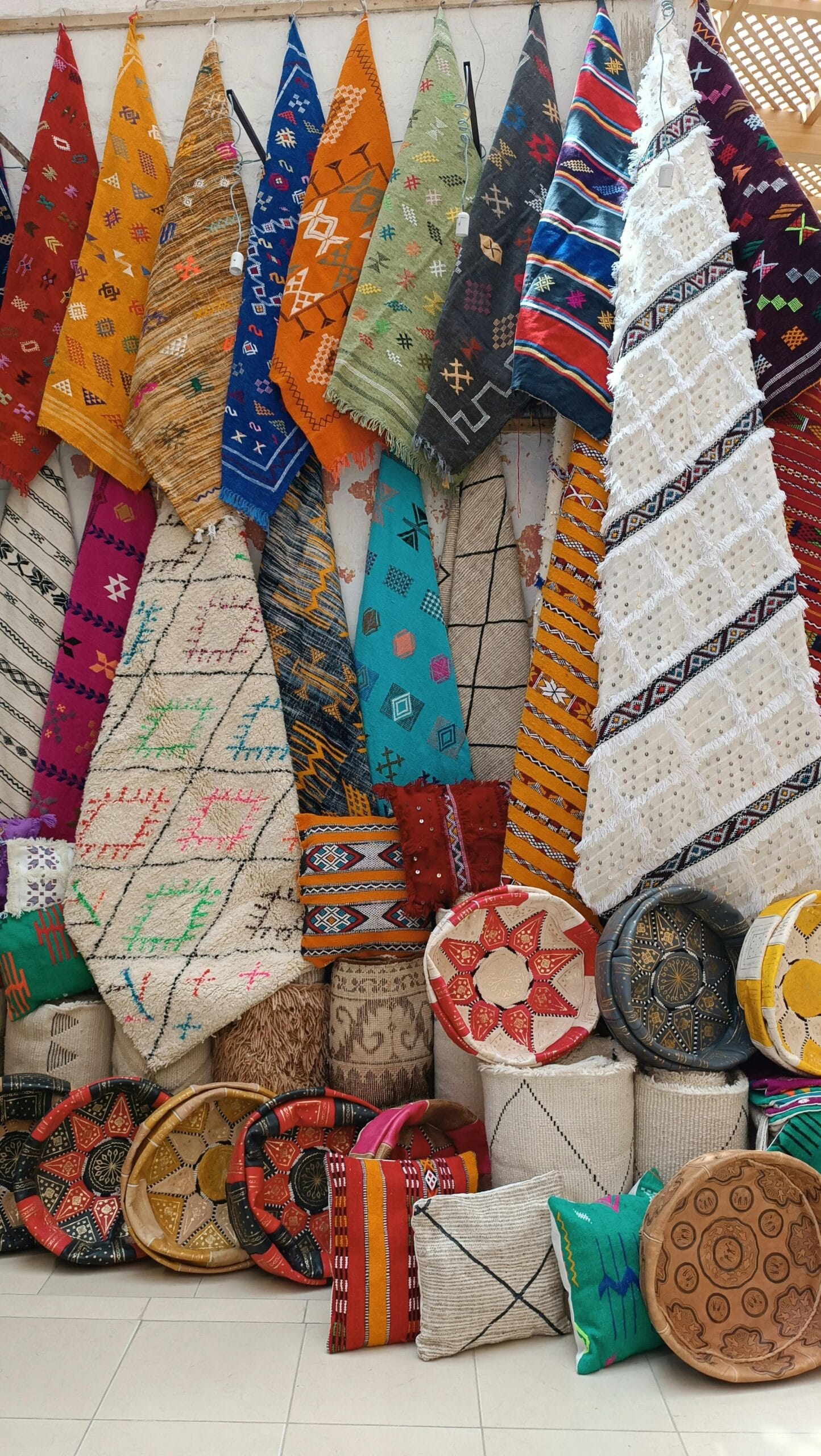
When you first stand before a handwoven Amazigh carpet or trace the carved motifs on an old cedar door, you may feel a quiet recognition — as if a language you didn’t know you learned was whispering to you. Those spirals, diamonds, triangles, and stepped lines are not mere decoration. They are signs: distilled memories, prayers, and social codes transmitted by women and artisans over centuries. They have survived migrations, conquests, and modernity because they are practical and symbolic, domestic and sacred.
This is the world of Berber symbols — a visual vocabulary that appears everywhere in Moroccan life: woven in carpets, inked on skin, hammered in silver, and carved into clay and plaster. In this article you’ll travel through that vocabulary: its origins, its grammar, its regional dialects, and its modern life. You’ll learn how patterns function as a kind of non-written literature — a compact, portable culture you can hang on a wall, wear on a chest, or bake into a pot.
Read this as a guided encounter. You’ll learn to read patterns, to notice what they hide and what they reveal. By the end you’ll not only recognize motifs — you’ll understand why they persisted, how they changed, and why they still matter.
Table of Contents
Why Symbols Matter: A Visual Language of Identity
Symbols Before Writing
Long before alphabets, human communities encoded memory visually. For many Amazigh (Berber) groups across North Africa, geometric motifs functioned as mnemonic devices: visual keys to kinship, territory, agriculture, fertility, protection, and spiritual values. Because Amazigh societies were traditionally oral and communal, visual markers — on cloth, body, or house — carried collective knowledge that could be “read” at a glance.
- Symbols travel easily: a rug carried on a caravan, a tattoo on a bride, or jewelry worn in a new town keeps identity portable.
- Symbols are economical: one motif can condense multiple meanings (fertility + protection + clan marker).
- Symbols are resilient: they survive language shifts and political changes because they attach to objects and rituals.
A Social Function: Communication, Memory, and Resistance
You should think of Berber symbols not only as art but as communication. A pattern on a carpet can announce the weaver’s origin, marital status of the owner, a prayer for childbirth, or an encoded map of safe trails. During times of cultural pressure — whether from centralized states or colonial powers — these visual codes acted as quiet resistance: identity without a single spoken word.
Key functions of Berber symbols:
- Identity: tribal, regional, familial markers.
- Protection: apotropaic motifs (eyes, zigzags) to ward off the evil eye.
- Fertility and domestic prosperity: recurring motifs used in wedding sets.
- Cosmology and spirituality: symbols that map the natural and supernatural world.
- Economic information: patterns indicating a workshop, a market origin, or quality.
Origins and Cultural Context of Berber Symbols
Deep Time and Local Innovation
The Amazigh cultural sphere stretches back millennia; archaeological pottery and rock art across North Africa show geometric motifs that resonate with later Amazigh designs. While exact genealogies of motifs are complex, two facts are clear:
- There is continuity: many motifs used in modern Amazigh crafts echo shapes found in Neolithic and pre-Roman material culture.
- There is adaptation: motifs evolved as communities moved, traded, and encountered other styles (Roman, Andalusian, Sub-Saharan).
Gendered Transmission
You must note the crucial role of women in transmitting these signs. Weaving, tattooing, spinning, pottery decoration, and many domestic arts were primarily women’s crafts. Mothers taught daughters through apprenticeship: a pattern is learned by hand, not by book. Because women controlled many domestic items — dowry carpets, baby wraps, storage vessels — they effectively curated the symbolic lexicon.
Regional Variation and “Dialect”
Berber symbolism is not monolithic. There are regional dialects of motif grammar:
- Rif & Northern motifs: linear bands, open lozenges.
- Middle Atlas: dense geometric fields, carved pottery textures.
- High Atlas / Souss: bold diamonds, abstracted human/animal signs, heraldic medallions.
- Anti-Atlas & Draa: stylized sun and star motifs, desert symbols.
Each region emphasizes motifs shaped by environment: water symbols in mountain valleys, caravan/travel symbols in trans-Saharan routes, olive and argan motifs in Souss.
Core Berber Symbols and Their Meanings
Below is a working list (not exhaustive) of recurring Berber symbols, their typical form, and common meanings. Remember: meanings can shift by context and region.
Table: Common Berber Symbols and Meanings
| Symbol | Visual form | Typical meanings / use |
|---|---|---|
| Diamond (⧫) | Rhombus, lozenge | Protection, fertility, female principle; often center medallions |
| Triangle (▲) | Single or repeated | Womb, mountain, feminine power |
| Zigzag | Repeated angular line | Water, serpent, life’s movement, obstacles overcome |
| Eye / Eye within circle | Dot in circle or oval | Apotropaic — protection from evil eye |
| Cross / X | Simple cross or diag lines | Balance, intersection of worlds, cardinal points |
| Spiral | Corkscrew line | Time, continuity, cyclicity |
| Star | Multi-point star | Cosmic order, heavenly protection |
| Chevron / Step | Stair-like motif | Fertility, crops, terraces, ascent |
| Tree / Palm motif | Stylized vertical tree | Life, agriculture, family line |
| Fish / Scale | Repeated petal shape | Abundance, travel, river life |
| Dots | Single or clustered | Seed, fertility, numerical markers |
(Sources for symbol interpretations derive from ethnographic works on Amazigh iconography and the collections of Moroccan museums and oral testimony of weavers and elders.)
Berber Symbols in Carpets: The Most Accessible “Text”
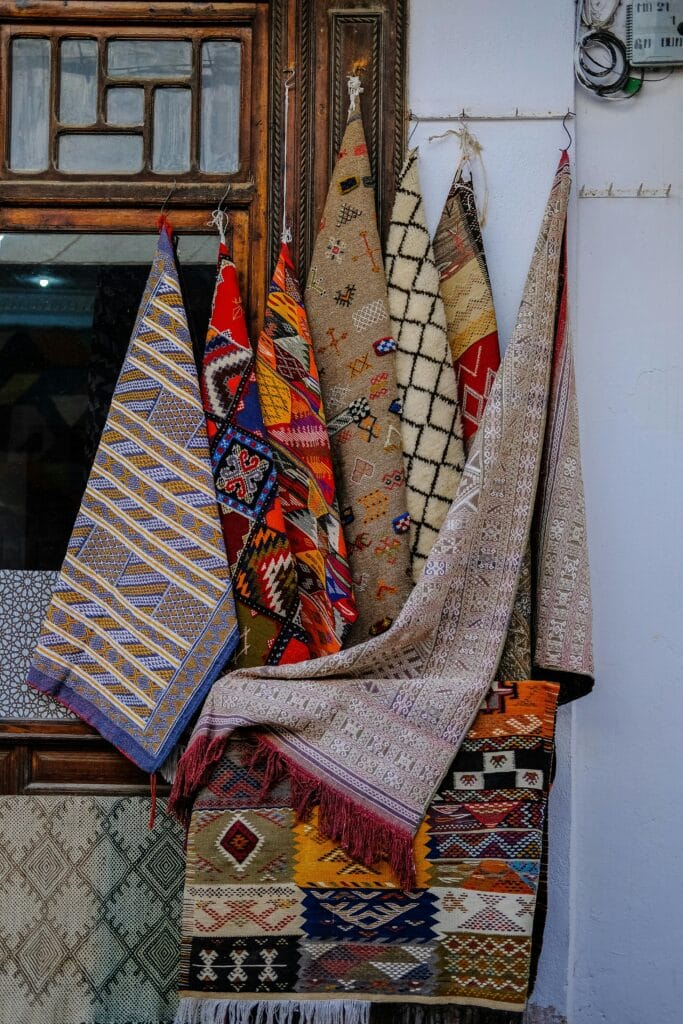
You will most often encounter Berber symbols in handwoven carpets. These are arguably the most legible and portable repositories of the visual lexicon.
Carpets as Living Texts
A carpet is a woven narrative. Categories of carpet symbolism:
- Dowry carpets: Woven for brides; heavy in fertility, protection, and marital symbols.
- Prayer/runic carpets: Central medallions or pointed motifs referencing spiritual thresholds.
- Daily mats and storage coverings: Simpler motifs but still carry maker’s signature.
What to look for when reading a carpet:
- Central medallion — often signals “the heart” or main blessing.
- Border motifs — protective wards that keep misfortune out.
- Field patterns — can encode clan marks, pastoral routes, or seasonal cycles.
Regional Styles and Iconography
- Beni Ourain (Middle Atlas): Bold drawn diamonds, neutral wool; meditative minimalism.
- Taznakht / Ouarzazate (High Atlas / Anti-Atlas): Red-field carpets with angular guardians.
- Zemmour & Rif: Band compositions, flattened animals stylized as repeating motifs.
Example: A Bridal Set
A typical bridal set might include:
- A large sleeping carpet with central diamond for fertility.
- Two side rugs with zigzags and eye motifs for protection.
- A small bag (shurafa) emblazoned with tribe’s mark for identity.
Each item is knitted into a portable domestic universe that travels with the bride.
Tattoos: The Body as Canvas of Identity
Historic Practice and Geographic Spread
Tattooing was widespread among Amazigh women (and in some areas men) — commonly on the face, hands, and chest. In the pre-modern era tattoos served multiple functions:
- Protection from the evil eye and illness.
- Marks of beauty and feminine identity.
- Indication of marriageability, tribal belonging, or rites of passage.
The practice declined in many areas under pressures of colonial regulation and 20th-century Islamization, but it persisted in pockets and is experiencing contemporary reclaiming.
Common Tattoo Symbols and Placement
- Chin lines and triangles (fertility and female power) — commonly on women’s chins in Middle Atlas and Souss.
- Dotted chains along the cheeks or forehead — aesthetic and apotropaic.
- Hand crosses and nets — practical symbols tied to weaving & domestic protection.
Modern Revival and Identity Politics
Today younger Amazigh women sometimes reclaim tattoo motifs as an act of cultural identity and feminist memory — not strictly as replication but as reinterpretation (temporary inks, henna echoes, and jewelry mimicking tattoo patterns).
Jewelry: Silver, Shape, and Social Grammar
Silver as Sacred Metal
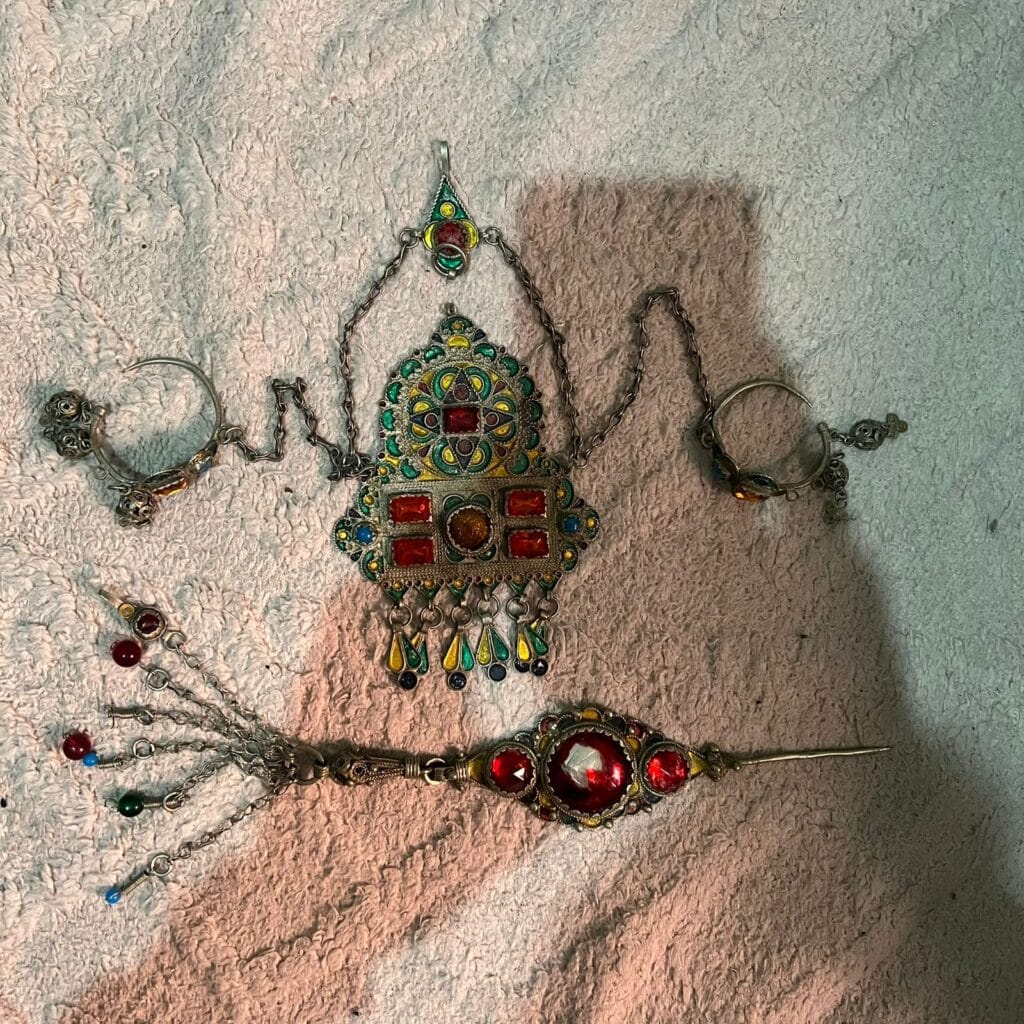
Amazigh jewelry emphasizes silver over gold — silver’s cool luster was traditionally linked to protection and spiritual power. Jewelry pieces both communicate identity and function as portable wealth.
Key pieces:
- Tizerzay/Tazemmurt (neck brooches) — often large, centerpieces of female attire.
- Khamsa (hand) amulets — protective talismans.
- Tiznit necklaces and coins — show marital status and wealth.
Motifs in Silverwork
The same motifs appear in metalwork:
- Small diamonds and triangles hammered into rectangular plates.
- Openwork filigree exploring star and sun patterns.
- Enamel colors (in some regions) adding symbolic color: red (life), green (nature), blue (protection).
Social Grammar: What Jewelry Tells You
On meeting a woman in Amazigh dress, jewelry communicates:
- Age and marital status;
- Tribe and sometimes family lineage;
- Economic standing (number/weight of silver).
Because jewelry is worn outwardly, it functions as immediate social language.
Architecture: Symbols Carved in Stone, Plaster and Wood
Public and Domestic Ornamentation
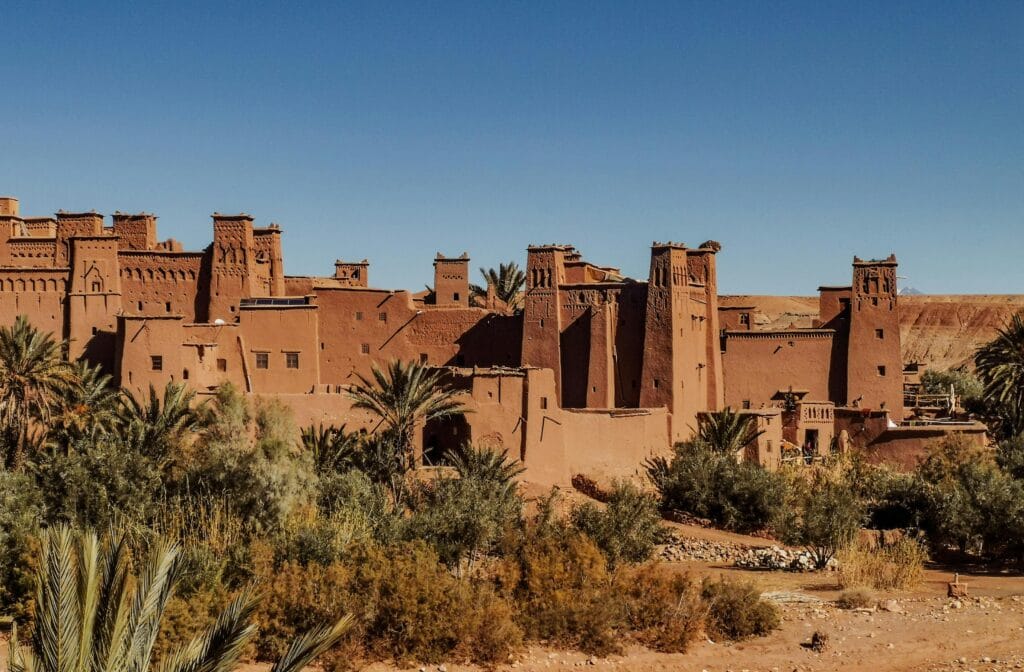
Amazigh motifs appear widely in architecture: wooden lintels, painted house facades, carved doors, and stucco friezes. Unlike carpets, architectural motifs must withstand weather; their placement often matters:
- Door frames and lintels: sites of protective symbols.
- Interior walls/courtyards (riad): sites of fertility and family motifs.
- Granaries (agadir) walls: clan marks and prize symbols.
How Space Speaks Symbolically
The built environment uses geometry for more than aesthetics:
- Courtyards center domestic life — often decorated with symbolic patterns at threshold points.
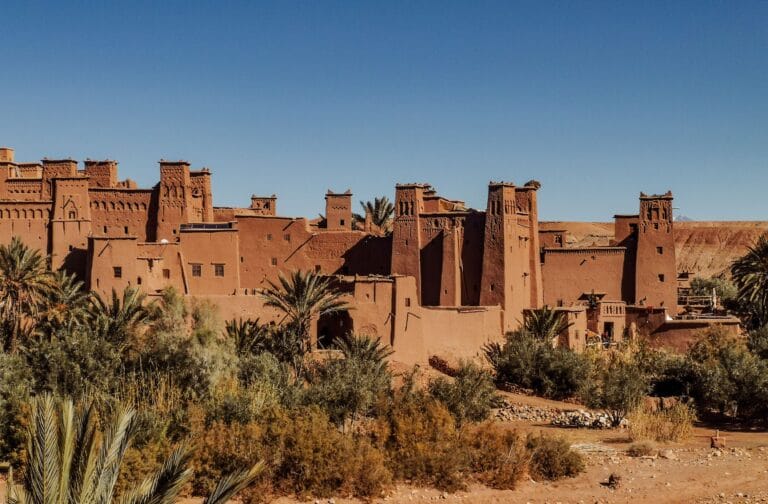
- Kasbah facades display repetitive forms (false windows, stepped crenellations) that assert tribal heraldry.
Examples to Observe
- Aït Benhaddou: repetitive patterns on earthen walls that function as both structural and symbolic marks.
- Rural Atlas villages: painted wall panels near doorways combining protective eyes and fertility motifs.
Color, Pigment, and Natural Dyes: The Meaning of Hue
Palette and Source
Color choices are meaningful and localized. Typical pigments:
- Red (iron oxide) — life, blood, strength.
- Black (carbon / manganese) — protection or boundary markings.
- White (kaolin / lime) — purity, spiritual openness.
- Yellow / Ochre — sunlight, harvest, wealth.
- Blue — sometimes used to suggest sky and refuge (also a more recent adoption).
Dyes are derived from local earth and plant sources — argan, pomegranate bark, indigo (in some coastal regions), saffron (rare and prized), and iron oxides.
Practical Note for Curators and Photographers
When photographing patterns for your site, include pigment notes in alt text: “red iron-oxide designs on Taznakht carpet — symbolizing fertility and life.”
Context Matters: Reading Symbols in Use
Symbols rarely appear in isolation. To interpret, you must consider context.
Contextual Factors
- Item type: Rug vs body vs jewelry => different semantic domains.
- Event: Bridal set vs daily mat => different intended readings.
- Age & maker: An elder’s carpet may encode different values than a young weaver’s fashion piece.
- Region and contact: Trade routes, migrations, and intermarriage alter motif readings.
A Short Case Study: The Bridal Rug
If you examine a bridal rug:
- The central diamond likely signals fertility.
- A border of eyes for protection.
- Flanking chevrons that could represent terraces or fields — a wish for agricultural prosperity.
Only when you read everything together do the meanings cohere.
Continuity and Change: Modern Uses and Reinterpretations
From Tradition to Contemporary Design
Designers and artists (both Amazigh and non-Amazigh) have reinterpreted motifs for modern audiences: cushions, printed textiles, contemporary jewelry, and graphic design. This can expand markets and visibility but also risks simplifying meanings for commercial use.
Successful modern uses:
- Ethical cooperatives producing museum-quality carpets with full symbolic explanation.
- Contemporary jewelry that honors artisan stamps with transparent sourcing.
- Textile designers collaborating with women’s cooperatives to retain pattern integrity.
Problems of Appropriation
Commercial use without attribution can flatten symbols into “ethnic chic.” You should favor collaborations that compensate and credit weavers and artisans. When you use images or sell designs, include origin info: weaver name, tribe, village.
Reading and Recording: Methodological Notes for Researchers and Curators
If you want to record Berber symbols responsibly:
- Interview the maker — the most reliable source of meaning is the artisan who made it.
- Note provenance — village, tribe, date of making.
- Document function — was this object for a bride, a household, a ritual?
- Preserve context — photos of object in situ (on an animal, in a courtyard) inform use.
- Cross-reference oral histories — combine motif reading with narrative accounts.
Scholars use combined approaches (ethnohistory, iconography, material culture studies) to avoid misinterpretation.
Table: How to “Read” an Amazigh Object — Quick Guide
| Step | Question to Ask | What it Reveals |
|---|---|---|
| 1 | What is the object’s function? (rug, jar, amulet) | Semantic domain (domestic, ritual, personal) |
| 2 | Where was it made? (village/region) | Regional dialect of patterns |
| 3 | Who made it? (gender, age, tribe) | Maker’s expressive vocabulary |
| 4 | What motifs appear? | Key meanings (fertility, protection, identity) |
| 5 | What colors/pigments? | Emotional/ritual tone |
| 6 | Any associated ritual or story? | Interpretive anchor |
Symbol Case Studies: Deeper Readings
The Diamond Medallion (Central Motif)
- Form: diamond within field or surrounded by four smaller diamonds.
- Layered meanings: womb/fertility; the four directions and community’s center; protection for children.
- Use: central motif on bridal rugs; repeated as house markers on storage jars.
Zigzag Lines
- Form: multiple horizontal zigzags or vertical meanders.
- Meaning: water pathways; agricultural terraces; serpents (ambivalent: danger and renewal).
- Use: border protection; transitional motifs between fields.
Eye Motif
- Form: dot in circle or almond shape.
- Meaning: protective amulet to deflect envy and misfortune.
- Use: near openings, on necklace panels, tattooed near the eyes or chest.
Berber Symbols and Gendered Meaning
Symbols are often gendered in function and placement:
- Women’s domain: carpets, tattooed chin lines, baby wraps — motifs emphasize fertility, protection, and domestic continuity.
- Men’s domain: weaponry decoration, harnesses, and external markers — motifs emphasize mobility, defense, and lineage.
Women produce the objects most saturated with symbolic alphabets because domestic objects are where life’s cycles (birth, marriage, food) are enacted.
Preservation and Ethical Use: Respectful Practices
If you publish or sell Berber-inspired designs, adhere to ethical practices:
- Provide provenance and artisan credit.
- Support cooperatives financially and through fair trade.
- Avoid cultural flattening — don’t present motifs as merely “tribal chic.”
- Document meanings where possible; publish maker interviews and origin narratives.
Museums and digital platforms should return interpretive authority to communities whenever possible.
FAQs — Berber Symbols: Quick Answers
Q1: What are Berber symbols?
They are geometric and abstract motifs used across Amazigh art (carpets, tattoos, jewelry, architecture), encoding identity, protection, fertility, and cosmology.
Q2: Are Berber symbols the same across Morocco?
No. They vary regionally — each “dialect” of motifs reflects local environment, history, and social priorities.
Q3: How were these symbols transmitted?
Primarily through apprenticeship: women and artisans taught patterns by hand, song, and ritual practice.
Q4: Are the meanings fixed?
Meanings are flexible; some motifs have core associations (e.g., diamond = fertility/protection) but interpretations shift by context.
Q5: Can non-Amazigh people use these designs?
Yes, ethically — with attribution, fair compensation, and attention to community benefit.
Conclusion: Learning to Read Patterns — Listening to an Unspoken Language
If you want to connect with Amazigh culture you must learn to see as well as listen. Patterns are more than pretty geometry; they are a durable civic language that records values, histories, and hopes. When you stand in a souk and buy a carpet, you can now ask: who wove this? what is its story? whom does its central diamond protect? Each answer returns power to the makers.
Berber symbols invite you into a conversation: not a tourist’s snapshot, but an ethical exchange. When you learn to read these signs, you become a more mindful guest. You support cultural continuity simply by understanding that a motif is not disposable ornament — it is the living speech of a people who, through line and loop, protected themselves and their futures.
Suggested Reading & Sources
- Ennajar, Abdelwahab, and Mohamed Chafik — works on Amazigh identity and symbols.
- Claudot-Hawad, H. — studies on tattoos and female iconography.
- UNESCO Intangible Cultural Heritage entries on Amazigh crafts and moussems.
- Local Moroccan museum catalogs (Rabat Museum of Moroccan Judaism, Marrakech Museum).
- Scholarly journals: Journal of North African Studies, Ethnology, and field ethnographies by regional anthropologists.