The Gnawa Ritual in Morocco: An Analytical Reading of Its Historical, Musical, Religious, and Symbolic Dimensions
Abstract
The Gnawa ritual in Morocco represents one of the most complex cultural and spiritual phenomena in North Africa, bringing together musical, ritual, and religious elements rooted in extended African and Mediterranean historical contexts. This article aims to present a comprehensive analytical reading of the principal academic approaches that have examined the Gnawa ritual, focusing on four major axes: historical origins, musical structure, religious and spiritual dimensions, and the symbolic system associated with the concept of the “lila,” spiritual entities, and colors. The article relies on a critical review of anthropological and ethnomusicological literature and seeks to move beyond descriptive accounts toward an analysis that highlights how this ritual has developed as an interactive space combining historical memory, aesthetic practice, and spiritual experience. It also discusses the contemporary transformations affecting the Gnawa ritual in the context of globalization and cultural tourism, and their impact on its symbolic structure and social function. The article concludes that the Gnawa ritual constitutes a complex cultural system that cannot be reduced to a single dimension, but must be understood within a network of historical, religious, and aesthetic relations that ensure its continuity and dynamism.
Table of Contents
Introduction
The Gnawa ritual constitutes one of the most prominent cultural and spiritual expressions in Morocco. It combines music, dance, and chanting within a complex ritual framework carrying multiple historical, religious, and symbolic meanings. This ritual has attracted the attention of numerous scholars in anthropology, ethnomusicology, and cultural studies due to its rich model of interaction between African and Islamic elements within a distinctive Maghrebi context.
The Gnawa ritual cannot be understood merely as an artistic or folkloric practice; rather, it is an integrated ritual system that embodies a particular worldview and a specific conception of the relationship between humans and invisible forces. Some studies suggest that this ritual is linked to a long history of exchanges between sub-Saharan Africa and North Africa and that it preserves traces of collective memory associated with experiences of slavery and migration (Kapchan, 2007). At the same time, the ritual became integrated into the Moroccan Islamic context through its relationship with religious lodges (zawiyas) and Sufi traditions, thereby acquiring a particular social and religious legitimacy.
This study proceeds from a central problem: most previous research has approached the Gnawa ritual either from a strictly musical angle or from a descriptive anthropological perspective, without attempting to synthesize these dimensions within a comprehensive analytical framework. Accordingly, this article seeks to reread the available literature in order to highlight the interconnection between the historical, musical, religious, and symbolic dimensions of the ritual and to understand it as an integrated cultural system that transcends narrow classifications.
This approach is particularly important in light of the contemporary transformations affecting the Gnawa ritual, which has become part of the global cultural scene through festivals, recordings, and transnational artistic collaborations. These developments raise questions about the relationship between authenticity and modernization, and between ritual function and performative display.
Literature Review
1. Early Anthropological Studies
The first systematic studies of the Gnawa date back to the mid-twentieth century, when researchers focused on tracing the African origins of the ritual and analyzing its ceremonial structure. Some early French scholars produced pioneering descriptions of the “lila” ritual as a therapeutic and spiritual system based on the invocation of invisible entities. These studies emphasized the composite character of the ritual, which combines Islamic elements with practices of African origin.
These early approaches were primarily ethnographic, relying on field observation and detailed descriptions of ritual stages. However, their descriptive orientation sometimes led to interpretations of the Gnawa tradition as a remnant of “primitive” culture—a view later criticized by scholars who sought to reassess the ritual within its specific social and cultural context.
2. Ethnomusicological Approaches
During the 1970s and 1980s, the study of Gnawa music experienced significant development through ethnomusicological research focusing on rhythmic structures, musical instruments, and performance patterns. These studies indicate that Gnawa music is based on a complex rhythmic system built around repeating musical cycles that help generate states of concentration and immersion (Schuyler, 1981).
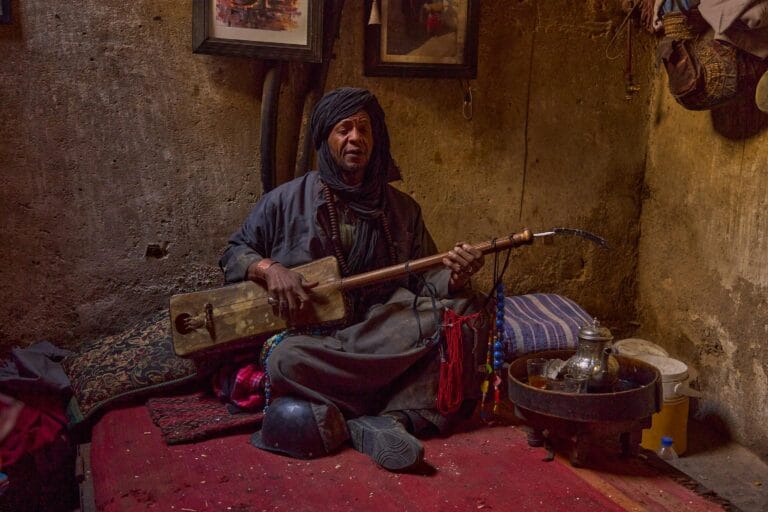
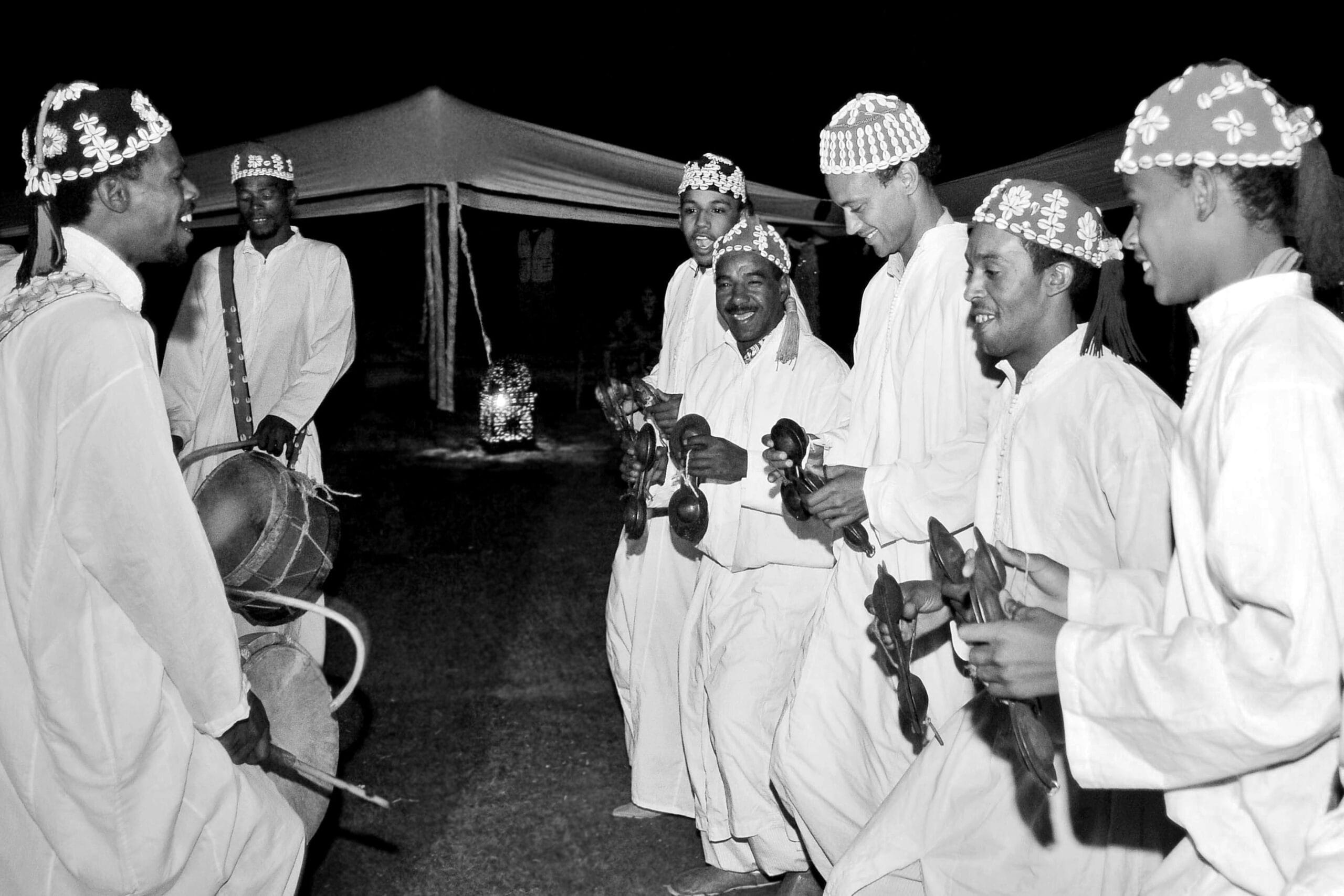
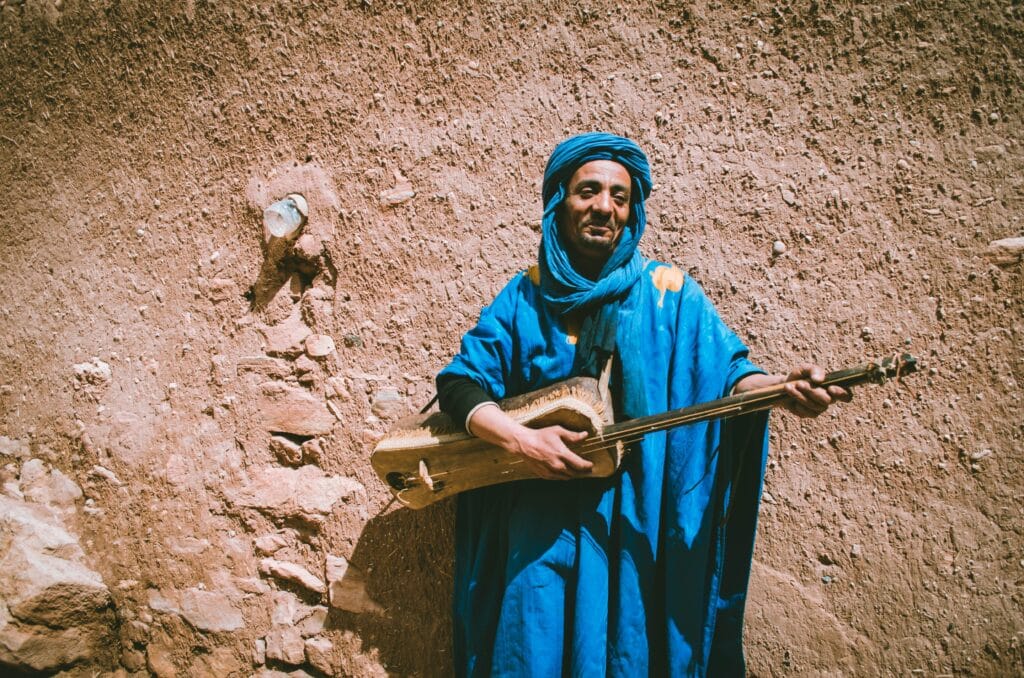
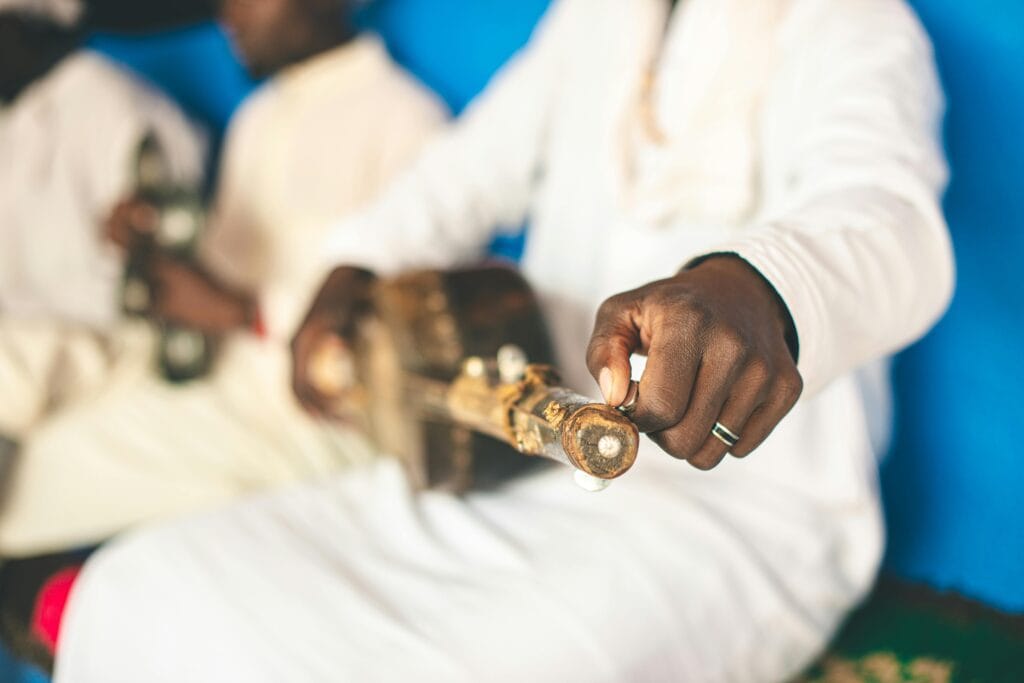
Researchers have highlighted the central role of the guembri (hajhuj) as the instrument that leads both melodic and rhythmic progression, alongside the metal castanets (qraqeb), which produce interlocking rhythmic layers. The relationship between music and bodily movement has also been analyzed, with dance recognized as an integral component of the ritual experience.
Some studies suggest that music in the Gnawa ritual serves not only an aesthetic function but also plays a fundamental role in structuring participants’ spiritual experience. Repetitive rhythms and gradual intensification contribute to inducing states of trance or jadba, interpreted within the cultural framework of the ritual as forms of communication with the invisible world (Kapchan, 2007).
3. Gnawa and Popular Sufism
A number of studies have examined the relationship between the Gnawa tradition and Sufi practices in Morocco, emphasizing its connections with certain religious lodges and saintly cults. Some scholars argue that the Gnawa represent a form of popular Sufism that integrates Islamic practices with local traditions.
The concept of baraka (spiritual blessing) occupies a central position in this context, as certain ritual figures are believed to possess special spiritual power enabling them to influence the invisible realm. Religious chanting and devotional recitations also play an important role in conferring an Islamic character upon the ritual.
However, the relationship between the Gnawa and Sufism is not one of complete identity but rather of interaction and overlap. Some researchers note that the ritual maintains relative autonomy as a distinctive ceremonial system, even while drawing on Sufi concepts and practices (Hell, 2002).
4. Symbolism and the Concept of the “Lila”
The concept of the lila constitutes a central focus in studies of the symbolic structure of the Gnawa ritual. The lila is understood as a ceremonial journey unfolding through successive stages, each associated with specific colors, chants, and spiritual entities.
Certain studies have analyzed the symbolism of colors linked to what are known as the “Lmluk” (spiritual beings). Each color group corresponds to a network of symbols and meanings reflecting particular conceptions of the world and of human relations with spiritual forces.
These studies demonstrate that the lila functions as an integrated symbolic system in which music, color, and movement interact to produce a complex sensory and spiritual experience. This interweaving is one of the reasons the ritual lends itself to multiple interpretations from religious, aesthetic, and psychological perspectives.
5. Contemporary Transformations
In recent decades, scholars have increasingly focused on the effects of globalization and cultural tourism on the Gnawa ritual. The emergence of international festivals has transferred the music from its ritual environment to performance stages, altering the relationship between performers and audiences.
Some studies argue that these transformations have contributed to redefining Gnawa identity, as artists navigate roles that combine ritual musicianship with global artistic performance. While certain researchers view this evolution as a threat to the spiritual dimension of the ritual, others interpret it as a form of cultural adaptation ensuring the tradition’s continuity in a changing global context.
Historical Origins of the Gnawa Ritual
1. The Problem of Origins: Between History and Myth
The question of origins is one of the most complex issues in the study of the Gnawa ritual, involving an interplay between historical data and foundational oral narratives. Academic research does not treat the Gnawa as a phenomenon emerging at a single historical moment but as the outcome of a long process of interaction between sub-Saharan Africa and the Maghrebi region.
Most anthropological studies associate Gnawa roots with population movements across the Sahara, particularly during periods marked by the expansion of trans-Saharan trade networks. These networks played a central role in the circulation of people, goods, and cultural practices, including musical and ritual traditions (Kapchan, 2007).
However, reducing the origin of the Gnawa solely to the history of slavery constitutes an oversimplification. Some scholars emphasize that cultural exchanges between North and sub-Saharan Africa predate the major phases of the slave trade and included diverse forms of migration and social interaction. The Gnawa ritual must therefore be situated within a broader framework of historical and cultural mobility characteristic of the Saharan zone.
2. African Memory and the Reconstruction of Identity
Several studies underline the presence of strong African musical and spiritual elements in the Gnawa ritual, particularly those originating in West Africa. These elements include cyclical rhythms, repetitive musical phrases, and the use of trance states as part of ritual experience.
Yet these elements were not transmitted unchanged; they were reshaped within the Moroccan context. Over time, African traditions merged with local and Islamic components, producing a new hybrid ritual form. This hybridity should not be understood as a loss of authenticity but as a creative mechanism for reconstructing identity in a new social environment.
Analyses suggest that the Gnawa ritual serves as a symbolic space in which collective memory linked to African heritage is reformulated. Through music and ceremony, a shared past is evoked, fostering a sense of belonging and continuity among participants.
3. Integration into the Moroccan Islamic Context
A crucial historical transformation of the Gnawa ritual lies in its gradual integration into Moroccan Islamic religious structures. Gnawa groups became associated with saints and religious lodges, acquiring social legitimacy through these connections.
This integration represents a complex process of cultural negotiation rather than superficial adoption. Ritual practices were reinterpreted through Islamic concepts such as baraka, intercession, and remembrance (dhikr). In this way, the Gnawa ritual became part of the broader landscape of popular Islam while preserving its symbolic specificity (Hell, 2002).
4. Gnawa as a Social and Organizational Structure
Beyond its spiritual dimension, Gnawa communities developed as organized social structures governed by internal rules and hierarchies. At the top stands the ma‘allem (master musician), who combines musical expertise with ritual authority. His role extends beyond performance to the supervision of ceremonies and the regulation of group relations.
Studies indicate that this internal organization reflects broader social patterns in Moroccan society. The relationship between master and apprentices blends instruction with spiritual initiation, resembling forms of mentorship found in Sufi orders.
5. From Margin to Center: Transformations of Social Status
Historically, Gnawa groups were sometimes associated with marginal social positions due to factors related to origin and ritual function. This status, however, was not static and evolved over time.
With the growing recognition of traditional music during the twentieth century, Gnawa music gained increasing acknowledgment as a component of Moroccan cultural heritage. Recordings and festivals contributed to expanding its audience and revaluing the social status of Gnawa artists.
6. Oral History as a Source of Knowledge
The study of Gnawa historical origins relies heavily on oral history, given the scarcity of direct written sources. Narratives transmitted by masters and participants form an essential part of how the community understands its past.
These narratives are interpreted not as strictly factual chronicles but as symbolic texts expressing collective self-representation. Their interaction with academic research allows for a more nuanced understanding that transcends the dichotomy between history and myth.
7. A Synthetic Reading of Origins
The historical origins of the Gnawa ritual emerge as the product of multiple interacting factors: trans-Saharan mobility, African musical and spiritual traditions, integration into Moroccan Islam, and subsequent social transformations. This plurality contributes to the richness and adaptability of the ritual.
The Musical Dimensions of the Gnawa Ritual
1. Music as a Ritual System
Ethnomusicological studies approach Gnawa music as a sonic system embedded in ritual function. Repetitive rhythmic cycles structure the ceremonial progression and guide participants toward states of immersion (Schuyler, 1981).
2. The Guembri as Central Instrument
The guembri provides both melodic and rhythmic foundations. Its deep timbre and hybrid playing technique generate a sonic base that anchors the entire performance.
3. Qraqeb and Rhythmic Layering
Metal castanets create interlocking rhythmic textures that contribute to a dense ritual soundscape experienced bodily as well as aurally.
4. Vocal Structure and Chanting
Call-and-response chanting reinforces collective participation and carries religious and historical meanings.
5. Music and Trance
Gradual rhythmic intensification supports the emergence of trance states interpreted culturally as spiritual communication (Kapchan, 2007).
6. Collective Performance
The interaction of musicians, dancers, and audience transforms the ritual into a shared social experience.
7. Analytical Synthesis
Gnawa music integrates technical structure and symbolic function, mediating between body and spirit.
Religious and Spiritual Dimensions
1. Between Islam and Popular Sufism
The Gnawa ritual operates within the sphere of popular Islam while maintaining distinctive ceremonial features (Hell, 2002).
2. Baraka and Spiritual Mediation
Spiritual authority is attributed to figures capable of mediating between visible and invisible realms.
3. Dhikr and Hadra
Chanting practices parallel Sufi remembrance while emphasizing musical embodiment.
4. The Lila as Ritual Framework
The lila organizes the spiritual journey through sequential ceremonial stages.
5. Spiritual Entities
Invocation of spiritual beings structures the symbolic universe of the ritual.
6. Embodied Spiritual Experience
Movement and dance serve as vehicles of spiritual expression.
7. Synthetic Interpretation
The ritual reflects a dynamic interaction between Islamic and African spiritual frameworks.
The Concept of the Lila as a Comprehensive Ritual Structure
The lila functions as an organized ceremonial journey involving preparation, sensory symbolism, sequential musical phases, and the invocation of spiritual entities. It establishes a temporary ritual space in which participants seek individual and collective balance (Kapchan, 2007; Hell, 2002).
Spiritual Entities and Color Symbolism
The system of mluk constitutes a symbolic cosmology expressed through color, music, and movement. Colors such as white, blue, and red carry layered meanings, while specific musical sequences mediate communication with spiritual realms. Trance represents a transformative moment of symbolic encounter.
Contemporary Cultural Transformations
Global festivals and recordings have relocated Gnawa performance to international stages. This shift generates tensions between ritual authenticity and artistic innovation while simultaneously enabling adaptive cultural continuity (Kapchan, 2007).
Conclusion
The Gnawa ritual emerges as a complex cultural system integrating historical memory, musical structure, spiritual practice, and symbolic expression. Its resilience lies in its capacity to balance continuity and transformation. This article provides an analytical foundation for understanding the ritual’s major dimensions and prepares the ground for future research exploring new perspectives on its social and psychological functions.
Frequently Asked Questions (FAQ)
What is the Gnawa ritual?
A musical and spiritual ceremonial system combining African and Islamic elements to achieve spiritual and social balance.
Why is music central to the ritual?
It structures the spiritual experience and facilitates trance.
Is the Gnawa ritual Sufi?
It intersects with popular Sufism while retaining distinctive features.
What is the lila?
The principal ceremonial framework organizing the ritual journey.
References (APA)
Kapchan, D. A. (2007). Traveling Spirit Masters: Moroccan Gnawa Trance and Music in the Global Marketplace. Wesleyan University Press.
Hell, B. (2002). Possession and Trance in the Maghreb. Brill.
Schuyler, P. D. (1981). Spirit possession in Moroccan Gnawa music. Anthropological Quarterly, 54(3), 135–147.