Tamazight of the Middle Atlas (Central Atlas Tamazight): A Comprehensive Academic Overview
Introduction: Tamazight of the Middle Atlas
Central Atlas Tamazight (often simply Tamaziɣt) is the Amazigh variety spoken across the Middle Atlas and adjacent regions of Morocco. It features a three-vowel system /a i u/, emphatic (pharyngealized/velarized) coronals, templatic verb morphology, and a free vs. annexed (construct) state on nouns conditioned by syntax. Since 2011, Tamazight is an official language of Morocco, with standardized Tifinagh used in schools and public life.
This article synthesizes core descriptive linguistics (phonology, morphology, syntax), writing systems, sociolinguistic status, and cultural interfaces with Middle Atlas performance traditions (e.g., Ahidous). Morocco World NewsWikipédia
Table of Contents
1) Ethnolinguistic Profile & Geographic Range
Central Atlas Tamazight (ISO 639-3: tzm) is spoken in the Middle Atlas (Ifrane, Azrou, Khénifra, El Hajeb, Sefrou, Imouzzer Kandar) and in parts of the eastern High Atlas and surrounding plateaus. Estimates of speaker numbers vary by source and census methodology; large-scale counts are difficult, but it is among the most widely spoken Amazigh varieties in Morocco. Wikipédia
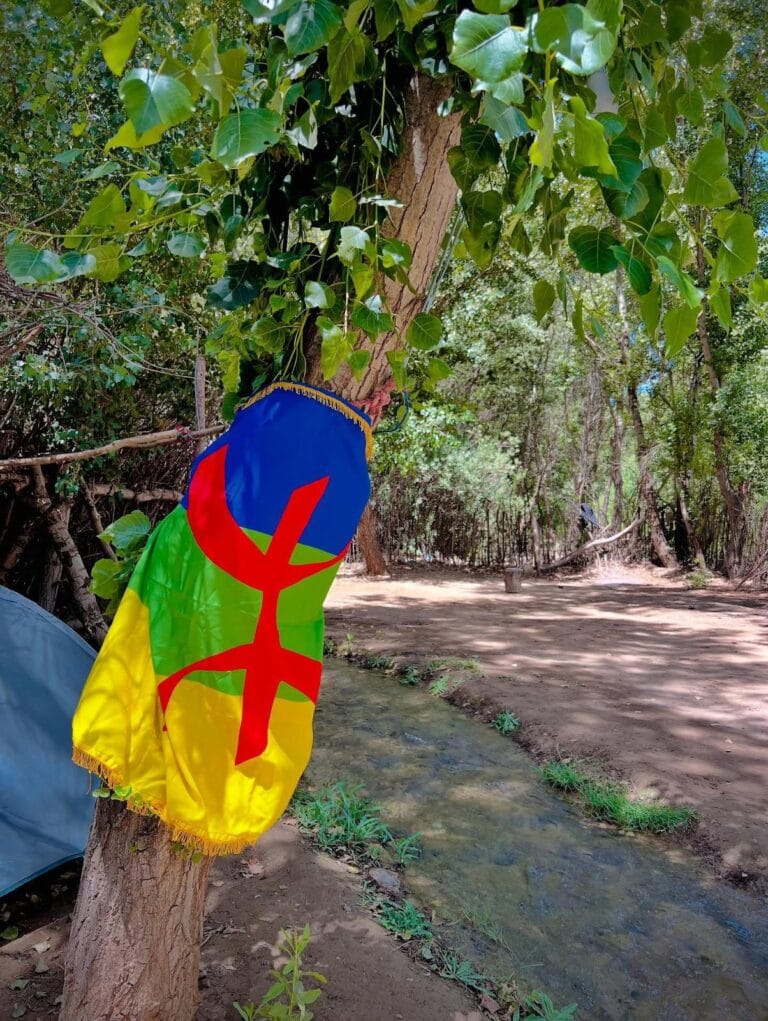
Policy status. Morocco’s 2011 Constitution (Article 5) recognizes Amazigh (Tamazight) as an official language and commits the state to protect and develop it. Morocco World News
2) Historical & Areal Background (Very Concise)
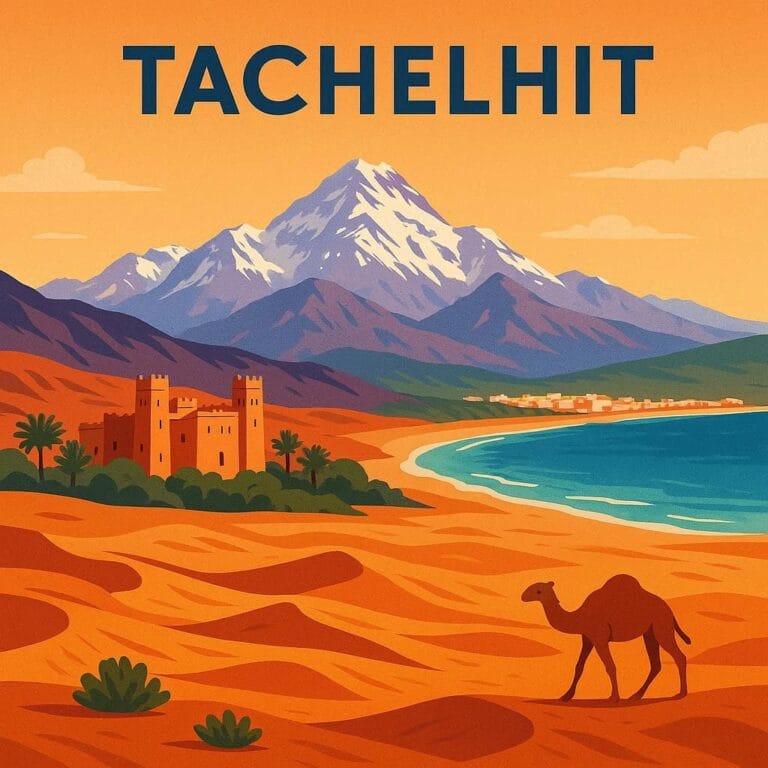
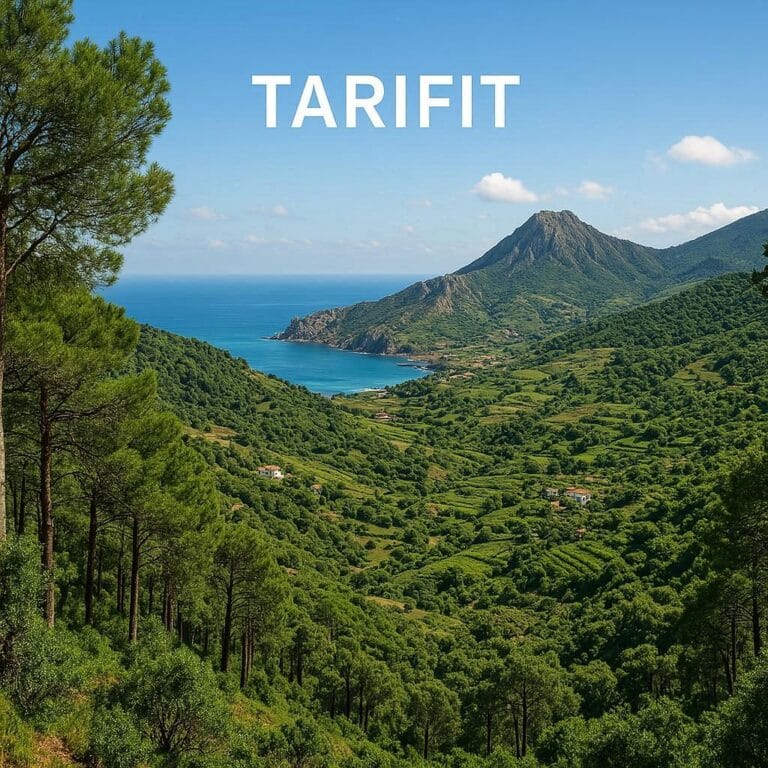
Berber (Amazigh) languages form a branch of Afro-Asiatic distributed across North Africa. Central Atlas Tamazight is closely related to Tachelhit, the High Atlas and Rif varieties (Tarifiyt) but shows its own sound system, nominal state alternations, and verbal templates documented since early modern Berberology and in classic grammars (e.g., Abdel-Massih 1971 for Ayt Ayache/Ayt Seghrouchen; Penchoen 1973 for Ayt Ndhir).
3) Phonology (with data-driven points)
3.1 Segmental inventory (overview)
- Vowels: a, i, u (with contextual allophony).
- Consonants: rich coronal series including emphatic segments; uvulars; pharyngeals; gemination is contrastive and morphologically active. Classic descriptions detail contrasts and gemination’s role in derivation.
Field note for readers: Unlike some neighboring varieties, CAT’s syllable structure is more conservative (compared with Tashlhiyt’s extreme consonant-only syllables). Still, complex clusters occur, and prosody interacts with morphology. (For comparison across Amazigh varieties see Dell & Elmedlaoui 2002; Ridouane 2008 on Tashlhiyt.)
3.2 Prosodic tendencies
Word-level prominence is weakly phonologized; morphological templates and clitic placement are better predictors of rhythm. (Prosodic discussions in CAT grammars are typically embedded within morphology.)
4) Morphology
4.1 Nouns: Gender, Number, State
- Gender: masculine vs. feminine; feminine typically marked by t-…-t (e.g., argaz ‘man’ vs. tamɣart ‘woman’; taddart ‘house’).
- Number: plurals formed by “sound” suffixes and/or internal vowel alternation (“broken” plurals), often with i-/ti- plural prefixes.
- States: free state vs. annexed (construct) state. The annexed state is required in specific syntactic contexts: e.g., after most prepositions, after numerals, and when the postverbal subject follows the verb. Formation commonly involves initial vowel alternations (e.g., masculine a- → u-/we-, i- → y-; feminine ta-/ti- → te-), with dialectal variation documented across Ayt Ayache, Ayt Seghrouchen, Ayt Ndhir, etc. Wikipédia
Examples (schematic, Central Atlas patterns):
- axxam ‘house’ → ixxamen ‘houses’; tafunast ‘cow’ → tifunasin ‘cows’.
- Free vs. annexed: argaz (‘man’) → wergaz (annexed) in prepositional contexts. (For detailed paradigms, see Abdel-Massih; Penchoen; Wikipedia grammar summary.)
4.2 Determination & Demonstratives
Definiteness isn’t morphologically marked; demonstratives and clitics cover many discourse functions. (CAT demonstratives are treated extensively in Abdel-Massih and Penchoen.)
4.3 Pronominal Clitics
Direct/indirect object clitics attach to the verb; ordering is constrained (e.g., IO precedes DO in many contexts). Wikipédia
5) Verbal Morphology & TAM
Berber verbs are templatic: a lexical root combines with vocalic patterns and (pre/suf)fixes to encode aspect, mood, polarity, and voice. In CAT:
- Aspectual stems (often labeled perfective, imperfective, aorist) are selected by syntax and particles.
- Causative is typically s-/ss-; reciprocal/reflexive and passive have dedicated morphological strategies.
- Subject agreement is circumfixal; object clitics are tightly integrated into the verb complex.
- The particle ad introduces intentional/future contexts.
- Negation minimally uses preverbal ur (dialectal reinforcement patterns exist).
Detailed paradigms (including person/number/gender agreement) are laid out in Abdel-Massih (1971) and Penchoen (1973).
6) Syntax
- Basic order: frequently VSO, with subject in annexed state when postverbal; SVO also appears in specific information-structural configurations.
- Attributive adjectives follow the noun and agree in gender/number; many have verbal counterparts for predication (a hallmark of Berber nominal/verb interface).
- Relativization, focus, and wh-questions employ cleft-like structures and specialized agreement behaviors. Wikipédia
7) Writing Systems & Orthography
7.1 Tifinagh (IRCAM Standard)
Morocco standardized neo-Tifinagh for public use and education in the 2000s (IRCAM). Tifinagh gained Unicode support (block U+2D30–U+2D7F, added in Unicode 4.1, 2005), enabling consistent digital publishing across platforms. Wikipédia
7.2 Latin & Arabic Scripts
CAT can also be represented in Latin-based and Arabic-based orthographies used in research, media, and legacy texts; the IRCAM Tifinagh remains the school standard.
8) Dialectal Variation (brief map)
Classic reference works cover Ayt Ayache, Ayt Seghrouchen, and Ayt Ndhir varieties in depth, illustrating differences in prefix vowels, state formation, lexicon, and some morphophonemics—but these varieties remain mutually intelligible for most everyday purposes.
9) Sociolinguistics, Education & Media
- Official status (2011) has driven curriculum development and signage. The Tamazight TV channel (SNRT Channel 8) launched in 2010, providing significant content in Amazigh varieties, including CAT. IWGIA
- Language vitality remains robust in rural zones; in mixed urban settings, bilingualism with Arabic (and French) is the norm. Estimating absolute speaker numbers is challenging due to census practices and definitional issues; scholars emphasize caution with figures. Wikipédia
10) Culture Interface: Ahidous of the Middle Atlas
Ahidous—the circle dance with antiphonal poetry and percussion—is emblematic of Middle Atlas Amazigh communities and remains a living environment for CAT verbal art. The National Festival of Ahidous (Aïn Leuh, Ifrane Province) is organized with the Ministry of Youth, Culture and Communication and hosts dozens of troupes annually, alongside academic symposia on intangible heritage. وزارة الشباب والثقافة والتواصلBarlaman Today
11) Sample Texts (tri-script)
Proverb
Tifinagh: ⵜⴰⵎⴰⵣⵉⵖⵜ ⴰⵎⴰⵣⵉⵖ ⵉⴳ ⵉⵣⵣⵔⴰⵢ
Latin (IRCAM-style): Tamaziɣt amazigh ig izzṛay.
Gloss (rough): “Amazigh language shows (one’s) Amazigh identity.”
(Illustrative; adapt wording to your local corpus.)
Simple clause with annexed state
Latin: i-ṛuḥ u-rgaz ɣr w-axxam.
Gloss: “The man went to the house.” (w-axxam = annexed state after preposition)
(Form reflective of CAT patterns summarized in references.) Wikipédia
what we mean by Central Atlas Tamazight?
(often simply Tamaziɣt) is the Amazigh variety spoken across the Middle Atlas and adjacent regions of Morocco.
Berber (Amazigh) languages?
a branch of Afro-Asiatic distributed across North Africa
Writing Systems & Orthography of Tamazight Language
Morocco standardized neo-Tifinagh for public use and education in the 2000s (IRCAM).
For Researchers: Foundational References (Annotated)
- Abdel-Massih, E. T. (1971/2011). A Reference Grammar of Tamazight.
Classic, data-rich grammar comparing Ayt Ayache & Ayt Seghrouchen; extensive paradigms across noun state, plural types, verb templates, clitics. Open-access via Michigan’s Deep Blue. - Penchoen, T. (1973). Tamazight of the Ayt Ndhir.
Detailed description of a Middle Atlas variety with careful treatment of morphophonemics and syntax (open digital facsimile). Internet Archive - Wikipedia summary (curated): Central Atlas Tamazight grammar.
Useful quick reference (with citations) on state alternations, word order, and agreement phenomena; verify against primary sources above. Wikipédia - Policy & script:
– Morocco Constitution (2011), Article 5 (official status). Morocco World News
– IRCAM Tifinagh & Unicode (digital support for Amazigh publishing). Wikipédia - Cultural interface:
– National Festival of Ahidous (Aïn Leuh)—ministry page & press releases document the event’s scope and symposiums. وزارة الشباب والثقافة والتواصلBarlaman Today
Internal link suggestions
- Link to your Languages hub and the sister pages Tachlhit (Souss & High Atlas) and Tarifiyt (Rif).
- From culture sections, link to your articles on Ahwach/Ahidous, weddings & traditions, and Moussem pages.
Entity & synonym coverage
- Sprinkle synonyms and abbreviations naturally: Central Atlas Tamazight, CAT, Tamaziɣt, tzm, Amazigh language Morocco.
14) Suggested Further Reading (for your sidebar)
- Abdel-Massih, A Reference Grammar of Tamazight (Ayt Ayache & Ayt Seghrouchen). Open access.
- Penchoen, Tamazight of the Ayt Ndhir. Open access. Internet Archive
- Central Atlas Tamazight grammar (encyclopedic overview; cross-check with primary sources). Wikipédia
- Constitution of Morocco (2011), Article 5. Morocco World News
- Unicode Tifinagh block; IRCAM standardization notes. Wikipédia
- National Festival of Ahidous (Aïn Leuh) – ministry & press coverage. وزارة الشباب والثقافة والتواصلBarlaman Today
Notes on accuracy & variation
Morphosyntactic details (e.g., annexed-state formation vowels, negation reinforcement, lexical items) vary across Ayt Ayache, Ayt Seghrouchen, Ayt Ndhir and neighboring groups. When you localize examples for Iwziwn (between Aoulouz and Tifnout in the High/Anti-Atlas interface), flag transitions toward High-Atlas features for clarity.
Source citations (clickable)
- Morocco 2011 Constitution – Tamazight official (Art. 5). Morocco World News
- Unicode Tifinagh block; r12a reference. Wikipédia
- IRCAM/Tifinagh overview.
- Abdel-Massih (1971/2011), A Reference Grammar of Tamazight (Deep Blue).
- Penchoen (1973), Tamazight of the Ayt Ndhir (Archive.org). Internet Archive
- Central Atlas Tamazight grammar (Wikipedia summary, updated). Wikipédia
- Berber languages overview (for context on counts/uncertainty). Wikipédia
- Tamazight TV (SNRT Channel 8) launch year. IWGIA
- Ahidous festival (Ministry of Youth, Culture and Communication) + press