
Moroccan Carpet: Weaving the Threads of Culture and Identity in Morocco
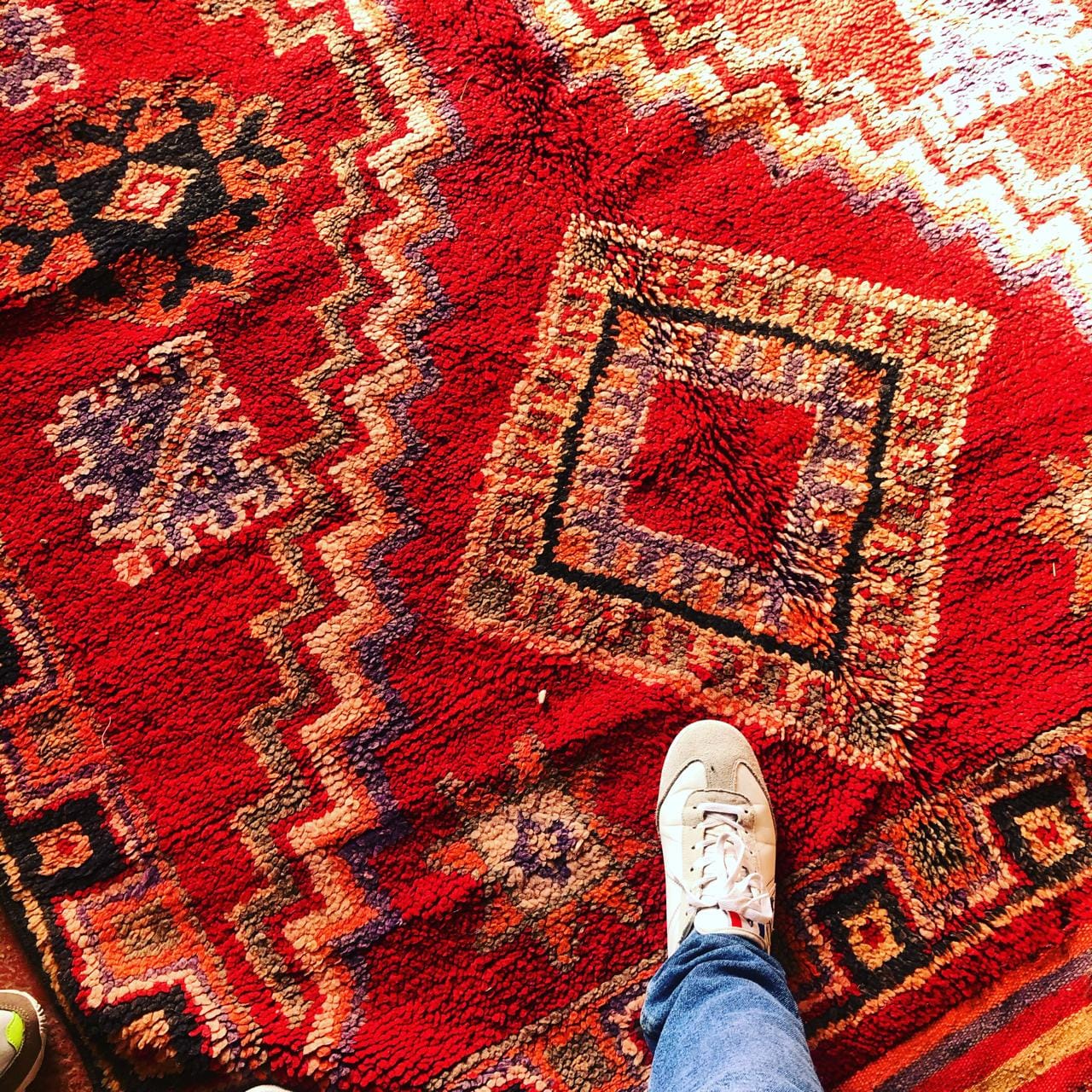
Moroccan Carpet: Weaving the Threads of Culture in Morocco
When you first set foot in Morocco, your senses awaken to a symphony of color, texture, and movement. The aroma of freshly tanned leather wafts from the medina, vendors call out with melodic insistence, and your eyes land on an explosion of woven beauty — vibrant carpets unfurled beneath the desert sun. Each Moroccan carpet seems alive, its patterns whispering stories that bridge centuries. You’re not just looking at art; you’re standing in front of history, identity, and emotion interwoven into every thread.
You may not realize it, but the moment your fingers brush the soft wool of a Moroccan rug, you’re touching the echoes of generations. This is more than craft — it’s a language. A Moroccan carpet doesn’t simply decorate a room; it transforms space, carrying within it the rhythm of a people whose creativity has endured from ancient Berber tribes to the global design studios of today.
In this journey, you’ll uncover how Morocco’s weaving traditions evolved, what each symbol means, and how these carpets connect the people who make them to those who cherish them worldwide. You’ll learn how to choose, care for, and appreciate authentic Moroccan textiles — and in doing so, you’ll understand why these woven masterpieces are not just décor but heritage.
Table of Contents
The Legacy of Moroccan Carpet Weaving
Origins Woven in Time
When you look at a traditional Moroccan carpet, you’re seeing the fingerprints of history. Weaving in Morocco traces back thousands of years, to a time when Berber women used hand looms to create woolen rugs for warmth in mountain winters and for ceremonies that marked life’s milestones.
These weren’t decorative luxuries — they were woven out of necessity and emotion. Every tribe developed its own unique symbols and patterns, passed down through mothers to daughters. Over time, these rugs became coded expressions of identity — each motif telling a story of ancestry, fertility, nature, and protection.
Some symbols are immediately recognizable once you know their language:
- The diamond: representing femininity and protection against evil spirits.
- The zigzag: symbolizing the unpredictable paths of life.
- The comb motif: a wish for fertility and abundance.
The ancient Berber tribes never wrote their history in books; they wrote it in wool. That’s what makes Moroccan carpets different from any other — they’re living documents of culture.
Regional Styles: A Map in Wool
As you travel across Morocco, you notice that the patterns and colors of carpets shift dramatically. This isn’t random — each region tells its story through design.
Beni Ourain (Middle Atlas)
If you’ve ever seen a creamy white rug with minimalist black lines and a thick pile, you’ve seen a Beni Ourain. These come from the nomadic Berber tribes of the Middle Atlas Mountains. The simplicity of design — neutral tones, geometric lines — reflects the purity of the mountain environment. Yet within that simplicity lies deep meaning: each diamond or cross represents protection or good fortune.
Azilal (High Atlas)
Further south, in the Azilal region, color bursts onto the loom. Here, you find whimsical, abstract designs — red, saffron, blue, and green — interwoven with spontaneous shapes that feel almost modernist. These are expressive rugs, made by women who often improvise their designs mid-weave, creating one-of-a-kind pieces that mirror life’s unpredictability.
Taznakht and Ouarzazate (Southern Morocco)
Head toward the Sahara, and you meet the Taznakht weavers. Their carpets feature dense, flat weaves dyed with saffron, henna, and madder root. These are some of the oldest styles, often incorporating tribal emblems and talismanic motifs used for protection.
Each carpet tells you where it was born — the mountains, the desert, or the plains. By learning to read them, you learn to read Morocco itself.
The Art and Technique Behind Moroccan Textiles
You might imagine that weaving is simply a matter of technique — thread after thread, knot after knot. But in Morocco, it’s something deeper. Every rug is infused with intent, patience, and spiritual presence.
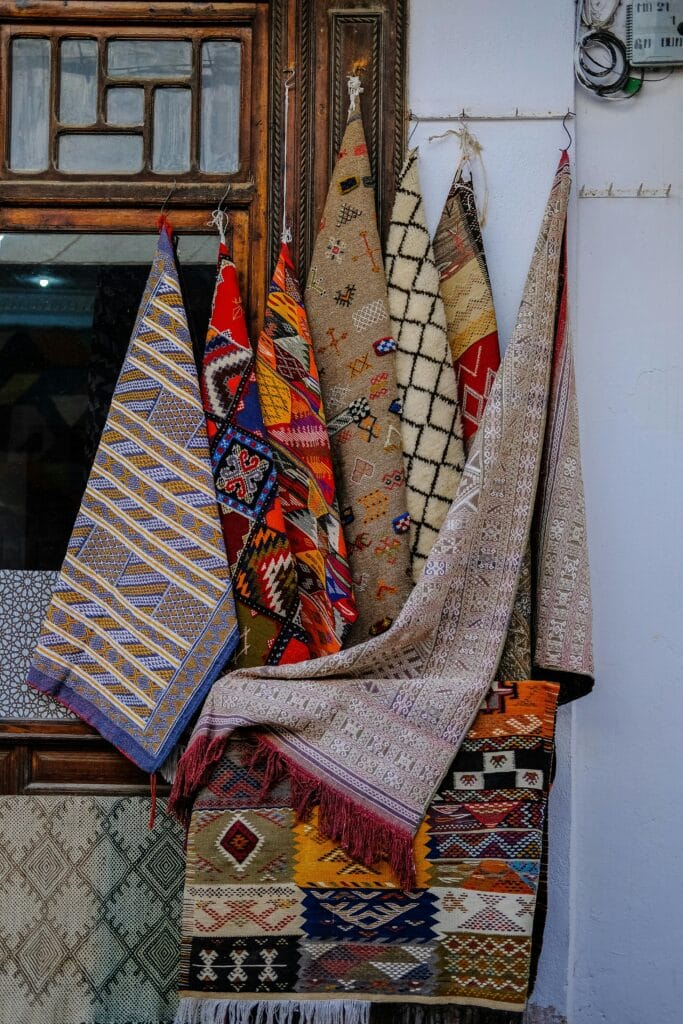
The Materials: Nature’s Palette
The soul of a Moroccan carpet begins with wool — not just any wool, but hand-spun strands from sheep grazing in the Atlas Mountains. The cold climate and rugged terrain give their fleece a soft yet durable texture, perfect for weaving.
Before any thread touches the loom, it’s cleaned, combed, and spun by hand — a rhythmic process that connects the weaver to her ancestors. The dyes come from nature too:
- Henna and pomegranate peel create shades of gold and rust.
- Saffron gives warm yellows.
- Indigo paints deep blues reminiscent of twilight in Chefchaouen.
- Madder root yields rich reds — a symbol of life and energy.
This dedication to natural materials gives Moroccan rugs a warmth and depth that synthetic imitations can never match.
The Weaving Process: From Thread to Art
You may never have seen a Moroccan loom up close — but imagine it as a standing frame, tall and commanding, where every movement of the hand becomes a gesture of creation.
The process unfolds slowly, like a meditation:
- Shearing & Cleaning: The wool is cut, washed, and prepared.
- Dyeing: The weaver mixes pigments by intuition — no chemical formulas, just generations of inherited knowledge.
- Warping the Loom: The foundation threads are stretched tightly.
- Weaving the Design: Knot by knot, row by row, the design emerges, often improvised.
- Finishing: When complete, the rug is washed, sun-dried, and trimmed.
It’s painstaking work — a large carpet can take months to finish. Yet for the weaver, each thread is a heartbeat, a prayer, and a piece of self-expression.
The Language of Symbols
Moroccan carpets are coded with motifs — some ancient, others evolving with the times. When you buy or admire one, you’re seeing a tapestry of language written without words.
Common motifs include:
- The Eye: Wards off envy and evil spirits.
- Fish or Water patterns: Represent life and prosperity.
- The Hand (Khamsa): A symbol of divine protection.
- Stars or Crosses: Connection between the spiritual and physical world.
Every weaver adds her unique touch — a personal symbol, a hidden name, or an emotion only she understands. This is why no two authentic Moroccan carpets are ever identical.
The Cultural Significance of Moroccan Carpets
You can’t separate Moroccan carpets from Moroccan identity — they are inseparable threads in the same cultural fabric. To own or even admire one is to glimpse the spirit of a people who have woven meaning into their everyday lives for centuries.
Carpets as the Language of Identity
When you look at a Moroccan carpet, you’re not merely seeing a decorative item; you’re witnessing the expression of a weaver’s soul. Each design is an autobiography told through texture and color.
A woman might weave a carpet for her marriage, using symbols of fertility, hope, and protection. Another might create one to celebrate harvest season, her designs echoing the rhythm of rain and the movement of grain. These carpets serve as both functional household pieces and deeply symbolic works of art.
In Moroccan homes, a rug is never just placed on the floor — it anchors the home’s energy. It’s used in celebrations, prayers, and storytelling, making it a spiritual object as much as a material one.
Women Weavers — The Keepers of Moroccan Heritage
You may not realize it, but the majority of traditional Moroccan carpets are woven by women — particularly in rural Berber villages. For centuries, weaving has been a woman’s craft, passed from mother to daughter, generation after generation.
Each piece a woman weaves holds part of her identity — her creativity, her struggles, and her joy. It’s said that a skilled weaver can tell her life story without ever speaking a word, because her rug speaks for her.
Beyond art, weaving also offers economic independence. Today, many cooperatives such as Coopérative Tisseuses du Maroc empower women to earn fair wages, educate their children, and preserve their traditions.
By supporting these artisans, you aren’t just buying a rug — you’re investing in human stories, in sustainable living, and in the survival of cultural heritage.
Moroccan Carpets in Modern Design and Global Influence
From Souks to Showrooms
If you’ve seen an interior design magazine lately, chances are you’ve seen a Moroccan carpet gracing the pages. What began as a rural necessity has become a global design phenomenon.
Designers love them because they blend effortlessly with both modern minimalism and eclectic bohemian styles. The Beni Ourain rug, in particular, has become an icon — its simple black-and-white patterns add warmth and sophistication to contemporary spaces.
But when you bring a Moroccan carpet into your home, you’re doing more than following a trend. You’re connecting your space to a centuries-old art form, a legacy that still beats with human touch.
The Modern Revival of Traditional Weaving
Across Morocco, young artisans and cooperatives are breathing new life into the weaving craft. They experiment with updated color palettes, mix materials, and reinterpret tribal motifs for modern audiences — all while respecting tradition.
In places like Marrakech and Essaouira, new studios blend ancient craftsmanship with contemporary design. The result is a living, evolving art that bridges the old and the new — a testament to Morocco’s creative resilience.
Sustainability and Ethical Sourcing
In a world of mass production, Moroccan carpets stand out as ethical luxury. Handwoven using natural materials and dyes, they embody sustainability long before it became a buzzword.
Still, the global demand has led to an influx of machine-made imitations. As a conscious buyer, you should always ensure that your rug comes from verified cooperatives or artisans, not mass producers.
Look for signs of authenticity:
- Irregularities in weave or color (proof of handmade work).
- Slight asymmetry in pattern.
- Use of natural wool and organic dyes.
- Documentation or cooperative tags confirming origin.
Buying ethically not only ensures quality but supports communities that rely on weaving for their livelihoods.
How to Choose and Care for a Moroccan Carpet
You’ve fallen in love with Moroccan rugs — now it’s time to find the one that speaks to you.
Choosing an Authentic Moroccan Carpet
When you’re browsing the souks of Marrakech or an artisan website, keep these tips in mind:
- Know Your Styles – Learn to distinguish between Beni Ourain, Azilal, Boujad, and Taznakht designs.
- Feel the Texture – Genuine wool feels soft yet dense; synthetic versions feel stiff.
- Look for Imperfections – Perfect symmetry is often a sign of machine production.
- Ask Questions – Ethical sellers are proud to share who made the carpet and where.
- Check the Dyes – Natural dyes have subtle tonal variations; chemical dyes appear uniform.
When you choose a handwoven Moroccan carpet, you’re not just buying art — you’re adopting a story.
Caring for Your Moroccan Carpet
To keep your carpet vibrant and beautiful for decades:
- Vacuum gently once a week using low suction.
- Avoid direct sunlight to prevent fading.
- Rotate the rug every few months for even wear.
- Blot spills immediately using mild soap and cold water — never rub.
- Professional cleaning every 2–3 years preserves wool softness.
With proper care, a Moroccan carpet can outlive you — aging gracefully as it becomes part of your own family’s history.
Frequently Asked Questions (FAQ) about Moroccan Carpets
1. What makes Moroccan carpets unique?
Moroccan carpets are handwoven expressions of culture, identity, and spirituality. Each pattern holds symbolic meaning, making every rug an individual work of art.
2. Are Moroccan carpets handmade?
Yes — authentic Moroccan rugs are woven entirely by hand on traditional looms using wool, cotton, and natural dyes.
3. How long does it take to make one Moroccan carpet?
Depending on size and complexity, a single rug can take anywhere from four weeks to six months to complete.
4. What are the most popular Moroccan carpet styles?
The most recognized are Beni Ourain (neutral and geometric), Azilal (colorful and abstract), Boujad (vintage pink and orange tones), and Taznakht (dense and traditional).
5. How do I know if my Moroccan carpet is authentic?
Authentic rugs show minor imperfections, uneven fringes, and a slightly irregular pattern — signs of handcrafting. Ask sellers for provenance and cooperative certification.
6. Do Moroccan carpets fit modern interiors?
Absolutely. Their natural textures and timeless designs complement both modern minimalist and rustic spaces, adding warmth and character.
7. Are Moroccan carpets environmentally friendly?
Yes. Traditional weavers use organic dyes and natural wool, making these carpets one of the most eco-friendly forms of textile art.
Conclusion — The Living Threads of Moroccan Culture
When you run your hand over a Moroccan carpet, you’re not simply touching wool; you’re feeling the rhythm of human heritage. Every knot tells a story of hope, every pattern an echo of identity, and every color a reflection of Morocco’s landscape — from the ochre sands of the Sahara to the cool blues of the Rif.
These carpets endure not because they’re fashionable, but because they’re meaningful. They weave together generations, preserving stories that would otherwise fade with time. And now, as you understand their origins and artistry, you can see why a Moroccan carpet is far more than décor — it’s a bridge between art, culture, and soul.
So when you next choose one for your home, let it remind you that beauty has history, and craftsmanship carries the heartbeat of humanity.
Hello! My name is Julia. I invest in startups. If you have an interesting project.
Call me on Whatsapp
Hello, everyone! My name is Julia. My team and I support early-stage startups. If you are looking for resources to launch or scale your project, tell us about your idea. We are open to considering interesting proposals.
Text me on Whatsapp
I represent the investment community. We help talented projects find funding and experts to help them grow. If you have an idea or a ready-made business model, let’s discuss the possibilities for cooperation.
Text me on Whatsapp for quick communication
I represent the investment community. We help talented projects find funding and experts to help them grow. If you have an idea or a ready-made business model, let’s discuss the possibilities for cooperation.
wa.me/+66908932810
or on Telegram
t.me//sveta_bez_sveta