The Symbolism of Moroccan Amazigh Jewelry – More Than Ornament
Introduction: When Jewelry Speaks the Language of the Soul
In Morocco, jewelry does not merely adorn — it speaks. Every etched line, every geometric curve, every shimmer of silver carries a message, an ancient whisper from generations past. The symbolism of Moroccan jewelry among the Amazigh (Berber) people transcends decoration; it is a spiritual code, a social emblem, and a bridge between visible beauty and invisible belief.
When you hold an Amazigh fibula, it’s not just a clasp of metal; it’s a protector, a storyteller, and a witness of a woman’s journey through life. These ornaments hold the secrets of birth, love, strength, and belonging. Each symbol — a triangle, a spiral, a sunburst — becomes a sacred sign woven into the rhythm of Morocco’s mountains and deserts.
This article unravels the symbolism of Moroccan jewelry, exploring how each piece represents a dialogue between people, nature, and the divine. It is a journey into meaning, spirituality, and survival — where beauty becomes a way of speaking truth.
Table of Contents
The Ancient Roots of Amazigh Symbolism
A Civilization That Spoke in Symbols
Long before written language reached the mountains of North Africa, the Amazigh people communicated through symbols. Carved on stones, painted on pottery, or etched into jewelry, these signs formed an unspoken alphabet of identity.
Jewelry became one of the most enduring mediums for this symbolic language. It transformed abstract ideas — fertility, protection, harmony — into wearable art. Women, as the primary keepers of tradition, carried this coded wisdom on their bodies.
The symbolism of Moroccan jewelry thus developed as a sacred grammar — not ornamental, but ontological, shaping how the Amazigh perceived life and the universe.
The Essence of Symbolism in Moroccan Jewelry
Jewelry as Sacred Geometry
Amazigh artisans believed that shapes carry power. The triangle, circle, and spiral are not mere patterns — they represent the essence of existence.
- Triangle: Symbol of femininity, motherhood, and the earth’s fertility. Often pointing downward, it represents the womb — the origin of life.
- Circle: Symbol of eternity, representing time’s cyclical nature and the divine’s unbroken presence.
- Spiral: Sign of life’s journey and transformation — a reflection of the soul’s movement between physical and spiritual realms.
- Lozenge (diamond shape): Represents balance and protection.
- Zigzag: Symbol of water, the giver of life in the desert — and a metaphor for continuity and flow.
These geometric codes were believed to guard against harm and maintain cosmic balance. When you wear a necklace engraved with triangles and spirals, you are not just wearing art — you are carrying a miniature map of the universe.
The Spiritual Energy of Silver
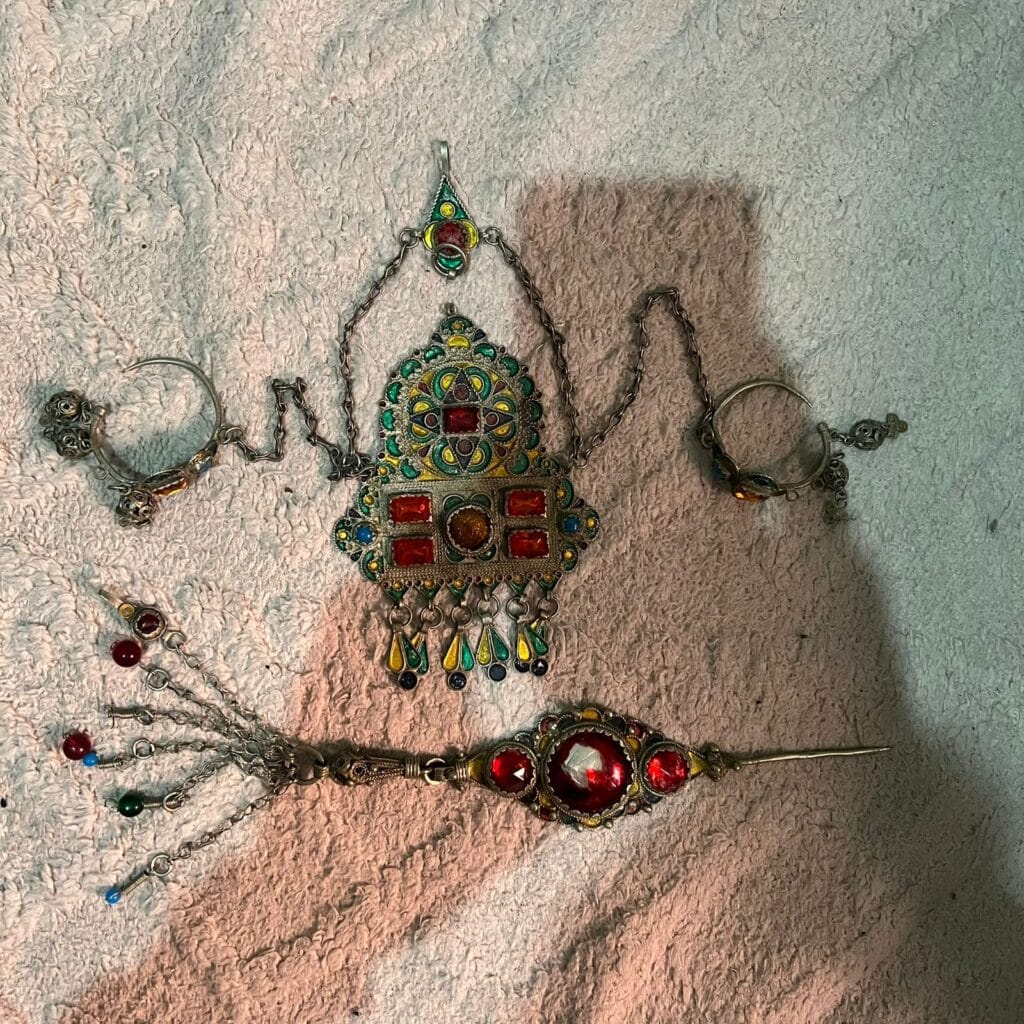
Silver holds special spiritual significance in Moroccan culture. It is associated with purity, protection, and feminine energy — the reflective light of the moon rather than the blazing vanity of the sun (gold).
Among Amazigh tribes, silver is considered alive — a metal that breathes and interacts with the body’s spirit. Its reflective surface is thought to repel evil eyes, deflect curses, and absorb blessings. For this reason, jewelry is often blessed by religious or spiritual figures before being worn.
Jewelry as Protection and Power
Amulets and the Power of Belief
The symbolism of Moroccan jewelry extends into the spiritual and magical domains. Many pieces are not only aesthetic but also amuletic — designed to protect the wearer from unseen forces.
Common protective motifs include:
- The Hand (Khamsa): The most powerful protective symbol, warding off evil eyes and bringing fortune.
- The Crescent: A lunar emblem invoking divine protection and feminine energy.
- Enclosed Circles: To trap negative energy and prevent it from reaching the body.
- Chains and Bells: The sound of metal was believed to scare away spirits.
Every woman’s jewelry box was once a sacred collection of spiritual defenses — her personal armor against misfortune, illness, and envy.
The Personal and Collective Spirit
In Amazigh culture, protection is communal. The jewelry worn by one woman represents not only her own safety but that of her family and tribe. To gift jewelry was to extend blessings and safeguard relationships.
Thus, each bracelet, pendant, or fibula becomes an act of care — a physical embodiment of prayer.
Symbolism and Identity – Jewelry as Social Language
Signs of Belonging and Status
Beyond spirituality, the symbolism of Moroccan jewelry reflects social structure. Among Amazigh tribes, jewelry communicates identity, marital status, and regional affiliation.
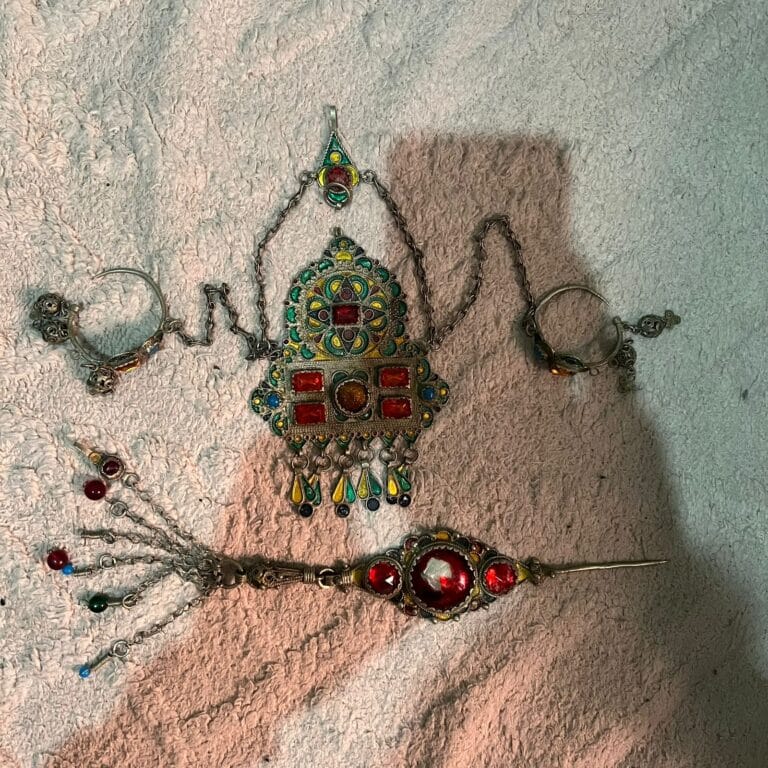
- A woman’s fibula style could indicate her tribe — the Ait Atta of the Anti-Atlas wore triangular brooches, while the Ait Youssi favored double fibulas joined by chains.
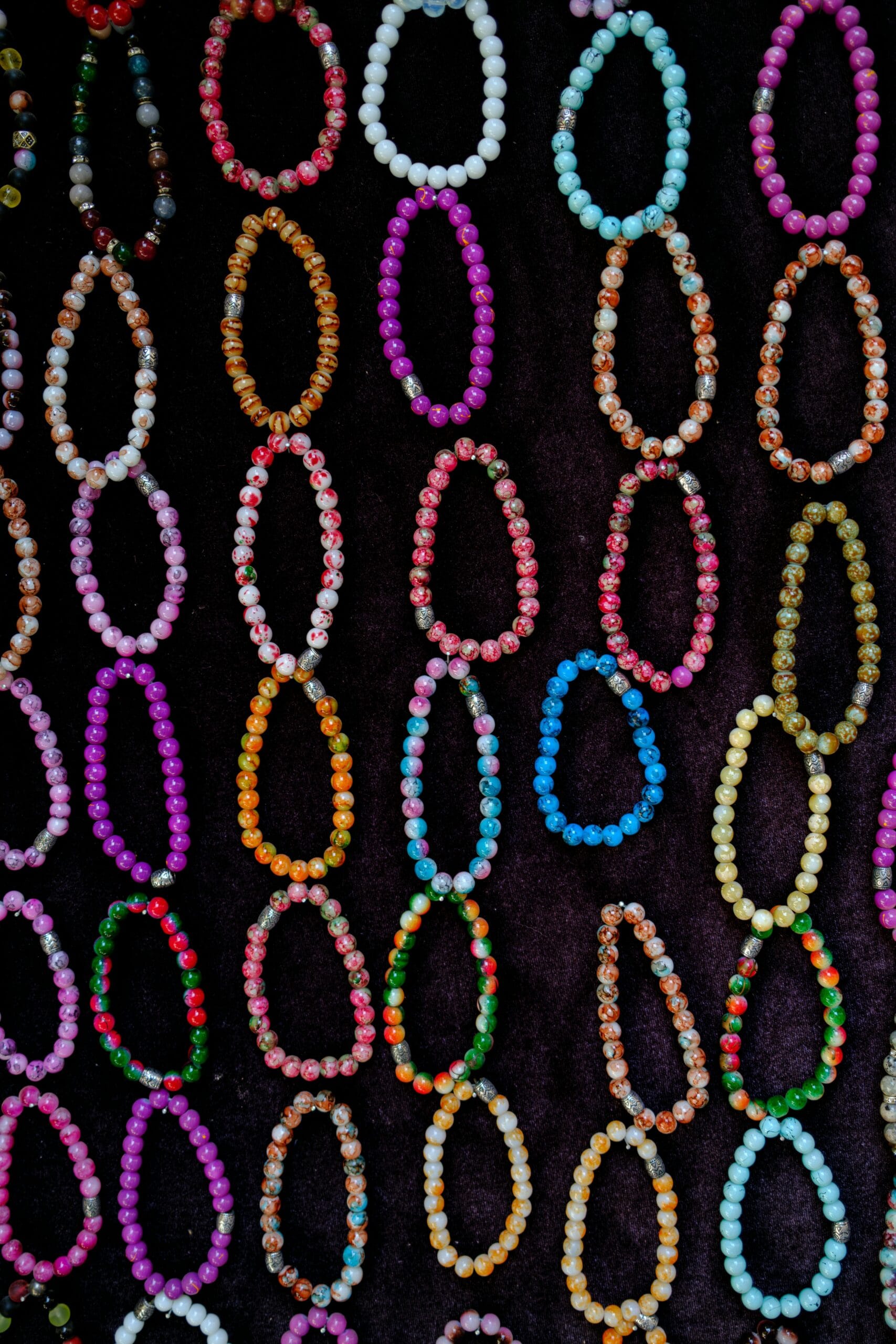
- Bead colors also carried meaning: red symbolized life force and fertility, blue for divine protection, and green for renewal.
- Size and weight revealed social standing — wealthier women wore heavier, more elaborate pieces.
Jewelry thus functioned as both a visual passport and a spiritual signature — each woman’s body a walking archive of her lineage and belonging.
Marriage and Fertility Symbolism
In Amazigh weddings, jewelry symbolizes the union of body and soul, tribe and family, heaven and earth. A bride’s ornaments are more than gifts; they are blessings.
Her necklace of coral beads guards her fertility, her anklets echo prayers for stability, and her headpiece of silver plates connects her to the moon — protector of women.
The symbolism of jewelry here transforms personal adornment into communal ritual. Through these symbols, marriage becomes not merely a social contract but a sacred cosmological act.
Symbolism in Design and Material
Stones, Colors, and Metaphysical Meaning
Every material used in Moroccan jewelry contributes to its symbolic strength.
| Material | Symbolic Meaning | Use in Jewelry |
|---|---|---|
| Silver | Purity, protection, reflection of the soul | Fibulas, necklaces, bracelets |
| Coral | Blood, vitality, fertility | Beads and pendants |
| Amber | Healing, warmth, spiritual energy | Necklaces, amulets |
| Carnelian | Courage and endurance | Ring stones |
| Turquoise | Sky energy, divine favor | Inlays and pendants |
The use of color symbolism deepens this spiritual vocabulary:
- Red: Life, fertility, and strength.
- Blue: The divine and the infinite sky.
- Green: Nature, prosperity, and protection.
- Yellow/Gold tones: Sunlight, divine blessing, and wisdom.
Each material resonates with the wearer’s intention — transforming jewelry into a living energy field, not a static object.
Patterns That Speak of Life’s Cycles
Amazigh artisans do not design randomly. Every engraved symbol mirrors nature: the sun’s path, water’s movement, the earth’s fertility, or the stars’ rotation.
Common motifs include:
- Radiant Suns – vitality and divine energy
- Serpentine Lines – renewal and immortality
- Starbursts – spiritual enlightenment
- Dots within circles – the eye of the divine watching over life
These patterns reveal the Amazigh worldview — one in which nature, spirit, and human life are inseparable threads woven into the same cosmic design.
The Feminine Power of Jewelry
Jewelry as Expression of the Sacred Feminine
For Amazigh women, jewelry embodies power — both earthly and spiritual. It transforms the body into a sacred site, where personal and cosmic energies meet.
The triangle, often engraved or shaped in pendants, is a direct homage to the feminine principle — the womb, the earth, and the divine mother. Wearing such symbols celebrates womanhood as the source of creation and continuity.
The Heirloom as a Vessel of Memory
In many Amazigh families, jewelry is passed from mother to daughter, carrying stories, blessings, and lineage. Each transfer reactivates the symbolism of Moroccan jewelry — making it a living testament to continuity, memory, and identity.
Unlike written history, which can be forgotten, jewelry endures — worn, touched, and cherished across generations.
Transformation in the Modern Era
Reinterpreting Ancient Symbols
Modern Moroccan artisans continue to use traditional symbols but reinterpret them for new contexts. Contemporary designers in Marrakech and Tiznit merge ancient Amazigh motifs with modern aesthetics — creating jewelry that bridges the sacred and the stylish.
These new pieces often emphasize minimalism, yet retain symbolic roots: triangles, spirals, and eyes continue to guard and inspire, now reimagined for global audiences.
Jewelry as Cultural Diplomacy
The symbolism of Moroccan jewelry has become an ambassador for Moroccan culture worldwide. Exhibitions in museums and fashion houses showcase not only beauty but meaning — demonstrating how Morocco’s aesthetic language speaks of spiritual depth, gender empowerment, and cultural endurance.
The Invisible Language of Symbols
Jewelry as Storytelling
Each pendant, each fibula, tells a story. Some are love stories, others are prayers, and some are laments of exile or endurance. The symbolism of Moroccan jewelry acts as a silent narrator — speaking in shapes where words may fail.
The artisan, in etching her designs, encodes emotion into metal. The wearer, in adorning herself, decodes that emotion through experience. Together, they participate in an eternal dialogue of creation.
The Continuity of Light
Silver, when polished, does not only shine; it reflects the world. In the Amazigh worldview, this reflection symbolizes continuity of spirit — light traveling across generations, illuminating memory and identity.
Thus, Moroccan jewelry becomes a metaphysical object — a conversation between light and life.
Frequently Asked Questions About the Symbolism of Moroccan Jewelry
What is the symbolism of Moroccan jewelry?
The symbolism of Moroccan jewelry reflects centuries of Amazigh traditions, beliefs, and cultural identity. Many designs represent protection, fertility, prosperity, family, spirituality, and the connection between people and nature. Each symbol often carries meanings that have been passed down through generations.
Why is Amazigh jewelry full of symbolic designs?
Amazigh jewelry was traditionally more than personal adornment. It served as a visual language that communicated identity, social status, tribal affiliation, marital status, and spiritual beliefs. Every engraved motif had cultural significance beyond its decorative appearance.
What do the triangle symbols on Moroccan jewelry represent?
Triangles are among the most recognizable motifs in Amazigh jewelry. They are commonly associated with femininity, fertility, protection, and the balance between the physical and spiritual worlds. Their exact interpretation can vary between different Amazigh communities.
Why is silver important in Moroccan Amazigh jewelry?
Silver has traditionally been valued in Amazigh culture for both practical and symbolic reasons. It is often linked with purity, protection, wisdom, and blessings, making it the preferred metal for ceremonial and everyday jewelry in many regions of Morocco.
What gemstones are commonly used in traditional Moroccan jewelry?
Traditional Amazigh jewelry often incorporates coral, amber, glass beads, enamel, turquoise, and other colorful materials. Beyond their decorative appeal, many were believed to provide protection against misfortune or symbolize vitality, health, and prosperity.
Do Amazigh jewelry symbols have the same meaning across Morocco?
Not always. While many symbols share common themes, their interpretation can differ between regions such as the High Atlas, Anti-Atlas, Souss, the Rif, and southeastern Morocco. Local traditions, tribal customs, and historical influences contribute to these regional variations.
How does Moroccan jewelry reflect Amazigh identity?
Traditional Moroccan Amazigh jewelry preserves cultural memory through its symbols, craftsmanship, and regional styles. Wearing these pieces has historically expressed community belonging, family heritage, and the continuity of Amazigh traditions across generations.
Is the symbolism of Moroccan jewelry still relevant today?
Yes. The symbolism of Moroccan jewelry continues to inspire artisans, designers, researchers, and collectors. Many contemporary craftspeople preserve traditional motifs while adapting them for modern audiences, helping keep Amazigh cultural heritage alive.
Where can you find authentic Amazigh symbolic jewelry?
Authentic Amazigh jewelry is still handcrafted in regions such as Tiznit, Tafraoute, the High Atlas, the Anti-Atlas, the Draa Valley, and parts of southeastern Morocco. Local cooperatives and experienced silversmiths continue to use traditional techniques and designs.
Why is the symbolism of Moroccan jewelry important to cultural heritage?
The symbolism of Moroccan jewelry is an essential part of Morocco’s intangible cultural heritage because it preserves indigenous knowledge, artistic traditions, oral history, and collective identity. Studying these symbols provides valuable insight into Amazigh history, beliefs, and social organization.
Conclusion: More Than Ornament – A Language of Being
The symbolism of jewelry in Moroccan Amazigh culture transforms ornament into ontology — it makes art into a way of being. Each piece is both an individual’s expression and a civilization’s memory, a fusion of spirit and substance.
To wear Amazigh jewelry is to speak in the language of ancestors — to carry with you the sun, the moon, and the sacred triangle of life. It is to honor the artisans who, through their silver hands, continue to translate the invisible into the tangible.
In every glimmer of silver lies a message: beauty is not the opposite of meaning — it is meaning. And in Morocco’s enduring artistry, that truth still shines.
References (Academic and Cultural Sources)
- Jereb, J. (1992). Arts and Crafts of Morocco. Chronicle Books.
- Meyer, L. (2014). Berber Jewelry: Tradition and Innovation in Morocco. Musée Berbère.
- Pâques, V. (1989). Berber Symbols of the Atlas: A Language of Ornament. CNRS Éditions.
- Evers Rosander, E. (1991). Women in African Societies: Amazigh Traditions and Transformations. Nordic Africa Institute.
- Stillman, Y. K. (2003). Jewish and Berber Silversmiths of Morocco: Shared Craftsmanship and Cultural Identity. Middle Eastern Studies.
- UNESCO (2019). Intangible Cultural Heritage Lists: Traditional Amazigh Crafts of Morocco.
- World Crafts Council (2021). Symbolism and Spirituality in Moroccan Jewelry.
Call to Action:
Support Morocco’s living symbols. When you wear or share authentic Amazigh jewelry, you are not just embracing beauty — you are preserving a sacred language written in silver and spirit.