
Introduction to the Amazigh Language: Understanding One of North Africa’s Oldest Living Languages

What Is the Amazigh Language?
Imagine discovering a language that has been spoken across North Africa for thousands of years—long before the arrival of Arabic, French, or Spanish—yet is still used today by millions of people. A language with its own alphabet, grammatical system, literature, poetry, and modern educational institutions. This language is Tamazight, also known as the Amazigh language.
For many people outside North Africa, the Amazigh language remains largely unknown. Some have heard it described as a “Berber dialect,” while others assume it is simply a local form of Arabic. Neither description is accurate.
Tamazight is a complete natural language with its own linguistic history, grammatical rules, sound system, vocabulary, and writing tradition. Like English, French, Spanish, Arabic, or Japanese, it possesses every component that linguists expect to find in a fully developed human language.
Today, Tamazight is taught in schools, studied at universities, researched by linguists worldwide, and spoken by millions of people across Morocco, Algeria, Libya, Tunisia, Mali, Niger, Burkina Faso, and the Amazigh diaspora.
Understanding Tamazight means discovering one of humanity’s oldest living linguistic traditions.
Table of Contents
Every Language Has a Scientific Structure—Tamazight Is No Exception
When people hear the word “language,” they usually think of speaking. Linguists, however, understand that every language is a highly organized system composed of several interconnected disciplines.
Whether we study English, Arabic, Chinese, or Tamazight, we analyze the same scientific components.
A language includes:
- Phonetics
- Phonology
- Morphology
- Syntax
- Semantics
- Pragmatics
- Lexicology
- Orthography
- Historical Linguistics
- Sociolinguistics
Tamazight possesses all of these components.
| Tifinagh | Latin | Arabic Equivalent |
|---|---|---|
| ⴰ | a | ا |
| ⴱ | b | ب |
| ⴳ | g | گ / ج |
| ⴷ | d | د |
| ⴹ | ḍ | ض |
| ⴻ | e | ـَ (neutral vowel) |
| ⴼ | f | ف |
| ⴳⵯ | gw | گو |
| ⵀ | h | ه |
| ⵃ | ḥ | ح |
| ⵄ | ɛ | ع |
| ⵅ | x | خ |
| ⵇ | q | ق |
| ⵉ | i | ي / إ |
| ⵊ | j | ج |
| ⴽ | k | ك |
| ⴽⵯ | kw | كو |
| ⵍ | l | ل |
| ⵎ | m | م |
| ⵏ | n | ن |
| ⵓ | u | و / ُ |
| ⵔ | r | ر |
| ⵕ | ṛ | ر̣ |
| ⵙ | s | س |
| ⵚ | ṣ | ص |
| ⵛ | c (ch) | ش |
| ⵜ | t | ت |
| ⵟ | ṭ | ط |
| ⵡ | w | و |
| ⵢ | y | ي |
| ⵣ | z | ز |
| ⵥ | ẓ | ظ |
| ⵖ | γ | غ |
Notes
- The Latin transcription follows the standard adopted by IRCAM for Standard Amazigh.
- The Arabic equivalents are approximate phonetic correspondences and are provided solely to help Arabic-speaking readers pronounce the sounds. They do not represent an official Arabic orthography for Tamazight.
- Some phonemes, such as ⵄ (ɛ), ⵖ (γ), and ⵕ (ṛ), have no exact equivalent in English and should be learned through phonetic practice.
This is one of the most important facts that many people outside the Amazigh world do not realize. Tamazight is not merely a collection of spoken words passed orally through generations. It is a language that can be analyzed scientifically using exactly the same linguistic methods applied to English, French, Arabic, or Latin.
For this reason, universities throughout the world teach Amazigh linguistics as an academic discipline.
Tamazight Belongs to a Large Language Family
Languages do not exist in isolation. Just as people belong to families, languages belong to language families.
Tamazight belongs to the Afro-Asiatic language family, one of the oldest language families in the world.
Within this family are:
- Amazigh languages
- Arabic
- Hebrew
- Ancient Egyptian
- Aramaic
- Hausa
This does not mean that Tamazight developed from Arabic or vice versa. Rather, they are distant linguistic relatives that evolved independently over thousands of years.
Just as English and German share ancient ancestors while remaining separate languages, Tamazight and Arabic share membership in the same broader language family while maintaining completely distinct grammatical systems and vocabularies.
Note: This table follows the standardized phonological inventory adopted by the Royal Institute of Amazigh Culture (IRCAM). The consonants are classified according to their place of articulation (lieu d’articulation) and manner of articulation (mode d’articulation), reflecting the modern standard Amazigh phonological system.
| Place of Articulation | Stops | Fricatives | Nasals | Liquids | Semi-vowels |
|---|---|---|---|---|---|
| Labial | b | f | m | — | w |
| Dental / Alveolar | t, d, ṭ, ḍ | s, z, ṣ, ẓ | n | l, r, ṛ | — |
| Palatal | c, j | — | — | — | y |
| Velar | k, g | — | — | — | — |
| Labiovelar | kw, gw | — | — | — | — |
| Uvular | q | x, γ | — | — | — |
| Pharyngeal | — | ḥ, ɛ | — | — | — |
| Glottal (Laryngeal) | — | h | — | — | — |
The Difference Between Language and Dialect
A language is generally defined as a complete linguistic system possessing its own grammar, vocabulary, phonology, and writing tradition. A dialect, by contrast, is a regional variation of a language.
Tamazight is often mistakenly described as a collection of dialects. While regional varieties such as Tachelhit, Central Atlas Tamazight, and Tarifit display differences in pronunciation and vocabulary, they share fundamental grammatical structures and a common historical origin.
Modern standardization efforts recognize these varieties as components of a broader Amazigh language rather than separate languages.
Moroccan Arabic (Darija)
Darija is Morocco’s widely spoken vernacular Arabic. Unlike Tamazight, Darija developed primarily from Arabic and incorporates influences from Amazigh, French, Spanish, and other languages.
Although many Moroccans are bilingual in Tamazight and Darija, the two languages differ significantly in:
- Historical origin
- Grammatical structure
- Sound systems
- Core vocabulary
- Writing traditions
Darija belongs to the Arabic branch of Afro-Asiatic languages, whereas Tamazight belongs to the Berber branch.
A Language Older Than Many Civilizations
The history of Tamazight extends back several millennia.
Ancient inscriptions written in Libyco-Berber scripts demonstrate that Amazigh languages were already established throughout North Africa centuries before the Arab expansion.
Throughout history, Amazigh speakers interacted with Phoenicians, Romans, Byzantines, Arabs, Andalusians, and Europeans. These contacts enriched the vocabulary without changing the fundamental structure of the language.
Like English—which borrowed thousands of French and Latin words after the Norman Conquest—Tamazight also incorporated loanwords while preserving its own grammatical identity.
Languages naturally evolve through contact with neighboring civilizations. Tamazight is no exception.
The Amazigh Language Is More Than Speech
Modern linguistics teaches that every language consists of several levels.
Linguistic analysis reveals that Tamazight possesses a highly structured grammatical and phonological system. Modern standard Amazigh has undergone extensive academic description and codification.
The Amazigh language Alphabet
The official writing system of standard Amazigh is Tifinagh. The modern version, known as Tifinagh-IRCAM, was standardized to ensure consistency in education and publication.
The alphabet was designed according to several principles:
- One sound corresponds to one symbol.
- Preference for phonological clarity.
- Representation of features shared by major Amazigh varieties.
- Reduction of unnecessary regional variations in writing.
The Tifinagh script is now visible throughout Morocco on public signs, educational materials, government publications, and cultural institutions.
The Amazigh language Phonemes
According to the IRCAM standard grammar, standard Amazigh contains 33 phonological units:
- 27 consonants
- 2 semi-consonants (y, w)
- 3 full vowels (a, i, u)
- 1 neutral vowel (e)
Table 1: Consonantal System of Standard Amazigh
| Category | Phonemes |
|---|---|
| Labials | ⴼ, ⴱ, ⵎ, ⵡ ( f, b, m,w ) |
| Dentals | ⵜ, ⴷ, ⵟ, ⴹ, ⵏ, ⵔ, ⵕ, ⵍ ( t, d, ṭ, ḍ, n, r, ṛ, l ) |
| Alveolars | ⵙ, ⵣ, ⵚ, ⵥ ( s, z, ṣ, ẓ ) |
| Palatals | ⵛ, ⵊ,ⵢ ( c, j, y ) |
| Velars | ⴽ, ⴳ ( k, g ) |
| Labiovelars | ⴽⵯ, ⴳⵯ ( kw, gw ) |
| Uvulars | ⵇ, ⵅ, ⵖ ( q, x, γ ) |
| Pharyngeals | ⵃ, ⵄ ( ḥ, ɛ ) |
| Laryngeal | ⵀ ( h ) |
| Semi-Consonants | ⵢ,ⵡ ( y, w ) |
Table 2: Vocalic System of Standard Amazigh
| Vowel Type | Vowels |
| Full Vowels | ⴰ,ⵉ, ⵓ ( a, i, u ) |
| Neutral Vowel | ⴻ ( e ) |
The neutral vowel “e” occupies a special status because its absence generally does not alter lexical meaning, although it may be preserved for orthographic readability.
Tamazight includes:
Phonetics Of The Amazigh language
The scientific study of speech sounds and how they are produced by the human vocal organs.
Researchers have carefully described the pronunciation of Amazigh consonants, vowels, emphatic sounds, labiovelars, and regional phonetic variation.
Phonology Of The Amazigh language
Phonology studies how sounds function inside the language.
The standardized Amazigh system identifies phonemes that distinguish meaning while eliminating purely regional pronunciation differences in writing.
This scientific approach allowed linguists to create a unified writing standard without eliminating local accents.
Morphology Of The Amazigh language
Morphology studies how words are formed.
Tamazight possesses an exceptionally rich morphological system.
Nouns change according to:
- gender
- number
- grammatical state
Verbs express:
- person
- tense
- aspect
- mood
- voice
- derivation
These patterns follow systematic grammatical rules comparable in complexity to those found in Arabic or Latin.
Syntax Of The Amazigh language
Syntax examines how words combine into sentences.
Tamazight has clearly defined sentence structures, agreement rules, negation patterns, interrogative constructions, and complex subordinate clauses.
These structures are taught in universities and described in academic grammars.
Semantics Of The Amazigh language
Every language organizes meaning differently.
Tamazight contains highly specialized vocabulary related to:
- mountains
- agriculture
- ecology
- architecture
- weaving
- pastoral life
- astronomy
- traditional law
- kinship
Many concepts reflect thousands of years of interaction between Amazigh communities and their environment.
Orthography Of The Amazigh language
A spoken language becomes even stronger when it develops standardized writing.
Modern Amazigh uses the official Tifinagh alphabet standardized by the Royal Institute of Amazigh Culture (IRCAM).
Its orthographic system follows scientific principles:
- one sound corresponds to one symbol whenever possible;
- spelling reflects the underlying linguistic structure rather than local pronunciation;
- regional phonetic differences are unified within a common written standard.
- The neutral vowel “e” is inserted where necessary to facilitate pronunciation and readability.
This makes written Tamazight comparable to other standardized world languages.
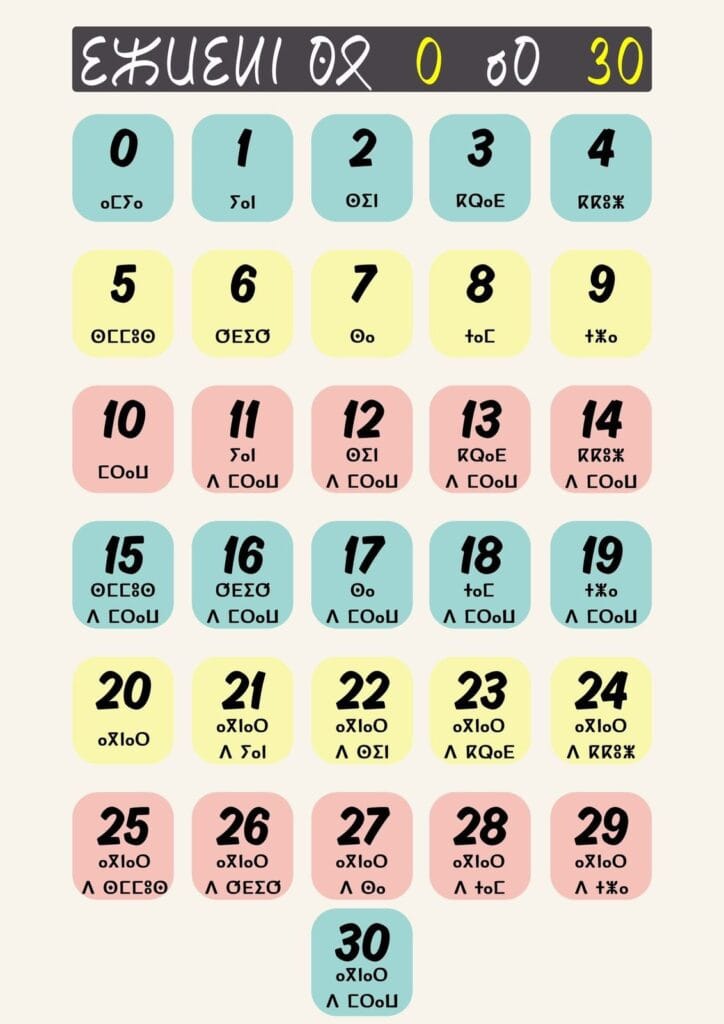
Tamazight and English Have More in Common Than Many People Think
At first glance, English and Tamazight appear completely unrelated.
One is spoken mainly in Europe and North America.
The other developed in North Africa.
Yet linguistically they share many universal characteristics.
Both languages possess:
✓ vowels
✓ consonants
✓ nouns
✓ verbs
✓ adjectives
✓ pronouns
✓ sentence structure
✓ grammatical rules
✓ dictionaries
✓ spelling conventions
✓ literature
✓ poetry
✓ historical development
✓ regional varieties
✓ language change over time
The differences lie not in whether they are “real languages,” but in how each language organizes these universal elements.
This observation reminds us that all human languages are equally sophisticated systems created by generations of speakers.
General Comparison Between Tamazight, Arabic, and Latin Languages
| Feature | Tamazight | Arabic | Latin |
| Language Family | Afro-Asiatic (Berber Branch) | Afro-Asiatic (Semitic Branch) | Indo-European |
| Script | Tifinagh | Arabic Script | Latin Alphabet |
| Geographic Origin | North Africa | Arabian Peninsula | Ancient Italy |
| Writing Direction | Left to Right | Right to Left | Left to Right |
| Morphology | Root-and-pattern with rich derivation | Root-and-pattern | Inflectional |
| Current Status | Living language | Living language | Classical language |
While Tamazight and Arabic belong to the same larger Afro-Asiatic family, they developed along different branches and possess distinct grammatical systems. Latin, by contrast, belongs to an entirely different linguistic family.
Why Has the Amazigh Language Become Increasingly Important?
During the last few decades, Tamazight has experienced an extraordinary linguistic renaissance.
Today it is:
- taught in Moroccan schools;
- researched in international universities;
- published in books and journals;
- used in television and radio broadcasting;
- integrated into digital technology;
- represented in Unicode and modern computing systems;
- increasingly present in scientific research.
These developments reflect not the creation of a new language, but the modernization and institutional recognition of one of North Africa’s oldest linguistic traditions.
Why Should Everyone Learn About Tamazight?
Learning about Tamazight is not only about learning another language.
It is about understanding the history of North Africa through the voices of its indigenous people.
Languages preserve knowledge that cannot always be translated perfectly into another language. Through Tamazight survive oral poetry, ecological knowledge, architecture, traditional medicine, music, customary law, and centuries of cultural memory.
Every language offers humanity a unique way of interpreting the world.
Tamazight is one of those voices.
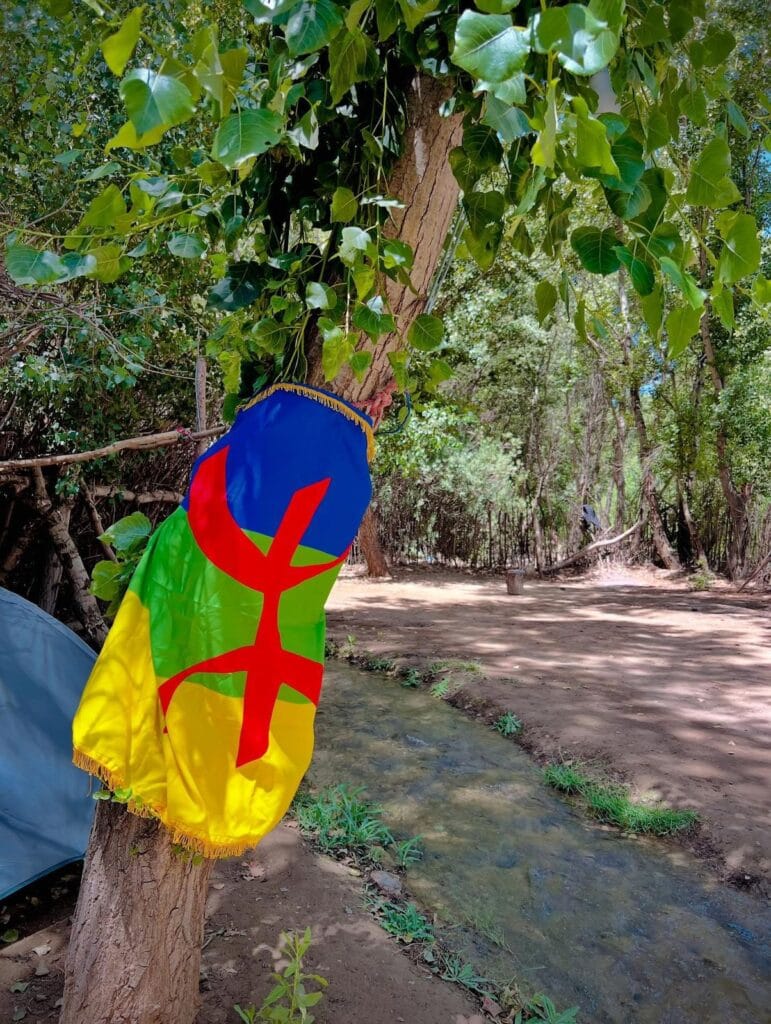
FAQ About The Amazigh Language
Is Tamazight the same as Berber?
Yes. “Amazigh” is the preferred self-designation, while “Berber” is the historical term commonly used in academic literature.
Is Tamazight an official language in Morocco?
Yes. Tamazight is officially recognized in Morocco and is increasingly integrated into education, administration, and media.
What alphabet does Tamazight use?
Modern standard Tamazight uses the Tifinagh-IRCAM alphabet.
How many people speak Tamazight?
Millions of speakers use Amazigh varieties across North Africa and the global Amazigh diaspora.
Is Tamazight older than Arabic?
Historically, Amazigh languages existed in North Africa before the Arab expansion into the region.
Are Tachelhit, Tarifit, and Central Atlas Tamazight different languages?
Most linguists consider them regional varieties of the broader Amazigh language continuum.
Conclusion
The Amazigh language demonstrates that linguistic richness is not measured by global popularity but by historical depth, structural complexity, and cultural significance.
Like English, Arabic, French, Chinese, or Latin, Tamazight possesses every characteristic expected of a complete human language. It has phonetics, phonology, morphology, syntax, semantics, orthography, literature, and an evolving academic tradition. Its grammar can be described scientifically, its sounds analyzed systematically, and its texts studied with the same linguistic methods applied to any major world language.
To study Tamazight, therefore, is not simply to learn the language of the Amazigh people. It is to explore one of the oldest continuous linguistic traditions in North Africa and to appreciate a language that continues to evolve while preserving a remarkable cultural heritage.
For anyone interested in languages, history, anthropology, or civilization, Tamazight deserves a place alongside the world’s great linguistic traditions.
References and External Sources
- Boukhris, Fatima; Boumalk, Abdallah; El Moujahid, El Houssaïn; Souifi, Hamid. La Nouvelle Grammaire de l’Amazighe. IRCAM, Rabat, 2008.
- Chaker, Salem. Berbères Aujourd’hui.
- Chaker, Salem. Linguistique Berbère.
- IRCAM Publications on Standard Amazigh.
- Encyclopaedia of Language and Linguistics, Berber Languages.
- UNESCO Reports on Indigenous Languages and Cultural Heritage.
- Kossmann, Maarten. The Arabic Influence on Northern Berber.


One Comment